This post contains affiliate links. We may earn a small commission when you buy through our links — at no extra cost to you.
A good activity cube has to earn its floor space. That’s the honest math of the category: a couple of square feet of your living room given over to one object, in a house that already has too many. The ones worth it turn a corner of the rug into something a toddler can work on alone for ten minutes straight — no narrating from you, no screen required.
We’ve had 12 in rotation over the past six months — wooden five-sided centers with bead mazes on top, plastic cubes with light-up buttons and songs — and the pattern was consistent across all of them. The activity count printed on the box tells you almost nothing. What matters is how many of those activities sit where a seated 1-year-old can actually reach them, because the top of the cube gets abandoned the moment a kid can pull up to standing.
The bead maze is the classic, and it does get played with, but in our testing it belonged more to the second birthday than the first; the sides carried the early months. Below are the cubes that were still getting played with in month six, whichever kind of household they’re headed to.


Best for Pull-Up Play
Battat Wooden Activity Cube
Key Features
- Height: 17.72 in
- Weight: 13.2 lb
- Batteries: Not required
- Sides of play: 5
- Price: Midrange
There’s a moment that decides whether a wooden cube earns its floor space: the first time a baby grabs the top rail and hauls herself up. The Battat is built for it. At 13.2 pounds with a 17.7-inch frame, it plants itself on the carpet and stays there while a new walker leans in to work the peekaboo doors. Rounded corners, no sharp hardware, and a base that doesn’t skate.
Five sides, all mechanical: a bead maze with loop-the-loops on top, peek-a-boo doors, spinning animal and object blocks, a zig-zag race down one face, and mix-and-match animal halves. No batteries, no songs, no volume switch to hunt for. What we appreciated most after a week of electronic cubes is how much of this toy a child runs herself. The doors need opening, the blocks need turning, and nothing rewards a swipe at thin air. The farm artwork is a step above the usual primary-color plastic, muted enough to sit in a living room without shouting.
Two things to weigh. The first is that this is furniture: nearly a foot and a half tall and 13.2 pounds, so it stays where you put it and moving it is a two-hand job. The second is arrival condition. Give the hinges, doors and top rail a once-over the day the box lands, and keep the packaging until you have, because joints are where trouble shows up. Past that, the case for it is simple: it never needs batteries, never needs charging, and never sends anyone hunting for a screwdriver.
Pros
- Five sides of mechanical play, no batteries
- Heavy, stable frame for pull-up play
- Age grade runs from 1 to 8 years
Cons
- Heavy enough that moving it takes two hands
- Top bead maze is out of a sitter’s reach
Our top pick: five sides of battery-free wooden play, heavy enough for a new walker to lean on, and the cube we hand to anyone buying a first birthday present.
Best for Babies 6-12 Months
VTech Busy Learners Activity Cube
Key Features
- Batteries: 2 AAA (included)
- Sides of play: 5
- Songs and melodies: 25
- Interactive features: 14
- Price: Budget
Nothing else in this guide gives you five sides of play for so little. The Busy Learners packs 14 features into a 6-inch plastic cube: four light-up animal buttons that name animals, sounds and shapes, a manipulative on every face, 25 songs and melodies, and a motion sensor that fires off a sound when the cube gets moved. A baby who bats it across the rug gets a reward, and learns to bat it again.
We like it best for the stage before walking. It weighs 1.4 pounds, so it sits on a blanket beside a sitter, goes into the diaper bag, and doesn’t claim a corner of the room. Adjustable volume and an auto shut-off are the two features we look for on anything with a speaker, and having both here is the reason this one stays in rotation instead of migrating to the bottom of the toy bin. The music is the trade: 25 songs stop feeling like 25 songs after a month, and this is the cube adults notice first.
Two practical notes. The included AAAs are demo cells, so plan on fresh batteries early, since a cube that lights up and then goes silent reads as broken to a baby. And at 6.2 inches it is a genuinely small toy, which is exactly right for a baby’s reach and exactly why a three-year-old walks past it. Buy it for the sitting-to-crawling stretch and expect to pass it on in good shape.
Pros
- Four light-up animal buttons and 25 songs
- Volume control and auto shut-off
- 1.4 pounds, easy to move or pack
Cons
- Music wears thin for adults
- Demo batteries need replacing early
The best cube for a baby who isn’t walking yet: light, loud, five-sided, and the least expensive way into a cube that actually holds attention.
Best for Toddler Button Play
VTech Sort and Discover Activity Cube
Key Features
- Size: 8.66 x 9.25 x 9.65 in
- Shape blocks: 4
- Sides of play: 5
- Songs, sounds and phrases: 75+
- Price: Midrange
If the Busy Learners is the cube for a baby still working out how to sit, the Sort and Discover is for the toddler who has worked out that buttons do things. Two electronic panels, five piano keys, a turning book page, a spinner, a shape sorter and seven activities across five sides. For the 18-month-to-3-year stretch, this is the pick we rank highest in this guide.
The shape sorter is the best thing on it, partly because it still works with the sound off. The book page plays two nursery rhymes, the spinner lights up and introduces animals, and the piano keys cover numbers, colors and music, 75-plus songs, sounds and phrases in total. When the batteries finally go, what’s left is a sorter and a keyboard, which is more than most electronic toys can say for themselves.
At 2.4 pounds and roughly nine inches on a side, it takes up about as much room as a toaster and moves between rooms in one hand. The age band runs 9 months to 3 years, and the electronics carry the first half of that while the sorter and the piano carry the rest. Set it down beside a toddler mid-tantrum and watch how quickly the lid on the shape sorter gets opened and shut.
Pros
- Two electronic panels and 75-plus songs
- Shape sorter plus five piano keys
- 2.4 pounds, carryable one-handed
Cons
- Shape sorter comes with only four blocks
- Smaller than the photos imply
The busiest cube here for toddlers: two light-up panels, 75-plus songs, and a real shape sorter for the child who pushes every button in the house.
Best for Hand-Me-Down Wooden Play
Hape Country Critters Play Cube
Key Features
- Height: 19.57 in
- Weight: 13.4 lb
- Material: Baltic birch and maple
- Included pieces: 10 pieces (3 balls, 6 shapes, play center)
- Price: Premium
No batteries, no lights, no songs, no volume switch: the Country Critters is the quietest cube here, and in a room that already has one singing plastic cube in it, that silence is worth paying for. What you get instead is hardwood, Baltic birch and maple from FSC-managed forests, with a water-based, non-toxic finish, ten pieces, and five sides of mechanical play.
Three wooden balls and six wooden shapes are the loose parts, and the ball run is the activity that justifies the price: drop a ball in at the top, watch it roll and drop out the side, do it again forty times. The balls do sometimes stop short in the track. A nudge frees them, and a toddler who has just discovered cause and effect will happily supply the nudge.
Where it separates from the Battat is finish and feel. The Hape is the better-looking object, from the artwork to the weight of the pieces in your hand, and at 13.4 pounds and nearly 20 inches it’s the tallest cube here, which makes it the one a standing toddler uses most naturally. It’s also the most expensive by a wide margin, and that money goes into materials and finish rather than more activities. Buy it if the cube is going in a room you care about and you want something you’ll still be glad to look at in five years.
Pros
- Hardwood with a water-based, non-toxic finish
- Ten pieces including three balls and six shapes
- Tallest cube here for standing play
- No batteries, no sound, nothing to switch off
Cons
- Paint at the edges can chip
The premium choice: quiet hardwood, ten pieces and nothing to switch off, and the cube here that a family is most likely to still own in ten years.
Best for Small-Space Gifting
TOYVENTIVE Wooden Activity Cube

Key Features
- Size: 7.48 x 7.48 x 7.09 in
- Material: Wood
- Bead maze: Removable, flips inside
- Activities: 5
- Price: Budget
The photos on this one are generous. In person the TOYVENTIVE is a 7.5-inch tabletop cube, roughly the size of two stacked board books, and that single fact decides who it’s for. Five activities are packed onto it: a bead maze on top, an abacus, spinning gears, a learning clock and a shape sorter, and the box adds a set of stacking cups and a first-words board book.
Small is the point. This is the cube that lives on a coffee table, travels to a restaurant, or gets handed over in a gift bag, and the bead maze lifts off the top and flips down inside the body so the whole thing stores on a shelf. We like that for apartments and grandparents’ houses, and we like the extras more than we expected to, because cups and a book buy a second sitting’s worth of play out of the same box.
What it can’t do is hold a new walker. At 7.5 inches tall it’s a lap-and-table toy, and a baby pulling up will take it with her. Buy it for the one-to-two stretch, for a small room, or as a present that arrives ready to hand over without batteries or assembly.
Pros
- Five activities plus cups and a board book
- Bead maze flips inside for storage
- Gift-ready packaging
Cons
- Bead maze top isn’t locked down
- Joints can work loose with rough play
The gift-friendly tabletop cube: five activities plus cups and a board book, sized for a coffee table or a small apartment rather than a playroom floor.
Best for Packed-In Variety
Bravmate 8-in-1 Wooden Activity Cube
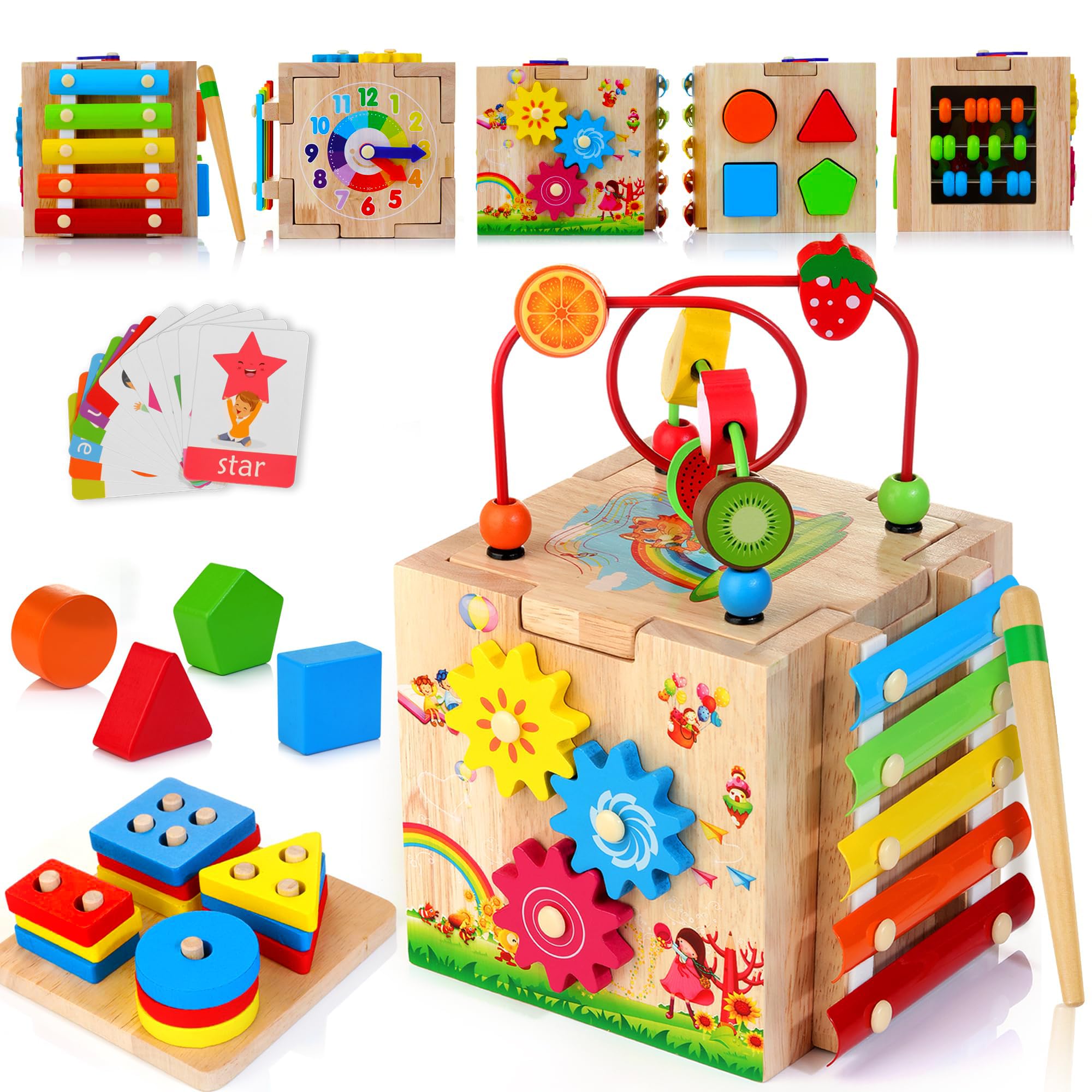
Key Features
- Size: 8.6 x 7.36 x 7.5 in
- Material: Rubber wood
- Bead maze: Detachable, flips inside
- Activities: 8 in 1
- Price: Budget
Eight activities in one cube: a bead maze, a xylophone, a learning clock, a shape sorter, an abacus and spinning gears packed into a frame not much bigger than a shoebox. On paper it’s the most toy per square inch here, and the xylophone alone makes it the pick for a household that wants music without a speaker: a real mallet, real bars, and nothing to switch off.
It’s rubber wood with rounded edges and a water-based paint, and the top bead maze detaches and flips down inside the box, so it stores in about the footprint of a big dictionary. It’s the least precious of the wooden cubes in the hand, not flimsy, but the sort of toy you can take to a restaurant without worrying. The compact frame is also the limit: it’s a sit-and-play cube, and a toddler who still mouths everything needs eyes on her while she works the shape blocks.
Where it gives ground to the Hape and the Battat is hand-feel and the long haul, since those two are built to be leaned on and this one isn’t. What it does better is hand a toddler a new action every few minutes, which matters more at 18 months than a finish a parent notices. If you want the widest spread of activities for the least money in this guide, this is where we point.
Pros
- Eight activities including a real xylophone
- Bead maze detaches and stores inside
- Rubber wood with rounded, smooth edges
Cons
- Too low for pull-up play
- Smaller in person than the photos imply
The most activities per cubic inch here, including the only real xylophone, in a sit-and-play cube for toddlers who need a new thing every few minutes.
How We Tested the Best Activity Cubes
We built the shortlist from scratch: every activity cube we could find from major retailers, filtered for a clearly stated age range, a base that wouldn’t tip at a toddler’s push, and a mix of wood and plastic so we weren’t testing the same material five times over. That left 12, which we bought ourselves and rotated through my living room, my sister’s playroom, and the kitchen floor during the dinner scramble.
Each cube got the same run: the pre-nap window, the post-nap window, and 20 minutes while I cooked. We kept a tally of which sides got touched in every session and compared day one to day twenty — the drop-off said more about variety and entertainment value than any feature list. We also watched whether kids started naming the animals and colors on their own, which is a better read on the educational side than the packaging. Then we hosted a playdate with three toddlers and one cube at a time, and wrote down what they fought over and what they ignored.
For sturdiness, one toddler in the group used every cube as a pull-up bar, and we tipped each one onto rug and onto hardwood to see how the corners held. We ran a damp cloth over painted surfaces twice a week and checked for color transfer and chipping at the edges after mouthing. On noise, we noted how loud the songs carried from across the room, whether there was a volume switch or a mute a parent could reach in a hurry, and whether the alphabet song was actually intelligible. We measured each footprint against a standard toy bin and carried every cube from room to room one-handed, since that’s how they travel.
Value came last: what a cube cost weighed against how many of its sides were still getting played with in month six.
How to Choose an Activity Cube
The decision that matters most isn’t how many sides a cube has; it’s whether you’re buying for a baby who sits or a baby who stands, because that one fact separates a tabletop toy from a piece of floor furniture.
Match the cube to the stage, not the age on the box
Age ranges on these boxes overlap wildly, and both ends can be honest: a 6-month-to-3-year band and a 1-to-8-year band describe the same toy doing different jobs. What actually changes is reach. A baby who can’t sit unaided can only use the bottom few inches of anything, so a 17-inch activity center is mostly wasted on her, while a 6-inch cube gives her a whole toy within arm’s length.
Buy for the next six months rather than the next six years. Shopping for a first birthday usually means a taller, heavier cube; shopping for a baby still working on sitting means starting small and trading up later.
Batteries or no batteries
The electronic cubes here hold attention with sound, 25 songs on one and more than 75 on another, and the cost arrives later in volume, battery changes, and a toy that goes quiet mid-afternoon. Look for adjustable volume and an automatic shut-off, and treat the demo cells in the box as a short-term loan.
Wooden cubes ask more of the child and last longer in the room, which is why they suit a toddler who already plays rather than a baby who needs a lure. Neither is better; they’re for different temperaments.
Weight, footprint, and the pull-up problem
Once a baby can pull up, the cube stops being a toy and becomes furniture, and that is where weight earns its keep. A 13-pound activity center stays put under a leaning baby; a 1.4-pound cube slides, and belongs on the floor for sitting play rather than at the side of a cruising baby.
Press a palm on one corner before you commit: a cube that rocks is a cube that will go over. On hardwood, a rug under it is worth more than any feature the box advertises.
How many activities is enough
More sides doesn’t mean more play. What holds a toddler is a variety of motions, twist, slide, open, drop, hammer, rather than five buttons that do the same thing in different colors. Look for at least one activity that works with the batteries out, one that uses a whole hand rather than a fingertip, and a shape sorter with enough blocks to count as a puzzle.
Then look at the end of the session. A bead maze that flips inside the body turns a floor toy into something you can put on a shelf, which matters more than any single activity in a small room.
Frequently Asked Questions
How do I clean a wooden activity cube?
Wipe it with a damp cloth and a little mild dish soap, then dry it straight away; soaking is what lifts paint and swells joints. Skip bleach and abrasive cleaners on painted surfaces, and never put a cube in the dishwasher, including the plastic ones with battery compartments. For bead mazes and the crevices around spinners, a soft toothbrush gets further than a rag. Once a week is plenty unless the cube is moving between kids.
Is an activity cube worth it if we already have a play gym and stacking toys?
It does a different job. A play gym is for lying down and batting at things; a cube is the first toy that asks a baby to sit, reach, twist and open in one place, and it’s the one that survives the move to standing, which is where a lot of baby toys drop out. If floor space is tight, one cube with genuinely varied motions beats three toys that all do the same thing.
What should I check before handing an activity cube to a baby?
Three things. On an electronic cube, the battery compartment should be screwed shut and the cells fresh, because a leaking demo battery ends the toy’s useful life early. Any bead maze that lifts off for storage should be out of reach of a baby who pulls up. And loose balls and blocks should be too big to pass through a toilet-paper tube, a decent stand-in for the small-parts test that applies to everything around children under three.
Final Verdict
The Battat Wooden Activity Cube is the one we recommend to most families: five sides of mechanical play, no batteries to feed, and enough weight that a new walker can haul up on it and keep playing into the preschool years. If the baby isn’t sitting unaided yet, the VTech Busy Learners is the better first cube, lighter, less expensive, and pitched at exactly that stage.
For a living room piece you plan to keep, the Hape earns its premium in hardwood and finish. Everyone else can start at the Battat and be done.
