This post contains affiliate links. We may earn a small commission when you buy through our links — at no extra cost to you.
An abacus is the rare math toy that shows a kid why carrying works instead of asking them to memorize it. Slide ten beads across a row, push them back, and swap them for one bead in the row above — suddenly the regrouping on the worksheet has a picture. That is also why the one you buy matters so much: a bead that sticks or a frame that wobbles turns a five-minute lesson into a negotiation. I have watched a kindergartner walk away from one mid-problem and happily finish the same problem on a different frame, and the only thing that changed was how the beads moved.
Over the past four months, my team and I have kept 14 abacuses in homework rotation, in the car, and on a classroom shelf, and the ones that earn their spot share a few traits. Bead movement is the whole game — beads should glide with one finger and stay where you leave them, which is the difference between counting and fiddling. Size decides who can actually use it: a 13-column soroban suits an older kid or an adult helper, while a chunky 10-row frame fits small hands and short attention spans.
Build quality is the other quiet decider, since these live in backpacks and get dropped on kitchen floors. Plenty of sets also throw in counting sticks, number cards, or a clock, and those extras only count if the kid reaches for them — a few of our testers ignored the cards entirely and used the beads to play store. The picks below are the ones that survived all of it.


Best for Counting to 100
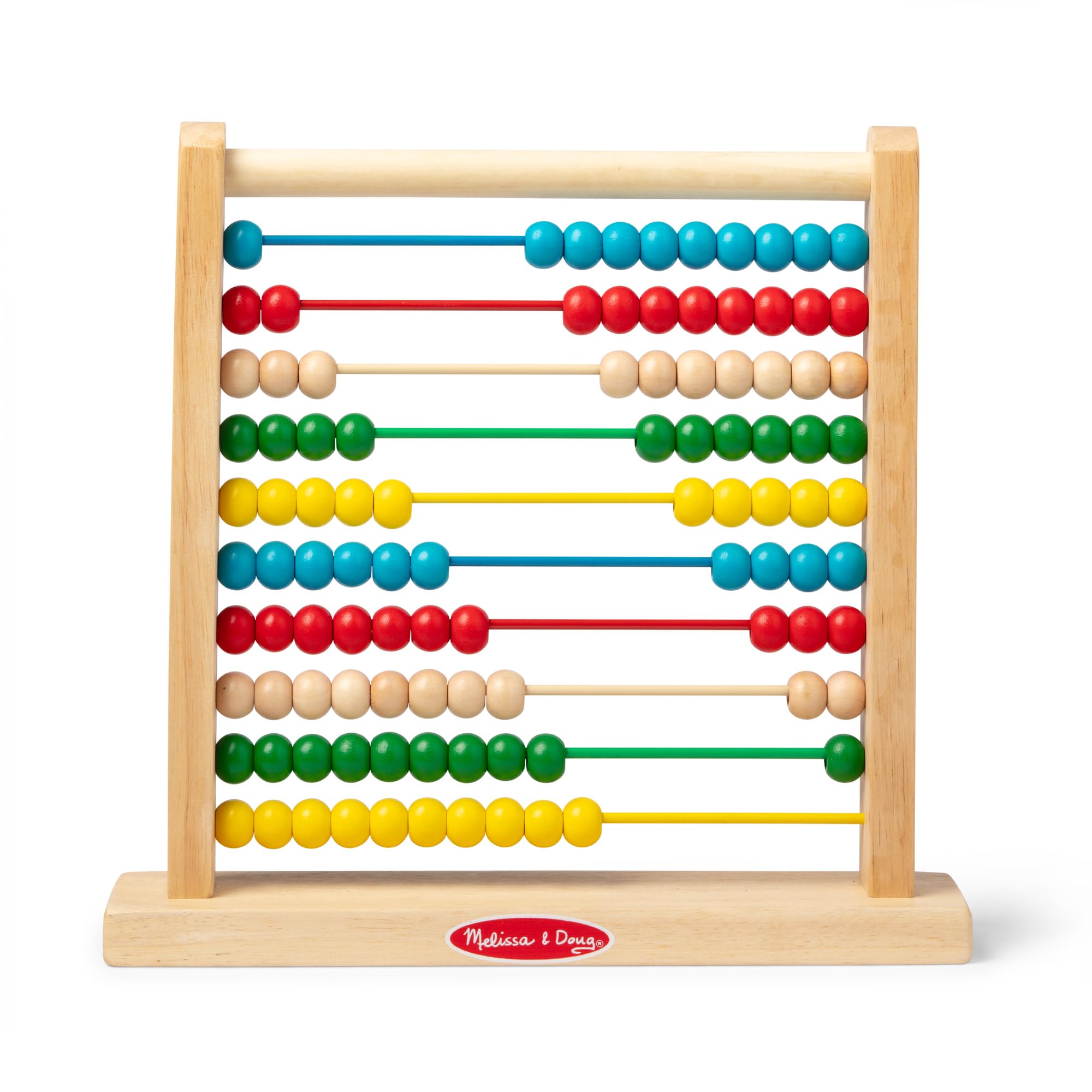
Melissa & Doug Abacus Classic
Key Features
- Size: 12.2 x 12.01 x 3.15 in
- Beads: 100 beads in 10 rows
- Frame: Solid wood
- Recommended age: 3 to 5 years
- Price: Budget
Give a child this frame and the first thing they do is run a hand down a row, then count by tens to the bottom. Ten rows of ten beads, each row in its own color, is the oldest design in the category and still the clearest: a three-year-old pushes beads one at a time, a five-year-old counts to a hundred and finds where 73 sits, and a second grader uses the rows to talk about tens and ones. We keep recommending it because it teaches nothing on its own and everything with a question attached — "show me twelve" is a game a child can win.
The build is the other half of the case. The frame is solid wood, and at a little over two pounds it stays where it is put instead of skating across the table when a toddler rakes a handful of beads. The rods are stout, the joints are screwed rather than pressed, and ours has been stacked, dragged, and pressed into service as a garage for small cars without a wobble. A bead coming loose in a younger sibling’s hand was never something we had to think about, which is not true of every wooden frame in this price range.
What is missing is structure. There are no cards, no counting sticks, no booklet — the box holds an abacus, full stop. Most families do not miss it, since the games are easy to invent and a hundred beads absorb a preschooler for a good while. If you want printed equations to prop above the beads, the Cltoyvers kit is the better buy, and it takes up less table while doing it.
Two limits are worth knowing before you order. At twelve inches square it is furniture rather than a travel toy, and the maker’s range stops at five even though the frame keeps working for years past that. The ceiling is the bigger one: a hundred beads is a hundred beads, so a seven-year-old doing multi-digit mental arithmetic needs a soroban, and the Chamigush is where we point them.
Pros
- A hundred beads in ten color-coded rows
- Stout wooden frame that stays put
- Survives stacking, dragging, and drops
- Cheapest full-size frame we recommend
Cons
- No cards or activity guide in the box
- Tabletop only; too big for a backpack
Solid wood, a hundred beads in ten color-grouped rows, and a price that makes trying it an easy decision — this is the frame we recommend to almost every family.
Best for Toddlers Learning Sums
Melissa & Doug Add & Subtract Abacus
Key Features
- Size: 4.75 x 9.55 x 12.7 in
- Beads: 55 beads
- Includes: 2 double-sided boards
- Recommended age: 2 to 6 years
- Price: Midrange
Fifty-five beads looks like a downgrade beside the hundred-bead frames, and for the youngest children that is exactly the point. A two-year-old cannot hold a hundred of anything in their head; a shorter frame of bright beads, with a board that reads 3 + 4, gives them a problem small enough to finish and a place to finish it.
The two double-sided boards are what earn the price. One face handles addition and subtraction, the other is a color-matching game, and each drops into the middle of the frame so the equation sits immediately above the beads it describes. We like that a preschooler can complete a round alone — slide in a board, move the beads, check the answer — and it is the only abacus here the maker rates from 24 months.
The trade is structure over volume, and it does cost something: this frame runs about twice the price of the classic hundred-bead version while carrying roughly half the beads. For a two- or three-year-old, that is the right trade, because a hundred beads is scenery at that age. Once a child counts past twenty and starts doing sums in their head, the plain frame covers more ground for less money, and the boards go back to being a color game.
Pros
- Boards turn a sum into a physical task
- Rated from 24 months, the youngest here
- Sturdy wood with bright, teaching colors
Cons
- Boards slide out of the middle slot easily
For a two- or three-year-old who isn’t ready to count to a hundred, this is our pick: fewer beads, a board with the problem printed on it, and wood that takes a tumble.
Best for One-Box Math Kit
Cltoyvers Wooden Abacus
Key Features
- Size: 8.3 x 2.5 x 9.5 in
- Beads: 100 beads in 10 rows
- Includes: 100 sticks, 110 cards
- Recommended age: 3 to 5 years
- Price: Budget
A slot runs across the top of the frame, and a math card drops into it so the equation sits directly above the row of beads it belongs to. Set 7 + 5 in the slot and a child pushes seven beads across, then five more, and counts the answer without anyone translating between paper and toy. That single detail does more for a beginner than any worksheet we have tried, because the problem never leaves the child’s field of view.
The rest of the box is generous: a hundred beads on ten wires, a hundred counting sticks, and 110 cards covering numbers and operations. At roughly eight by nine and a half inches it takes up about the space of a tablet, so it lives on a shelf and comes out for homework — a real advantage over the twelve-inch frames when the kitchen table is already crowded. We carried this one between rooms without thinking twice about it.
It is not the sturdiest thing here. The frame has a wobble you notice when a child pushes a whole row at once, and it is a table toy rather than something to toss in the car. What you get in return is everything a parent needs to run ten minutes of practice with nothing printed and nothing hunted down. If a teaching clock would help with the telling-time unit, the Flzoaveus set bundles one for about the same money.
Pros
- Card slot holds the equation above the beads
- 110 cards and 100 sticks included
- Compact enough for a shelf
Cons
- Frame wobbles when a row is pushed hard
We reach for this kit when a child is ready for printed equations: the card slot puts the problem right above the beads, and the sticks and cards stretch one purchase across a school year.
Best for Classroom Sets
hand2mind Mini 20-Bead Rekenrek Set
Key Features
- Beads: 20 beads, two colors
- Set size: 25 rekenreks
- Recommended age: 3 years and up
- Price: Premium
Twenty-five counting frames in one box is an odd purchase for a single child at a kitchen table and exactly right for a teacher, a co-op, or a parent running a small group. hand2mind sells these as a class set because that is what they are: identical tools, sized for little hands, that stand up on their own while a child works.
What separates a rekenrek from a hundred-bead frame is the layout: twenty beads in two colors, blocked in fives, so seven looks like a group of five and two more. Children stop counting beads one at a time and start seeing quantities. The move the design invites — sliding two beads over from the second row to turn 8 + 5 into 10 + 3 — is the one that makes mental math feel obvious instead of memorized.
Compact is the other advantage. Each frame is small and light enough to sit on a desk beside a worksheet, and twenty-five of them stack in a cupboard. Buying as a set is how a teacher equips a room in one order rather than twenty-five, which matters when a school budget has to approve the purchase.
Twenty-five is also the catch. Unless the group is real, you are buying a cupboard of frames to use one; for a single child the Melissa & Doug classic covers counting to a hundred for far less, and a lone rekenrek bought separately does the fives-and-tens work. This set earns its place when you are, in fact, outfitting a class.
Pros
- Twenty beads in two colors, blocked in fives
- Compact and stable on a desk
- Class-set pricing for a whole room
Cons
- Sold only as a set of 25
- Built for table work, not for bags
If you’re outfitting a classroom, this is the set to buy: twenty-five two-color rekenreks that build number sense in fives and tens at a price a school budget can carry.
Best for Learning Soroban
Chamigush Wooden Soroban
Key Features
- Rods: 13 columns
- Frame: Wood with rubber feet
- Weight: 12 oz
- Includes: Guide handbook and reset button
- Price: Midrange
A soroban does not count to a hundred — it computes. Thirteen rods, one bead above the bar worth five and four below worth one each, and a method that turns a number into a pattern of beads. A child who learns it can add three-digit numbers by moving a handful of pieces, which is a different skill from sliding beads along a counting frame and the reason this sits beside those toys rather than replacing them.
The handbook is what makes this one worth more than the cheaper soroban here. Soroban technique is not self-explanatory, and a slim manual that walks through bead values and the first operations is the difference between a working tool and a curiosity that ends up on a shelf. The reset button handles the rest: one press clears all thirteen rods, so a child who has muddled a sum starts fresh instead of sweeping beads back one at a time. Rubber feet keep the frame planted while both hands are busy.
Construction is the pleasant surprise. The frame is wood, the beads are a dense artificial stone with a solid click to them, and at 10¾ by 3¾ inches and twelve ounces it reads as a desk instrument rather than a toy. Set it beside a plastic frame and the difference in the hand is obvious.
Pros
- Wooden frame with non-skid rubber feet
- Reset button clears every rod at once
- Includes a step-by-step handbook
- Dense stone beads with a solid click
Cons
- Small beads suit school-age hands
- Learning the method takes an adult’s help
Our pick for a child ready to learn soroban properly: a wooden thirteen-rod frame, a reset button, and a handbook that actually teaches the method.
Best for Math and Time
Flzoaveus Wooden Abacus Set

Key Features
- Size: 8.3 x 2.5 x 9.5 in
- Beads: 100 beads in 10 rows
- Includes: Clock, 100 sticks, 110 cards
- Recommended age: 3 to 8 years
- Price: Budget
The clock is what separates this set from the other card-and-sticks kits. A wooden face with movable hands and readable numerals sits in the same box as the abacus, so one purchase covers the two things early elementary homework keeps returning to: sums and telling time.
The abacus half is the familiar design — ten rows of ten beads, a card slot across the top, 100 counting sticks for grouping and sorting, and number cards running 1 to 100. A child can build a number on the frame and hold up the card that matches it, which is a better game than it sounds and one a five-year-old can run without help.
What we appreciate most is that the clock does not feel like a throw-in. Movable hands, clear numerals, and a size a child can hold make it useful for the five-past work a wall clock is too abstract for. Sit down with the whole set and you can run a ten-minute session that touches counting, adding, and time without hunting through three separate toy bins.
The frame is smaller than the listing’s photos suggest — desk-sized rather than a table centerpiece — and the set only earns its keep once an adult sits down to run the game. If you do not need a clock, the Cltoyvers kit does the same job without one. If telling time is on this year’s list, buy the box that already has a clock in it.
Pros
- Abacus, sticks, cards, and a teaching clock
- Movable clock hands with clear numerals
- Card slot holds the equation in view
Cons
- Frame is smaller than the photos suggest
A sensible one-box answer for a five- or six-year-old: a hundred beads, cards and sticks, and a wooden teaching clock for the telling-time unit that comes next.
Best for Practice on the Go
Yellow Mountain Imports Soroban

Key Features
- Rods: 13 columns
- Frame: ABS plastic
- Weight: 0.4 lb
- Recommended age: 5 years and up
- Price: Budget
Next to the Chamigush, this is the soroban that travels: 9.7 inches long, four-tenths of a pound, and slim enough to slide into a laptop sleeve. For a child drilling bead work on a car ride or between classes, that is the whole argument.
Underneath it is a proper thirteen-rod soroban, so the values are the standard ones — one bead above the bar worth five, four below worth one each — and a child who learns here can move to any other frame. The ABS plastic is how it stays this light, and the beads move crisply, which matters once the technique clicks and speed becomes the point.
The trade for that lightness shows up the first time someone bumps the table. Beads drift, the number changes, and a beginner who was sure of an answer starts over, which is a real frustration in the first few weeks. Set it on a stable surface — a desk, a tray table, a lap board — and the problem disappears; carry it loose in a bag and you will be resetting it constantly.
Pros
- Thirteen rods in a travel-friendly frame
- Four-tenths of a pound
- Beads move crisply for fast drills
Cons
- Plastic frame rather than wood
- Beads are on the small side
A thin, light thirteen-rod soroban that goes in a backpack — the one we pack for trips, as long as your child already knows the method.
Best for Restless Preschoolers
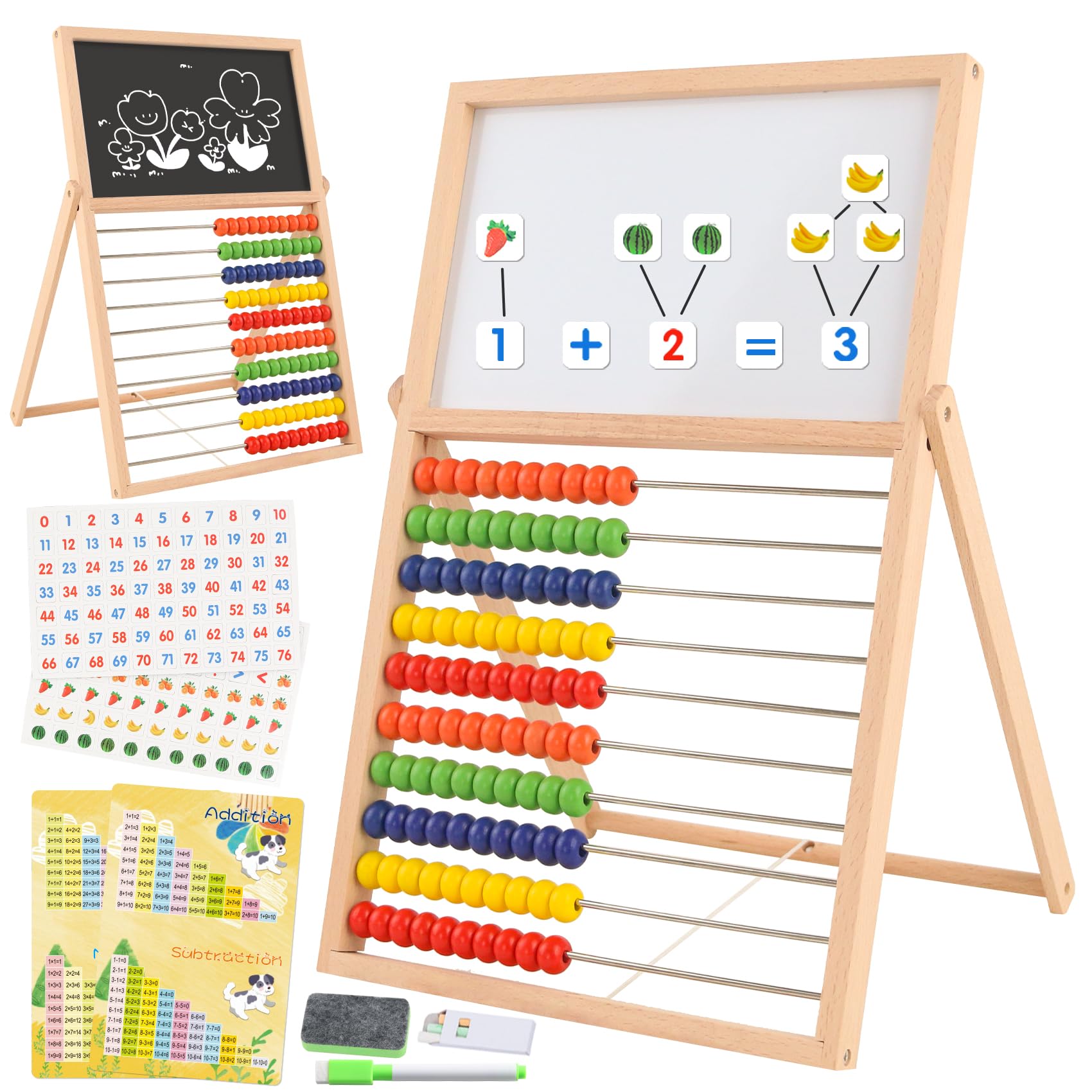
Ranqibo Magnetic Abacus
Key Features
- Beads: 100 beads in 10 rows
- Weight: 1.9 lb
- Includes: 100 number and 40 fruit magnets
- Recommended age: 3 years and up
- Price: Midrange
Most abacuses assume a child will sit still and count. This one assumes they will not. The double-sided board is the giveaway — a hundred beads on one face, a blackboard and whiteboard on the other, with magnetic numbers and fruit shapes to stick on it — and the whole thing is aimed at the three- and four-year-old who needs something to do with their hands while an adult talks.
The board does the recruiting. A child who will not count past twelve will happily park the numeral 7 next to seven beads, wipe it off, and start again, and the counting happens as a side effect. The abacus half is the standard wooden ten-by-ten frame with metal rods, so nothing about the counting is a compromise.
Weight is the thing to know. At close to two pounds this is a two-handed object for a preschooler — fine flat on a table, awkward on a lap, and not something a child carries to a restaurant. The magnets are the other consideration: they come off by design, which is exactly what makes the matching games work.
One caution before you buy. The box’s toddler language runs ahead of the manufacturer’s own three-and-up recommendation, and for a toy with loose magnetic numbers, three is the number to follow. Treat the magnet side as supervised play and the bead side as the part a very young child can use alone, and this is the abacus that gets picked up without being asked.
Pros
- Beads on one side, magnetic board on the other
- 100 number and 40 fruit magnets included
- Wooden frame with smooth-sliding beads
- Gets a restless preschooler counting
Cons
- Loose magnets and numbers need supervision
Give this to a three- or four-year-old who won’t sit still for a lesson: a hundred beads on one side, a magnetic drawing board on the other, and enough going on to hold a toddler’s attention.
How We Tested the Best Abacuses for Kids
We started by gathering every abacus that was in stock and priced for a family, then filtered by style so the shortlist covered the real ground: chunky 10-row preschool frames, 100-bead classroom standards, 13-column sorobans, double-sided boards with magnetic pieces, and a class set of mini 20-bead racks for teachers buying in bulk. That left 14 abacuses, which stayed with us for four months.
They lived where the product actually lives. Two kids used them at the kitchen table through after-school homework, a preschooler made bead patterns with them on the living room rug, a teacher friend tried the mini racks with a first-grade group, and two frames rode in the back seat for a month of short drives. We slid every bead in every row with one finger to feel whether it moved freely or caught on a burr, then flipped each frame upside down and shook it to see if the beads drifted out of place on their own. We ran a thumb along every frame and rod for splinters and sharp ends, dropped each one twice from table height onto hardwood, and wiped the surfaces with a damp cloth to see how the paint and finish held up under real kid handling.
Before the first use, we counted every bead, stick, and card against what the box claimed, because a set short four beads is a set short a lesson. We wrote on the boards with the supplied chalk and markers and erased them, stuck and unstuck the magnetic pieces until the backing stopped grabbing, and pressed the reset button on the soroban style frames a few dozen times. Size got judged by our shortest tester’s hand span, and adjustability by whether a rod or bead could be swapped without cracking the frame.
Value came down to one question we asked at the end of the four months: is this still the frame the kids grab first? The ones that held their place in the rotation, with beads still sliding true and no rattling joints, are the ones worth buying.
How to Choose an Abacus for Kids
The bead layout matters more than the brand, because the right frame is the one whose structure matches the math your child is doing right now.
Match the Bead Layout to the Math
Ten rows of ten is a counting and place-value machine: it goes to a hundred, it shows tens and ones, and it earns its keep from about three to seven. A twenty-bead rekenrek in two colors does something narrower and better, building number sense around fives so that 7 becomes 5 plus 2 without any counting at all. A thirteen-rod soroban does something different again: it computes, using a method somebody has to teach.
The trap is buying upward. A soroban in the hands of a four-year-old looks impressive and teaches nothing, because the technique comes before the magic. Start with beads a child can count, and move to a computing frame when they are fluent.
Size It for the Table It Will Live On
Compact in a listing means desk-sized, not pocket-sized, and photos flatter every frame. The card-and-sticks kits here run roughly eight by nine and a half inches, about the footprint of a tablet, which suits one child at a kitchen table and still fits on a shelf.
The full-size wooden counting frames are around twelve inches square and about two pounds, and they take real space: an advantage in a classroom, a nuisance on a crowded counter. If the abacus will travel, weight decides more than dimensions, since anything near two pounds stays home.
Watch How the Beads Move
A good frame lets a bead slide with one finger and then holds it where it is put. Wooden beads on stout rods and wires give you that; a bead that jams or drifts turns every sum into an argument, and a child who has to re-set a row mid-problem loses the thread.
Sorobans are the exception worth knowing about, since light, fast beads are the entire point of the design, which also means a bumped table can change the answer. Test any frame the way a child will: run a row down fast, then knock the table and see whether the beads stay.
Decide Which Extras You’ll Actually Use
The extra worth paying for is a card slot that holds the equation directly above the beads, because it keeps the problem in view while the child works. Counting sticks and loose number cards are useful for grouping games and hopeless without a container to live in. A handbook is essential on a soroban and unnecessary on a hundred-bead frame, and a teaching clock in the box covers a second skill for about the same money.
None of it replaces ten minutes of sitting down together. Buy the extras that shorten the distance between you and the beads, not the ones that fill a box.
Frequently Asked Questions
How do you teach a child to use an abacus?
Start with free play. Let them slide beads, sort colors, and make noise with it before anything becomes a lesson. Then count one bead per number up to ten, always starting from the left, with the child saying each number as a bead moves.
Next, build ten in different ways on a single row: 6 plus 4, 7 plus 3, 9 plus 1. Ten minutes at a time is plenty, and the frame will still be there tomorrow.
Are abacus beads a choking hazard?
Treat them that way for anyone under three. The beads on these frames are small parts, which is why most makers rate them for ages three and up, and the risk grows if a rod or glued joint lets go. Check that beads cannot slip off the rod ends before you hand one over.
Use the toilet-paper-tube test: a bead that drops through the tube is small enough to matter. Keep loose magnetic numbers away from children who still mouth objects.
Does an abacus still help if my child does math on a tablet?
Yes, for one specific gap: quantity. An app shows the numeral 7, while a frame shows seven things you can push, and that is the piece many young children are missing when they can recite numbers but cannot say which of two is bigger.
Keep the abacus beside the tablet for the concept, then let the app do the drill. A hundred-bead frame covers the most ground here, since it handles counting, tens and ones, and simple addition.
Final Verdict
For most families the Melissa & Doug Abacus Classic is the one to buy: a hundred beads, a wood frame that survives a preschooler, and a price low enough to add a second abacus later without flinching.
Two situations change the answer. With a two- or three-year-old, take the Add & Subtract frame instead, because fewer beads and a printed sum are what make the task finishable. For a child of seven or eight who wants to compute rather than count, the Chamigush soroban is the tool, handbook included.
