This post contains affiliate links. We may earn a small commission when you buy through our links — at no extra cost to you.
The fantasy is a quiet hour at the kitchen table and a kid holding up a bracelet they made themselves. The reality is usually a slippery knot, a bracelet that comes apart in the car, and hundreds of tiny beads working their way into the rug. A good jewelry making kit is what keeps that first bracelet from being the last one.
I’ve watched plenty of these get opened at birthdays, and the box matters far less than what’s inside it. Over four months, my team and I built alongside kids from preschool age to tweens using 14 kits — clay beads, looms, wooden beads, pop beads, stickers — and the same few things kept deciding whether a kit earned a second session.
Bead count is the least useful number on the box. Variety is what a kid actually notices, and value is whether there’s enough cord and clasps to use up the beads. What predicts a good afternoon is whether the cord fits through a hole twice, whether a kid can close the clasp without an adult, and whether the bracelet survives a week of handwashing — the three things every pick below has in common.



Best for Ages 7–12
Redtwo 5100 Clay Bead Kit
Key Features
- Bead size: 6 mm, 2 mm hole
- Clay colors: 18
- Total pieces: 5,100
- Also included: Clasps, scissors, tweezers
- Price: Budget
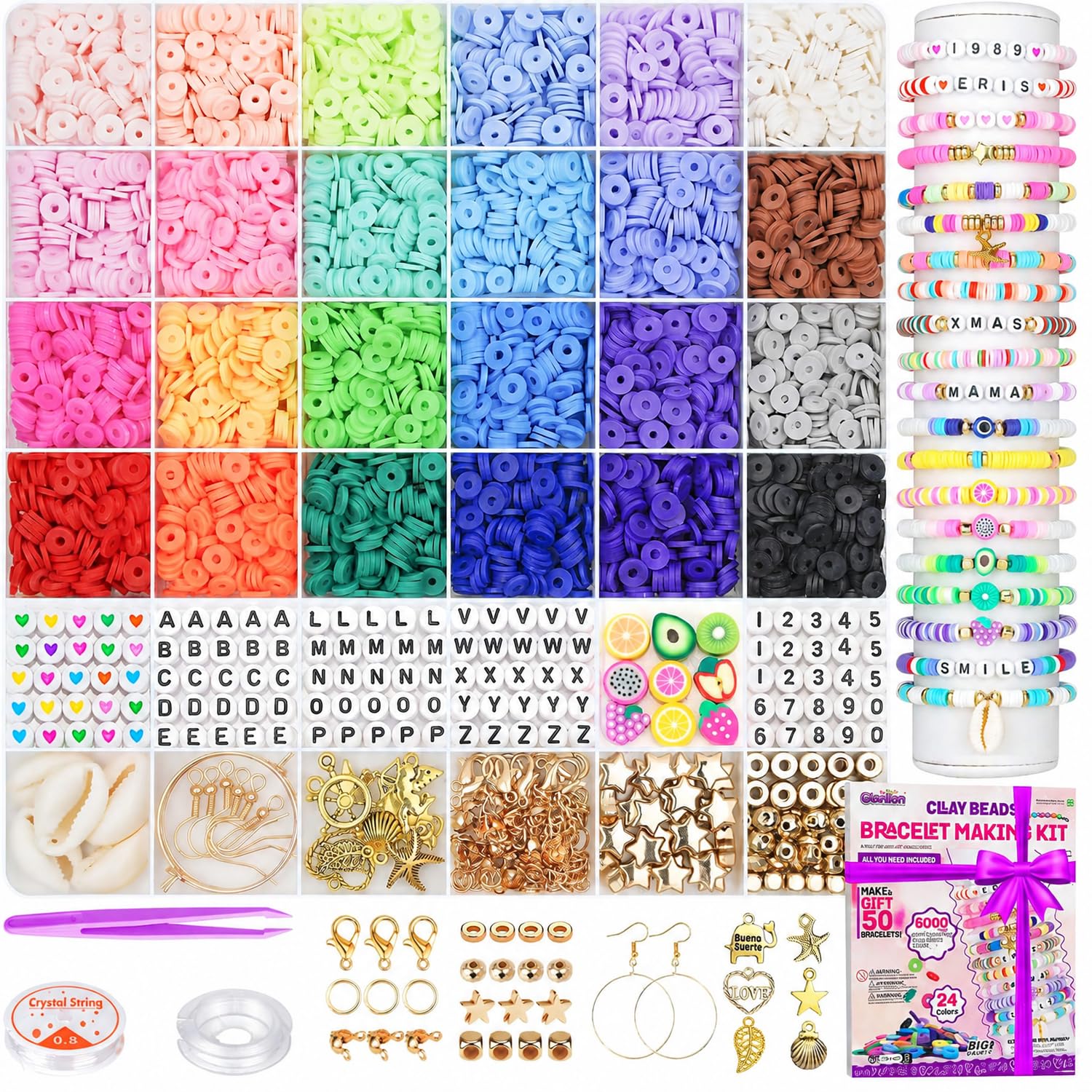
Open the box and the beads turn out to be half of it. Alongside roughly 4,600 flat clay heishi discs in 18 colors, Redtwo packs 500 pieces of hardware: letter beads in three finishes, numbers, hearts, fruit, gold spacers, starfish and shell charms, lobster clasps, plus the scissors and tweezers most kits leave you to supply.
We think the clasps are what earn this one the top spot. Every kit here can produce a bracelet; only a couple hand you a way to close it that is not a knot, and a knot in a stretchy cord is exactly where a kid’s project falls apart on the playground. The charm assortment does the rest — a name spelled in letter beads is a different object from a row of identical discs.
The beads themselves measure 6 mm across, 1 mm thick, drilled with a 2 mm hole. That is small enough for a 10-year-old to knock out a stack of friendship bracelets in an afternoon and fiddly enough that a 5-year-old needs an adult threading alongside. Eighteen colors covers the basics, though it is not the widest range in this group.
The elastic is slick, so a single knot works loose — double it and seal it, or use the lobster clasps instead. And treat the 3+ age label as optimistic: at this bead size the kit hits its stride around age 7, when a kid can thread, knot, and undo a mistake without help.
Pros
- Clasps, tweezers, and scissors included
- 18 colors plus letter, number, and fruit charms
- 5,100 pieces go a long way
- Beginner instructions in the box
Cons
- Elastic slips out of a single knot
- Sets can arrive short of the listed count
Our default pick: a complete clay-bead kit with real clasps, tweezers, scissors, and letter charms, so a kid finishes actual jewelry instead of a knotted loop.
Best for Color-Obsessed Kids
Gionlion 6000 Clay Bead Kit
Key Features
- Elastic: 2 spools, 5 m each
- Bead size: 6 mm, 2 mm hole
- Clay colors: 24
- Total pieces: 6,000
- Price: Budget
If the argument in your house is about shades rather than charms, buy this one instead. Twenty-four colors is the widest clay palette in this group, and at this bead size that is the difference between a bracelet that matches a specific outfit and one that is merely purple.
The count runs about 5,500 beads plus 550 charm pieces — letter beads, smiley faces, hearts, shells, pendants — along with two 5-meter spools of elastic, scissors, and a lobster clasp. Dimensions match the standard here: 6 mm wide, 1 mm thick, 2 mm hole, so the discs sit flat against each other the way the friendship-bracelet style requires.
The cord is where it gives ground. Elastic this thin stretches with wear and can tear at the knot, and a bracelet that goes into the bath will give out sooner than one that comes off at bedtime. We like the beads enough to look past it: restringing a favorite takes five minutes and a fresh length of cord. The 6+ age rating is more honest than most and lines up with what these beads ask of a kid’s hands.
Pros
- 24 colors, the widest clay palette here
- Two 5-meter spools of elastic included
- About 550 charms and letter beads
- Scissors and lobster clasp in the box
Cons
- Elastic stretches and can tear at the knot
Twenty-four colors, two spools of elastic, and the same small heishi discs as our top pick — the better buy if your kid plans designs around shade.
Best for Tweens
Rainbow Loom MEGA Combo Set
Key Features
- Bands: 7,000+, latex-free
- Storage: Divided organizer case
- Age range: 7+
- Band colors: 21
- Price: Premium
This is not beads on a string, and that is the whole point. Rainbow Loom asks a kid to load a pegboard, hook bands over one another, and pull a woven bracelet off the end — a craft with a real learning curve rather than an open-and-string afternoon.
The Mega Combo carries 7,000 latex-free bands in 21 colors, 300 C-clips, 12 gift bags, a metal hook, and the loom itself, all in a clear organizer case with divided compartments. That is enough for weeks of bracelets, rings, and charms, and the gift bags mean the output has somewhere to go besides the bottom of a drawer.
We rate the case as the practical win. Seven thousand loose rubber bands are a household menace, and sorting them once by color is what makes the set usable instead of abandoned. Expect a video tutorial for the first bracelet — the printed instructions cover the basics, but the patterns that make this fun to keep doing live online. Bands do snap mid-weave, which is the cost of the tension the weave needs to hold.
Pros
- 7,000 latex-free bands in 21 colors
- Divided case keeps colors sorted
- 300 C-clips and 12 gift bags
- Makes bracelets, rings, and charms
Cons
- Bands can snap mid-weave
- First bracelet needs a video tutorial
Not a bead kit at all: 7,000 latex-free bands and a divided case for the kid who wants a hobby to come back to, not one afternoon’s craft.
Best for Ages 3–6
FUNZBO Pop Beads Set
Key Features
- Makes: 8 bracelets, 4 headbands, 10 rings
- Age range: 3–8
- Fastening: Snap-together, no cord
- Total pieces: 520+
- Price: Midrange
No cord, no knot, no scissors. FUNZBO’s beads snap together — a peg on one end clicks into the socket on the next — so the step that defeats most preschoolers simply is not there.
We think that one design change is worth more than any feature list at this age. The failure point on every other kit here is the finish: a 4-year-old can thread a whole bracelet and then has to hand it to an adult to close. Here they can build it, wear it, pull it apart, and start over without anyone’s help, and the pinching and pressing is genuine finger-strength work.
The set runs 520-plus pieces and includes eight bracelets, four headbands, ten rings, an instruction guide, and a layered case with a carrying handle. Two things to know: some connectors need a specific angle and a firm press, so a young 3-year-old will still want help, and a few joints work loose enough that a finished piece sheds a bead. The case latch is the flimsiest part of the package.
Pros
- No cord and no knots
- 520+ pieces make bracelets, headbands, and rings
- Layered carry case with a handle
- Snapping builds finger strength
Cons
- Some connectors need a firm, angled press
- Case latch can break and spill beads
The kit for a 3- or 4-year-old who cannot tie a knot: 520 snap-together pieces that make bracelets, headbands, and rings with no cord at all.
Best for Preschoolers
Tara Toys Disney Princess Necklace Case
Key Features
- Beads: 150
- Charms: 5 Disney princesses
- Age range: 3+
- Necklaces: 5
- Price: Midrange
We think the bead holes are the reason this one works. They are wide enough that a preschooler hits them on the first or second try, which is the difference between a craft that ends in a necklace and one that ends in tears.
Inside the case: 150 beads in mixed shapes — round, flower, translucent, opaque — five rubber Disney princess charms, and five necklace cords. It is rated 3+, and unlike most of the labels in this category, that one holds up: threading is well within a 3-year-old’s reach once the hole is generous.
The clasp is the weak point. Pull on a finished necklace and the ends can slip apart, dropping beads, and the plastic case is thin enough that it will not survive being sat on. At this age that is a fair trade, because the fun is in stringing and restringing rather than in wearing — a necklace that comes apart gives a kid a reason to build it again.
Pros
- Wide holes a 3-year-old can thread
- Five Disney princess charms
- Carry case holds beads and cords
- Take apart and rebuild endlessly
Cons
- Clasp ends slip apart when pulled
- Thin case will not take much abuse
Wide bead holes and five princess charms make this the kit a 3-year-old can actually finish alone — and take apart to rebuild tomorrow.
Best for Ages 4–7
Melissa & Doug Sweet Hearts Bead Set
Key Features
- Sets: 2 themed
- Beads: 250+ wooden
- Cords: 10 color-coordinated
- Storage: 2 wooden trays
- Price: Premium
This is the most expensive kit in the group, and the money goes into wood. Two themed sets — Sweet Hearts and Butterfly Friends — each carry more than 120 painted wooden beads and five color-coordinated cords, with a shallow wooden tray for each.
The beads are chunkier than any of the clay discs here, and the cords come with plastic tips on the ends, so small fingers can post a bead without hunting for a needle or licking the cord. The trays do real work too: they hold the sorted pieces while a kid works and stack away in seconds.
We like this one for the years rather than the afternoon. Water-based paint on wood does not chip the way coated plastic does, the pieces can be restrung until the cord gives out, and nothing about it feels babyish to a 6-year-old. The clasps are the fussy part — expect to help, especially with a necklace — and a few beads have rougher holes that slow threading down.
Pros
- 250+ wooden beads across two themed sets
- Two wooden storage trays
- Cord tips make stringing easier
- Painted wood holds up to repeat use
Cons
- Clasps are fiddly for small hands
- Some bead holes are rough inside
For a preschooler who will still be beading in three years: 250+ painted wooden beads, two trays, and cords that thread easily.
Best for Quick Crafts
Melissa & Doug Design-Your-Own Bracelets

Key Features
- Closure: Tab closure
- Stickers: 100+ gem and glitter
- Age range: 4+
- Bracelets: 4, double-sided
- Price: Budget
Four double-sided bracelets, 100-plus gem and glitter stickers, and tab closures — that is the entire kit. No stringing, no drying time, no loose beads rolling under the sofa.
Each bracelet carries a different color on each side, so a kid can decorate one face, flip it, and decorate again. The stickers can be nudged and repositioned while they are fresh, which makes the design decisions low-stakes for a child who is still deciding what looks good.
It is also the shortest-lived option here. The stickers lose their tack after a few weeks of wear, and the activity is one sitting rather than a summer of afternoons.
We still keep it on the list because nothing else here is this easy for the youngest crafters. A 4-year-old can finish a bracelet start to finish without an adult, and the whole thing drops into a bag for a restaurant or a plane ride. Buy it as an afternoon’s present, not as a craft supply.
Pros
- No stringing, drying, or clean-up
- Four double-sided bracelets
- 100+ gem and glitter stickers
- Tab closures work for small hands
Cons
- Stickers lose tack after a few weeks
- One sitting’s worth of activity
Twenty minutes of decorating, no cord to knot: the kit we hand a 4-year-old who wants jewelry now and has no patience for beads.
Best for Siblings and Classrooms
Dowsabel 3-Box Clay Bead Kit
Key Features
- Boxes: 3
- Clay colors: 48
- Total pieces: 10,800
- Also included: Elastic, hooks, jump rings
- Price: Midrange
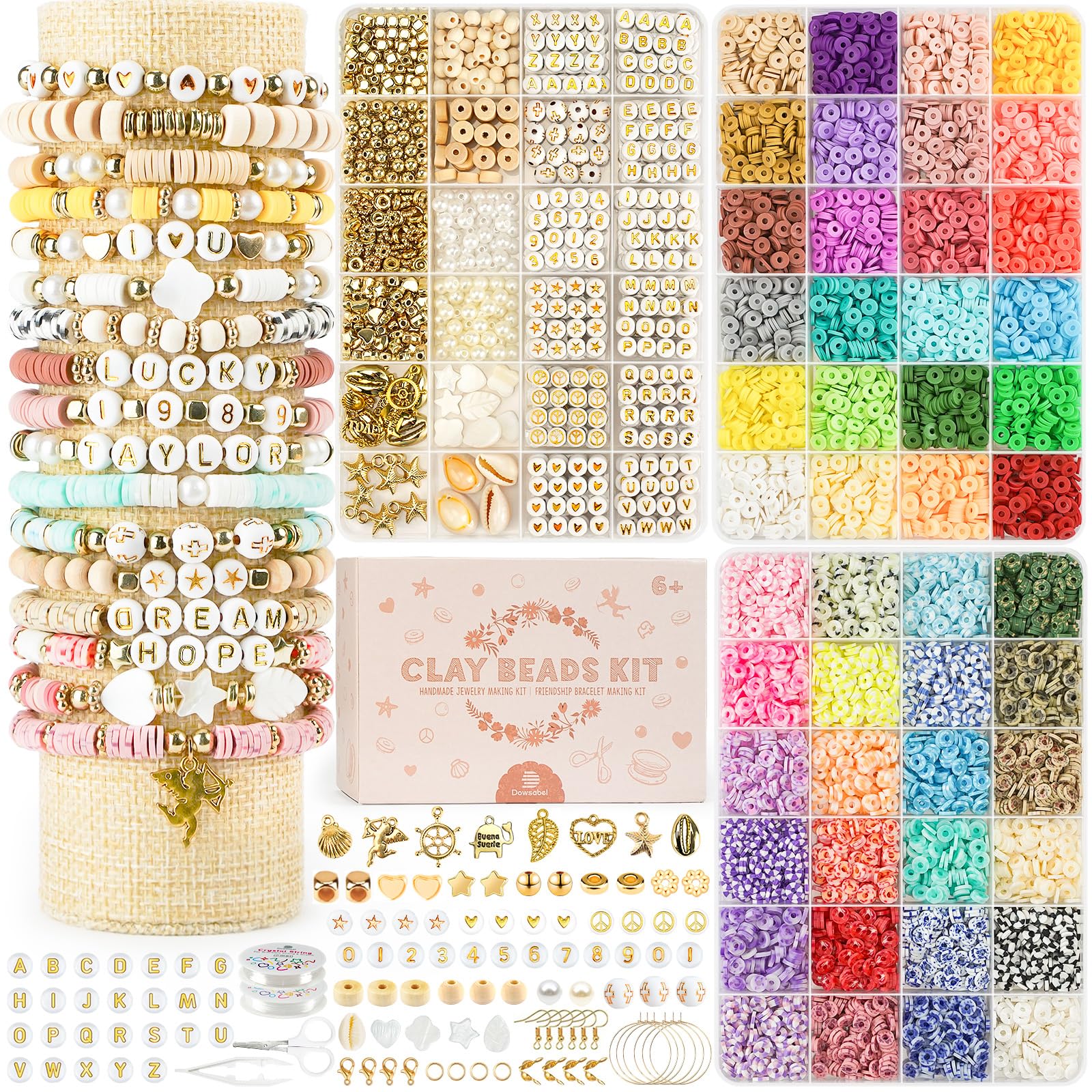
Ten thousand eight hundred pieces is a number that stops meaning anything, so here is the practical version: three separate boxes, roughly 7,200 clay discs across 48 colors, and about 1,100 bead and charm pieces on top.
The palette leans boho — soft nudes and neutrals sitting beside the brights — which reads older than the primary-color assortments most kids’ kits ship with. Tools come included: elastic string, earring hooks, jump rings, tweezers, and scissors, enough to move past bracelets into earrings, phone straps, and glasses chains.
The format is the same small flat disc as every other clay kit here, with the same threading demands and the same need for an adult to finish a knot. Nothing about the individual beads is different; there is simply far more of everything.
The three-box split is why we kept it. Hand one box to each kid and the sorting argument disappears, and each box stays a manageable size on a shelf. For a single child, a single-box kit is the better use of space — this one earns its place in a house with siblings, a cousin group, or a classroom.
Pros
- 10,800 pieces across three boxes
- 48 colors in a boho palette
- Elastic, hooks, jump rings, and tools included
- Boxes split easily between kids
Cons
- Far more to sort and store than a single box
The bulk buy: 10,800 pieces in three boxes with a 48-color palette, for the family where more than one kid is beading at once.
How We Tested Kid Jewelry Making Kits
We started with every kit marketed to kids rather than to adults, then cut anything with no age guidance, no storage, or a piece count that worked out to roughly one finished bracelet. That left 14 kits, which my team and I tested over four months with kids ages 3 to 12 at the table: clay bead sets, a rubber band loom, wooden beads, chunky pop beads, and sticker bracelets.
Most of the testing happened where these kits actually live — the kitchen table after school, a rainy Saturday, and one birthday party where four kids opened similar kits side by side. We timed how long it took a child to finish a first bracelet with no adult hands involved, and noted where they stalled: cords that wouldn’t pass through a bead hole twice, clasps that needed an adult’s fingernails, instructions with no pictures. Small pieces got a second look against the age printed on the box and against a preschooler’s fingers.
Then we wore the results. Every finished bracelet went on a wrist for a week of handwashing and pulling on and off, plus one deliberate tug, and we noted whether knots slipped, elastic stretched out, or stickers and gems lifted at the edges. Storage cases got shaken upside down to see if the lid held. For variety, we counted the colors and shapes a kid could actually tell apart, and whether there were enough duplicate letter beads to spell a name. For value, we kept building until the box ran out of something essential — cord, clasps, a popular bead color — and counted how many finished pieces each kit produced.
How to Choose a Jewelry Making Kit for Kids
The kit that delights a 9-year-old will defeat a 4-year-old, so start with what the child’s hands can already do rather than with whichever box holds the most pieces.
Start With How the Pieces Fasten
Every kit here closes jewelry one of three ways: thread a cord through a hole, snap one piece into the next, or stick a decoration onto a ready-made band. Threading is the most versatile and by far the most demanding. Snapping and sticking remove the fine-motor hurdle entirely, which is why they suit the under-six crowd so well.
If a child is still working on a pincer grip, a snap set like the FUNZBO pop beads gets used and a 5,000-bead clay kit sits in the closet. If they have been making bracelets at camp all summer, the reverse is true and the small discs are the point.
Check the Hole, Not Just the Bead Count
Two kits can both promise 6 mm beads and behave nothing alike. A flat clay heishi disc is drilled with a 2 mm hole, which is fine for a second grader and genuinely hard work for a kindergartener. Pony beads and wooden beads are larger and drilled wider, which is why the Melissa & Doug wooden set works for a 4-year-old while the clay kits stall.
Buy the narrow hole for a 9-year-old who wants a flat, grown-up bracelet and the wider hole for anyone still learning. Holes that are not smooth inside will snag even a plastic-tipped cord, so run a thumbnail through one before you commit.
Budget for the Finish, Not the Beads
Bead count is the number printed on the front of the box; clasps and cord decide whether anything actually gets worn. A kit that ships lobster clasps or metal findings turns out jewelry that survives a school day. Elastic alone needs a double knot and a dab of glue, and the stretchy cord in most of these sets will tear at that knot eventually.
We prefer a set that includes both: clasps for the pieces a kid is proud of, elastic for the ones they will take apart tomorrow.
Match the Quantity to the Household
A 5,000-piece kit is generous for one child and a sorting chore for three. If siblings, cousins, or a classroom will share it, three smaller boxes beat one big tub — the Dowsabel three-box set divides by kid instead of by argument.
For a single child, a smaller kit with a real storage box keeps the coffee table clear and can be topped up with a bag of beads when it runs low.
Small Parts and Age Labels
Clay beads run roughly 6 mm across with a 2 mm hole, which is a choking hazard for anyone still mouthing things. The age labels on these kits are unreliable in both directions: one listing here says 3+ for a bead size that realistically suits a second grader.
Buy for the child’s dexterity, keep loose beads out of reach of toddlers, and plan to sit in on the first session — less to supervise the craft than to keep the beads on the table and out of the carpet.
Frequently Asked Questions
How long will one kit keep a child busy?
A big clay-bead kit is months of occasional afternoons; 5,000 beads is dozens of bracelets. A sticker kit is one sitting of roughly an hour. Match the purchase to the occasion rather than to the piece count.
Can you buy refill beads and elastic separately?
Yes, and it is worth restocking before the last bracelet. The flat 6 mm clay discs are sold in bags by color, and elastic cord comes on spools of 10 meters or more. Match the hole size when you buy: a bag of narrow-holed beads will fight the cord that came with the kit.
What if the kit arrives short of the listed count?
Count the pieces in the first week, while the return window is open. These counts are approximate — listings say about 4,600 for a reason — but a set missing a whole charm bag or an entire color is a packing error, not rounding. Photograph what is short and contact the seller before the window closes.
Final Verdict
The Redtwo 5100 is the kit we hand to most families. It is one of the cheapest here, it includes the clasps, tools, and letter charms that turn beads into jewelry, and 18 colors is enough for a kid to have opinions about.
Buy the Gionlion instead when color range is the deciding factor — 24 shades, the same bead size, about the same money. And if the child is under six, skip both and start with the FUNZBO snap beads or the Tara Toys princess case, where the fastening itself cannot defeat them.
