This post contains affiliate links. We may earn a small commission when you buy through our links — at no extra cost to you.
There’s a specific minute in every dinner out with a toddler — somewhere around minute twelve — when the crayons are gone, the crackers are on the floor, and you start calculating how fast you can get the check. A bead maze is what I reach for in that minute. Nothing comes apart, nothing rolls under the next table, and it holds their attention.
Over the past four months we’ve lived with 14 of them, from palm-size wooden squares to full looping roller coasters, and the gap between a good one and a frustrating one is wider than wire and paint would suggest. The beads either slide around a bend or jam in place; the base either grips a high chair tray or goes flying with one swat.
The other thing nobody tells you: bigger is not automatically better. A small maze with a handful of beads gets played with on a high chair, in a car seat, and in a stroller, and the counting and color-naming come along for the ride; a wide tabletop loop is a floor toy a 1-year-old can’t reach across. Our picks split along exactly that line.


Best for High Chair Play
Melissa & Doug First Bead Maze
Key Features
- Base: Suction cup
- Dimensions: 8.66 x 8.07 x 4.13 inches
- Beads and wires: 18 wooden beads, 3 rings, 4 wires
- Recommended age: 12 months to 2 years
- Price: Budget
The suction cups are what make this the one we reach for first. Press the base onto a high-chair tray and the maze stays put while a baby uses both hands to pull a bead along one of the four wires, with no chasing it across the tray between bites and no toy on the floor every ninety seconds. Eighteen wooden beads and three rings give a 1-year-old plenty to push, spin, and slide, and the wires are soft-coated, so a grab that misses lands on something smooth.
At 8.66 by 8.07 by 4.13 inches and a little over a pound, it claims a corner of the tray rather than the whole thing, and it drops into a diaper bag for a restaurant dinner without adding noticeable weight. That compactness cuts both ways: the play area is small, and a toddler who is already steering beads deliberately will run out of route before they run out of patience. We treat it as a 12-to-24-month toy, which is the age range on the box.
The one thing to learn is the suction. Wet the cups before you press them down and wipe the tray first, because dust and grease are what let a dry cup let go mid-meal. On a smooth plastic tray it will hold through a serious tug; on a textured or unfinished surface it won’t, and the maze turns into a lap toy. Given how much of a baby’s day happens strapped into a chair, that trade is worth making.
Pros
- Suction base grips a high-chair tray
- Small and light enough to take along
- Smooth wood and coated wires wipe clean
Cons
- Suction needs a smooth, clean surface
- Small play area limits older toddlers
We recommend this one first: it clings to a high-chair tray, wipes clean in seconds, and buys you a whole meal’s worth of busy from a 1-year-old.
Best for Babies under One
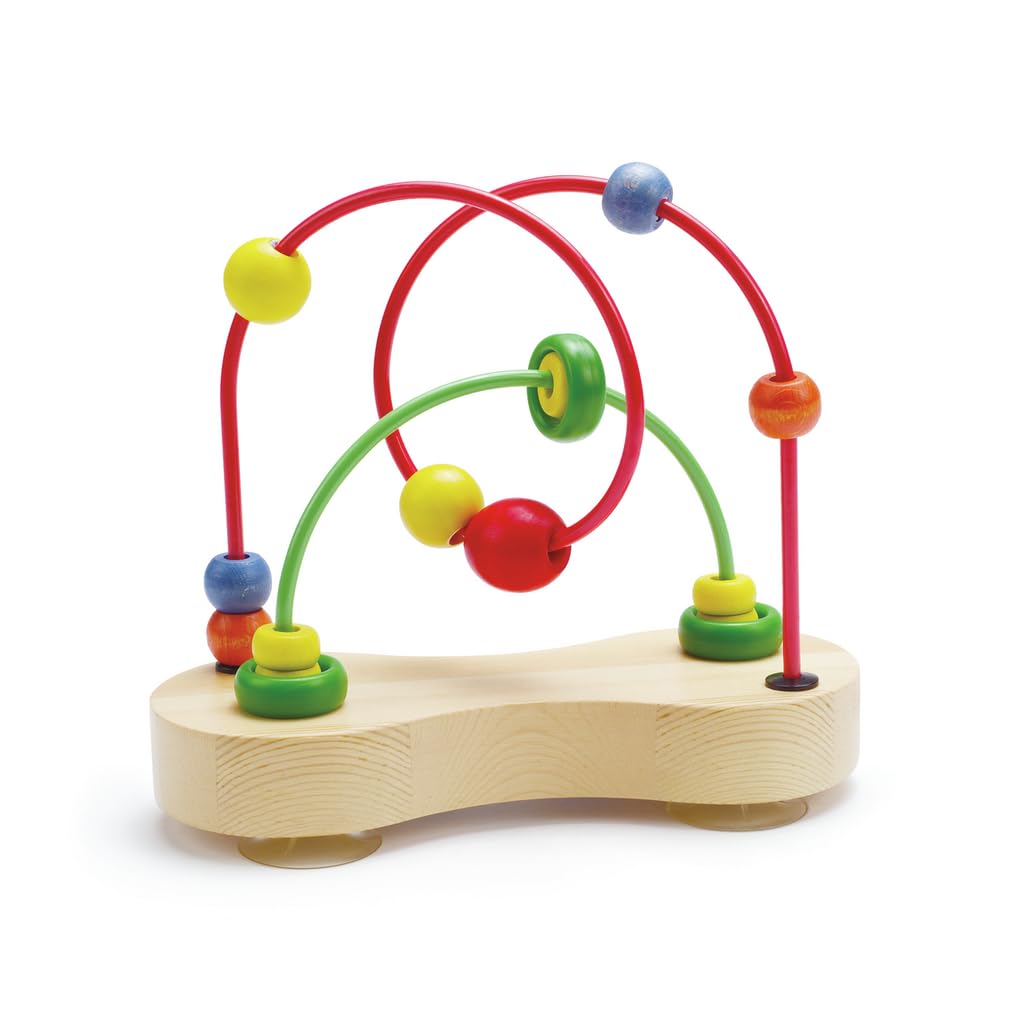
Hape Double Bubble Bead Maze
Key Features
- Base: Four suction cups
- Bead style: Nesting beads
- Dimensions: 8.46 x 3.54 x 7.6 inches
- Recommended age: 6 months to 3 years
- Price: Midrange
Six months is earlier than almost any bead maze will ask, and that’s the gap this one fills. Four suction cups hold the base down, the frame measures 8.46 by 3.54 by 7.6 inches, and the beads are big enough for a hand that hasn’t worked out gripping yet. For a baby still swatting at things rather than steering them, that’s the right amount of toy.
The nesting beads are the detail we appreciated most. Some beads slide inside others, so a simple push becomes a small lesson about inside and outside, the kind of thing a 7-month-old repeats for the fun of it without knowing they’re learning anything. It’s a cleverer bit of design than most of this group, where a bead is mostly just a bead.
What you give up is surface area. The wires sit close to the base and the routes are short, so a 2-year-old will have exhausted it inside a week. The cups are also only as good as what you stick them to: a smooth tray, yes; a scrubby wooden table, no. That’s an acceptable trade for the baby this is built for, though it isn’t the maze a child grows into.
Pros
- Rated from 6 months, the earliest here
- Four suction cups hold it steady
- Nesting beads teach inside and outside
Cons
- Short routes are outgrown by about age 2
A rare maze that genuinely suits a baby under one: light, steady on a tray, and small enough to take along, as long as your surface is smooth.
Best for Tabletop Toddler Play
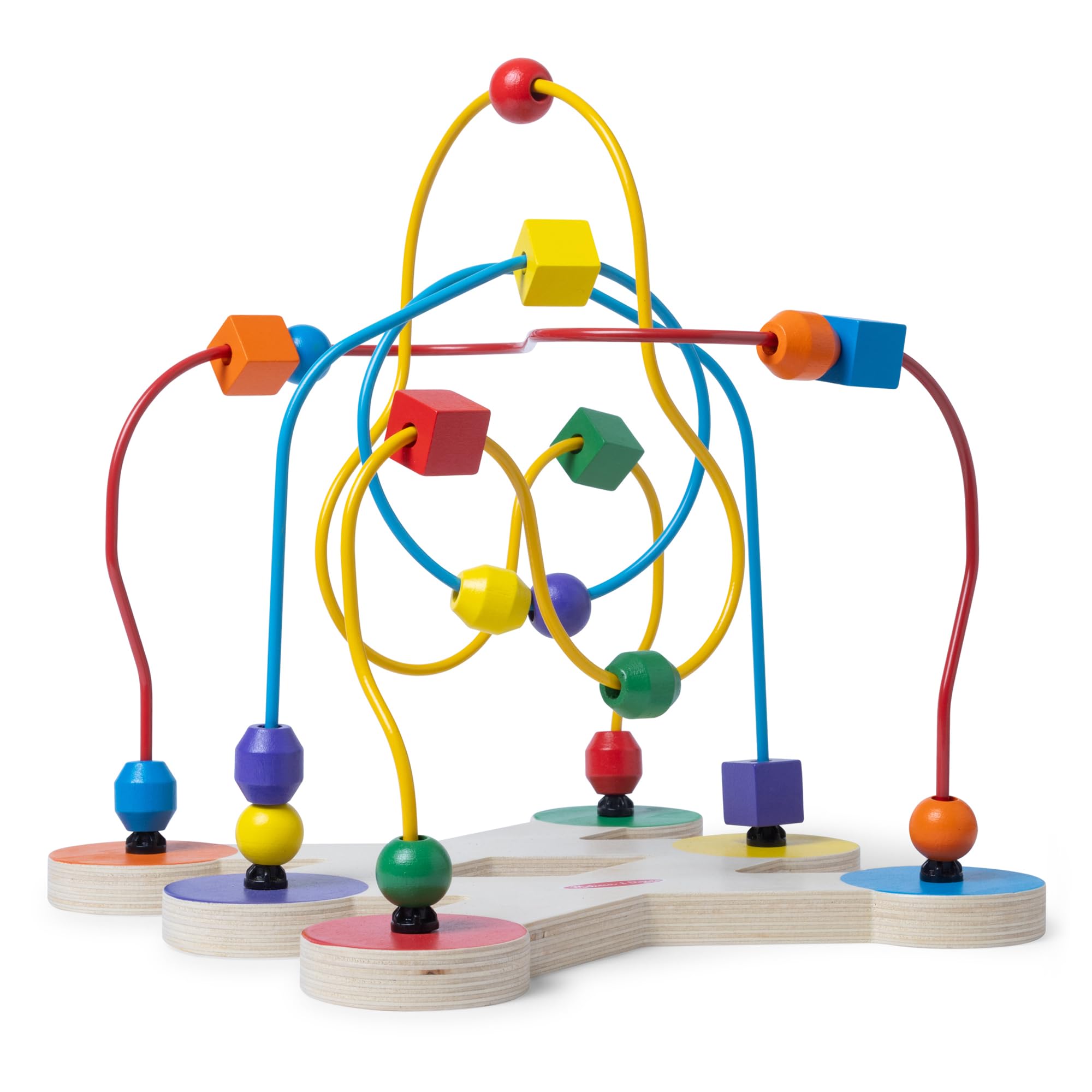
Melissa & Doug Classic Bead Maze
Key Features
- Base: Solid wooden base
- Dimensions: 12.55 x 12.3 x 14.65 inches
- Beads and wires: 18 wooden beads on 3 wires
- Recommended age: 12 months to 2 years
- Price: Premium
Where the First Bead Maze is small enough to live on a high-chair tray, this one wants a table of its own: a foot of wood with three wires arcing high enough that a toddler can work a bead from one end to the other instead of just nudging it around the bend.
The height is the point. At 12 months a baby mostly pushes beads; by 2 they’re planning a route, and there’s enough wire here for that shift, with 18 beads in a mix of shapes rather than plain spheres so color and shape become part of the play. It’s the maze we leave out on a coffee table for a toddler to come back to on their own, and the base is solid enough that pulling up on it isn’t a disaster.
The trade-off is footprint. Nothing sticks, nothing folds, and it will slide on a polished floor when a child leans their weight on it, so put a rug or a non-slip mat underneath. In a playroom that’s an easy yes. In a small apartment, the compact mazes earn their keep instead.
Pros
- Three tall wires with 18 shaped beads
- Solid wooden base resists tipping
- Bright colors and varied shapes hold attention
Cons
- No suction, so it slides on smooth floors
- Takes up a real square of table
Our pick once a child outgrows a tray toy: a bigger wooden maze with real routes to plan, steady enough to lean on, and good-looking enough to leave out.
Best for Budget Pick
B. toys Loopty Loo Bead Maze
Key Features
- Weight: 16 oz
- Material: Wood
- Recommended age: 18 months to 3 years
- Beads and routes: 47 beads on 5 wire routes
- Price: Budget
Forty-seven beads on five routes is more wire-work than anything else here, and it’s the least expensive of the wooden mazes in this group. If the goal is the most sliding and spinning for the money, this is the one: the beads are real wood, the routes loop and cross each other, and the whole thing is about 8 inches across.
Portability is where it won us over. At 16 ounces it disappears into a diaper bag, and the compact frame works on a lap in a booth or beside a car seat, the two places a bead maze actually earns its keep. The wooden beads click softly against each other when the toy is tipped, which is either charming or the reason your toddler will tip it forty times in a row.
The catch is density. Five routes packed into an 8-inch frame crowd each other, and in places the wires run close enough that a bead stops short of the end, so a toddler expecting a satisfying clack gets a stuck bead. It’s rated 18 months and up, and that fits: a younger baby loses patience with the tight bends, while an older toddler works around them and gets all 47 beads to play with. Give the beads and wire ends a pull now and then; a bead that works loose is the one thing here worth watching.
Pros
- 47 beads across five routes, the most here
- 16 ounces, light enough to carry anywhere
- Least expensive of the wooden mazes here
Cons
- Beads jam where the wire routes crowd
The most beads for the money: a five-route maze that disappears into a diaper bag and keeps an 18-month-old busy in a restaurant booth.
Best for Car and Travel
Boby Wooden Bead Maze
Key Features
- Material: Wood
- Bead style: Animal-shaped beads with abacus row
- Dimensions: 8.5 x 6.8 x 8.7 inches
- Recommended age: 12 months and up
- Price: Midrange
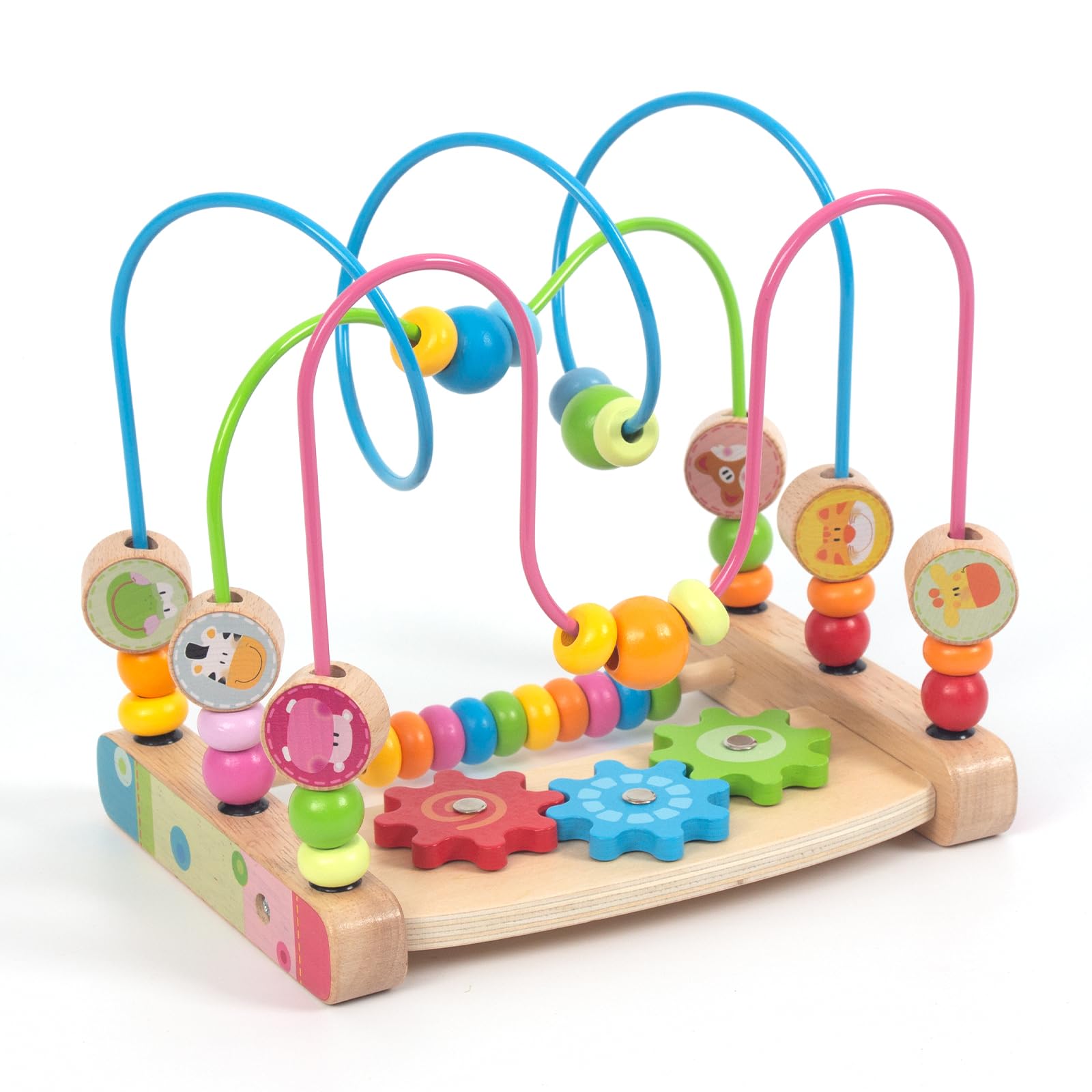
There’s no suction cup on this one, and that’s less a flaw than a job description: it’s a lap-and-floor maze, 8.5 by 6.8 by 8.7 inches, light enough that a baby can pick it up, turn it over, and set it down again. We like it in the car and in a diaper bag more than on a high chair, where a suction base does the work better.
The face of it is doing a lot of the work. The beads are shaped and painted as animals, with an abacus row underneath, so there’s color and animal naming to talk about while a baby slides, which is the difference between a toy you hand over and a toy you play together with.
Size is where expectations and reality part. It’s genuinely small, and the product photos make it look like table furniture; buy it for a 3-year-old who wants a long wire to work and you’ll be disappointed. For a 9-month-old who mostly wants to grab, turn, and mouth something, the scale is right, and the smooth, burr-free finish takes that handling without complaint.
Pros
- Light enough for a baby to lift and turn
- Animal beads and an abacus row to name
- Smooth, rounded finish with no sharp edges
Cons
- Much smaller than the photos suggest
The one to keep in the car: small, light, and cheerful, with animal beads to name, just don’t expect a tabletop-sized maze.
Best for Gift for Toddlers
Joqutoys Wooden Bead Maze

Key Features
- Material: Wood and metal
- Dimensions: 8.66 x 5.71 x 8.86 inches
- Play features: 3 bead trails, 2 slider rows, abacus
- Recommended age: 36 months and up
- Price: Midrange
Three wire trails, two rows of slider beads, and an abacus across the front: this one packs several toys into a single small frame, and it arrives assembled. That last part counts for more than it should, with nothing to screw on and nothing to lose in the box.
The animal faces are the draw. A toddler who isn’t yet interested in sliding beads will still point at a lion, and the counting row gives you something to do together once the sliding gets old. At 8.66 by 5.71 by 8.86 inches it’s a tabletop piece, and a light one, so it moves from room to room without a second trip.
Two things to know. The manufacturer’s age range starts at 36 months, later than most here, and it shows in the bead size and the tightness of the turns: a 1-year-old can bat at it, but it rewards a child with a pincer grip. It also plays smaller than the photos imply, so don’t buy it expecting a centerpiece.
Where it lands for us is a good gift for a 2- or 3-year-old and an awkward one for a first birthday, when the bigger, simpler mazes are easier for a baby to use. If there’s already a bead maze in the house, the abacus and the animal beads make this different enough to justify the shelf space.
Pros
- Abacus plus three trails and two slider rows
- Arrives fully assembled
- Animal-faced beads invite naming games
Cons
- Age range starts at 36 months
- Plays smaller than the photos suggest
Buy it for a 2- or 3-year-old: three trails, an abacus, and animal beads in one compact frame that comes out of the box ready to play.
Best for Counting Practice
QZMTOY Wooden Bead Maze

Key Features
- Assembly: Fully assembled
- Material: Wood
- Play features: Bead maze, abacus, roller coaster
- Recommended age: 36 months and up
- Price: Midrange
Small is the honest description here: this is a compact tabletop maze rather than a floor piece, at home on a high-chair tray or the back seat. The frame carries wires on top and an abacus below, with fruit-shaped beads in place of plain spheres, so there’s naming and counting to do alongside the sliding.
The wood feels better than the price suggests, and the beads are smooth enough that a baby can mouth one without you wincing. It’s the sort of toy that gets played with in five-minute stretches rather than half an hour, which for a bead maze is a normal day’s work.
What holds us back is how it wears. The bottom rack is the piece that takes the knocks when a toddler tips it over, and it’s the piece most likely to need attention first; the larger shaped beads also catch in the tighter bends instead of sliding through cleanly. If the maze is going to sit on a tray, that’s a lot of play for the money. If it’s going to live on the floor and get thrown into a bag, the Melissa & Doug First Bead Maze is the sturdier bet.
Pros
- Wires, abacus, and fruit-shaped beads in one
- Wood feels better than the price suggests
- Compact enough for a high-chair tray
Cons
- Bottom rack is the first thing to give
- Shaped beads catch in the tight bends
A cheerful, compact three-in-one for a tray or a car seat, just don’t count on it surviving a season of being hurled across the room.
Best for Second High-Chair Toy
Wondertoys Wooden Bead Maze

Key Features
- Base: Suction cup
- Weight: 1.2 lb
- Dimensions: 8.58 x 5.47 x 8.19 inches
- Recommended age: 36 months and up
- Price: Midrange
Think of this as the top pick’s job in a slimmer, lighter package: about a pound, three wire trails, two rows of slider beads, and a suction cup underneath. At 8.58 by 5.47 by 8.19 inches it sits on a high-chair tray without taking the whole thing over.
The materials are stated plainly: water-based paint, a BPA-free finish, smooth edges. On a toy a 1-year-old will taste before they play with it, that’s the detail we look for first, and it’s here in writing.
The wires sit lower and closer than on a full tabletop maze, which suits a small baby on a tray and gives an older toddler less to plan. There’s nothing unusual in how it plays, either: three trails and two slider rows, done competently, without the nesting beads or the animal faces that give a few of the others here some personality.
Our read is that this is a sensible second maze. If you want one for the high chair and one for the car, or a gift that costs less than the big wooden tabletop piece, this does the job without asking much. It doesn’t beat the Melissa & Doug mazes on route variety or the Hape on early-baby fit, and it isn’t trying to.
Pros
- Suction base with three trails and two slider rows
- About a pound, easy to move between rooms
- Water-based paint and rounded edges
Cons
- Low, close wires leave older toddlers little to plan
A tidy, lightweight maze with a suction base: a solid second toy for the high chair if you don’t need the biggest wire layout.
How We Tested 14 Bead Mazes
We pulled together every bead maze we could find from the established wooden-toy brands alongside the budget listings that imitate them, then narrowed to 14 that spanned the actual size range: compact first mazes meant for a tray, mid-size tabletop versions, and the big looping roller coasters that live on the floor.
Testing ran four months, in the places these toys really get used — clipped to a high chair during a 7 a.m. snack, on a restaurant table during a wait for food, in a car seat on the drive to daycare, and on the living room rug while dinner got made. We counted beads, traced every route with a finger, and watched whether small hands could get a grip and whether the beads slid freely around each bend or stuck where the wire curved.
For the bases, we stuck each one to three surfaces — a clean plastic high chair tray, a varnished wood table, and a slightly textured laminate restaurant table — then let a 1-year-old and a 3-year-old go at it, timing how long the base held and pushing it sideways the way a toddler does when they want something off a tray. Some held through an entire meal and slid off the restaurant table in seconds; a few wobbled the whole maze with every tug.
Durability got its own round: each maze was dropped from high chair height onto a wood floor, tossed into a bag with sippy cups and toy cars, and wiped down with a damp cloth to check for paint lift, splinters, and chipped beads. We weighed all of that against price, comparing bead count, route complexity, and how solid the wire felt when we flexed it.
How to Choose a Bead Maze
Two decisions settle almost everything about a bead maze: how it attaches, and how old the child using it is.
Suction Base or Free-Standing
A suction base turns a bead maze into high-chair equipment. It holds the toy still while a baby uses both hands, which is the difference between play and a running game of chase across the tray. The catch is the surface: cups need something smooth, non-porous, and clean, such as a plastic tray or sealed wood, and they hold far better if you wet them before pressing down.
A free-standing maze asks nothing of your furniture and slides on a polished floor when a toddler leans their weight on it. If most play happens at meals, buy suction. If it happens on the floor and in the playroom, buy the bigger free-standing piece.
Match the Maze to the Child’s Age
A 6- to 9-month-old mostly swats and mouths, so the right maze has few routes, fat beads, and a frame short enough to reach across; the Hape Double Bubble, rated from 6 months, is built for exactly that stage. A 1-year-old is working on steering one bead from end to end, which is where the Melissa & Doug mazes sit. Past 2, a child wants more route to plan and more beads to sort.
Buying ahead is the common mistake. A 36-month maze handed to a 1-year-old frustrates both of you, and a baby maze given to a 3-year-old is abandoned inside a day.
Routes, Beads, and Whether They Travel
Bead count is the number on the box; bead travel is what a child actually feels. A bead that runs the full length of its wire and stops with a click is the whole pleasure of the toy, and one that jams three-quarters of the way along is why a maze gets set aside. Jams happen where wires crowd each other, and five routes on an 8-inch roller coaster is a lot of wire in a small space.
Run every bead end to end on every wire before you wrap the box, or in the store if you can. A bead that stops short now will keep stopping short.
Size, Weight, and Where It Lives
Measure the tray, not the toy. High-chair trays vary, and a maze that overhangs gets knocked to the floor; the compact mazes here run around 8 to 9 inches across, while the big tabletop piece is roughly a foot square. Weight decides who carries it: around a pound is liftable by a 1-year-old, and anything bigger is a toy you place rather than one they haul around.
Think about the second location, too. A maze that lives only on the high chair is one toy; one that fits in a diaper bag is three, covering dinner out, the car, and a grandparent’s kitchen.
What You’re Paying For
In this group, price tracks size and route count more than materials. The least expensive maze here also carries the most beads, and the most expensive is the largest. What the extra money buys is footprint and wire length, so match it to the table you actually have rather than assuming more money means better wood. If you’re torn between a small one and a big one, the small one gets used more often.
Frequently Asked Questions
Is a bead maze actually educational, or just a distraction?
It’s a fine-motor toy first. Sliding a bead along a wire asks a baby to hold a position and steer at the same time, which is the same skill set as scribbling and, later, using a spoon. The colors, shapes, and animal faces give you something to name out loud, and most of the language value sits in that naming.
Don’t expect the toy to teach counting by itself. The abacus rows are there for you to count with, not for the maze to instruct anyone.
How do I clean a wooden bead maze?
Wipe the frame, wires, and beads with a damp cloth and a little mild dish soap, then dry it thoroughly, paying attention to the wire ends and the suction cups where water lingers. Don’t soak it and don’t put it in the dishwasher; heat and a long soak will lift paint and swell the wood.
For a maze that lives on a high chair, a quick wipe after each meal is usually all it needs.
Are bead mazes safe for a 1-year-old?
The beads are captive on the wires, so there’s nothing loose to pick up and swallow. The risk is a bead that has cracked or a wire that has worked loose. Every few weeks, run each bead the length of its wire, look for splits and chips, and tug the wire ends.
Take a damaged maze out of rotation until it’s repaired or replaced, and follow the age rating, since a maze marked 36 months and up is built for a child who no longer mouths everything.
Wood or plastic bead maze: which is better?
Wood is heavier, which keeps a compact maze from skidding across a tray, and it stands up to being chewed and dropped; the trade-off is chipped paint over time. Plastic is lighter and easier to replace, which suits a toy that lives in a bag.
Either way, check two things: that the beads are fixed to the wire, and that the edges and wire ends are smooth.
Final Verdict
The maze we recommend first is the Melissa & Doug First Bead Maze. It grips a high-chair tray, wipes clean, and is small enough to go to a restaurant, which is where most bead-maze play actually happens. If your baby is still under a year, the Hape Double Bubble is built for that earlier stage and weighs almost nothing. For a toddler who has outgrown tray toys, the Classic Bead Maze gives them a foot of wire to plan a route on.
If two mazes are going to live in your house, make the smaller one the suction-base model and the bigger one the tabletop piece.
