This post contains affiliate links. We may earn a small commission when you buy through our links — at no extra cost to you.
It’s 2 a.m., someone in the house is warm to the touch, and the thermometer hands you a number you don’t believe. So you take it again. And again. Three readings, three answers, and now you’re up for the night. An ear thermometer is supposed to end that loop: the ear canal sits close to the body’s core temperature, and a decent one returns a number in a second or two, even on a sleeping kid who won’t sit still for a mouth reading.
We spent six months with a dozen ear thermometers, and what separated them had almost nothing to do with the spec sheet. It came down to how steady the reading was across three tries in a row, how loud the beep was, and whether the screen lit up. One thing first-time buyers don’t know: probe angle matters more than brand. Go in too shallow and you’re reading the room, not the person.
Dual ear-and-forehead models turned out to be less of a gimmick than I expected once you’re chasing a toddler who has learned to swat the probe away. The picks below are the ones that gave fast, repeatable readings, handled well at odd hours, and came with the batteries, covers, or pouch you’d otherwise buy separately.



Best for Age-Based Fever Checks
Braun ThermoScan 7
Key Features
- Probe care: Disposable lens filters
- Response time: 0.5 seconds
- Fever guidance: Age-adjusted (Age Precision)
- Measurement site: In-ear
- Price: Premium
The first thing the ThermoScan 7 asks when you switch it on is how old the child is. It reads like a nuisance on the box and feels like one at three in the morning, but it is the reason this thermometer takes the top spot: a temperature that counts as a fever at two months is unremarkable at four years, and Age Precision moves the color threshold on the display to the age you selected. You get a green, yellow, or red screen that already knows who it is looking at instead of a number you have to interpret half asleep.
The hardware behind it is well considered too. The tip is pre-warmed so the probe does not chill the ear canal on the way in, and ExacTemp waits for a steady position before it lights and beeps, which is the difference between a reading you trust and one you take twice. Results arrive in about half a second, the only speed that works on a baby who has decided she is finished with the whole business. Disposable lens filters keep the tip clean as the thermometer passes between family members.
Two things to know before you commit. You reselect the age every time, because there is no default, and that small ritual is the price of the feature. The backlit display is a real help in a dark nursery, though it is bright enough that some find it glaring up close, and the filters are a running cost — buy a box with the thermometer rather than discovering you are out at midnight.
Build is the caveat we cannot wave away: the reliability record is mixed, with a share of units failing inside a year, so keep the receipt. What tips it for us anyway is how much of the midnight decision it takes off your hands. If age bands do not matter in your house — a couple of adults and one school-age kid — the case for spending this much gets thinner fast.
Pros
- Age-adjusted fever thresholds, not memorized cutoffs
- ExacTemp confirms the probe is seated
- Half-second readings from a pre-warmed tip
- Backlit display for dark-room checks
Cons
- Age must be reselected on every use
- Mixed reliability, so keep the receipt
We recommend it first because Age Precision turns a raw number into a fever verdict that shifts with the child’s age, the feature that matters most with a newborn in the house.
Best for Whole-Household Use
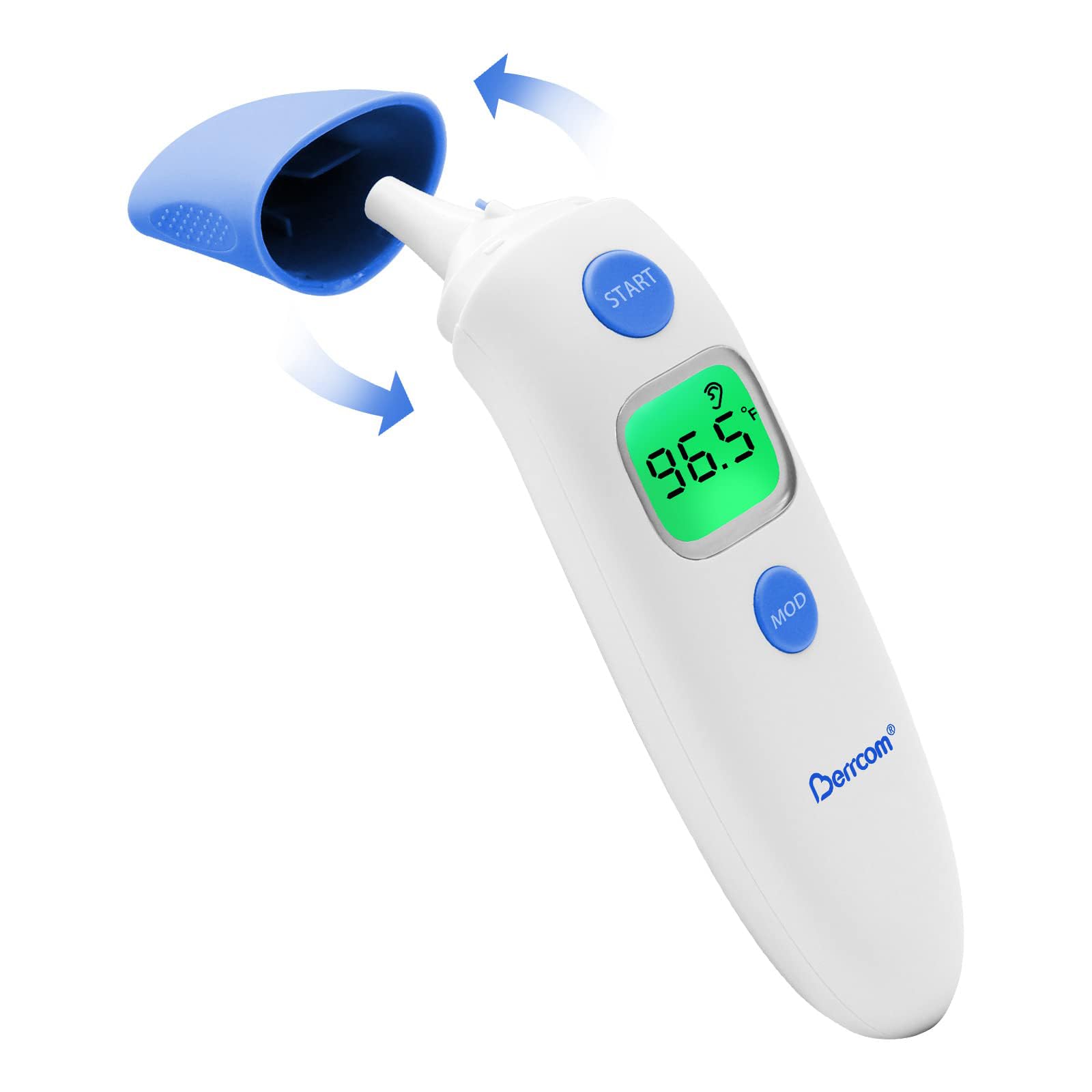
Berrcom ET003 3-in-1
Key Features
- Modes: Ear, forehead, object
- Memory: 20 readings
- Display: Color-coded backlight
- Response time: 1 second
- Price: Midrange
One thermometer, three jobs: with the probe cover off, the Berrcom reads an ear; with the cover on, a forehead; a third mode reads bathwater, a bottle, or the room. That flexibility is the whole pitch, and we think it is the right first thermometer for a household that cannot agree on a method. The body is light plastic with a simple two-button layout — nothing premium, nothing flimsy.
The color-coded backlight is the part we appreciate most. Green, yellow, and red tell you what you are looking at before you have parsed the digits, which matters when you are half awake. Twenty stored readings let you see whether a fever is climbing or breaking, and a one-second read is fast enough that a toddler does not have time to mount a protest. The 30-second auto-off keeps the batteries alive in a drawer between illnesses.
Where it needs care is the forehead mode. A scan across the brow reads the skin, so a drafty room, a hat, or a sweaty flush can move the number; use it for a quick look and take the ear reading when you need a number you will act on. The single probe cover lifts off and presses back on, so there is nothing separate to lose in a dark room — a small thing that matters more than it should at three in the morning.
Pros
- Three modes: ear, forehead, and object
- Color-coded backlight readable half asleep
- One-second readings and auto-off battery protection
Cons
- No storage pouch or case in the box
The one we hand to a household that wants a single device — ear for the toddler, forehead for a sleeping child, object mode for the bath — at a midrange price.
Best for Overnight Checks
iProven DMT-77
Key Features
- Alert: Silent vibration
- Modes: Ear, non-touch forehead
- Memory: 20 readings
- Warranty: 2 years
- Price: Midrange
The loudest thing in a sick child’s room at two in the morning is usually the thermometer’s beep — the reading you wanted, announced to everyone. The iProven DMT-77 confirms with a vibration instead, and once you have taken a temperature next to a sleeping baby you notice every beep the other units make.
The rest of it holds up. Ear mode is the medical-grade reading and the one to trust, while a forehead mode handles a sleeping child without touching them. One button runs the whole thing, the color indicator gives you the fever band at a glance, and 20 readings of memory cover about a day of checks. The two-year warranty is the longest of any pick here, which counts for something in a category where units stop working.
What the Braun adds for the extra money is age-adjusted thresholds; whether that is worth the jump depends on whether there is an infant in the house. Otherwise this is the quietest, simplest thermometer here to run one-handed in the dark, and the vibration alert is the reason it stays within reach of the crib rather than in a drawer downstairs.
Pros
- Silent vibration instead of a beep
- Two-year warranty, the longest here
- Ear and non-touch forehead in one button
Cons
- Forehead mode is an indicative scan, not a medical-grade read
Our pick for night checks: the confirmation is a silent vibration, so a baby who has finally gone down stays down.
Best for Multi-Day Fever Tracking
GoodBaby AOJ-20B
Key Features
- Modes: Ear, forehead, object
- Memory: 40 readings
- Display: Color-coded backlight
- Age settings: Adjustable by age
- Price: Budget
A fever that lasts three days needs a record, not a single number. The AOJ-20B holds 40 readings and lets you scroll back through them, which is the difference between she has been warm since Tuesday and a timeline you can hand to a nurse.
Around that it covers the basics well: ear, forehead, and object modes, age settings so the fever bands shift with the child, a display that turns green, yellow, or red as the reading climbs, and a one-second result. A pouch comes in the box, which stops being trivial the first time you are hunting for a thermometer in a diaper bag.
The manual is the weak spot. The modes and age settings take a few minutes of pressing to sort out, and the instructions do little to speed that up. Accuracy is decent rather than exceptional, so when a number is going to decide whether you call the pediatrician, confirm it with a second reading instead of acting on one pass. At this price it is the best-equipped thermometer here for following a fever over several days, and the 40-reading history is the reason.
Pros
- Forty stored readings for a multi-day fever
- Age settings shift the fever bands
- Color-coded display readable at a glance
Cons
- Thin instructions slow mode and age setup
- Accuracy is good, not exceptional
Our pick when you are following a fever across days: 40 stored readings, age settings, and a color screen you can read half asleep.
Best for Backup and Travel
GoodBaby FC-IR100

Key Features
- Modes: Ear, forehead, object
- Memory: 35 readings
- Display: 3-color backlight
- Response time: 1 second
- Price: Budget
Two thermometers beat one, and the FC-IR100 is the cheapest route to that: an ear probe, a forehead mode, and an object mode in a light black body that disappears into a diaper bag. We keep it as the second unit rather than the only one, and that is the role it is good at.
It is not stripped down. You get 35 stored readings, a backlight that changes color with the reading, a mute setting for a sleeping child, and a one-second result. The buttons are large, the shape is easy to hold, and the whole thing weighs 66 grams — light enough to forget it is in the bag until you need it.
The compromise is the reading itself. Against the other ear-capable picks here, its accuracy is middling at best, and a number that moves between passes is the last thing you want from the thermometer you are relying on at midnight. Treat its result as a cue rather than a verdict: it is good for knowing whether a child is worth waking, not for the decision you build a night around. As the backup already in the bag when you are caught out, it does what its price promises.
Pros
- Least expensive ear-and-forehead unit here
- Thirty-five readings and a color backlight
- Light body that suits a diaper bag
Cons
- Middling accuracy against the rest of this group
We treat it as the spare: the least expensive ear-and-forehead unit here, and the one that lives in the diaper bag instead of on the shelf.
Best for One-Handed Mode Changes
Alcedo AE174

Key Features
- Modes: Adult forehead, child forehead, ear, object
- Memory: 20 readings
- Warranty: 1 year
- Probe cover: Magnetic, removable
- Price: Midrange
The probe cap on the Alcedo is held by a magnet, and the detail makes sense the first time you work it with a toddler on your hip: pop the cap off for ear mode, snap it back for a forehead scan, and nothing goes rolling under the sofa. Four modes in all, including separate adult and child forehead settings and an object mode for a bottle.
The rest is thoughtful in the same practical way. The backlit numbers are big enough to read without your glasses, there is a silent mode, and it stores 20 readings. At 4 inches long and 4.8 ounces it is the smallest of the full-featured units here, and it comes with batteries, a pouch, and a one-year warranty.
Consistency is where it gives ground. Of the ear-capable picks here, this one has the weakest record on repeatable numbers, and a forehead reading that runs warmer than the ear is the kind of thing that sends you hunting for a second thermometer at the worst possible moment. Longevity is the other open question, and the one-year warranty is shorter than the iProven’s, so keep the receipt. Buy it for how it works in your hand, not for the number it gives you.
Pros
- Magnetic probe cover switches modes one-handed
- Four modes, including separate adult and child forehead
- Oversized backlit numbers and silent mode
Cons
- Repeat readings can vary between passes
- One-year warranty, shorter than the iProven’s
The best one-handed design here — a magnetic cap flips between ear and forehead — though its readings are the least consistent of our picks.
How We Tested a Dozen Ear Thermometers
We started with about 40 models on the shelf at major retailers and cut the list to 12, keeping a spread of price points and the features shoppers actually compare: dual ear-and-forehead modes, fever alerts, age settings, memory recall, and a mute option. Anything that shipped without batteries or a Fahrenheit/Celsius switch got noted rather than dropped — those extras show up on the receipt.
Testing ran six months in a house with a newborn, a preschooler, and two adults who kept catching whatever came home. We timed each reading from button press to number, then took three consecutive ear readings per person to see how far they drifted. The best held within a couple of tenths of a degree; the weakest swung half a degree or more — the difference between calling the pediatrician and going back to bed.
Since these live in a drawer and come out in the dark, we also ran them with the lights off: whether the backlight was readable without waking anyone, how loud the beep was, and whether mute mode still showed the result clearly. We logged memory recalls to see how easily a 3 a.m. reading could be pulled up the next morning, and we switched between age settings on each model to check whether a half-asleep adult could do it without the manual.
Each one got dropped from counter height, wiped after every use, and packed into a diaper bag for weekend trips, where we checked whether the pouch protected the probe and how long the batteries held. Portability is more than size — it’s whether the caps, covers, and instructions survive a bag. At the end we weighed price against what came in the box, because a thermometer that needs covers you can’t find is the most expensive one in the drawer.
How to Choose an Ear Thermometer
An ear thermometer is only as accurate as its aim, which is why the placement aids on the front of these devices matter more than the feature list on the back of the box.
What an Ear Reading Actually Measures
A tympanic thermometer reads the infrared heat coming off the eardrum, which sits close to the body’s core and shares its blood supply. That is why a properly taken ear reading tracks a true fever more closely than a scan across the forehead. The catch is access: the probe has to point at the eardrum, angled gently back and up toward it, without being forced.
Anything that interferes with that line of sight pulls the number down — a probe held at an angle, a chilly ear canal after a walk outside, or a canal narrowed by positioning. If you take one thing from this guide, take this: two thermometers with identical sensors will disagree if one of them was aimed badly, and no feature on the box fixes that.
Placement Aids Are the Accuracy Feature
Since aim decides the reading, the aids that help you aim are worth more than an extra mode. A stability indicator — Braun calls its version ExacTemp — waits until the probe is seated before it confirms with a light and a beep, which is the difference between a number you trust and a number you take twice. A pre-warmed tip stops the probe from cooling the canal as it reads.
On an adult who can sit still, none of that matters much. On a child who twists away, it matters more than anything else on the spec sheet, and it is the main reason to spend more than the entry price in this category.
Ear Only, or Ear Plus Forehead?
Hybrids add a forehead mode, and the appeal is real: a no-touch scan does not wake a sleeping baby and is faster on a child who will not accept anything in their ear. The makers are fairly honest about the split — one of these units labels its forehead mode an indicative reading and its ear mode the medical-grade one, and that ranking holds across the category. Use the forehead number for a look and the ear number for a decision.
An ear-only unit has fewer modes to fumble at three in the morning and usually a simpler button layout. If the thermometer only ever goes in ears, buy the simpler thing and put the savings toward a stability indicator; if one device has to serve a baby, a partner, and a grandparent, a hybrid earns its place.
Night Checks and the Memory You Will Want
Three things do the work after dark: a backlit display, a muted or vibrating confirmation, and enough memory to see whether a fever is climbing or breaking. Memory matters more than it sounds — 20 readings covers roughly a day of checks, 40 covers a long weekend, and the numbers scroll off the back of the list once it fills.
Buy the backlight if you check temperatures without turning on a light, and buy the silent confirmation if anyone in the house wakes at the sound of a beep. Those two details decide more 2 a.m. experiences than a decimal place of resolution.
Frequently Asked Questions
Do Braun ear thermometers need replacement lens filters?
Yes. The Braun models use a disposable filter over the probe, which keeps the tip clean and lets you pass the same thermometer between family members without worrying about what was in whose ear.
It is the only recurring cost in this category, so order a box with the thermometer rather than discovering you are out during a fever. The hybrid units here wipe clean and cost nothing after purchase.
Is an ear thermometer accurate for a newborn?
Ear thermometers are generally sold for use from about a month old, because a newborn’s canal is narrow and easy to miss with a probe. Below that age, the reading your pediatrician will want is a rectal one.
Check the minimum age on the unit you own before the first fever rather than at the first fever. If your baby is younger than the label allows, take the method your pediatrician recommends.
Can I use an ear thermometer to check bathwater or a bottle?
On a unit with an object mode, yes — the Berrcom, both GoodBaby models, and the Alcedo all include one. It reads the surface temperature of what you point it at, not a body, so it will not tell you whether a child has a fever.
Switch to object mode first, then aim; leaving a unit in ear mode and pointing it at water is how people get a number that makes no sense.
How should I clean the probe?
Wipe the probe with an alcohol swab and let it dry completely before the next reading. None of these units are meant to be rinsed or dunked, and a wet tip will read low.
On the Braun models the filter does most of the work, so replace it rather than washing it. A dirty or reused filter is the simplest way to turn an accurate thermometer into a confusing one.
Final Verdict
The Braun ThermoScan 7 is the ear thermometer we point most families to. Age Precision turns a raw number into a verdict that matches the child in front of you, and the ExacTemp light is the difference between a reading you trust and a second attempt.
If your checks happen at 2 a.m. beside a sleeping baby, the iProven’s silent vibration is worth the switch. If you want ear and forehead in one unit for a whole household, the Berrcom covers both for less.
