This post contains affiliate links. We may earn a small commission when you buy through our links — at no extra cost to you.
A baby’s review of a formula arrives about an hour after the bottle — in the burp, the diaper, and whether the house settles back to sleep at 3 a.m. What separates a good one from a bad one barely shows on the label: how fast the powder dissolves when you’re half awake and working one-handed, whether the smell turns your stomach, and whether your baby’s gut tolerates it for a week straight. The right formula does that quiet work without turning every evening into a fight against gas and spit-up.
Over the past six months, my team and a panel of 15 families have kept 12 formulas in rotation — powder and ready-to-feed, standard and sensitive — and the differences came down to tolerance more than marketing. Here’s what seasoned parents know: switching brands every few days makes it impossible to tell what’s working, because a baby’s gut needs a week or more to adjust. The picks below are the ones that earned a repeat buy, whether your baby spits up after every feed or drains a bottle in four minutes.


Best for Everyday Infant Feeding
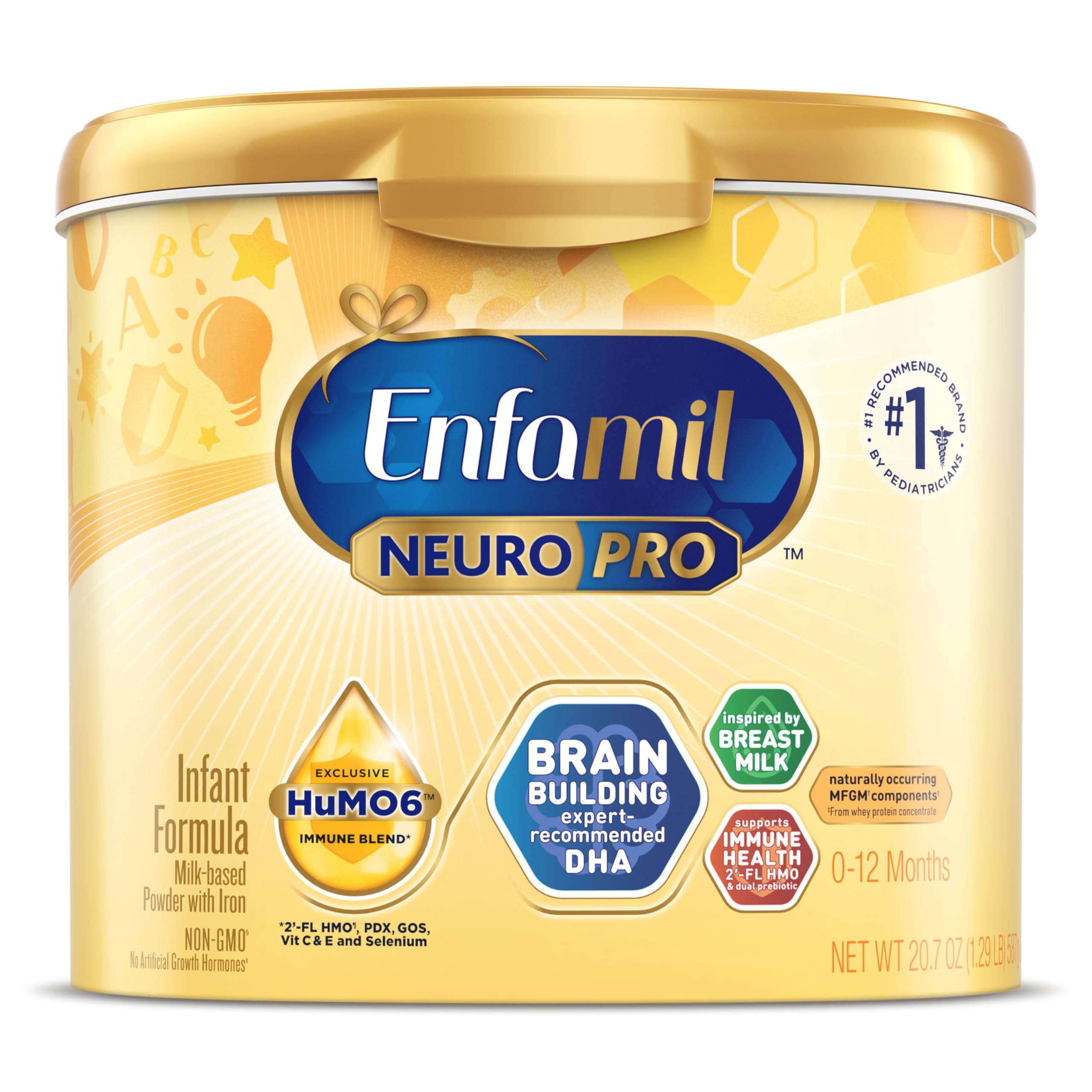
Enfamil NeuroPro
Key Features
- Age: 0–1 years
- Form: Powder
- Can size: 20.7 oz
- Key ingredients: MFGM and DHA
- Price: Midrange
The MFGM and DHA blend is the reason Enfamil NeuroPro sits at the top of this list. It is a standard infant formula for a healthy baby, not a specialty product, and that is exactly why it earns the default spot: most families need a dependable everyday powder, and this one gets the fundamentals right. We like that the brain-building claim is tied to a specific pair of ingredients rather than a vague promise, and the 20.7-ounce can is easy to store and scoop.
Mixability is another practical strength: the powder dissolves into water without the stubborn clumps that can clog a nipple, so a hungry baby is less likely to end up with a bottle that needs another round of shaking. That matters more than it sounds, because a lumpy bottle is a fast way to make a baby refuse a feed. We also appreciate that the can is a manageable size for a first try; you are not committing to a club-store tub before you know whether your baby takes to it.
Most babies tolerate it well, and the formula has a long track record with pediatricians. If your baby has a diagnosed milk-protein allergy or frequent spit-up, this is not the formula to force; start with a specialty pick instead. For a healthy baby without those issues, it is the low-drama choice we keep coming back to.
Pros
- MFGM and DHA in one standard formula
- Mixes smoothly with less clumping
- Broadly tolerated by babies
Cons
- Some babies may become constipated
Enfamil NeuroPro is the standard formula we recommend first for a healthy infant, because it mixes easily, is widely tolerated, and pairs DHA with MFGM.
Best for Prebiotic-Rich Daily Feeding
Similac 360 Total Care
Key Features
- Form: Powder
- Can size: 20.6 oz
- Growth hormones: No artificial growth hormones
- Prebiotic blend: 5 HMO prebiotics
- Price: Midrange
The five-HMO prebiotic blend is the reason to look at Similac 360 Total Care. It is a standard powder designed to support immune and digestive health, and the blend is structurally identical to five HMOs found in breast milk, which is a more specific story than most standard formulas tell.
We rank it just behind Enfamil NeuroPro for a healthy baby because the two cover similar ground: both are mainstream powders with DHA and a broad nutrition panel. The difference is emphasis. If prebiotics are the piece you care about, this is the one; if you want the MFGM and DHA combination, go with NeuroPro. The 20.6-ounce can is easy to handle, and the powder is non-GMO with no artificial growth hormones.
Mixability is where it can stumble. Some bottles need a hard shake and a little patience, and the powder can leave a film if you are rushed. That is a setup issue rather than a dealbreaker: shake harder and give it a minute before you judge the bottle. It is also one of the few formulas here that is explicitly EBT-eligible in select stores, which is a practical detail for families who use SNAP benefits.
Pros
- Five HMO prebiotics in a standard powder
- No artificial growth hormones
- EBT-eligible in select stores
Cons
- Some babies get gas or reflux
Choose Similac 360 Total Care if you want a standard powder built around five HMO prebiotics, but watch for gas if your baby is sensitive.
Best for Milk Protein Allergy
Similac Alimentum
Key Features
- Form: Ready-to-feed
- Protein: Hypoallergenic milk protein
- Immune ingredient: 2′-FL HMO
- Price: Premium
Alimentum is a different kind of purchase: a case of ready-to-feed bottles rather than a can of powder. It is the formula we recommend when a baby has a diagnosed milk-protein allergy or colic tied to protein sensitivity, because the milk protein is broken into tiny pieces that are easier to tolerate. This is not a casual switch for a fussy week; it is a specialty tool for a specific problem.
The 2′-FL HMO is the detail that separates it from older hypoallergenic formulas. It is an immune-nourishing ingredient, and the formula is designed to start reducing colic symptoms due to protein sensitivity within 24 hours in most infants. The ready-to-feed bottles are genuinely convenient: no scooping, no mixing, and an 8-ounce bottle is easy to portion for a night feed or a diaper bag.
This only makes sense when there is a real need. If your baby is thriving on a standard formula, do not move to this one just because it sounds gentler; the specialty design is not a generic upgrade. For the family who needs it, the ready-to-feed convenience and the targeted protein design are hard to beat, and the 24-pack format removes one more decision from a stressful week.
Pros
- Hypoallergenic milk protein for allergy and colic
- Ready-to-feed bottles need no mixing
- Includes 2′-FL HMO
Cons
- Premium price
- Can cause constipation in some babies
Similac Alimentum is the one we recommend for a diagnosed milk-protein allergy or protein-related colic, when the ready-to-feed format is worth the premium.
Best for Sensitive Tummies
Good Start Gentle Pro
Key Features
- Form: Powder
- Protein: 100% whey, hydrolyzed
- Can size: 32 oz
- Probiotic: B. lactis
- Price: Budget
The protein is the story here: Good Start Gentle Pro uses 100% whey protein, and a two-step hydrolysis process makes those proteins 10 times smaller than intact cow’s milk proteins. That is the design behind its sensitive-tummy positioning, and it is why we reach for it when a baby is gassy, fussy, or struggling with a standard formula.
We rank it as the best sensitive-tummy powder in this group because it pairs that hydrolyzed whey with a probiotic, B. lactis, and a broad nutrition blend that includes DHA and HMOs. The 32-ounce can is also a practical advantage: it lasts longer than the standard 20-ounce cans here, so it costs less per prepared ounce and means fewer reorders. For a breastfed baby transitioning to formula, the 100% whey profile is a sensible first step.
It is not a hypoallergenic formula, so a diagnosed milk-protein allergy still calls for Alimentum or another extensively hydrolyzed option. If gas and fussiness are the main issue and your baby does not have a diagnosed allergy, this is the powder we reach for first.
Pros
- 100% whey, hydrolyzed protein for sensitive tummies
- Probiotic B. lactis included
- 32-ounce can stretches further
Cons
- Smell is stronger than some formulas
Good Start Gentle Pro is our pick for a sensitive-tummy powder, with hydrolyzed 100% whey protein and a large can that stretches further.
Best for Spit-Up and Reflux
Enfamil A.R.

Key Features
- Form: Powder
- Can size: 19.5 oz
- Key nutrients: DHA and dual prebiotics
- Special feature: Rice starch for spit-up
- Price: Premium
A.R. is not the formula for a baby who spits up a little after a big feed. It is for frequent spit-up or reflux that is interfering with feeds and sleep, and that distinction matters because this is a thicker, rice-starch formula with a specific job.
The rice starch is clinically proven to reduce frequent spit-up by over 50%, and the formula still carries DHA, dual prebiotics, and complete nutrition for the first year. For a baby who is losing a meaningful amount of every feed, that combination is more useful than a generic gentle formula. It is also a powder, so you keep the flexibility of mixing only what you need.
The texture is the catch. A.R. is thicker and foamier than a standard powder, and a slow-flow nipple can struggle with it; a faster-flow nipple often fixes the feed. We rank it as the best spit-up pick in this group because it addresses the cause rather than just the symptom, but it is a narrow tool. If your baby has occasional spit-up and is gaining well, start with a standard formula and save this one for a real reflux pattern.
Pros
- Rice starch clinically proven to reduce frequent spit-up
- DHA and dual prebiotics included
- Targets reflux rather than masking it
Cons
- Can cause constipation in some babies
Enfamil A.R. earns a place for frequent spit-up and reflux, though its thicker texture needs a faster nipple and can constipate some babies.
How We Tested the Best Baby Formulas
We started by rounding up every first-year formula we could find on the shelves of two national retailers and our local grocery, then sorted them by protein base, carbohydrate source, iron and DHA levels, and price per prepared ounce. Anything with a recent recall or unreliable stock got cut. That left 12 to actually use — powders and ready-to-feeds, standard and sensitive, cow’s-milk and reduced-lactose.
Those 12 went home with 15 families whose babies were already making a change, some on a pediatrician’s suggestion, some because their current formula was causing trouble. Each family committed to a full week on a formula before judging it, and we asked them to make bottles the way they really do: at 2 a.m. in a dark kitchen, in the diaper bag on the way to daycare, in a four-ounce top-up after a nap.
What we watched for was concrete. We timed how long each powder took to dissolve at the temperature on the can and noted whether it clumped in the bottle neck or foamed up past the nipple line. Families tracked how much of each bottle got finished and whether the baby fussed at the halfway mark, plus spit-up, gas, and next-morning diapers in a shared log. A few of us tasted a drop of every mix for a metallic or cloying finish, and we did the math on cost per prepared ounce against how often a can actually got finished before it went stale. The highest scorers weren’t the priciest — they were the ones that mixed smooth, stayed consistent from can to can, and left babies calm and regular within the week.
How to Choose a Baby Formula
The right formula is the one your baby tolerates and that fits your budget and preparation routine, not the one with the longest ingredient list.
Match the formula type to the feeding problem
Start with what is actually happening at feeds. A healthy baby who is growing well and comfortable after bottles usually does best on a standard formula like Enfamil NeuroPro or Similac 360 Total Care. If gas, fussiness, and loose or hard stools are the pattern, a partially hydrolyzed gentle formula such as Good Start Gentle Pro is the next step. For frequent spit-up or reflux, a rice-starch formula like Enfamil A.R. is designed for that job. A diagnosed milk-protein allergy or colic tied to protein sensitivity calls for a hypoallergenic formula such as Similac Alimentum, not a gentle one. We do not recommend moving to a specialty formula without a clear pattern and pediatric guidance, because the cost and the taste change are real.
Look at protein processing, not just the front of the can
Protein is the clearest dividing line between standard, gentle, and hypoallergenic formulas. Standard formulas use intact milk protein; gentle formulas use partially hydrolyzed protein, which is broken into smaller pieces to make digestion easier. Good Start Gentle Pro goes further with 100% whey and a two-step hydrolysis process that makes the proteins 10 times smaller than intact cow’s milk proteins. Hypoallergenic formulas such as Alimentum break the protein down much further, which is why they are for a diagnosed allergy rather than a casual sensitive-tummy switch. If your baby is gassy but not allergic, start with a gentle formula; if there is a diagnosed allergy, ask about hypoallergenic.
Choose powder or ready-to-feed based on your week
Powder is the better default for most families: it costs less per prepared ounce, stores easily, and lets you mix only what you need. Ready-to-feed bottles earn their premium when you are traveling, packing a diaper bag, or doing night feeds where scooping and shaking are the last things you want to do. Similac Alimentum is the clearest example here: the case of ready-to-feed bottles is a genuine convenience for a specialty formula. The trade-off is shelf space and upfront cost. If you use powder, keep the can dry and follow the mixing ratio exactly.
Expect a texture difference with reflux formulas
Thicker formulas behave differently in a bottle. Enfamil A.R. uses rice starch to reduce frequent spit-up, and that makes the formula thicker and foamier than a standard powder. A slow-flow nipple can collapse under it, so you may need to size up; that is a setup issue, not a reason to abandon the formula. Powder formulas can also clump if you rush the shake, and some standard powders leave a film on the bottle. Mix with the water temperature the can recommends, shake hard, and check the nipple before a feed. If a bottle takes much longer than usual, adjust the nipple before you blame the formula.
Compare the can size and the cost per prepared ounce
The sticker price is only half the story. A 32-ounce can like Good Start Gentle Pro lasts longer than a 20-ounce can, so it can be the better value even when the upfront price looks similar. Specialty formulas cost more because the protein processing is more involved, and ready-to-feed cases cost more again. We look at cost per prepared ounce, how often we need to reorder, and whether the can size matches how fast your baby goes through it. If you use SNAP benefits, check eligibility before you settle on a brand; Similac 360 Total Care is explicitly EBT-eligible in select stores.
Frequently Asked Questions
Can I switch formula brands without a transition?
Yes, but a gradual switch is easier on a sensitive baby. Mix a small portion of the new formula with the old one and increase the ratio over several days, or offer one bottle of the new formula and watch for gas, stool changes, or spit-up. If your baby has a diagnosed allergy or reflux, make the switch with your pediatrician’s guidance rather than experimenting.
How long can I keep an open can of powder formula?
Follow the use-by window printed on the can, and write the opening date on the lid so you do not have to guess. Keep the lid tight, store the can in a cool, dry place, and do not put powder in the refrigerator. If the powder smells off or has clumped beyond a normal scoop, throw it out rather than risk a feed.
Do I need to warm ready-to-feed formula?
No. Ready-to-feed formula can be served at room temperature, and warming is a preference rather than a requirement. If you do warm it, place the bottle in a bowl of warm water and test a drop on your wrist; do not microwave it, because hot spots can burn a baby’s mouth. Discard whatever is left in the bottle after a feed.
Can I use toddler milk instead of infant formula?
No. Infant formula is designed to be the main source of nutrition for babies up to 12 months, while toddler milks are supplements for children over 12 months and do not match infant needs. If your baby is approaching the first birthday, ask your pediatrician about the transition rather than switching early.
Final Verdict
Start with Enfamil NeuroPro if your baby is healthy and comfortable on a standard formula; it has the strongest mix of evidence, mixing ease, and everyday value here. If your baby needs a specialty formula, the decision changes: Similac Alimentum for a diagnosed milk-protein allergy, Enfamil A.R. for frequent spit-up, and Good Start Gentle Pro for sensitive tummies. Similac 360 Total Care is the standard alternative when prebiotics are the priority.
