This post contains affiliate links. We may earn a small commission when you buy through our links — at no extra cost to you.
You fill your cart with toys labeled ‘Montessori,’ only to find they break, chip, or fail to hold your child’s attention past a week. The real secret isn’t the label—it’s whether the toy invites open-ended, repeatable play with materials that survive drops, bites, and dishwashers.
This guide focuses on the toys that grow with your child, from a first sensory companion for tummy time to a practical-life cleaning set for a three-year-old. Every pick puts durable construction and self-directed learning above marketing gloss.
You’ll notice a trade-off between a toy that packs multiple skill-building modes into a single kit and a simpler classic that adapts everywhere from the bath to the car. Both paths work, and the right choice depends on whether you value deep, layered learning or maximum versatility across scenarios.




Best for Multi-Skill Learning
Farm Animals Set
Key Features
- Age Range: 12–36 months
- Material & Durability: Plastic barns, vinyl animals
- Developmental Focus: Counting, sorting, pretend play
- Pieces & Play Style: 20 pieces, finger puppets + sorting
- Price: Mid-Range
The farm set bundles number posting, color sorting, and puppet play into 20 pieces that keep toddlers engaged across multiple skill levels. Numbered barns and dot markers introduce counting and matching naturally, while the vinyl animals become finger puppets for storytelling. The tough construction handles drops and chewing without cracking.
This set suits toddlers 12–36 months who are ready for structured but self-directed play. The plastic barn edges on some units arrive with slight sharpness; a quick parental check and light sanding resolves the issue, making it safe for supervised use. Children who still mouth objects heavily may prefer toys without smaller parts.
Pros
- Finger puppet animals let toddlers practice counting, color matching, and pretend play with one set
- Bright numbered barns and dot markers make early math feel like a game
- Tough plastic and vinyl construction holds up to drops and chewing
Cons
- Barn edges on some units may need light sanding before play
A single kit that transitions from number posting to color sorting and finger puppet storytelling – real learning without the fluff.
Best for Stacking & Bath
Stack & Count Cups
Key Features
- Age Range: 6–24 months
- Material & Durability: BPA-free plastic
- Developmental Focus: Stacking, water play, grasping
- Pieces & Play Style: 8 cups, stacking & water
- Choking Risk: No
- Price: Budget
These stacking cups blend highchair stacking with bath pouring and outdoor water-table play, making them a multi-environment option for parents who want one toy that works in several settings. The numbered bottoms introduce early counting during dry play, while drainage holes turn bath time into a pouring activity. The cups are noticeably smaller than standard stacking cups — ideal for tiny hands under 18 months, but older toddlers may lose interest once mastering the basic stack.
Pros
- Durable BPA-free plastic holds up to bath, outdoor, and highchair use.
- Numbered bottoms add early counting practice to stacking play.
- Rounded edges and easy-rinse design suit babies and messy play.
Cons
- Cups are smaller than standard; older toddlers may outgrow the stacking challenge quickly.
A budget-friendly set that works across multiple play environments, best suited for babies under 18 months who are still developing stacking skills.
Best for Practical Life
Dust Sweep Mop Set
Key Features
- Age Range: 3–5 years
- Material & Durability: Wood, soft bristles
- Developmental Focus: Practical life, gross motor
- Pieces & Play Style: 6 pieces, real cleaning tools
- Choking Risk: No
- Price: Mid-Range
Where threading beads build pincer grip, this set channels a toddler’s urge to imitate into real chores — sweeping, dusting, and mopping with child-sized wooden tools. It suits families who want toddlers engaged in daily routines, though a few minutes of setup may be needed if the mop knot arrives loose. The compact storage stand keeps pieces accessible and reinforces order, a core Montessori principle.
Pros
- Durable wood construction lets toddlers sweep and mop alongside adults
- Fosters independence and practical life skills through realistic role play
- Child-sized tools and a storage stand that keep the set organized and accessible
Cons
A role-play set that turns clean-up into shared activity — ideal for toddlers who want real tools, not just pretend.
Best for Fine Motor
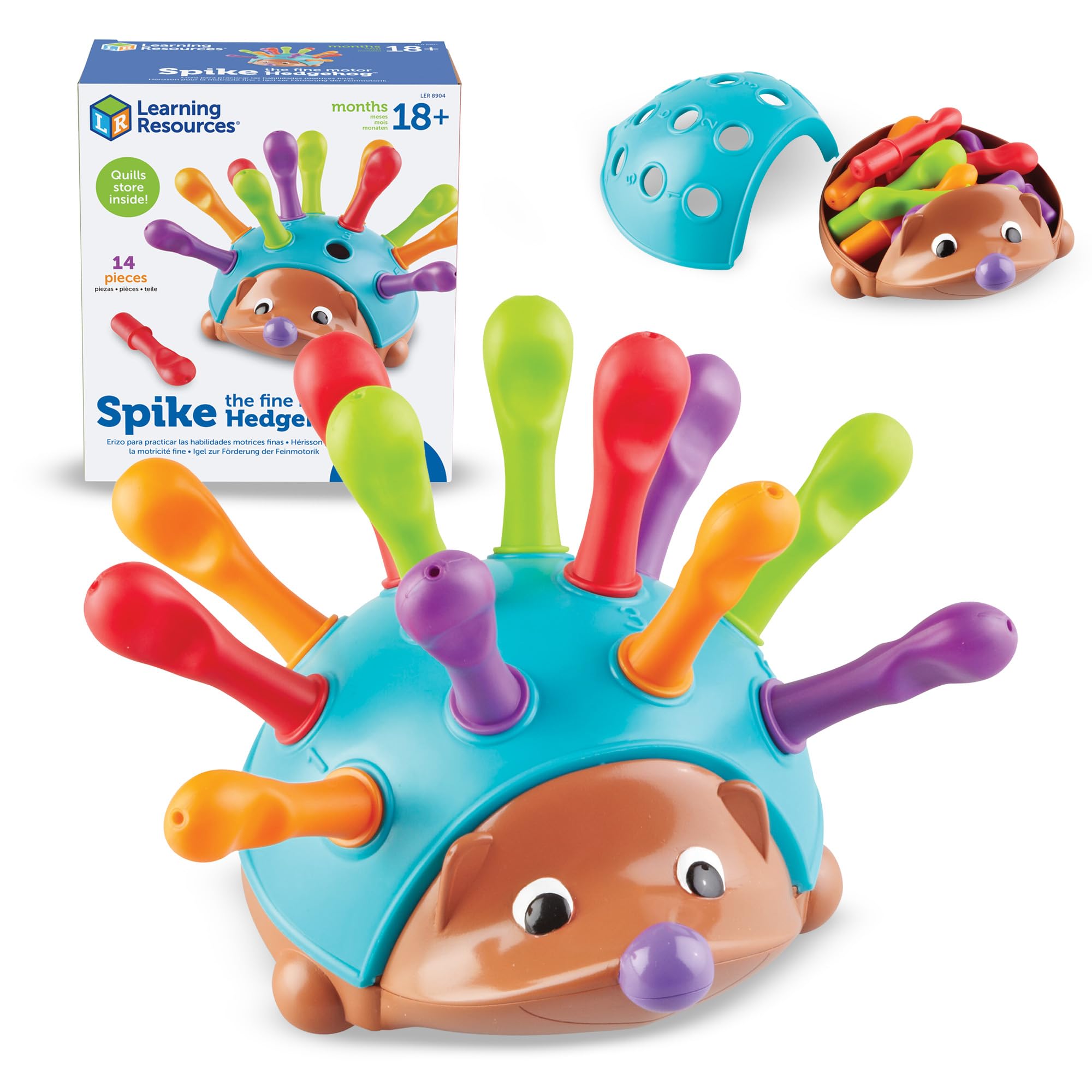
Spike Hedgehog
Key Features
- Age Range: 18+ months
- Material & Durability: Plastic
- Developmental Focus: Fine motor, color/number
- Pieces & Play Style: 12 pieces, posting & storage
- Choking Risk: No
- Price: Budget
Where the top pick layers in sorting, color matching, and pretend play, Spike strips things back to a single, well-executed fine motor task: push the chunky quills into the hedgehog’s shell, pull them out, and do it again. The numbered, color-coded pegs give just enough cognitive structure for early counting without turning the activity into a formal lesson. Toddlers naturally settle into the repetitive posting loop, building grip strength and hand-eye coordination with each jab.
This is a toy for the 18–30 month crowd who are working hard on pincer grasp, whether at home or in early intervention sessions. The self-storing shell makes it a weekend bag staple. One boundary: the plastic quills can bend or snap if chewed with real determination, so Spike isn’t the right fit for heavy mouthing phases.
Pros
- Develops pincer grasp and hand strength through repeated posting
- Holds toddler attention with simple, self-directed looping play
- Self-storing shell contains all 12 quills for travel
Cons
- Quills can bend or snap with aggressive chewing
For parents who want a straightforward fine-motor tool that travels effortlessly and holds a toddler’s focus, Spike is a smart, affordable pick — just plan to swap it out during bite-heavy teething spells.
Best for Teething & Sensory
Sensory Teether
Key Features
- Age Range: 0–18 months
- Material & Durability: BPA-free silicone, ABS plastic
- Developmental Focus: Sensory, teething, grasping
- Pieces & Play Style: Multi-textured teether
- Price: Budget
With twisting rings that click, a gentle rattle, and multiple silicone textures, this compact toy keeps teething babies occupied while providing the varied oral stimulation they crave. The lightweight, easy-to-grip build encourages hand coordination, and the silicone stands up to determined chewing.
The teething balls are intentionally petite to keep the whole unit pocket-sized, but that means some babies may struggle to get them positioned comfortably in the mouth. This suits parents who need a grab-and-go calmer for short outings, rather than a primary teether for all-day gnawing.
Pros
- Multiple textures and sounds keep babies engrossed and soothe sore gums.
- Easy for tiny hands to grip and maneuver, encouraging motor development.
- Made from safe, BPA-free silicone that withstands heavy chewing.
Cons
A budget-friendly, travel-ready sensory teether that packs a surprising amount of stimulation into a tiny frame—best as a supplemental on-the-go toy, not a mainstay for babies who prefer larger mouth contact.
Best for Sorting & Pretend
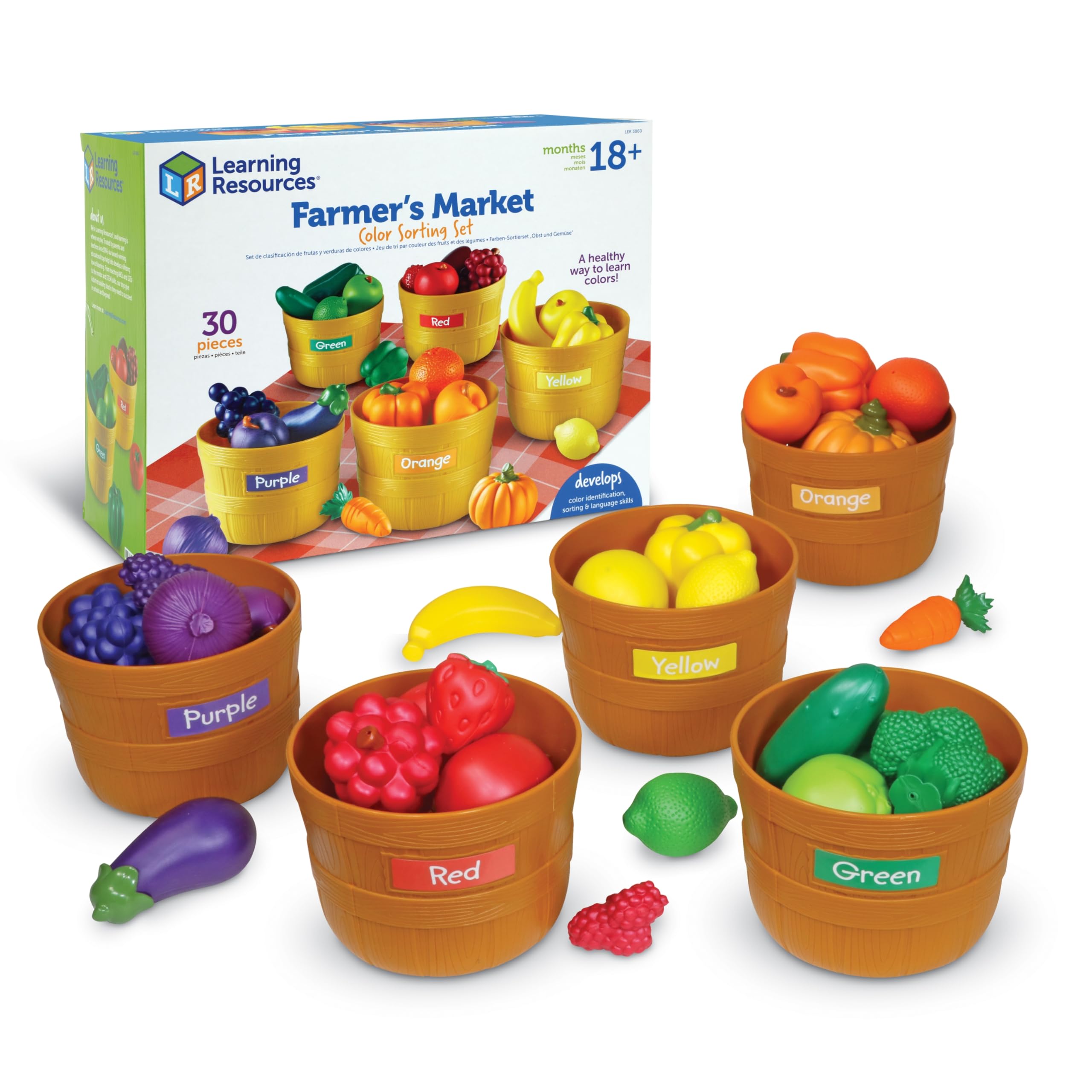
Farmers Market Sorting Set
Key Features
- Age Range: 18+ months
- Material & Durability: Soft rubber-like plastic
- Developmental Focus: Sorting, colors, pretend
- Pieces & Play Style: 30 pieces, sorting baskets
- Choking Risk: Small fruits, under 2 risk
- Price: Mid-Range
Unlike the fine motor hedgehog toy, this set builds learning through pretend — toddlers sort vibrant produce by color, name foods, and later stage market scenes. Five labeled baskets reinforce color matching and vocabulary. The soft, durable material holds up to drops and occasional chewing.
The tiny berries and grapes pose a mouthing risk for children under 2, so plan to remove them initially. This boundary aside, the set grows with a child, rewarding families who want a sorting toy that transitions into open-ended kitchen play.
Pros
- Realistic, vibrant fruits and vegetables spark sorting and pretend kitchen play
- Soft, durable material survives drops and teething
- Evolves from color matching to imaginative market scenarios, offering years of use
Cons
- Smallest berries and grapes can be a mouthing hazard for children under 2; may need temporary removal
A durable sorting set with unmatched realism for pretend play — ideal when you’re willing to trade a few months of worry-free use for years of imaginative learning.
Best for Lacing & Patterns
Lacing Beads
Key Features
- Age Range: 3+ years
- Material & Durability: Wood
- Developmental Focus: Fine motor, patterns
- Pieces & Play Style: 32 pieces, lacing
- Choking Risk: Small beads, 3+
- Price: Budget
Unlike cleaning sets designed for practical life role play, these lacing beads target fine motor precision and pattern creation. Thirty chunky wooden beads in varied shapes pair with two laces for open-ended threading that builds bilateral coordination. Some bead interiors feel rough and may snag laces, but smoothing with sandpaper or waxed cord prevents fraying. Best for preschoolers ready to thread and create sequences; not for children under 3 due to small parts.
Pros
- Bright, varied shapes support color and shape recognition without extra prompting
- Threading beads builds fine motor skills and bilateral coordination
- Chunky wooden construction is sturdy and comfortable for small hands to grip
Cons
- Inner bead holes can feel rough, causing laces to catch and fray over time
A classic lacing activity for preschoolers who need fine motor practice; the occasional rough bead hole is easily fixed, leaving behind a durable, screen-free toy that supports pattern and coordination skills.
Best for Travel Puzzle
Wooden Shape Puzzles

Key Features
- Age Range: 3–8 years
- Material & Durability: Wood, some plastic
- Developmental Focus: Spatial, patterns
- Pieces & Play Style: 36 pieces + 60 cards, pattern cards
- Choking Risk: Small pieces, 3+
- Price: Budget
Two durable tins hold 60 pattern cards and 36 colorful wooden shapes, encouraging independent puzzle solving on the go. Some sets arrive missing black/white or small geometric pieces—a quick inventory check and possible exchange resolves this. When complete, it sparks creativity without screens.
Pros
- Sparks open-ended creativity and independent spatial reasoning.
- Durable tins keep everything contained for car rides, waiting rooms, and trips.
Cons
- Sets may ship missing black/white and small geometric shapes, which are needed for many pattern cards.
Best for families who don’t mind doing a quick part check and are willing to exchange if needed — once complete, it’s a portable puzzle that builds spatial skills quietly in waiting rooms.
How to Choose
The single most important factor is whether a toy genuinely encourages open-ended, self-directed play rather than just mimicking the Montessori aesthetic.
Age Range
Age labels are guidelines, not guarantees. A toy marked 18+ months may still have small parts a heavy-mouthing toddler can choke on. Observe your child’s mouthing habits, not just the manufacturer’s number.
True Montessori toys adapt as skills develop. A set that starts as a stacking activity and later introduces counting or color sorting will outlast a single-function gadget. Look for ‘grows with the child’ design, not just a birthdate stamp.
Material & Durability
Wooden toys look beautiful but soft pine or rough edges can splinter after a few falls. Dense hardwoods and thick, BPA-free plastics often survive drops and bites better than painted or glued composites.
Check the finish: non-toxic, water-based paints without lead are essential. Many parents find that unpainted wood or silicone holds up better to chewing and repeated sanitizing. If it feels rough out of the box, sand it before use.
Developmental Focus
A toy that only wobbles or crinkles loses its appeal once the novelty fades. The strongest picks layer multiple goals—a sorting set that also teaches color naming and imaginative play.
Beware of vague labels like ‘sensory toy’ that mask one-note functions. Prioritize toys where a physical action directly leads to a learning outcome: threading beads to make a pattern, or pushing a broom to see dust move.
Piece Count & Open-Endedness
More pieces doesn’t always equal more play. A 100-piece block set can overwhelm a toddler, while a 6-piece cleaning kit inspires hours of dramatic role play. Open-ended toys—those without a single predetermined outcome—fuel creativity.
Stacking cups become bath scoops, nesting towers, and counting tools. A puzzle with fixed patterns, on the other hand, limits exploration. Choose toys that can be used in at least two distinct ways to extend their lifespan.
Choking Hazard Risks
Even if the box says 3+, small detachable parts like lacing beads or tiny play fruits can wind up in a baby’s mouth. A practical rule: if a piece fits through a toilet paper tube, keep it away from children under three.
Many Montessori sets include small components that need temporary removal until the child is past the intense oral stage. Inspect multi-piece toys immediately; missing parts not only break the educational function but can become a swallowing hazard.
FAQ
Why do my wooden pattern blocks slide around on the board instead of staying in place?
Smooth wooden shapes on glossy boards lack the friction to stay put. Placing a felt mat or non-slip shelf liner underneath reduces movement, but this is an inherent design trait of flat pieces on hard surfaces.
How can I keep a bead maze suction cup from falling over during tummy time?
Wipe both the suction base and the highchair tray or table with a damp cloth, then press firmly to remove air bubbles. If the surface is textured or curved, a thin silicone placemat can create a flat, grippy area.
What should I do if a wooden Melissa & Doug toy splinters or paint starts chipping?
Lightly sand the rough area with fine-grit paper and seal with a food-safe wax or oil. If chipping continues, discontinue use—frequent mouthing can worsen the damage and create safety concerns.
Is this farm animal sorting set safe for a 12-month-old who still puts everything in their mouth?
The plastic barns and vinyl animals are larger than typical choking hazards, but some barn edges may feel sharp fresh from the box. Supervise play and remove any tiny parts until mouthing decreases; a quick edge sanding eliminates the sharpness.
Why do my lacing beads snag the string, making it hard to thread them?
Rough inner holes on wooden beads can catch the lace. Run a piece of waxed string or a pipe cleaner through the beads to smooth the interior, or lightly sand the inside with rolled fine-grit sandpaper.