This post contains affiliate links. We may earn a small commission when you buy through our links — at no extra cost to you.
Soft sand is where a regular stroller goes to die. The wheels dig in, the frame shudders, and suddenly you’re carrying the baby, the beach bag, and the stroller back to the car. A true beach stroller is the difference between a relaxed walk to the water and a sweaty relay race with your gear. Over the past seven months, my team and I pushed eight strollers across soft sand, packed sand, and boardwalk planks to see which ones actually earn their keep.
Beach strollers live a double life: they need to float over sand on Saturday and fold small enough to fit in a crowded trunk on Sunday. We paid close attention to quality, ease of use, foldability, and assembly, but also to the less glamorous stuff — how much space each one takes up in the garage and whether it actually fits the beach gear you’re hauling. A smooth ride matters, but so does value: the right pick is the one you’ll still be glad to unfold after a long, sandy day.


Best for One Child, Packed Sand
Delta Apollo Jogging Stroller
Key Features
- Weight: 33 lb
- Rear wheel: 16 inches
- Front wheel: 12 inches
- Maximum weight: 50 lb
- Price: Midrange
The 16-inch rear wheels are the reason the Apollo gets our top spot. They are paired with a 12-inch front wheel, a lockable swivel, and a shock-absorbing frame, which is the setup we want for packed sand and the rutted paths that lead to it. Bigger rear wheels roll over the soft edge of a beach path with less digging than a smaller rear wheel, though none of these strollers turns dry sugar sand into pavement.
The safety package is straightforward: a five-point harness, reflective piping, a wrist tether, and JPMA certification. We like that the tether is included rather than sold separately, because a beach path can slope unexpectedly. The car-seat adapter fits Graco SnugRide Click Connect and Evenflo Nurture and Embrace seats; check your own seat model before assuming it clicks in.
Storage is generous: a parent organizer with two cup holders, a swing-out child tray, and a large basket underneath. We kept sunscreen, a towel, and a water bottle in the basket without hanging a bag from the handle, which matters because a top-heavy stroller is harder to control on sand. The seat has plenty of leg room for a toddler, and the recline gives a tired child a place to settle.
The 33-pound weight is the trade-off. This is a stroller we leave assembled in the garage rather than carry up apartment stairs, and the flat fold measures 18.5 by 15.5 by 31.5 inches. The payoff is a stable ride with the basket loaded, and quick-release rear wheels help when trunk space is tight. If you need a lighter stroller for stairs, the Baby Trend Expedition is the better fit.
Pros
- 16-inch rear wheels for packed sand
- Shock-absorbing frame and wrist tether
- Large basket and parent organizer
- Folds flat with quick-release rear wheels
Cons
- Seat fabric is spot-clean only
We recommend the Delta Apollo as the best beach stroller for one child: its 16-inch rear wheels and shock-absorbing frame handle packed sand, and it still folds flat for the trip home.
Best for Budget Beach Jogging
Baby Trend Expedition Jogger
Key Features
- Weight: 23.6 lb
- Harness: 5-point
- Tire type: All-terrain bicycle tires
- Maximum weight: 50 lb
- Price: Budget
At 23.6 pounds, the Baby Trend Expedition is the stroller we grab when the beach access involves stairs or a long ramp. It is also the least expensive jogger in this group, which makes the all-terrain tires and lockable front swivel feel like a small victory. We noticed the weight difference immediately when lifting it out of a trunk; this is one of the few here that does not demand a second person.
The front wheel locks straight for a jog or a long packed-sand push, then swivels for tight boardwalk turns. The five-point harness and 50-pound weight limit cover a wide age range, and the child tray gives a toddler somewhere to put a snack. We like the covered parent compartment for keys and sunscreen, and the two-plus-two cup holders are genuinely useful on a beach day rather than decorative.
Availability is the catch. Stock comes and goes, and when it disappears the Apollo is the one to order. We still keep it on the list because the price-to-weight ratio is the strongest here; just check the seller before you plan a trip around it. For a family that wants one light stroller for beach paths, park loops, and errands, it is the easiest one to justify.
Pros
- Light 23.6-pound frame
- Lockable front swivel wheel
- All-terrain bicycle tires
- Parent and child trays
Cons
- Bulky in small trunks
- Canopy can snap back
The Baby Trend Expedition is the value play: light, affordable, and genuinely all-terrain, so we point beach-bound families here when it is in stock.
Best for Two Kids or Cast Access
Ever Advanced Side-Unzip Wagon
Key Features
- Seats: 2
- Folded size: 22 x 9 x 14 inches
- Rear wheels: 12-inch anti-shock
- Maximum weight: 110 lb
- Price: Budget
The zip-down side panel is the reason to look at this wagon. It lets a child climb in from the side instead of being lifted over the frame, and it opens into a bench-like seat that is genuinely useful for a child in a medical cast or with limited mobility. We like that the five-point harness stays part of the setup; side access should not mean a looser restraint.
For beach use, the 12-inch anti-shock rear wheels and 360-degree front wheels are the right starting point, and the wagon is rated to 110 pounds. It folds to 22 by 9 by 14 inches, which is compact for a two-seater. The side opening also makes it easy to brush sand off the seat before a child gets back in, and the UPF 50 canopy is a real advantage on open sand.
Storage is better than we expected: a foldable rear basket, cup holder, and pockets for diapers and snacks, plus JPMA certification. This is not the stroller for a quick solo errand; it is the one for a beach day with two kids or a child who needs extra help getting in and out. If you have one child and no access issue, the Apollo is easier to live with.
Pros
- Zip-down side for easy access
- Five-point harness and JPMA certification
- 12-inch anti-shock rear wheels
- Compact fold for a two-seater
Cons
- Heavy to lift when loaded
For two children or a child who needs side access, we recommend the Ever Advanced Side-Unzip; its zip-down panel and big rear wheels make beach days easier.
Best for Two Kids Plus Gear
Jeep Deluxe Wrangler Wagon
Key Features
- Seats: 2
- Weight: 46.6 lb
- Folded size: 38 x 29 x 25 inches
- Maximum weight: 110 lb
- Price: Premium
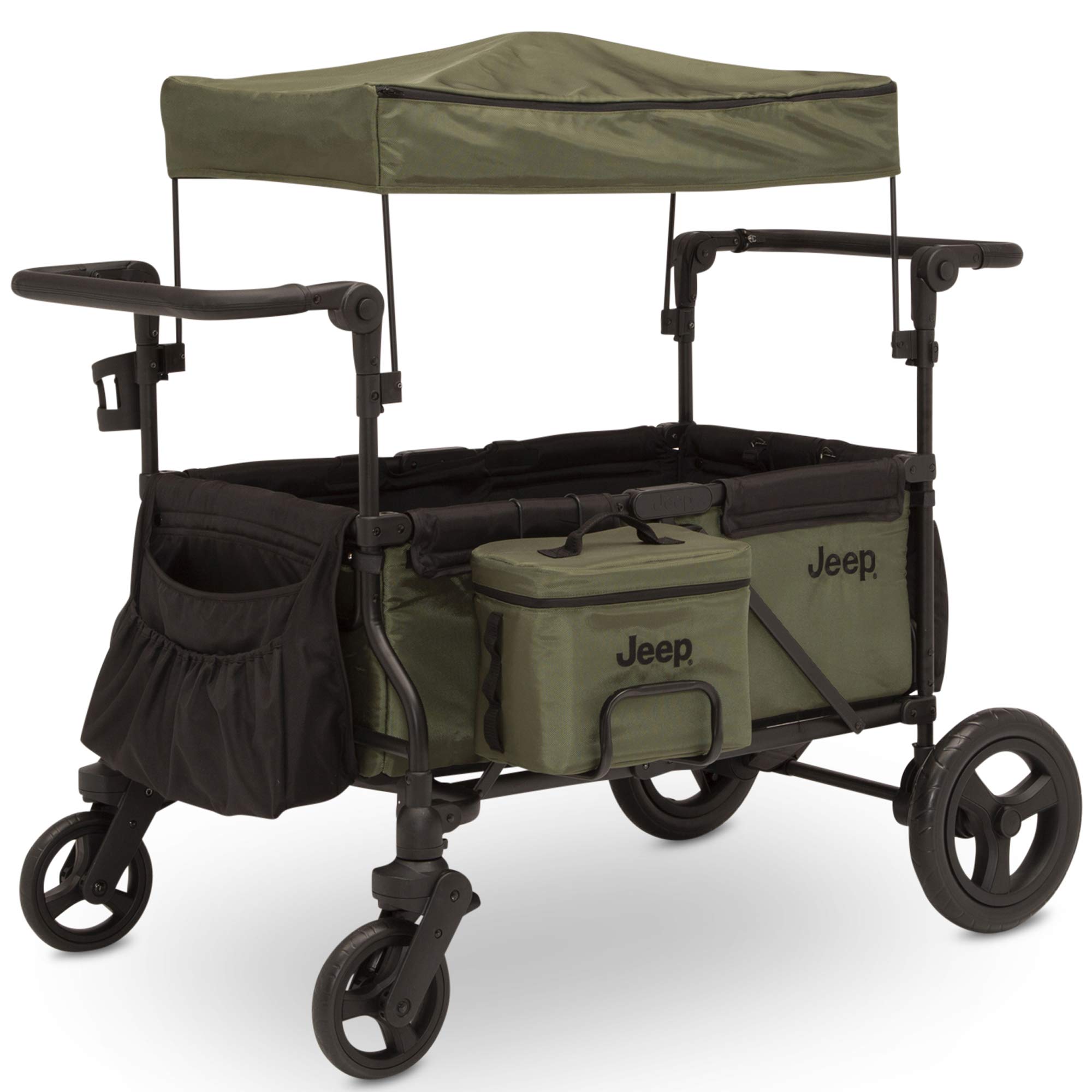
The detachable cooler bag holds up to 16 cans, and the parent organizer has three compartments and a zippered pocket. That is the most beach-specific storage setup here, and it is why the Jeep Deluxe makes sense as a base-camp wagon rather than an everyday stroller. You load it once, park it near your blanket, and let the wagon hold the day’s supplies.
Two five-point harness seats, a car-seat adapter, and a 110-pound capacity give it real family range. We like the two leatherette handlebars because they let you push through a crowd or pull over a rough patch without changing your grip. The all-terrain puncture-proof airless tires and one-step brake are the right hardware for a packed-sand approach; airless means no flat to fix at the beach.
The 46.6-pound weight and 38-by-29-by-25-inch fold are the price. This is not a wagon you lift into a rooftop box or carry up stairs alone, and it takes real trunk space. The car-seat adapter works with listed Graco SnugRide models, so check your seat before you count on travel-system mode. If your beach day starts and ends near the car, that trade is easier to accept; if you need to haul it far, the Ever Advanced Side-Unzip is lighter.
Pros
- Holds a 16-can cooler bag
- Two five-point harness seats
- All-terrain airless tires
- 110-pound total capacity
Cons
- 46.6 pounds and bulky folded
- Car-seat adapter fits listed models only
We recommend the Jeep Deluxe for families who treat the wagon as base camp: it carries two kids, a cooler, and gear, but you will need space and a second pair of hands.
Best for Push-Or-Pull Outings
Baby Trend Expedition Wagon

Key Features
- Seats: 2
- Weight: 37.9 lb
- Folded size: 45 x 26.25 x 18.5 inches
- Maximum weight: 110 lb
The hideaway telescoping pull handle is what makes this wagon more than a stroller. You can push it like a conventional stroller through a boardwalk crowd, then pull it behind you over a packed-sand access path. We found the push mode more natural in tight spaces, while the pull handle earns its keep when the surface gets rutted.
It seats two with three-point harnesses, accepts an infant car seat, and carries up to 110 pounds. The UPF 50 canopy, mosquito netting, and four cup holders are welcome beach-day extras, and the 30-pound basket is big enough for towels and a small cooler. The 8-inch front and 11.5-inch rear EVA wheels are smaller than the Apollo’s, so we keep this on packed sand, boardwalk, and grass rather than soft dry sand.
The folded size is 45 by 26.25 by 18.5 inches, which is long for a compact trunk, and the three-point harnesses are a step down from the five-point setups on the Apollo and Jeep Deluxe. Neither makes it a bad wagon; they just narrow the cases where it is the best choice. If you need a roomy two-seater with a car-seat option and do not want to pay wagon-premium money, this is a sensible middle path.
Pros
- Push or pull with two handles
- Two seats plus car-seat adapter
- 110-pound total capacity
- UPF 50 canopy and bug netting
Cons
- Long 45-inch folded shape
- Three-point harnesses, not five-point
We recommend the Expedition 2-in-1 for push-or-pull families, with the caveat that its small front wheels and long fold keep it on packed sand and out of tight trunks.
How We Tested Beach Strollers
To build the shortlist, I started with roughly two dozen strollers marketed for beach or all-terrain use and compared wheel size, folded dimensions, weight, seat recline, brake type, and price. That cut the field to eight models, which we assembled, folded, pushed, and packed up over seven months.
Assembly happened in my garage with a stopwatch running and only the tools in the box. We folded and unfolded each stroller at least 20 times — sometimes one-handed, sometimes with a beach bag in the other arm — then loaded it into a midsize SUV and a compact hatchback to see how much trunk space remained. We measured the folded footprint for garage storage, checked whether each stroller fit through a standard boardwalk shop doorway, and tested seat width and canopy height with a 2-year-old and a 4-year-old.
On the beach, we pushed each one across loose dry sand, wet packed sand near the waterline, boardwalk planks, and a gravel access path. Baskets held towels, a small cooler, and a beach bag; we noted whether the front wheels dug in, the frame flexed, or the ride turned jarring over roots and boards. After each trip we checked seams, canopy joints, and wheel wobble, and we buckled and unbuckled harnesses and set brakes with sandy hands. At the end, we weighed price against how often we reached for each stroller and how well it handled the sand-to-trunk routine.
How to Choose a Beach Stroller
The beach stroller that works is the one you can push over packed sand and still lift into the car; no stroller here turns soft dry sand into pavement.
Start With the Wheels, Then Check the Sand
Wheel diameter is the first beach spec we check. A larger rear wheel rolls over ruts and the packed strip near the water, while a small wheel starts digging in sooner. The Apollo lists a 16-inch rear wheel, the largest rear-wheel figure here; the Baby Trend wagon’s 11.5-inch rear wheel is better suited to packed sand and boardwalk than to the soft stuff. A lockable front swivel gives you straight-line tracking for a jog and the ability to turn in a crowd.
Our advice is to choose the biggest rear wheel you can live with, then test the packed-sand edge before committing to a long walk. Deep, dry sand is a different surface. Plan to turn back, lift the stroller over the soft patch, or use a wagon with a pull handle rather than fight it.
One Child or Two Changes the Whole Purchase
A single jogger is lighter and narrower, and it is the right default if one child rides while the other walks. A wagon earns its extra weight when you need two seats, a car-seat adapter, and room for beach gear. The Apollo and Expedition Jogger each carry one child to 50 pounds; the Side-Unzip and Jeep Deluxe wagons carry two to 110 pounds.
Check the harness as carefully as the seat count. Five-point harnesses are the better match for a younger child or a child who slumps, while some wagons use three-point belts. If one rider has a cast or limited mobility, side access matters more than another cup holder.
Weight and Fold Are Beach-Day Costs
A stroller that is easy to push can still be a pain to own if it is hard to lift. The range here runs from 23.6 pounds for the Baby Trend Expedition Jogger to 46.6 pounds for the Jeep Deluxe, and that difference shows up when you hoist it over a tailgate or drag it up a rental stairway.
Check the folded length against your trunk, not just the folded height. The Baby Trend wagon folds to 45 inches long, while the Apollo’s flat fold is tall and narrow. Quick-release rear wheels help, but they do not turn a big wagon into a small-car stroller.
Safety and Car-Seat Compatibility
Look for a five-point harness, a brake you can set with one foot, and a wrist tether if you plan to jog. JPMA certification is a useful baseline on the Apollo, Side-Unzip, and Baby Trend wagon, but it does not tell you whether your infant seat fits.
Car-seat adapters are model-specific. The Apollo lists Graco SnugRide Click Connect and Evenflo Nurture and Embrace; the Jeep Deluxe lists specific Graco SnugRide models; the Baby Trend wagon accepts an infant car seat but the listing does not give the full compatibility list. Confirm your seat before you count on travel-system mode.
Storage and Sun Protection
Beach gear adds up: towels, sunscreen, water, snacks, and a change of clothes. A large basket is useful only when the weight sits low and centered; hanging a heavy bag from the handle changes the push and can make the stroller tippy. The Jeep Deluxe’s 16-can cooler bag and the Side-Unzip’s rear basket are the most beach-specific storage setups here.
Canopy coverage matters more on open sand than in a neighborhood. Look for UPF 50 fabric and a canopy that pulls forward far enough to shade a sleeping child. The Baby Trend wagon adds mosquito netting, which is a practical extra for a beach path at dusk.
Frequently Asked Questions
Can I use my everyday stroller on the beach?
Only on the packed strip. Small plastic wheels sink and skid once the sand softens. Load your everyday stroller as you normally would, push it a few yards on the hard-packed edge, and check whether the wheels sink beyond the tread. If they do, turn around. The Apollo’s 16-inch rear wheels give you more margin, but they are not a soft-sand guarantee.
How do I get a stroller through a soft patch?
Travel light, keep the heavy gear low and centered, and use the packed strip rather than the dry sand. A wagon with a pull handle is easier to drag behind you than a stroller is to push. Do not pull a loaded stroller sideways; it digs a trench and strains the frame. If the patch runs long, lift the stroller over it or choose another access point.
Do beach strollers need special maintenance?
Yes. Brush dry sand off the fabric before it works into seams, wipe the frame with fresh water and mild soap, and dry it fully before folding. Check the wheels and brake for grit after a saltwater trip. A spot-clean seat like the Apollo’s is easy to wipe, but any stroller that goes to the beach benefits from a quick freshwater wipe.
Final Verdict
Start with the Delta Apollo if you want one stroller for a single child and a mix of packed sand, boardwalk, and park. The 16-inch rear wheels and shock-absorbing frame are the most beach-relevant combination here, and it folds flat enough for a trunk.
If you need two seats, the Ever Advanced Side-Unzip is the better family wagon, especially for a child who needs side access. The Jeep Deluxe is the gear-heavy choice when you have the space and two people to lift it.
