This post contains affiliate links. We may earn a small commission when you buy through our links — at no extra cost to you.
A crib that fits is the whole game in a small nursery. The wrong one eats the only clear wall, blocks the closet, and turns middle-of-the-night feedings into a game of shin against frame. I’ve measured a nursery corner with painter’s tape and taped out three different layouts before buying anything, so I know how quickly ‘compact’ stops being a nice-to-have. The right small-space crib gives back floor you can actually walk on, fits a real mattress without a scary gap, and stays rock-solid when a toddler uses the rail as a drum.
We spent seven months with eight compact cribs, from first unboxing through the toddler stage. We built each one without extra help, noted whether the instructions matched the hardware, checked mattress fit and thinness, and watched for finish odor and arrival condition. We also moved each crib between rooms to see how build quality, durability, sturdiness, and appearance held up, and whether the value still felt right after months of use. The picks below earned their square footage—read on for the setups and budgets that fit.


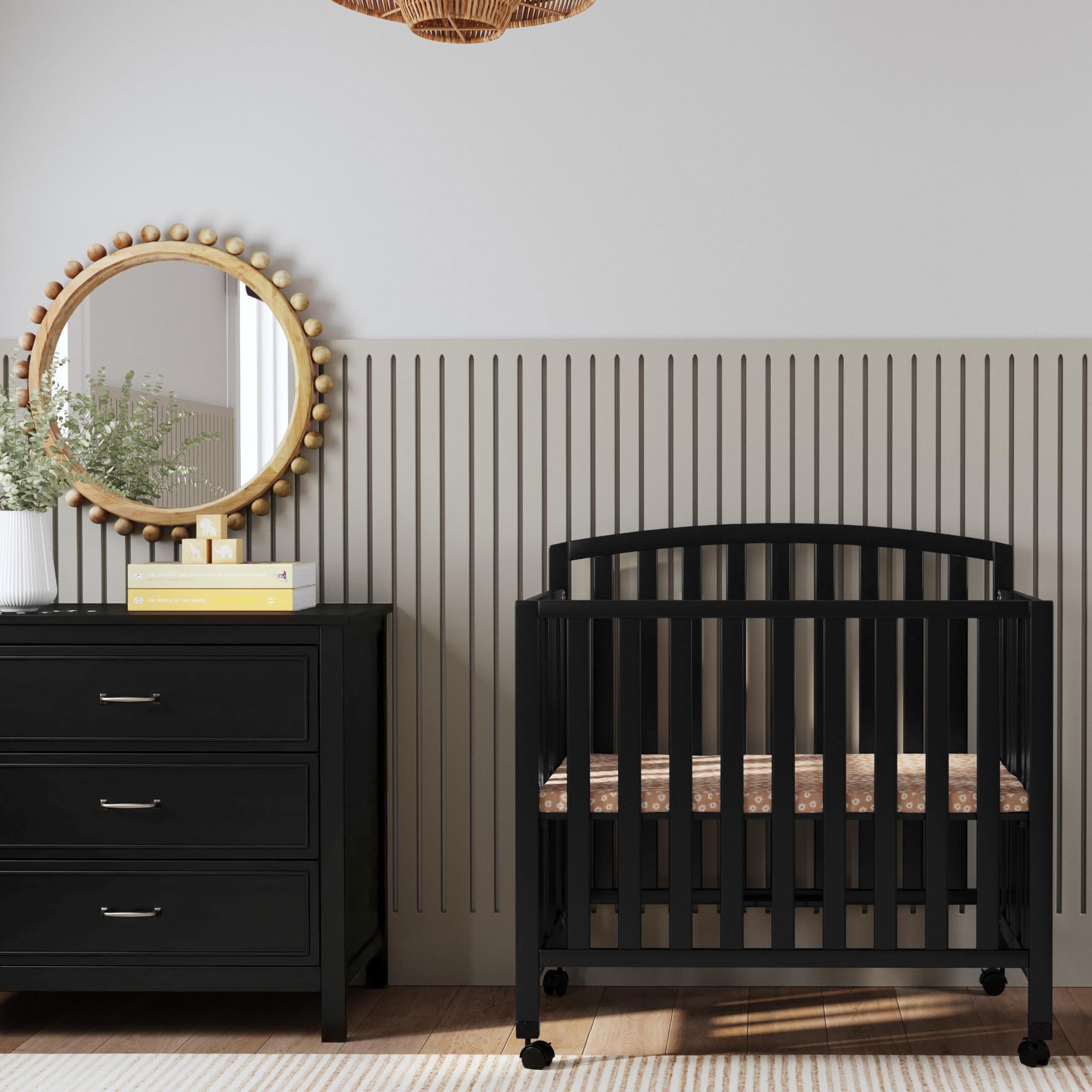

Best for Tight Nurseries
Dream On Me Aden Mini Crib
Key Features
- Converts to: Mini daybed and twin, kits sold separately
- Assembled size: 39"L x 28"W x 37"H
- Mattress positions: 3
- Included sleep surface: Mattress included
- Price: Midrange
Thirty-nine inches by 28 is the number that earns this crib its place. That’s the assembled footprint, and it’s narrow enough that we moved it through a standard doorway without pulling the rails off — a detail that only matters until the first time you have to get a crib around a corner in a hallway. In a room where the crib has to sit beside your bed or under a window, that inch count is the difference between a nursery and a storage unit with a baby in it.
The three mattress heights are the part we miss when they’re absent. The support starts at 18 inches off the floor for a newborn, steps to 14.1, then down to 10.1 — a real range rather than a token adjustment, which means you’re not bending to the floor with a two-week-old. It’s GREENGUARD Gold certified and built from New Zealand pine, and a mattress comes in the box: a basic one, but it means the crib is usable the day it’s built.
Where it gives ground is the finish. Cracked rails, split wood and chipped paint are what turn up, and some units arrive dented straight out of the carton. Lay every panel out and check the top rails and the mattress support before you start turning bolts — a five-minute habit that saves a return argument. The assembly itself is straightforward; we had no trouble with the hardware or the sequence.
One cost the listing doesn’t lead with: the daybed and twin conversions both need kits sold separately, so the grows-with-them story is a purchase, not a feature. Budget for the daybed kit when your baby starts pulling up and the path makes sense; the crib itself is the cheap part of it.
Pros
- 39-by-28 footprint clears standard doorways assembled
- Three mattress heights, from 18 inches down
- Mattress included, so it’s usable day one
Cons
- Chipped paint and cracked rails turn up on arrival
- Daybed and twin conversion kits cost extra
The best all-round small-space crib here: a 39-by-28 footprint, three genuine mattress heights and a mattress included, for a nursery with one tight corner.
Best for Travel and Grandparents
Delta Children Folding Mini Crib
Key Features
- Mobility: Casters, folds flat
- Assembled size: 39"L x 25"W x 38"H
- Mattress positions: 2
- Included sleep surface: 1.5-inch mattress
- Price: Midrange
The first time we folded this crib flat and rolled it out of the room on its casters, it was obvious who it’s for. It isn’t the crib you buy to furnish a nursery forever; it’s the one that doesn’t have to stay in the same place twice in a month. Folded, it goes behind a door, into a trunk, or into the corner of a room that has to be an office again on Monday.
At 39 inches by 25, it’s the narrowest of the four here, and it passes through standard doorways on its wheels without a second person. That combination — narrow, wheeled, folding — is what makes it the answer for a grandparents’ house, a temporary room-share, or a family splitting time between two homes. Two mattress heights is the trade: you drop the support once as your baby starts sitting up, and that’s the whole adjustment.
The included mattress is the weak spot. At 1.5 inches it’s a pad more than a mattress, and it’s the first thing to replace. A standard mini crib mattress drops straight in, so buy both at once and this becomes a genuinely comfortable place to sleep rather than somewhere to nap while you wait for a delivery.
What you don’t get is a conversion path — no daybed, no twin mode, so when your child outgrows it, that’s the end of the crib. It’s rated to 35 pounds, and a crib that lives at grandma’s rarely sees the far end of that. Between the JPMA certification, the easy build and the finish, which looks better than the construction suggests, the missing conversion costs most buyers very little.
Pros
- Folds flat and rolls on casters
- Narrowest footprint here at 25 inches deep
- Passes through standard doors assembled
Cons
- Included 1.5-inch mattress is thin
- No daybed or twin conversion
The one to buy if the crib has to move: it folds flat, rolls on casters and slips through doorways, and you should price a real mattress alongside it.
Best for Room-To-Room Mobility
DaVinci Dylan Mini Crib
Key Features
- Certification: GREENGUARD Gold
- Assembled size: 40.35"L x 25.28"W x 40.9"H
- Mattress positions: 4
- Included sleep surface: 1-inch waterproof pad
- Price: Midrange
Four mattress positions is why this one is here. The other minis in this set give you two or three; the extra stop is worth paying attention to if you’re tall, if the crib sits against a bed higher than the crib rail, or if bending into a low crib is the part of the day you dread. You can keep the mattress nearer your hands for longer before it has to drop.
It rolls and folds as well, so it’s the other movable option here, and it manages that without giving up the height adjustment the way the Delta does. The ebony finish is the sharpest of the four in our setup, the frame felt solid every time we pushed it across a room rather than lifting it, and GREENGUARD Gold certification covers the finish and the foam.
What’s in the box is a 1-inch waterproof pad, not a mattress, so plan on buying a mini crib mattress; the pad earns its keep as a liner underneath. The instructions are almost entirely diagrams. We got there, but laying the hardware out in the order the picture shows saves a false start, and the paint-and-glue smell at unboxing is worth planning for — air the panels a day before you build.
The 50-pound rating is the highest in this group alongside the Jayden, and it converts to a twin with a kit sold separately, so the useful life runs longer than the footprint suggests. If you want four positions and a crib that lives on wheels, this is the one; if you want a mattress in the box and a shorter build, the Aden is the easier buy.
Pros
- Four mattress heights, the most here
- Folds and rolls for storage or moving
- Rated to 50 pounds
Cons
- Instructions are mostly diagrams
- Ships with a 1-inch pad, not a mattress
Buy this one for the most mattress positions of any crib here and a frame that rolls; just add a mini crib mattress, because the box holds a pad.
Best for One-Wall Nurseries
Dream On Me Jayden Mini Crib & Changer
Key Features
- Storage: Three drawers and changing station
- Assembled size: 53.75"L x 27.56"W x 39.76"H
- Mattress positions: 3
- Included sleep surface: 1-inch mattress pad
- Price: Premium
A crib, a changing table and a dresser normally eat three separate runs of wall. This one puts them in a single 53.75-inch stretch: mini crib at one end, a changing pad with a safety strap and buckle at the other, three drawers underneath. In a room where the floor is small but the wall is workable, that consolidation is the entire argument.
It’s the pick for a nursery with one usable wall and nowhere to put a dresser — a box room, a shared bedroom, a converted closet. We stop short of calling it a small-space crib in the usual sense, though. At 53.75 inches it’s the longest thing in this group by more than a foot, and at 64.5 pounds it’s a two-person build that doesn’t move once it’s placed.
The details hold up: three mattress heights starting at 17 inches off the floor, GREENGUARD Gold and JPMA certification, New Zealand pine, and a changer that detaches when you convert to a full-size bed. The pad that comes with it is an inch, so a real mini crib mattress belongs in the budget, and the drawer runners are the part to check first, since misaligned glides are the recurring frustration.
Which brings up the thing to tell a friend: open it on delivery day and check every panel before you start. Scratched faces, chipped edges and the occasional cracked board are the risk with this one, and once it’s built you’ve lost the easy chance to swap it. Build it in the room it’s staying in, too — 64.5 pounds with drawers on is not a piece to carry up a staircase twice.
Pros
- Crib, changer and three drawers in one piece
- Three mattress heights starting at 17 inches
- GREENGUARD Gold and JPMA certified
- Changer detaches for the bed conversion
Cons
- Arrives scratched, chipped or cracked often enough to inspect
- Longest footprint here, and heavy at 64.5 pounds
The right buy when the nursery has one wall and needs three functions on it — just measure the run first, because this is the longest crib here.
How We Tested Small-Space Cribs
We started with a shortlist of compact and mini cribs sold in the U.S., then filtered by exterior dimensions, mattress size, conversion options, and price. We dropped any crib with vague footprint specs or no clear mattress standard. Eight made the cut.
For seven months, we used those eight cribs as primary beds in small bedrooms, including a 9-by-10-foot nursery, a shared primary bedroom, and a guest room that doubles as an office. We assembled each one solo with the included tools and timed it, then compared the manual’s steps with the hardware bag. Before assembly, we inspected boxes, rails, slats, and hardware for dents, cracks, and missing pieces. We measured each footprint at its widest point, carried the crib through a standard doorway, and checked whether it could sit beside a bed without blocking a closet.
Once built, we shook and pushed each frame to judge sturdiness, watched for wobble at the joints, and fitted a standard crib mattress to check gaps at the corners. We pressed the included mattress to see how thin it felt, smelled the finish at unboxing and again after three days, and wiped the rails to see how the surface held up. Over the months, we moved cribs between rooms, noted chips or loosening hardware, and tracked whether instructions still made sense for disassembly. At the end, we weighed build quality, appearance, and value against how much usable floor space each crib preserved.
How to Choose a Crib for a Small Space
Most small-nursery crib shopping comes down to one question the listing never answers directly: is the room short on floor, or short on wall?
Measure the wall run, not the floor
A true mini crib runs roughly 38 to 40 inches long and 24 to 28 wide, against about 54 by 30 for a full-size crib. The three minis here sit within an inch and a half of each other in length, so the footprint figure rarely decides between them. What decides is the wall you’re putting it against, plus the door swing and the space to drop the mattress.
The trap is reading compact as fits anywhere. A crib can be small on the floor and still be the wrong shape for a narrow alcove with a radiator under the window. Pace the run, add the door, then look at depth: 25 inches leaves a walkway where 28 does not.
Mattress height is a back decision
Two, three or four positions sounds like a spec-sheet detail until you’re lifting a newborn in and out eight times a night. The setting that matters most is the top one, because that’s the height you live at for the first months: the Aden starts at 18 inches off the floor, the Jayden at 17, and a crib with a lower top setting asks more of your back from day one.
The bottom setting matters just as much for a different reason — it has to be reachable once your baby can pull up, which is when the crib gets deeper. If you’re shorter than average, check that the lowest position is still workable before you commit. The Delta adjusts through two positions only, so there’s less to like there and less to go wrong.
Decide now whether it leaves the room
Folding and casters are the two features that separate a crib that stays put from one that travels. The Delta folds flat and rolls; the DaVinci folds and has wheels; the Aden and the Jayden are built to be placed once. If the crib will spend weekends at a grandparent’s house or shift between a bedroom and a living room, folding is worth more than a third mattress height.
If it’s going into one corner for two years, the reverse is true: put the money into height positions, a mattress in the box and a conversion path instead. Buying a folding crib that never folds means paying for a hinge you’ll never use.
What’s actually in the box
Included mattresses vary enormously, and this is where a small-space budget quietly grows. The Delta ships with a 1.5-inch mattress, the DaVinci and Jayden with 1-inch pads, and the Aden with a mattress that’s best treated as a starter. A mini crib mattress is a separate purchase you should plan for unless the crib includes a real one.
Conversion kits are the other hidden line. On the Aden, DaVinci and Jayden the daybed and twin conversions need parts sold separately, so the grows-with-them story is a cost that arrives in year two, not a feature you’ve already paid for.
Open the box before you build
The shared weak point across compact cribs is arrival condition, not design. Chipped paint, cracked rails and split panels are the recurring theme, and they’re far easier to resolve before you’ve turned fifty bolts. Lay every panel out on the floor, check the top rails and the mattress support board, and keep the carton until you’re done.
Assembly difficulty is uneven too. The Delta and Aden go together with ordinary patience; the DaVinci’s instructions are almost all diagrams; the Jayden’s 64.5 pounds and drawers make it a two-person job. Line up help before delivery day rather than after.
Frequently Asked Questions
Will standard crib sheets fit a mini crib?
No. A mini crib mattress runs about 24 by 38 inches, so sheets cut for a full-size crib will bag and pull loose at the corners. Buy mini crib sheets, and match the mattress to the size the crib’s own listing states rather than to mini as a category — the Jayden, for instance, takes a 38-by-24 mattress specifically.
Fit matters more than fabric here. A sheet that lifts off a too-small mattress creates a loose layer next to a sleeping baby, so pull each corner and check it stays tucked.
How long can a baby use a mini crib?
Until your child can climb out or reaches the crib’s weight limit, and those limits differ more than you might expect in this group: 35 pounds on the Delta, 40 on the Aden, 50 on the DaVinci and Jayden. If you’re hoping to get past the two-year mark, start with one of the 50-pound models.
The mini mattress itself isn’t usually the limit. It’s climbing, and it arrives on the child’s schedule, not the spec sheet’s.
Is a folding crib as safe as a stationary one?
The fold isn’t the safety question — certification and setup are. A folding crib certified to ASTM standards meets the same requirements as a stationary one, and both the Delta and the DaVinci fold. What you have to do is confirm the latches seat fully every time the crib goes up.
Push down on each corner before the baby goes in, and check the mattress support is on the setting you think it is. Never add a second mattress or extra padding to soften a thin pad; that’s the failure mode, not the fix.
Final Verdict
For most small nurseries the Dream On Me Aden is the crib to buy: 39 by 28 inches of floor, three real mattress heights, and a mattress in the box so it’s usable the day it’s built. If the crib has to move between rooms or travel, the Delta’s fold and casters are worth giving up the extra height position and the conversion path.
And if your nursery has one usable wall and not three, buy the Jayden — but measure that run first, because it’s the longest piece here by a foot.
