This post contains affiliate links. We may earn a small commission when you buy through our links — at no extra cost to you.
The day my nephew hit 45 pounds, his stroller stopped being a ride and became a suggestion. The frame flexed at the joints, the canopy pressed into the top of his head, and the front wheels picked up a shimmy I could never tighten away. Most seats are rated to 50 pounds, but that figure assumes a child who sits still and doesn’t dangle their legs over the footrest. A stroller built for a bigger kid fixes that at once: a taller seat back, a wider bench, a quiet frame, and a wheelbase that doesn’t tip when a preschooler leans out to point at a dog.
Over the past eight months, my team and I have pushed nine of them through school drop-off, the zoo, a theme park, and a grocery aisle with a cart in one hand. What separated them had almost nothing to do with the spec sheet and everything to do with whether the seat still felt solid under a 50-pound kid three hours in, whether the fold left a hand free, and whether assembly on day one took ten minutes or an entire evening. The ones that passed are below, sorted by the kind of day you actually have.


Best for One Older Child
Coche XL Special Needs Stroller
Key Features
- Max height: 48 inches
- Max weight: 110 lb
- Seat width: 15 inches
- Stroller weight: 15.4 lb
- Price: Premium
The seat is what earns this one its place: 15 inches across, rated to 48 inches of child height, with a 110-pound weight limit. That’s a different proposition from the wagons here, because all of that capacity goes to one rider instead of being split between two. We put it at the top of this list for the family whose seven-year-old still needs a seat, and for the parent tired of a child’s shoulders pressing into a canopy that was never meant for them.
It’s also the lightest thing here by a wide margin — 15.4 pounds against 31 to 39 for the wagons — and it folds umbrella-style to 31.5 by 11.8 inches. That difference showed up most at the end of an outing, when the child is out of the seat and you’re the one doing the lifting. It goes into a trunk with one hand and none of the wheels come off.
Pushing it with a bigger child aboard is easier than the frame weight suggests. The front wheels swivel a full 360 degrees, so narrow shop aisles and clinic corridors aren’t a wrestling match, and the footrest adjusts to take a longer leg. The five-point harness has enough adjustment left over for a school-age child, which isn’t a given on a stroller this size.
Two things to know. The canopy and the storage are sold as extras, which stings on a stroller at the premium end of this group. And the parts that take the abuse from a heavier rider — the footrest and the front wheels — are the ones to look over now and then rather than assume will last forever. Neither changes our recommendation; for one big child, this is still the most useful design here.
Pros
- Rated to 110 pounds and 48 inches
- 15.4-pound aluminum frame folds umbrella-style
- 360-degree swivel front wheels
- Adjustable footrest for longer legs
Cons
- Canopy and storage sold separately
- Solid tires feel firm on broken pavement
If your child has outgrown a regular stroller by height or weight, this is the one we point you to first: a single seat rated to 110 pounds that folds small enough to lift alone.
Best for Two Big Kids
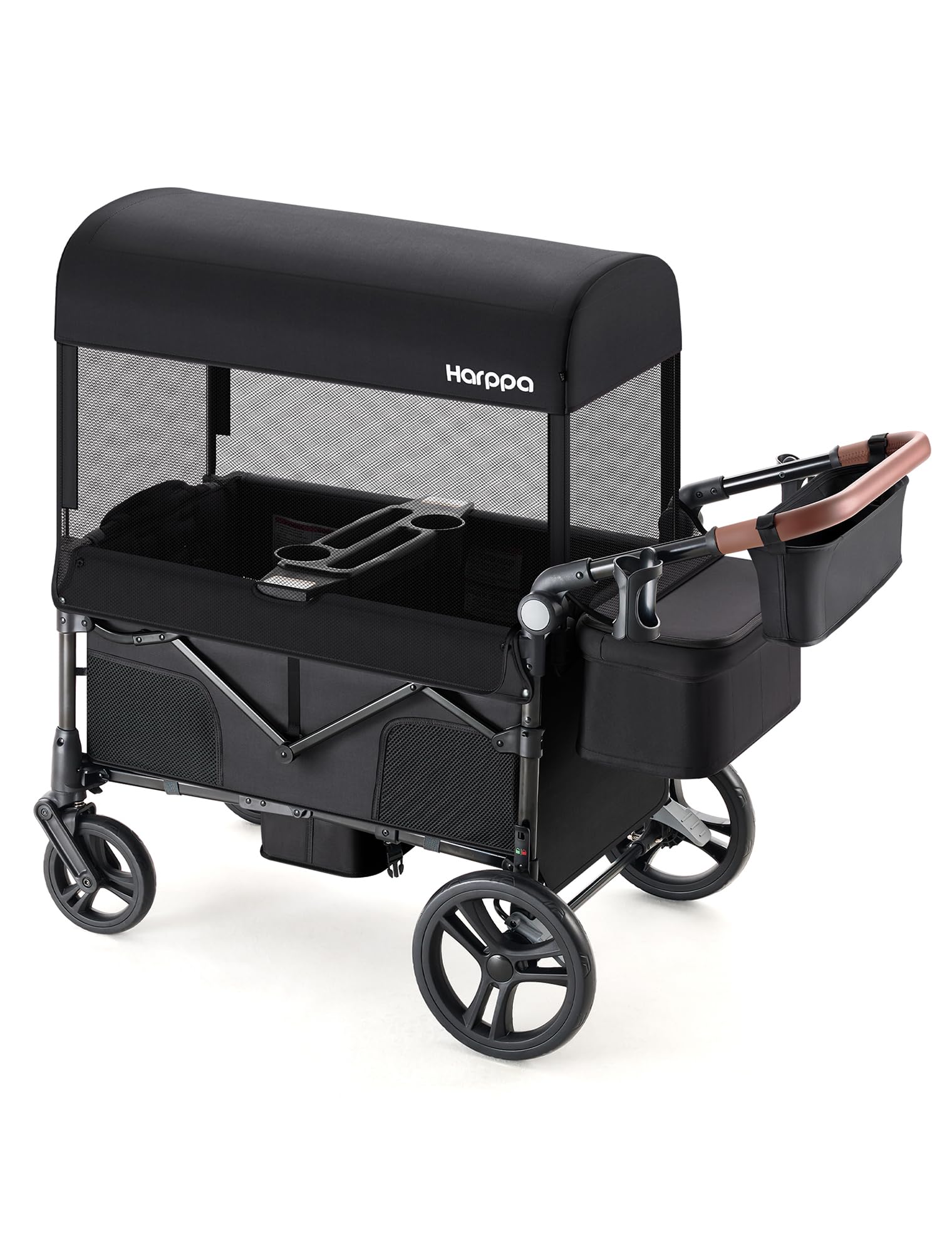
Harppa Remy Wagon Stroller
Key Features
- Seats: 2
- Max weight: 180 lb
- Folded size: 26 × 15 × 27 inches
- Stroller weight: 33 lb
- Price: Midrange
Two riders is where this wagon makes its case. The 180-pound capacity is a total spread across both seats rather than a limit for each child, and it’s generous enough that two school-age siblings can ride at once without the frame complaining. It’s the wagon we reach for when both kids are past the toddler stage and neither wants to walk.
We think it’s the best-built of the wagons here, and the details say why: a five-point harness on each seat, a drop-down footwell so legs hang properly instead of dangling, and a padded seat back. The padding itself is the weak spot — thin enough that a long day at the zoo leaves a child shifting around. Fine for a park loop; add a cushion for anything longer.
The push-and-pull arrangement is what makes it practical. The leather-wrapped handlebar adjusts for a tall parent, and the two-section pull handle locks so you can haul it over grass or gravel rather than fight it. Sand is the boundary; this rolls on sidewalks, paths and short grass, not soft beach.
It folds to 26 by 15 by 27 inches and weighs 33 pounds, which one adult can manage into an SUV or a deep trunk. The listing’s six-to-36-month age range undersells it badly — the seat size and the weight limit are what matter here, and both point at older children.
Pros
- 180 pounds of total capacity
- Folds to 26 by 15 by 27 inches
- Push or pull with a lockable handle
- Five-point harnesses and drop-down footwells
Cons
- Thin seat padding for long days
- Not built for soft sand
Our pick when you’re moving two children who’ve outgrown toddlerhood: 180 pounds across two seats, a fold that clears a trunk, and a handle that lets you pull instead of push.
Best for Jogging with Two
BOB Gear Revolution Flex 3.0 Duallie
Key Features
- Seats: 2
- Tires: Air-filled
- Max weight: 100 lb
- Stroller weight: 33.1 lb
- Price: Premium
The ride is the best in this group and the seats are the tightest, and both are true of the Duallie. Sixteen-inch air-filled rear tires, a mountain-bike-style suspension and a front wheel that locks straight make gravel, tree roots and cracked pavement feel like nothing underneath the seats.
We pushed it one-handed with a child in each seat and the front wheel locked, which is the thing that sells a jogger to anyone who has ever shoved a wagon up a hill. The nine-position handlebar means a short parent and a tall one can share it, and the swivel lock engages in a second.
Here’s the catch: the seats don’t grow the way the frame does. The 100-pound limit covers both riders together, so a pair of 45-pound kids is realistic and a pair of 60-pound kids isn’t. Height is the real pinch point — headroom under the canopy runs out before the weight does. Sit your child in one before you commit, and check shoulder height against the canopy rather than the number on the box.
At 33.1 pounds and 40 by 30.5 by 17.5 inches folded, it’s a wheels-off proposition for some sedans. The frame warranty runs five years, the longest here, which says something about how the chassis is built.
Pros
- Air-filled tires and real suspension
- Pushes one-handed on rough ground
- Nine-position handlebar for tall parents
- Five-year frame warranty
Cons
- Seats run out of headroom for tall kids
- Heavy, and wheels off for some trunks
For running with two riders, no other pick here rides rough ground better; just check that your taller child still clears the canopy before you spend the money.
Best for Facing Seats
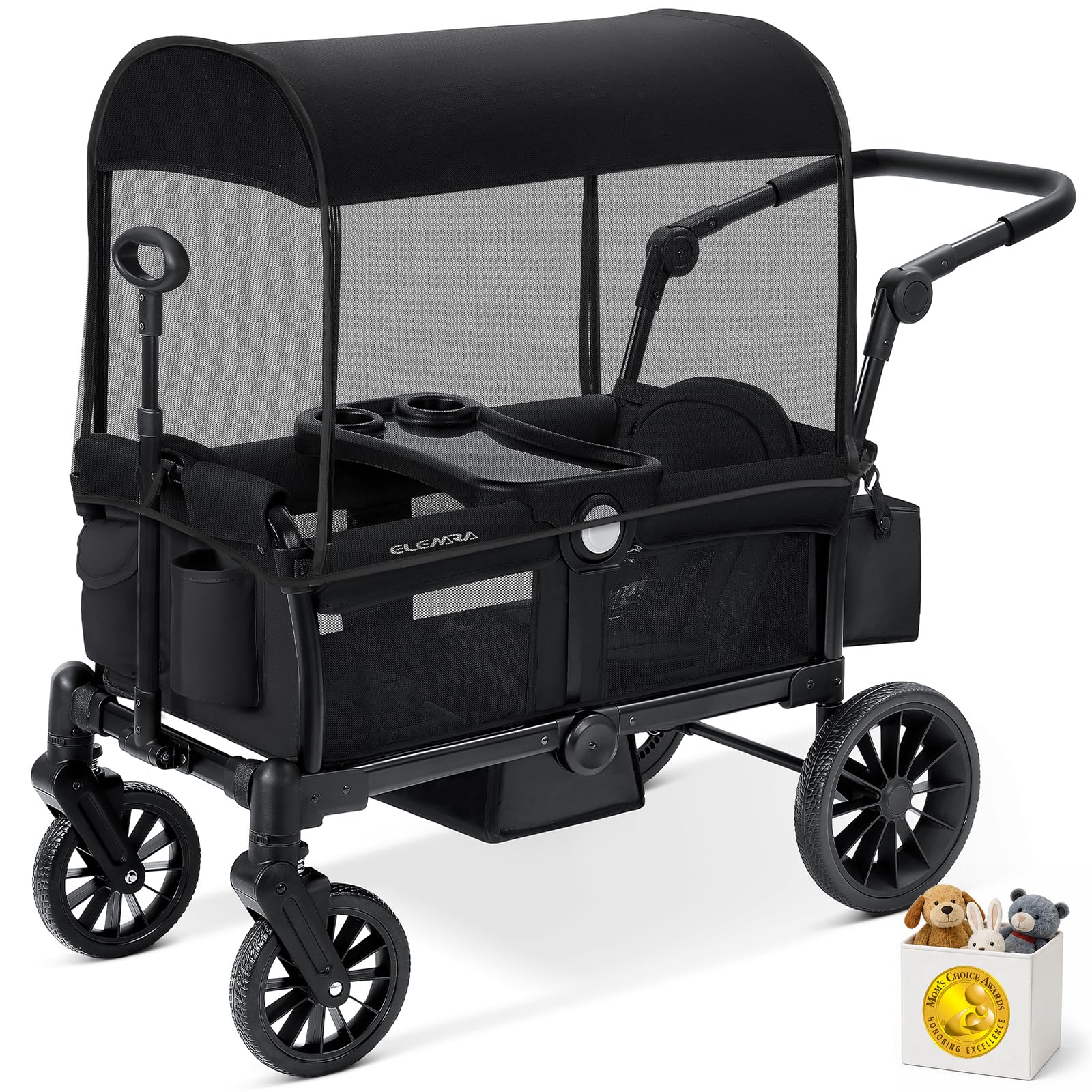
ELEMARA Foldable Wagon Stroller
Key Features
- Seats: 2
- Harness: 3-point
- Max weight: 110 lb
- Stroller weight: 39 lb
- Price: Midrange
The seats face each other, and that layout is the reason to pick this wagon over the others here. Siblings who spend an hour at the zoo talking to each other rather than at the back of a head is a small thing that changes a whole outing.
What we like most is that nothing important is an add-on: the canopy, a movable snack tray and cup holders, a zippered storage bag and a mosquito net all come in the box. It rolls smoothly over grass and cracked sidewalk, and the fold is quick enough to manage at the back of the car with a child on your hip.
The limit to understand is per seat. That 110 pounds is the total for both children, so each rider needs to stay around 55 pounds — the tightest per-child allowance among the wagons here. If your kids are seven and nine and both solid, this isn’t the wagon for you; the Harppa carries more.
Two details matter with bigger kids. The harness is a three-point, so there are no shoulder straps — fine for a child who sits up, less so for one who falls asleep and slumps sideways. And at 39 pounds it’s the heaviest wagon in this list to lift into a trunk.
Pros
- Face-to-face seats keep siblings engaged
- Canopy, snack tray, storage and bug net included
- Rolls smoothly over grass and cracked pavement
- Folds quickly for the trunk
Cons
- About 55 pounds of child per seat
- Three-point harness with no shoulder straps
A well-equipped wagon for two children who each stay near 55 pounds; bigger riders need the Harppa instead, and the three-point harness is the other thing to weigh.
Best for Occasional Outings
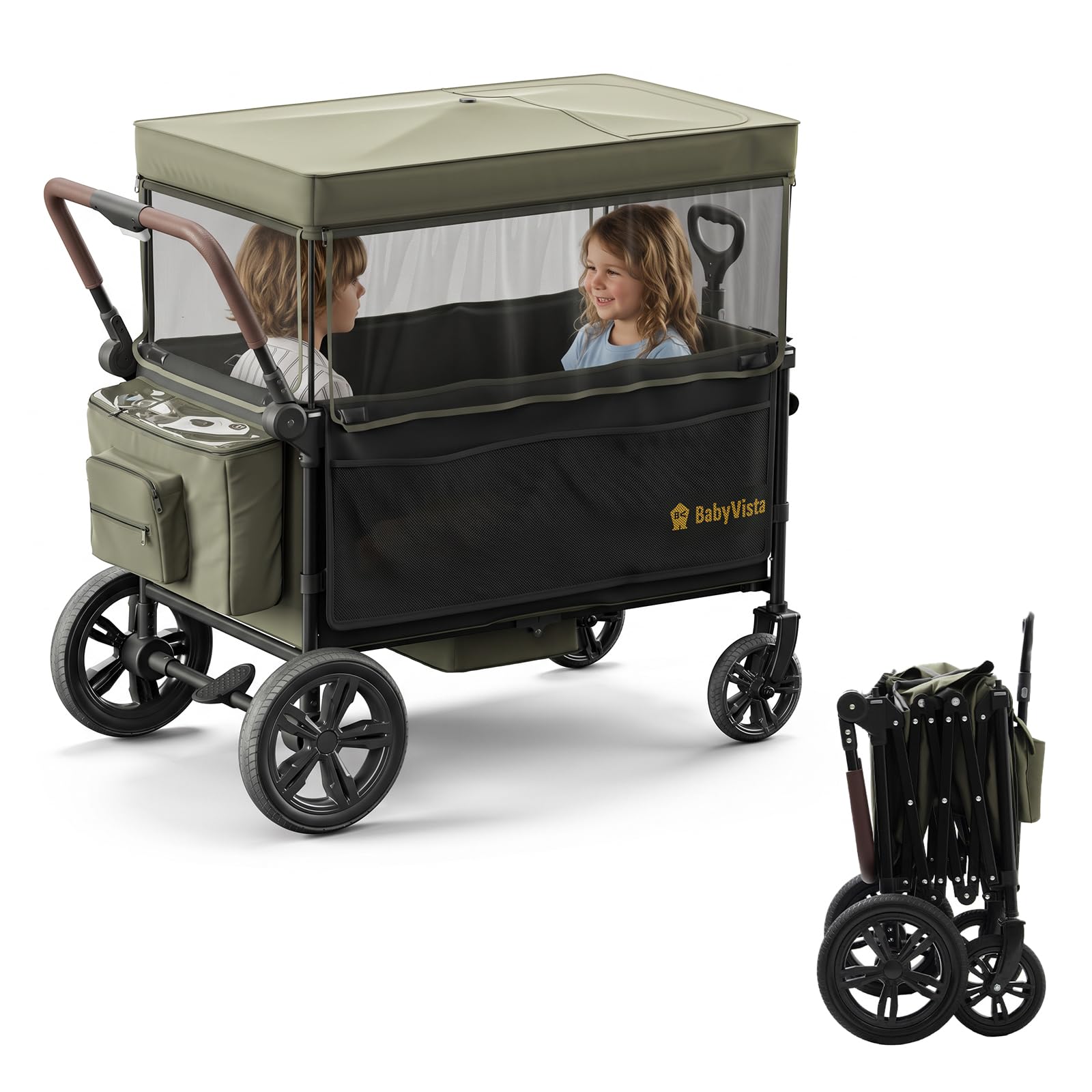
BabyVista Stroller Wagon
Key Features
- Seats: 2
- Canopy: UPF 50+ with bug net
- Max weight: 300 lb
- Stroller weight: 31 lb
- Price: Budget
Three hundred pounds is the number on the box, and it’s the largest capacity anywhere in this group by a distance. What that figure describes is the frame’s rating, not a promise about how the fabric and joints will hold up with two heavy children in the seats week after week.
There’s a lot to like for the money. The canopy is UPF 50+ with a bug net built in, the push handle adjusts with one hand, and the 8-inch front and 11-inch rear wheels handle gravel and uneven paths. Assembly is mostly a matter of popping the wheels on, and the storage — dual side pockets, cup holders, a large organizer bag — is the sort of thing you stop noticing because it simply works.
Our reservation is durability. This is the wagon in this list where a torn seam or a frame pole that won’t stay up is the failure that turns up, and sometimes early on. The three-year warranty is the longest of the wagons, so register it the day the box arrives.
For occasional use — the school run, the county fair, a holiday — the capacity and the low price make it the sensible entry point. Just don’t ask it to be the everyday workhorse for two large children.
Pros
- 300-pound stated weight capacity
- UPF 50+ canopy with built-in bug net
- One-hand adjustable push/pull handle
- Three-year manufacturer warranty
Cons
- Fabric and frame joints are the weak point
The most capacity for the least money here, and a good buy for occasional outings, provided you’re not leaning on it daily with two heavy riders.
How We Tested Strollers for Big Kids
We started with a list of more than 30 strollers marketed to bigger kids and narrowed it by seat-back height, seat width, stated weight limit, folded footprint, and whether the price included the accessories you’d otherwise buy separately. Nine made the cut, running from compact fold-ups to full-size all-terrain models.
Assembly came first. I timed each one out of the box with a stopwatch, working alone, and noted whether the instructions made the difference between the two axle washers obvious or left me guessing. Then each stroller went into rotation for eight months across neighborhood sidewalks, a gravel path, the zoo, a full day at a theme park, and grocery aisles with a cart in one hand. We loaded every seat with a 45-pound sandbag plus a diaper bag and a jug of water, pushed them over curb cuts and tree roots, bumped them up a step, and folded and unfolded each one at least 30 times, including in the trunk of a sedan with one hand.
Stability got a deliberately unfair test: I hung the loaded diaper bag on the handlebar and had a 45-pound kid climb in unassisted, watching to see whether the rear wheels lifted. Ease of use came down to small things, like whether the harness straps adjusted tall enough for a 42-inch torso, whether the canopy cleared a helmet, and whether the brake set with a sandal on. For durability, I checked joint play and tire wear at the end of eight months and washed each seat fabric once. On value, I counted what came in the box against what had to be bought separately.
How to Choose a Stroller for a Big Kid
The number that decides most of these purchases isn’t the age range on the box — it’s the weight limit per seat and the room your child’s shoulders and knees actually get.
Weight Limits Are Usually Shared, Not Per Child
It’s easy to read 180 pounds as a figure for each child. On a wagon it’s the total for both seats, so two 90-pound riders is the ceiling, and a wagon rated 110 pounds really allows about 55 pounds a child. That’s why a single-seat pushchair rated to 110 pounds can carry more child than a two-seater. Work out how many children need to ride at once before you compare capacities, because the arithmetic changes which product wins.
The Seat Has to Fit a Shoulder, Not Just a Weight
A stroller can be rated for the weight and still be wrong for the child. What matters is width across the shoulders, how much back height there is before the canopy begins, and whether the footwell lets a longer leg hang instead of dangling. Bring the child with you if you can. Ordering online, measure shoulder to knee and compare it with the seat depth; that predicts comfort better than the weight limit does.
One Rider or Two Changes Everything Else
A single-seat pushchair like the Coche is narrower, far lighter and turns where a wagon won’t, and the entire weight allowance goes to one child. A wagon seats two and gives siblings somewhere to sit, at the cost of 30-plus pounds of stroller and a wider footprint in every doorway. If one child rides and the others walk, the single seat is the easier object to live with. If both need to ride, the wagon earns its bulk.
Lift It Before You Buy It
Stroller weight runs from about 15 pounds to nearly 40 in this category, and you feel that difference every time you load the car. A 39-pound wagon is a two-hands job; a 15-pound pushchair goes in one-handed. Folded length matters as much as weight — check it against your trunk opening rather than the trunk volume, and expect to pull the wheels off a double jogger if you drive a sedan.
Wheels, Ground and the Person Pushing
A heavier child makes every wheel, bearing and handlebar work harder, so the running gear matters more than it does on an infant stroller. Air-filled tires and suspension smooth out gravel and tree roots but need air now and then; solid tires never go flat and pass more of the bump through. If anyone plans to run, the front wheel needs to lock straight. Tall parents should check handlebar height too — stooping to a low handle with 60 pounds in the seat is the complaint nobody anticipates.
Frequently Asked Questions
Can a stroller wagon work for a child with special needs?
Sometimes, but a single-seat adaptive pushchair is usually the safer starting point. The Coche XL gives one child a 15-inch-wide seat, a 48-inch height allowance, a five-point harness and an adjustable footrest — the support an older child who can’t hold themselves upright needs. Some wagons use a three-point harness with no shoulder straps, which won’t hold a child who slumps. Match the seat and harness to the child before you match the price.
What does a big-kid stroller cost to keep running?
Less than the purchase price, but not nothing. Air-filled tires on a jogger need a pump and eventually a replacement tube; the solid tires on an adaptive pushchair don’t. Check what comes in the box, because on the Coche the canopy and storage are separate purchases and that changes the real cost. Register the warranty on arrival: coverage here runs from one year on fabric and components up to five years on a jogger frame.
Can I take a wagon stroller to a theme park?
Check the park’s rules before you buy for a trip. A wagon with a harness and a push handle is still a wagon to gate staff, and some parks bar them outright however the manufacturer classifies it. Where wagons are allowed, the two-seaters here fold to roughly 26 to 40 inches long. If wagons are out, a single pushchair rated for an older child gets through and folds smaller.
Final Verdict
The Coche XL is the stroller we recommend for a big kid. It’s the only single-seat pushchair here built around an older, heavier child — 110 pounds, a 15-inch seat, a 48-inch height allowance — and at 15.4 pounds it’s the one you can still lift into a trunk at the end of a long day.
If two children need to ride, the Harppa Remy is the better answer: 180 pounds across two seats, a fold that clears an SUV, and the option to pull rather than push. Choose the BOB Duallie instead when running is part of the plan, and accept that its seats suit the smaller end of big.
