This post contains affiliate links. We may earn a small commission when you buy through our links — at no extra cost to you.
There’s a special kind of helplessness that comes with seeing your baby’s bottom raw and red. A good diaper rash cream won’t magically erase the sting, but it creates a breathable barrier that keeps wetness and irritants off the skin, moisturizes dryness, and gives it room to heal. It also needs to stay where you put it—through naps, overnight stretches, and the inevitable wiggle. Consistency matters: some creams go on like a thick paste that clings for hours, while others absorb quickly and need reapplying sooner.
To find the ones that actually protect, I enlisted a panel of parents with babies between 3 and 18 months and tested 14 creams over three months. We applied them at every diaper change, noted whether the cream was still there at the next change, and checked how easily it washed off with a wipe. Fragrance was another divider—lightly scented creams sometimes irritated, while unscented ones felt safer. We also tracked how long a tube lasted and whether the cream cleared existing rash or just prevented it. The picks below earned a spot on the changing table.




Best for Active Rash Treatment
Desitin Maximum Strength
Key Features
- Size: 16 oz
- Free from: Dyes, parabens, phthalates
- Protection: Up to 12 hours
- Active ingredient: 40% zinc oxide
- Price: Midrange
Forty percent zinc oxide is the highest concentration in this roundup, and it is why this is the first cream we reach for when a bottom is already red and sore. At that strength the paste does the job a barrier is meant to do: holding wetness away from skin so it can heal. The protection is clinically shown for up to 12 hours, which is the number that decides your bedtime change.
Thickness is the price of that barrier. This is a paste, not a lotion, so it sits on the surface rather than sinking in, it takes a few seconds to spread over a sore bottom, and your fingers need a wipe afterward. We do not hold any of that against it — the same grip is what keeps it in place through a bowel movement and a long nap — but keep the wipes within reach of the changing pad.
Buy the tub rather than a tube if this is going to be your default. Sixteen ounces is sized for applying at every change without rationing, and the wide mouth makes it quick to load a finger one-handed. It is the cream that stays open on the changing table; the travel tube is a separate purchase for the diaper bag.
Pros
- Maximum 40% zinc oxide strength
- Protection stated for up to 12 hours
- Hypoallergenic and free of dyes and parabens
Cons
- Pungent smell straight from the tub
When a rash is already there, we point to this tub: the strongest zinc oxide in this group, protection that lasts through the night, and a price that makes using it generously easy.
Best for Sensitive, Reactive Skin
Triple Paste
Key Features
- Size: 16 oz
- Formula: Hypoallergenic
- Free from: Fragrance, alcohol, dyes, parabens
- Active ingredient: 12.8% zinc oxide with oat extract
- Price: Premium
If your baby’s bottom reacts to everything — the wipe, the elastic, the weather — start with this one. Triple Paste is built around 12.8% non-nano zinc oxide and oat extract, and it leaves out fragrance, alcohol, talc, dyes, parabens, phthalates, and preservatives. That is a long list of absences, and on reactive skin they matter more than a bigger zinc number.
It carries less zinc than the 40% pastes here, which reads like a downgrade until you use it. The paste is thick enough to stay where you put it and smooth enough to spread over sore skin without dragging, and it comes away at the next change without the scrubbing that makes a rash angrier. On a rash that has been hanging on for days, this is the tub we reach for first.
Two things to know before you commit. It is the priciest tub in this group, which stings less once you see how little a change takes — a fingertip covers the whole diaper area. And at a pound it stays home: decant a couple of days’ worth into a small screw-top pot for the diaper bag.
Pros
- Fragrance-, dye-, and preservative-free formula
- Calms redness quickly on stubborn rashes
- A little covers the whole diaper area
Cons
- Costs the most of the creams here
- One-pound tub is awkward to carry
Start here if your baby’s skin reacts to everything: no fragrance, no dyes, and a zinc-and-oat paste that calms redness fast — you pay more for that calm.
Best for Daily Prevention
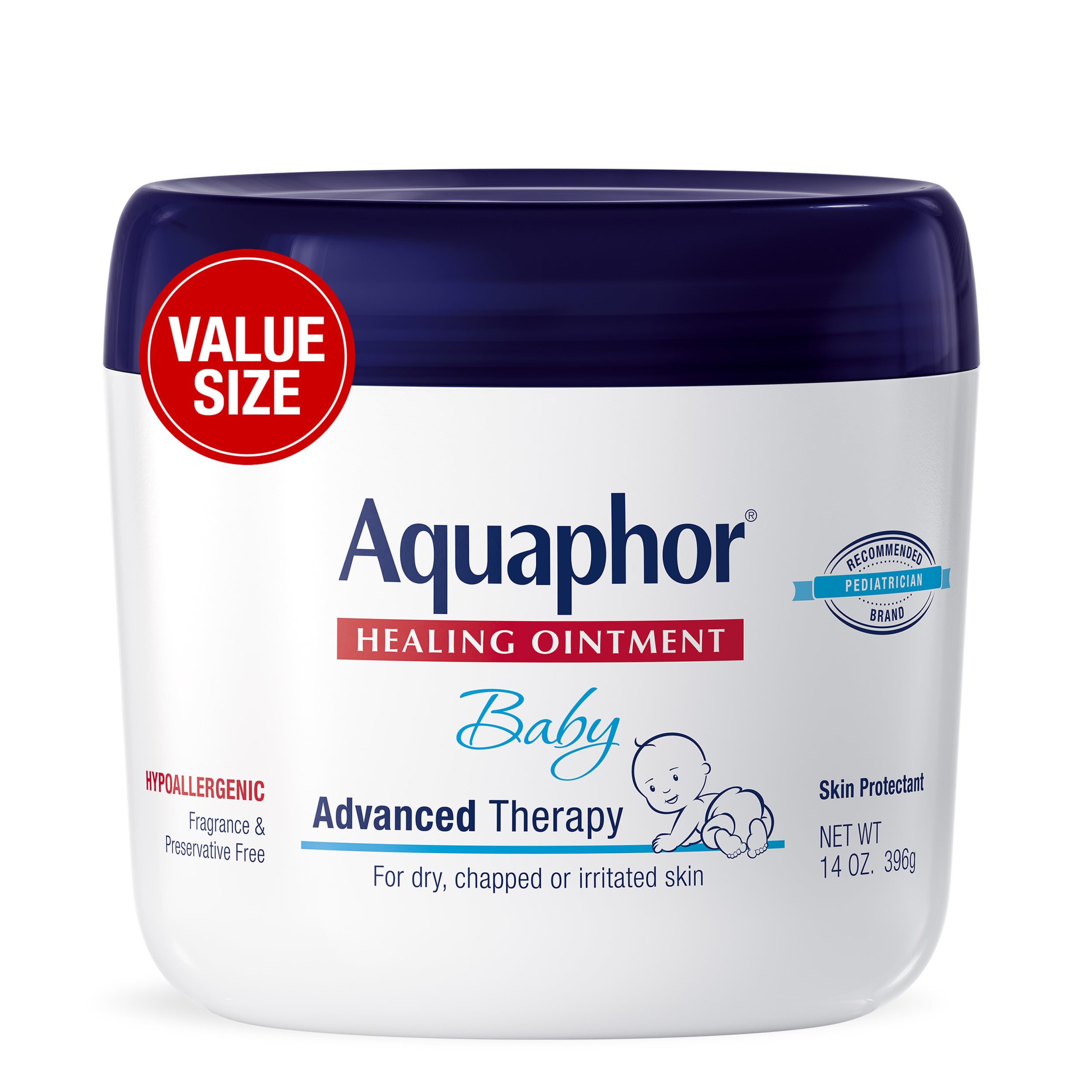
Aquaphor Baby Healing Ointment
Key Features
- Size: 14 oz
- Free from: Fragrance, preservatives
- Multi-use: Diaper area, chafing, dry skin
- Active ingredient: 41% petrolatum
- Price: Midrange
There is no zinc in this jar, and that is exactly why it earns a place. Aquaphor is 41% petrolatum, which does not so much treat a rash as keep one from starting: it seals skin against wetness and chafing and lets oxygen through. That is the half of diaper care a thick paste cannot cover, and on clear skin at every change it is what we use.
It also works around the diaper as well as under it. The dribble rash that collects beneath a chin, the chapped cheeks that arrive with teething, dry patches on arms and legs — one 14 oz jar handles all of it, which is why it ends up on the shelf within reach rather than in a drawer.
Where it stops is a rash that has already broken the skin. For that you want zinc, and our top pick or Triple Paste will do more. On a bottom that is merely pink and damp, this is the gentler answer, and it is the one we put on a newborn.
Pros
- Barrier protection without a rash-fighting ingredient
- Handles drool rash, chapping, and dry patches
- Fourteen-ounce jar lasts through daily use
Cons
- No zinc, so it cannot treat broken-skin rash
No zinc, and that is the point: we use this 41% petrolatum ointment on clear skin at every change, and on the drool rash and chapped cheeks a diaper cream never reaches.
Best for Diaper Bag Duty
Boudreaux’s Butt Paste Max
Key Features
- Form: Tube
- Size: 4 oz
- Recommended age: 0 to 12 years
- Active ingredient: 40% zinc oxide
- Price: Budget
Every diaper bag needs one cream that does not eat the whole pocket, and this is the tube we keep in ours. Boudreaux’s Maximum Strength packs 40% zinc oxide — the same strength as the tub we recommend first — into four ounces of thick, cream-like paste.
That consistency is the whole argument for it. It goes where you put it and stays there through a car seat, a nap, and the walk home, and there is nothing fiddly about getting it out of the tube when you are working one-handed on a bench in a parking lot.
Our take is that this is a tube for occasional redness rather than a two-week flare. Four ounces disappears quickly when you are applying at every change, so if the rash is stubborn, put a tub on the changing table and keep this one for the road.
Pros
- 40% zinc oxide in a small tube
- Fits a diaper bag or a coat pocket
- Thick, cream-like paste that stays put
Cons
- Four ounces goes quickly with daily use
The tube we keep in the stroller: the same 40% zinc oxide as our top pick in a size that fits a pocket, for a baby who only gets the occasional red patch.
Best for Wriggly Babies
Boogie No-Rub Diaper Rash Spray
Key Features
- Size: 1.7 fl oz, 3 pack
- Application: Touch-free spray
- Active ingredient: 25% zinc oxide
- Sprays per bottle: 200+
- Price: Premium
If your baby treats a diaper change as a wrestling match, the case for a spray makes itself. Boogie’s version is one-handed and touch-free, landing as a fine mist that dries slightly powdery — no cream on your fingers, no rubbing a sore bottom to spread it, and no negotiating with a baby who has decided to roll.
It carries 25% zinc oxide, less than the 40% pastes here, and we think that is the right trade for what it is. On a mild rash, the cream that actually gets applied beats the paste that does not, and the barrier it leaves is enough for everyday redness. For raw, weeping skin, go back to a thick paste.
Cost is where it gets harder to love. It is priced like a premium product, and the three-bottle pack only makes sense if you will use it — though with a toddler who fights every change, three bottles do disappear. Keep the nozzle clean, since a clogged spray turns the whole idea back into a chore.
Pros
- No touching, no rubbing, no mess
- One-handed application on a moving baby
- Over 200 sprays per bottle
Cons
- Premium price for a convenience format
- Lower zinc oxide level than the pastes
For the baby who rolls away mid-change, this is the answer: 25% zinc oxide in a spray that lands where you aim and never touches your fingers.
Best for Cloth Diapers
Earth Mama Organic Diaper Balm
Key Features
- Size: 4 fl oz, 6 pack
- Formula: Zinc-free herbal balm
- Certification: Certified organic by Oregon Tilth
- Diaper compatibility: Cloth diaper friendly
- Price: Premium
Cloth diapering changes the cream question. The thick zinc pastes that protect a bottom best are also the ones that cling to fabric and leave residue behind, which is why cloth households often look for something else entirely. Earth Mama’s balm is that something: no zinc, no petroleum, no preservatives, and a formula listed as cloth-diaper friendly.
What is in it instead is a blend of organic herbs — calendula, chickweed, plantain, St. John’s wort — in a base that smells like a garden rather than a medicine cabinet. It is certified organic by Oregon Tilth, and it goes on like a balm rather than a paste, so you can work it into skin folds and under a chin without leaving a white mess.
Results are why it holds a place here. Redness that is there at the last change of the evening tends to be gone by morning, and it manages that without the residue that makes cloth parents wince. The catch is the box it arrives in: this is the economy six-pack, a serious outlay for a family that has not tried the balm yet. Buy a single jar first if you can, and commit to the case once you know it works.
Pros
- Zinc-free and safe with cloth diapers
- Clears redness without white residue
- Certified organic ingredients
Cons
- Sold as a six-pack, a large upfront cost
- No zinc, so severe rashes need more
The cloth-diaper answer: a zinc-free, petroleum-free balm that washes out of fabric and settles redness, sold in a bulk six-pack that only makes sense if you are committed.
Best for Fragrance-Free Treatment
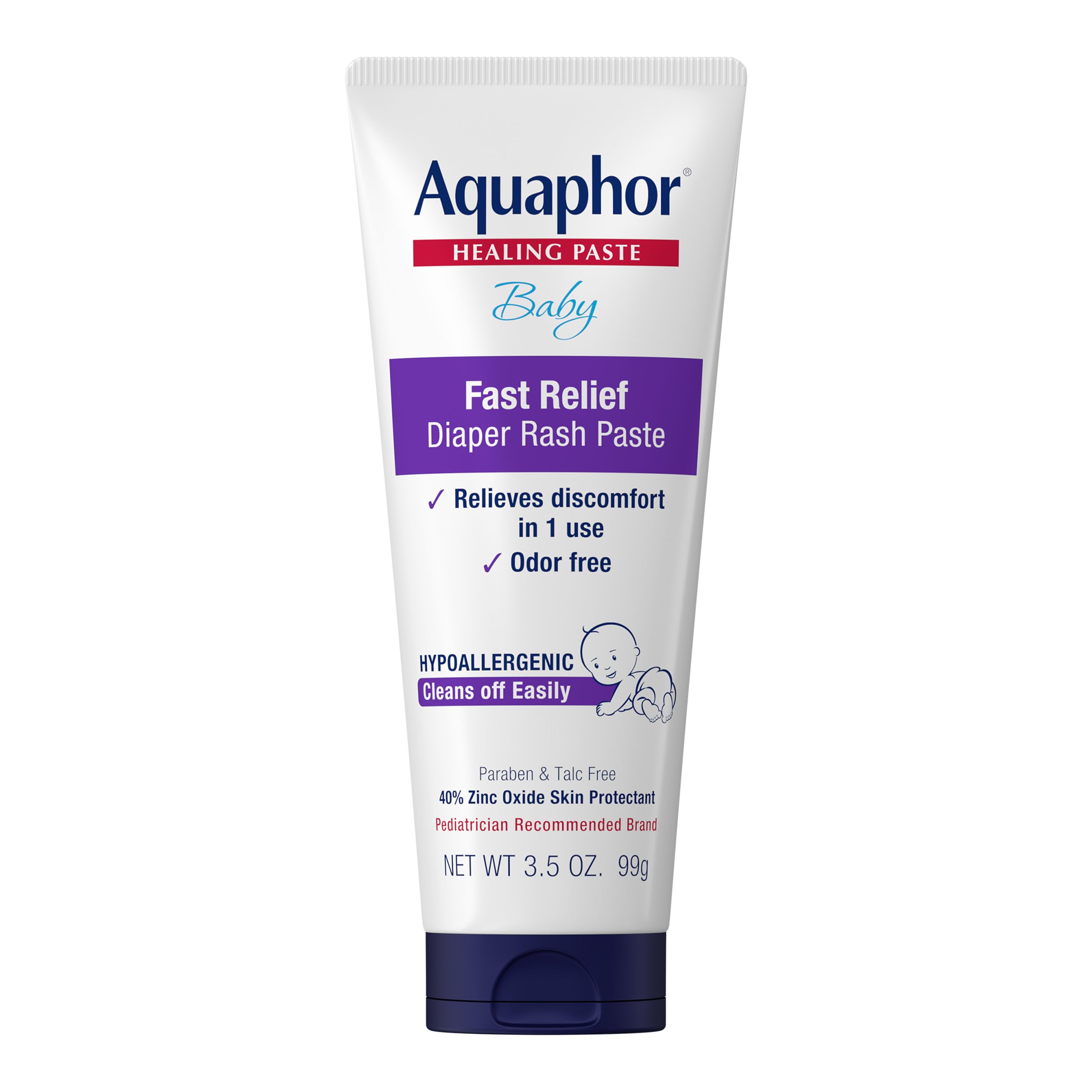
Aquaphor Baby Diaper Rash Paste
Key Features
- Size: 3.5 oz
- Free from: Fragrance, parabens, talc
- Intended for: Moderate to troublesome rash
- Active ingredient: 40% zinc oxide with shea butter
- Price: Budget
Same 40% zinc oxide as our diaper-bag pick, without the smell that one carries. Aquaphor’s Baby Diaper Rash Paste adds shea butter to the zinc, skips fragrance, parabens, and talc, and comes in a 3.5 oz tube that fits wherever the other one does not.
In use it is a genuinely sticky paste, and that is meant as a compliment. It grips the skin instead of sliding, which is what makes it a real barrier on a moderate rash, and it is also why a change takes an extra wipe — especially in the creases at the top of the legs.
The tube is both the appeal and the limit. It is the right size for a changing bag, a grandparent’s house, or the car, and the wrong size if it is going to be your everyday cream, because you will be replacing it constantly.
So we treat it as the fragrance-free alternative to Boudreaux’s rather than a first choice: the same strength, no scent, a little harder to clean up, and roughly the same money.
Pros
- 40% zinc oxide with shea butter
- Fragrance-, paraben-, and talc-free
- Small tube travels well
Cons
- Takes extra wiping out of skin folds
- Small tube for everyday use
If the smell of our top pick puts you off, this is the same 40% zinc in a fragrance-free travel tube that grips skin and stays where you put it.
Best for Mild, Easy Cleanup
A+D Treat & Heal Zinc Cream

Key Features
- Form: Tube
- Size: 4 oz
- Active ingredients: Zinc oxide and dimethicone
- Price: Budget
This is the cream that comes off in one pass. Where the pastes here need a wipe and some patience, A+D’s zinc cream glides on, spreads evenly across a sore bottom, and lifts away at the next change without leaving a film behind.
Zinc oxide and dimethicone do the protecting, a pairing that seals out wetness without the grip of a 40% paste. For mild redness — the pink that shows up after a long nap or a day of acidic stools — that is plenty, and it is easier to apply to a baby who complains about being touched.
The trade is staying power. It lays down a lighter film than Desitin or Triple Paste, so for a rash that is raw or spreading we want the thicker product. We would rather keep both in the house than ask one tube to do the other’s job.
As the everyday cream, though, it is hard to argue with: quick to apply, quick to clean up, and one of the least expensive tubes here. If your baby’s rashes are mild and your patience for scrubbing is low, this is the one to keep by the changing pad.
Pros
- Spreads evenly and wipes off easily
- Zinc oxide plus dimethicone barrier
- Low-cost four-ounce tube
Cons
- Lighter barrier than a thick paste
For mild redness and parents who hate scrubbing: this cream spreads in one pass and wipes off just as easily, with zinc and dimethicone doing the protecting.
From the Changing Table: How We Tested Diaper Rash Creams
We started with more than 30 diaper rash creams from drugstore shelves, best-seller lists, and pediatrician recommendations. We narrowed it to 14 by comparing ingredient panels—zinc oxide and petrolatum content, fragrance or essential oils, and sensitive-skin claims. Price per ounce mattered, but we skipped anything that felt like a bargain-bin gamble. The final 14 went home with a panel of parents whose babies ranged from 3 to 18 months, and we used them for three months.
Testing happened at the changing table. We applied each cream at every diaper change—daycare drop-offs, post-nap changes, and 2 a.m. wake-ups. At the next change, we checked whether the cream was still visible or had rubbed off onto the diaper. We noted how thick it felt between two fingers and whether it spread easily or dragged. To judge removal, we counted how many baby wipes it took to clear the skin. For protection, we watched whether existing redness calmed down over a day or two, and whether new rash appeared in the folds.
Fragrance was easy: we smelled each cream from the tube and again on the skin an hour later. Moisturizing showed up as whether skin felt soft after wiping clean, or tight and dry. Longevity was about the tube—we tracked how many days a 4-ounce tube lasted with twice-daily use, then divided by the number of changes to get a real cost per application. Value for money wasn’t the sticker price; it was how far a tube stretched and whether we needed to reapply more often. We’ll keep using these and update if anything changes.
How to Choose a Diaper Rash Cream
The right cream comes down to one question: are you treating a rash that is already there, or keeping one from starting?
Match the active ingredient to the job
For an active rash you want zinc oxide, and the percentage tells you what you are buying. Forty percent is the ceiling in this group and the level both our top pick and Boudreaux’s use — a genuine treatment strength. Around 13% is a daily-defense level: enough for mild redness, easier on skin that is being cleaned many times a day.
Petrolatum is the third option, with no rash-fighting ingredient at all: just a barrier that keeps wetness off clear skin, which is what Aquaphor’s healing ointment does. Most families end up owning two of the three — a strong paste for flares, something lighter for maintenance.
Read the inactive list, not just the active
Fragrance is the ingredient most likely to upset a baby’s skin and the one most likely to arrive unannounced: a cream can be free of added perfume and still smell strongly of its base. If your baby has reacted to a cream before, start with one that is explicitly fragrance-free, such as Triple Paste, the Aquaphor rash paste, or Desitin Maximum Strength.
Natural is not a shortcut here. Earth Mama’s balm contains no artificial fragrance and is still scented by its herbs, which suits plenty of babies and not all of them. Patch-test anything new on a small patch of skin for a day before you commit to a whole tub.
Decide how much staying power you want
Thick pastes protect best and are the most work. They stay put through a bowel movement and a long nap, and they take a wipe or two to get off your fingers and out of skin folds. Lighter creams like A+D’s zinc cream come off in one pass and feel kinder on a sore bottom, but they give up sooner overnight.
Our habit is to use the thickest paste at bedtime, when nobody wants to be woken by a wet barrier, and something easier during the day. That beats hunting for one cream that does both jobs well.
Sort out cloth diapers before you buy
Zinc pastes and cloth do not mix well. The cream clings to fabric, can leave residue behind, and complicates the wash. If you cloth diaper, either use a disposable liner under any zinc cream or choose a zinc-free balm like Earth Mama’s, which is listed as cloth-diaper friendly.
The rest of the routine does not change — clean, dry, apply — but the product has to come out in the wash, not just off the baby. That single requirement narrows the list faster than any ingredient claim.
Pick the format for where you will use it
A tub stays on the changing table and is the most economical way to buy; a tube lives in the bag; a spray is for a baby who will not lie still. The trap is buying only the small format — four ounces disappears fast when you are applying at every change — or expecting a spray to do a paste’s job.
Sprays deliver a thinner coat at a higher price per use, which is fine for mild redness and not much help on a bad one. Buy the format that matches the changing table first, then a travel version second.
Frequently Asked Questions
How thick should I apply diaper rash cream?
Thicker than feels natural. For treatment, aim for a visible layer you can still see at the next change — spread thin enough to cover, thick enough that the skin underneath is not showing through. At bedtime, go thicker still, since a paste that survives the night does more than a film that has rubbed away by midnight.
On clear skin, used for prevention, a thin coat is enough. You are not moisturizing; you are putting a barrier between skin and wetness.
Will zinc oxide cream stain my baby’s clothes?
It can leave white marks on dark onesies and on the waistband of a diaper cover. Most of it washes out, but treat the marks with a stain stick and a cool wash before they set rather than after.
During a bad flare we dress the baby in light colors and save the nice outfit for later. The cream is doing its job precisely because it is not soaking in.
When should I stop switching creams and call the pediatrician?
Most rashes start easing within a day or two of consistent barrier protection. If it is worse after two or three days of steady use, or you see bright red skin with small satellite spots, blisters, or a rash that keeps coming back within hours of clearing, that is a pediatrician question rather than a cream question.
Bring the cream you have been using to the appointment; the ingredient list is more useful to a clinician than the brand name.
Final Verdict
If you are buying one cream today, make it Desitin Maximum Strength: the highest zinc oxide level in this group, a barrier that holds through the night, and a tub big enough to use without rationing. It is the cream we would put on an established rash before trying anything else.
Switch to Triple Paste if your baby’s skin reacts to everything or the rash has been slow to settle, and to the Boogie spray if getting cream onto your baby at all is the fight. For cloth diapers, buy Earth Mama’s balm instead — it is a different product doing a different job, not a lesser version of the paste.
