This post contains affiliate links. We may earn a small commission when you buy through our links — at no extra cost to you.
The first time you steam a butternut squash, mash it, and turn around to a sink full of baskets, lids, and spatulas, the appeal of a dedicated baby food maker becomes obvious. These appliances are meant to shrink the work of feeding a baby: steam, blend, and clean without turning your kitchen into a production line. A good one fixes the daily friction; the wrong one just moves it to the sink.
Over the past eight months, my team and I have put 12 baby food steamers and blenders through weekday breakfasts, Sunday batch cooking, and the occasional late-night puree panic. We weighed blending power against cleanup, tracked how often we reached for each one while holding a baby, and kept an eye on reliability, durability, staining, leaks, and whether a bottle-warmer setting is useful or just another part to wash. Value, to us, is a machine that still runs smoothly after months of carrots and doesn’t make you dread the sink.



Best for Daily Purée Making
EVLA’S Baby Food Maker
Key Features
- Cleaning: Self-clean cycle
- Controls: Touch screen
- Steam and blend: Same bowl
- Price: Midrange
A sweet potato goes into the basket, fifteen minutes of steam later it is soft, and a minute after that it is purée — in the same bowl, with nothing poured from one hot container into another. Then you fill the tank, press clean and walk away. That loop is the whole case for the EVLA’S, and it is why this is the machine we point first-time parents toward.
Consistency is what puts it ahead of the rest of this group. Blending is where most of these machines struggle: fibrous vegetables and fruit skins collect at the top of the bowl and you end up stopping the cycle to scrape down the sides. In our batches, the EVLA’S pulled the food down and finished the job, and the result was smooth enough for a first spoon without a second pass. Since the machine’s whole purpose is to buy you time, that matters more than anything else on the box.
Texture comes from cycle length rather than a dial: run the auto blend once for a thin stage-one purée, twice for something with more body. The touchscreen is the only control, which keeps the front panel clean and means there is nothing to knock out of position with a wet hand. Parts are few — basket, bowl, lid — and everything that touches food is dishwasher safe, the kind of detail you appreciate at nine at night.
Batches are sized for a few days of feeding rather than a month in the freezer, and for most households that is the right shape: you are cooking alongside dinner, not running a production line. Where it earns its keep is the evenings you don’t have it in you to cook at all — a tank of water, a chopped apple and fifteen minutes gets you out of the kitchen with a fed baby.
Pros
- Steams and purées in one bowl
- Self-clean cycle between batches
- Smooth results with fibrous vegetables
- Only three parts to wash
Cons
- Lid seal must seat flat or it leaks
The one we recommend first: steam and purée happen in one bowl, it cleans itself afterwards, and fibrous vegetables come out smooth.
Best for Stain-Free Steaming
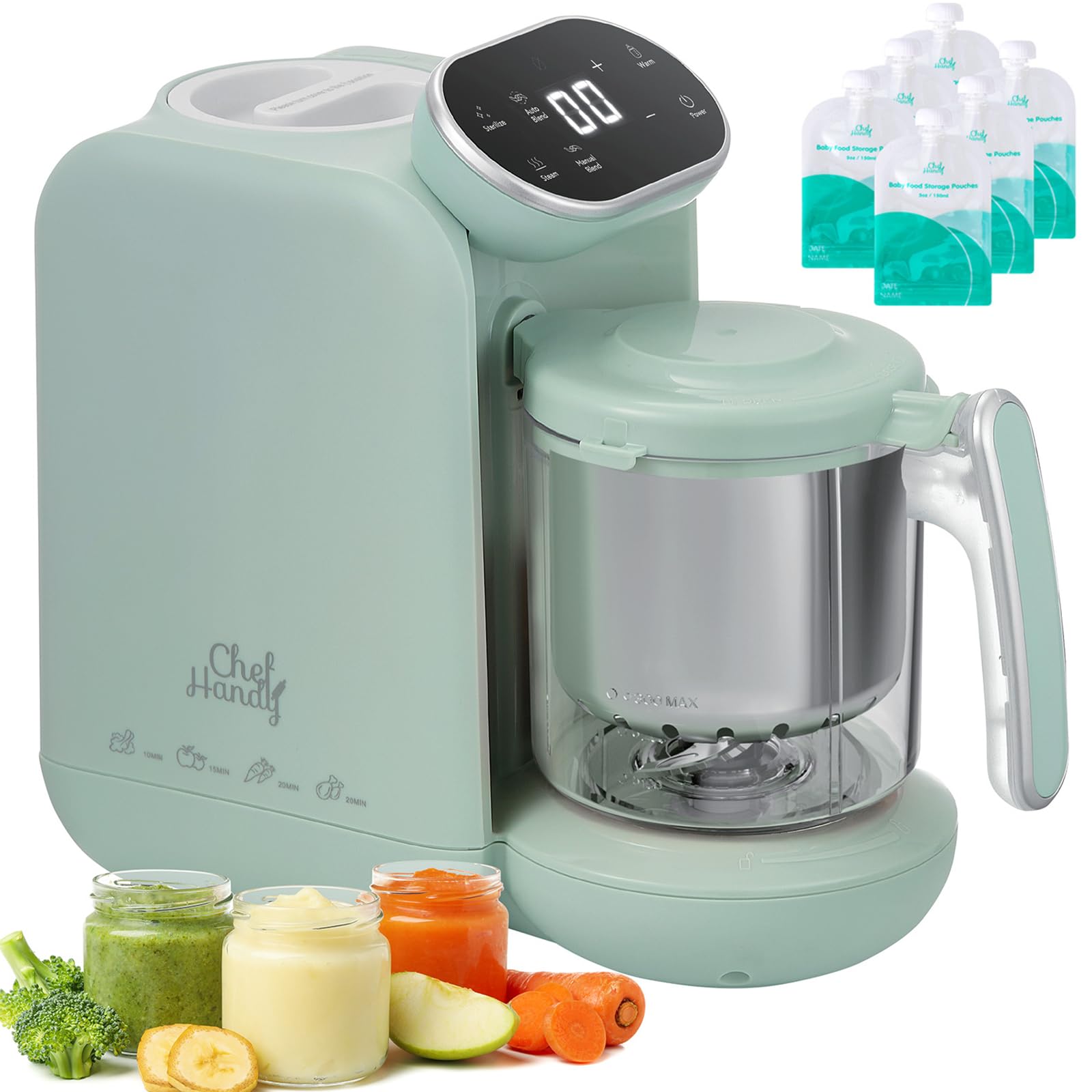
Chefhandy Baby Food Maker
Key Features
- Functions: Steam, blend, warm, sterilize
- Blend modes: Auto and manual
- Steam basket: Stainless steel
- Bowl capacity: 0.75 liters
- Price: Budget
Stainless steel in the steam basket is the detail that separates the Chefhandy from everything else on this list. Plastic baskets take on the colour of whatever went in last — sweet potato and carrot are the usual offenders — and a basket that looks five years old after five weeks is hard to love. Stainless wipes clean, holds no smell and doesn’t discolour. That alone is reason enough to choose this one over a machine with a plastic basket.
It is a capable machine underneath the fix. The 0.75-litre bowl sits in the middle of this group — a few days of purée, not a freezer marathon — and the 300-watt motor takes the auto blend in its stride. Steaming is the stronger half; vegetables come out soft enough to purée on the first pass, and the manual blend lets you leave lumps when your baby is ready for them. Bottle warming and sterilizing are the functions that keep it out on the counter after the purée stage ends.
Two practical notes before you order. The bowl is hand wash only, which is the trade for that stainless basket, and the silicone seal ring is the piece to check when you take it apart. We got more use out of the included recipe guide than expected — it lists steam times per food, which is exactly the part new parents guess at.
Pros
- Stainless basket resists stains and odour
- Auto and manual blend for texture
- Bottle warming and sterilizing built in
- Pouches and recipe guide included
Cons
- Bowl is hand wash only
- Silicone seal ring can wear out
Buy it if stained plastic would bother you: the stainless basket stays clean, and the auto blend plus bottle warming covers more than purées.
Best for Tiny Kitchens
Grownsy Baby Food Maker
Key Features
- Blend modes: Auto and manual
- Bowl capacity: 300 ml
- Bowl material: BPA-free Tritan
- Price: Budget
Counter space is the quiet decider in this category. If your kitchen already has a bottle warmer, a drying rack and a formula tin on the go, the Grownsy is the machine that fits in the gaps: a 300 ml bowl, a body small enough to shift aside when you need the counter back, and a basket that lifts out without a fight.
For its size it does the full job. The elevated steam basket keeps the food above the water rather than sitting in it, the bowl is BPA-free Tritan, and there are two mixing modes — auto for a hands-off purée, manual when you want to watch the texture. A chopped apple fits in the basket in one go, which is a fair picture of what small batch means here: a couple of portions, not the week.
The basket is where it gives ground. It is plastic, and sweet potato or carrot leaves a mark that a scrub won’t lift — rinse it the moment the cycle ends and you’ll keep it presentable for longer. We minded the stain less than the size: 300 ml goes quickly once your baby is on three meals a day. For the first months of solids in a kitchen with no spare counter, though, it is the machine most likely to still be sitting out when you need it.
Pros
- Small enough for a crowded counter
- BPA-free Tritan bowl
- Auto and manual mixing modes
- Elevated basket for true steaming
Cons
- 300 ml batches are small
Our pick for small kitchens: compact, simple and quick, provided you’re feeding one baby a portion or two at a time.
Best for Texture Control
NutriBullet Baby Steam + Blend
Key Features
- Speeds: 3
- Cleaning: Bowl and lid top-rack dishwasher safe
- Blend functions: Manual, pulse, auto
- Price: Midrange
One dial, three positions and a pulse. The NutriBullet Baby Steam + Blend is the least fussy interface here: turn one way to steam, the other to blend, and the middle setting runs the whole steam-then-blend cycle by itself while you get on with something else.
That dial is also the most useful texture control in this group. Manual blend and pulse let you stop exactly where you want, which matters far more once your baby moves from smooth to lumpy — you can leave a purée with a bit of body instead of committing to a full cycle. At 450 watts it has more muscle than the budget machines, and it cooks and purées in the same bowl, so there is nothing to decant while it’s hot.
The trade is how it ages. The bowl and lid are top-rack dishwasher safe and the blade wipes clean, but the plastic takes on colour — carrot and sweet potato first — and the handle is the part that gives way. Treat it as a one-baby appliance: keep the receipt and the box, and register the warranty when it arrives.
We rate it as the pick for a household that cooks by feel rather than by preset, the sort of person who tastes as they go and adjusts. If you would rather press one button and come back to a finished purée, the EVLA’S is the easier machine; if you want to decide when the blending stops, this is the one.
Pros
- Manual, pulse and full auto blend
- 450 watts, more than the budget machines
- Compact body with a small footprint
- Bowl and lid are dishwasher safe
Cons
- Plastic parts stain from orange foods
- Handle is a weak point
Our pick for hands-on cooks: a single dial, real pulse control and a compact body — just expect the plastic to show its age.
Best for Batch Cooking
Béaba Babycook Solo
Key Features
- Speeds: 1
- Cleaning: Dishwasher safe
- Steam basket: 800 ml
- Bowl capacity: 4.5 cups
- Price: Premium
Twenty-seven servings is Béaba’s own number for a full 800 ml steam basket, and the 4.5-cup bowl is the largest on this list. That changes the rhythm of the job: instead of a portion at a time, you steam a batch of carrot and a batch of chicken in turn, blend each, and fill the freezer. If you work full-time and cook on Sunday, nothing else here matches the volume.
It is a one-speed machine, and that is the thing to understand before you buy. Texture comes from how long you run the blade rather than from a setting, so you pulse in short bursts and stop when it looks right. We found that fine for the way most people actually cook, though it takes a batch or two to learn. The one-handed operation and the auto shut-off timer are what make it pleasant at six in the morning: add food, add water, press steam, walk away.
The plastic bowl can crack at the seam, and at this price that is the risk to weigh. Check that replacement bowls and blades are easy to buy where you live before you commit — a bowl you can replace is worth more than one you can’t. What you are paying for is volume and a well-built steam basket, and on those two counts it is the strongest machine in this group.
Pros
- 800 ml basket, up to 27 servings
- Largest bowl in this group
- One-handed operation and auto shut-off
- 950 watts for a full basket
Cons
- Single speed limits texture control
- Plastic bowl can crack at the seam
The batch-cooking choice: the biggest bowl and basket here, one speed, and a plastic bowl worth checking before you commit.
Best for Budget Versatility
MOMYEASY Baby Food Maker

Key Features
- Blade: Removable
- Cleaning: Self-cleaning
- Controls: Touch panel
- Functions: Steam, blend, defrost, bottle warming
- Price: Budget
The MOMYEASY stacks more functions into one box than anything else here: steam, purée, chop, grind, defrost and a bottle warmer, driven from a touch panel, with a removable blade for cleaning and a wide stainless water tank that won’t rust. It is the version of this appliance for someone who wants the whole toolkit at the budget end of the list rather than one job done perfectly.
The core works. Food steams in the basket and purées in the same container, the auto cycle handles vegetables and fruit without much intervention, and the trace of excess water is routed away rather than left in the bowl. What we kept coming back to is that stainless tank: easy to fill, easy to wipe out, and you can see what is in it. When the alternative is a plastic reservoir you squint into, that is a daily win.
Where it wobbles is consistency. This is the machine in the group where unit-to-unit variation matters most, and the failure mode is the machine stopping rather than the food coming out wrong. Buy it somewhere with a straightforward return policy and run a full steam-and-blend cycle in the first week; you’ll know quickly what you’ve got. Do that, and the function-per-dollar math is hard to argue with.
Pros
- Steam, blend, defrost and bottle warming
- Removable blade for cleaning
- Stainless water tank resists rust
Cons
- Can stop working within months
The budget all-rounder: steam, blend, defrost and bottle warming in one box, with the widest unit-to-unit variation on this list.
Best for Budget Simplicity
AMZBabyChef Baby Food Maker

Key Features
- Texture: Fine to chunky
- Controls: Mechanical knobs
- Functions: Steam, blend, defrost, reheat
- Bowl capacity: 2 liters
- Price: Budget
Two mechanical knobs and a timer, with no touchscreen and no menu to learn. The AMZBabyChef is the simplest machine here to operate half-asleep: set the steam time on one dial, turn to blend, and the auto shut-off ends the cook for you.
It is also the roomiest bowl at the budget end: the mixing bowl is rated at 2 litres, and the blend is adjustable from fine to chunky rather than fixed. Four functions cover steam, blend, defrost and reheat, which is the sensible minimum, and the Tritan container is free of BPA, lead and phthalates. For a first machine bought before you know how long your baby will tolerate purées, that is a lot of function for the money.
The lid seal is where it asks for care: liquid can escape around the lid if the gasket isn’t seated flat, so rinse and dry the gasket separately rather than leaving it clamped shut between batches. What we liked most is that nothing about it needs explaining. Buy it as a first machine with half an eye on the return window, not as the one you plan to hand down to a second child.
Pros
- Two-knob mechanical control
- Large 2-litre mixing bowl
- Adjustable fine-to-chunky texture
- One-year limited warranty
Cons
- Plastic bowl can crack at the seam
The simplest way into steam-and-blend: two knobs, a big bowl and a lid seal that needs a careful hand.
How We Tested Baby Food Steamers and Blenders
We started by pulling together the steamers and blenders that show up most often in baby registries and parent forums, then narrowed the list by capacity, counter footprint, number of parts, and whether replacement seals and baskets were easy to find. From that shortlist, we tested 12 machines over eight months, running each through the same routine: steaming and pureeing single-ingredient batches, then moving on to thicker combinations of chicken, lentils, and fibrous greens. We timed each batch from loading the basket to a spoonable puree, and noted whether we could start a batch one-handed and how much hand-holding the controls required during a real feeding week.
Cleaning was the deciding test more often than any feature list. Right after each batch, we rinsed the basket, lid, and jug, then let a second dirty batch sit for an hour to see whether carrot or sweet potato stained the plastic and whether dried puree hid in the gasket. We also filled reservoirs to the max line and tipped each machine slightly to check for leaks, and ran fibrous greens and chickpeas through the blade to see if the texture came out smooth or needed scraping.
Over the eight months, we kept a simple log of motor strain, steam output, and any cracked lids or loose seals; a machine that needed a replacement part in month two lost points for reliability and durability. For models with a bottle-warmer setting, we warmed bottles of expressed milk and checked for hot spots and even heating. At the end, we compared what each machine could do against what it cost to run and clean—value here meant fewer steps, not more attachments.
How to Choose a Baby Food Steamer and Blender
Match the machine to how you actually feed your baby rather than to the feature list — the two things that decide whether you’ll use it daily are how the bowl workflow runs and how much it holds.
One bowl or two: how the workflow really runs
Nearly every machine here steams the food in a basket that sits inside the blending bowl, then blends in that same bowl. That is the design worth paying for: no pouring hot food from a steamer into a blender, no second jug to wash. The differences sit in the details — how easily the basket lifts out, whether the blade stays put during steaming, whether you’re fishing a hot basket out with a fork. A machine that makes you decant its food has given up the category’s main advantage, so look at how the basket and blade sit together before you order.
Batch size: how often you’ll actually cook
Bowl capacity ranges widely here, from 300 ml in the Grownsy to a 4.5-cup bowl and 800 ml basket in the Béaba, and it decides how often you cook. Small batches mean a session every day or two; a big bowl means a freezer afternoon. Neither is wrong. Match the bowl to your week rather than to a number: if you batch-cook on a Sunday, buy volume; if the machine lives on the counter and gets used fresh, a midsize bowl takes less space and gets used more. Bigger is only better if you’ll fill it.
Texture control as your baby moves from purée to lumps
Stage one is forgiving — almost anything will purée soft food eventually. The useful questions arrive later, when you want something thicker and the machine insists on smooth. Look for a manual or pulse function rather than a single automatic cycle: the NutriBullet’s dial gives manual blend, pulse and a full auto cycle, the Chefhandy and Grownsy split auto and manual, and the Béaba is one speed where texture comes from run time. Manual control also saves you when a food turns gluey, as potato and banana both do, because you can stop before it becomes paste.
Cleaning and the staining problem
Self-clean cycles all do the same thing: water plus a short blend. Useful between batches, no substitute for a wash. The parts that stain are the plastic ones — baskets, lids, bowls — and orange vegetables are the usual culprit, so a machine with a stainless basket sidesteps the problem entirely, which is why the Chefhandy takes this one. Whatever you buy, rinse the basket before the purée dries: dried sweet potato is far harder to shift than warm.
Durability is the thing to plan for
These are small appliances with a motor, a heating element and a plastic bowl, used daily for months. Failures cluster in two places: the motor or steam element giving up, and plastic bowls cracking at a seam or a handle. That is not a reason to skip the category, it is a reason to shop carefully. Keep the box for the first month, register the warranty, and check that replacement bowls and blades are sold separately before you commit to a premium model. A bowl you can replace is worth more than one you can’t.
Frequently Asked Questions
Can I use a baby food maker for adult food later?
Yes, and it is the best argument for buying one at all. The bowl will steam and purée soups, sauces, hummus and smoothies long after your baby moves to finger foods. Capacity is the limit — a 300 ml bowl is a single serving of soup — so if you want the machine to keep earning counter space, a larger bowl matters more than the baby-specific extras.
How long do homemade purées keep?
Cool a batch quickly, spoon it into small lidded pots or an ice-cube tray, and refrigerate what you’ll use over the next couple of days; freeze the rest. Label with the date, thaw one portion at a time rather than the whole batch, and reheat thoroughly, stirring and testing the temperature before it goes near the baby. Don’t refreeze a portion you’ve already warmed.
How loud are these machines?
The steam phase is close to silent, just a faint gurgle from the tank. The blend is a short, sharp burst rather than a long whirr, over in seconds, so the practical move is to blend before a nap rather than during one, or to shut the kitchen door. None of them will drown out a baby who has already decided to wake up.
Do I need the pouches and storage containers that come in the box?
Only if you’ll use them. A pouch set is handy for outings, and both the EVLA’S and the Chefhandy include one, but for the freezer, small lidded pots or an ice-cube tray do the same job. Don’t let a bundle of accessories decide the purchase — judge it by whether you’d buy those pieces on their own.
Final Verdict
The EVLA’S is the machine we recommend first: it steams and purées in one bowl, cleans itself between batches, and handles the fibrous vegetables that trip up cheaper machines.
Buy the Chefhandy if stained plastic would bother you — its stainless basket stays clean, and the bottle warmer and sterilizer keep it useful past the purée stage. Choose the Béaba if you’re cooking for the freezer rather than for tomorrow, and accept one speed and a plastic bowl you may end up replacing.
