This post contains affiliate links. We may earn a small commission when you buy through our links — at no extra cost to you.
A good kids go-kart is one of the few ride-on toys that earns its keep after the novelty wears off. Put a kid behind a wheel, point them at a driveway or a stretch of short grass, and the afternoon disappears. But the gap between a kart that becomes a favorite and one that sits in the garage comes down to unglamorous details: steering that responds, a ride that doesn’t rattle, and hardware that survives a season of hard use. The right one gives kids control, delivers enough fun per dollar to justify the space, and gives parents an assembly process that doesn’t require extra coffee.
I paid attention to steering, ride quality, and performance on surfaces kids use—driveways, cul-de-sacs, and a bumpy backyard path. Over eight months, my team tested 12 go-karts with kids of different ages and sizes, timing battery life on electric models and checking chains, tires, and welds on pedal versions. The keepers were the ones the kids asked to ride again—and the ones that didn’t make us dread assembly or a loose bolt.


Best for First Drift Kart
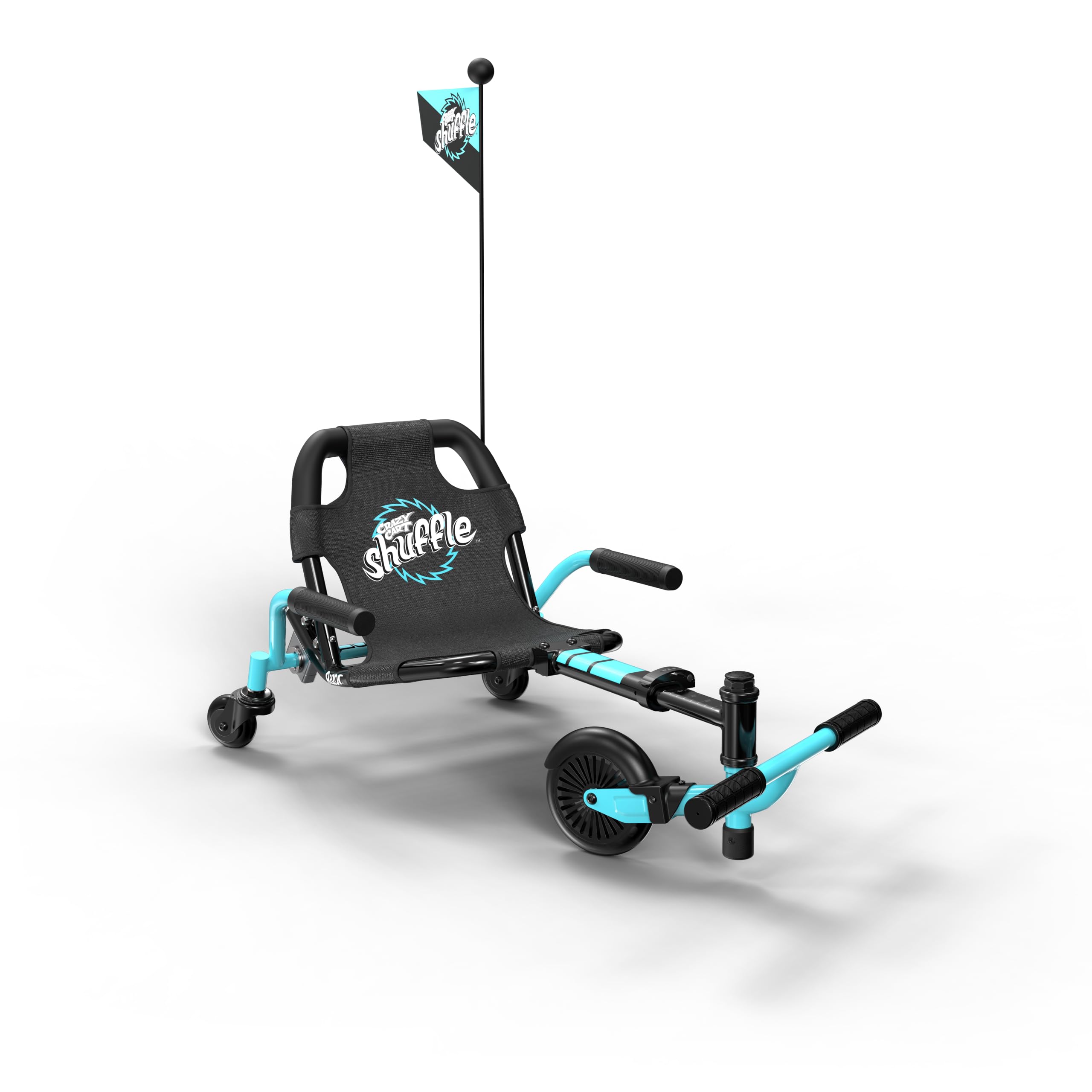
Razor Crazy Cart Shuffle
Key Features
- Frame: Adjustable length
- Age range: 4 years and up
- Propulsion: Kid-powered, no battery
- Weight limit: 150 lb
- Price: Budget
No charger, no warm-up, no argument about whether the battery is full. The Crazy Cart Shuffle is kid-powered, and that single fact is why it is the kart we recommend to almost every family: a four-year-old can haul it out of the garage and be sliding sideways a minute later. Riders build their own speed, pull the bar in their hand, and the rear casters let go.
The frame extends, which matters more than it sounds. The same kart that fits a cautious four-year-old still fits a lanky nine-year-old a few summers on, and because it carries up to 150 pounds, a parent can take a turn without folding it in half. Assembly is a screwdriver job, and the thing feels like a bike rather than a toy — the steel does not flex when a kid throws it into a turn.
Hard polyurethane wheels and rear casters want smooth ground. Driveways, courts, garage floors and the basement over winter are all fair game, it rolls quietly enough that a neighbor will not hear it through a wall, and the seat adjusts to the rider rather than the other way round. Grass is where it stops — the small hard wheels bog down the moment the surface softens, so treat this as a pavement kart.
What you get in exchange is the only kart here with nothing to recharge, nothing to replace and no motor to make a mistake hurt. For the child who just wants to slide, that beats a faster machine that spends half its life on a charger.
Pros
- No battery to charge or replace
- Adjustable frame grows with the rider
- 150 lb limit covers adults too
- Very stable and simple to assemble
Cons
- No brake; riders stop with their feet
If your kid is four to nine and you want zero charging drama, this is the kart we point you to: it is ready the second they are.
Best for Grass and Trails
Razor Ground Force Dune Runner
Key Features
- Brake: Hand-operated rear disc
- Motor: 350W chain drive
- Tires: 8 in pneumatic, knobby
- Top speed: 10 mph
- Price: Premium
Almost everything in this category is a pavement machine, and the Dune Runner is the one that is not. Eight-inch knobby pneumatic tires, terrain-following rear suspension, and a hand-operated disc brake on the rear axle: that is a specification for a yard, not a driveway.
It is the kart we reach for when the only open space is grass. The pneumatic tires hold traction where hard plastic wheels spin, the suspension takes the chatter out of a rough lawn, and the 350-watt chain drive pulls through it at up to 10 mph with a variable throttle instead of a switch. That combination is worth the premium if your kid rides on anything other than smooth asphalt — and if they ride on asphalt, you are paying for suspension you will not feel.
The rest is sensible: an open steel frame, a foam-padded bucket seat with a lap belt, and a hand brake that stops it in a straight line. At about 67 pounds it is a two-person lift into a truck bed, and the 40-minute run time is the usual figure for a kart this size. There is no reverse, so a wrong turn in a tight yard means getting out and pushing it back. Bring the battery inside when the temperature drops, because a frozen pack is a dead pack.
Ten miles per hour is at the top of this set, and the disc brake is why that reads as fun rather than frightening — it scrubs speed predictably instead of relying on feet. For a first motorized kart on rough ground, that is the combination we trust.
Pros
- Pneumatic knobby tires grip grass and dirt
- Rear suspension and hand disc brake
- 350W chain drive with variable throttle
- Lap belt and padded bucket seat
Cons
- Heavy at 66.8 lb to lift and store
If the riding happens on a lawn rather than a driveway, this is the electric kart to buy and the only one here built for it.
Best for Classic Pedal Kart
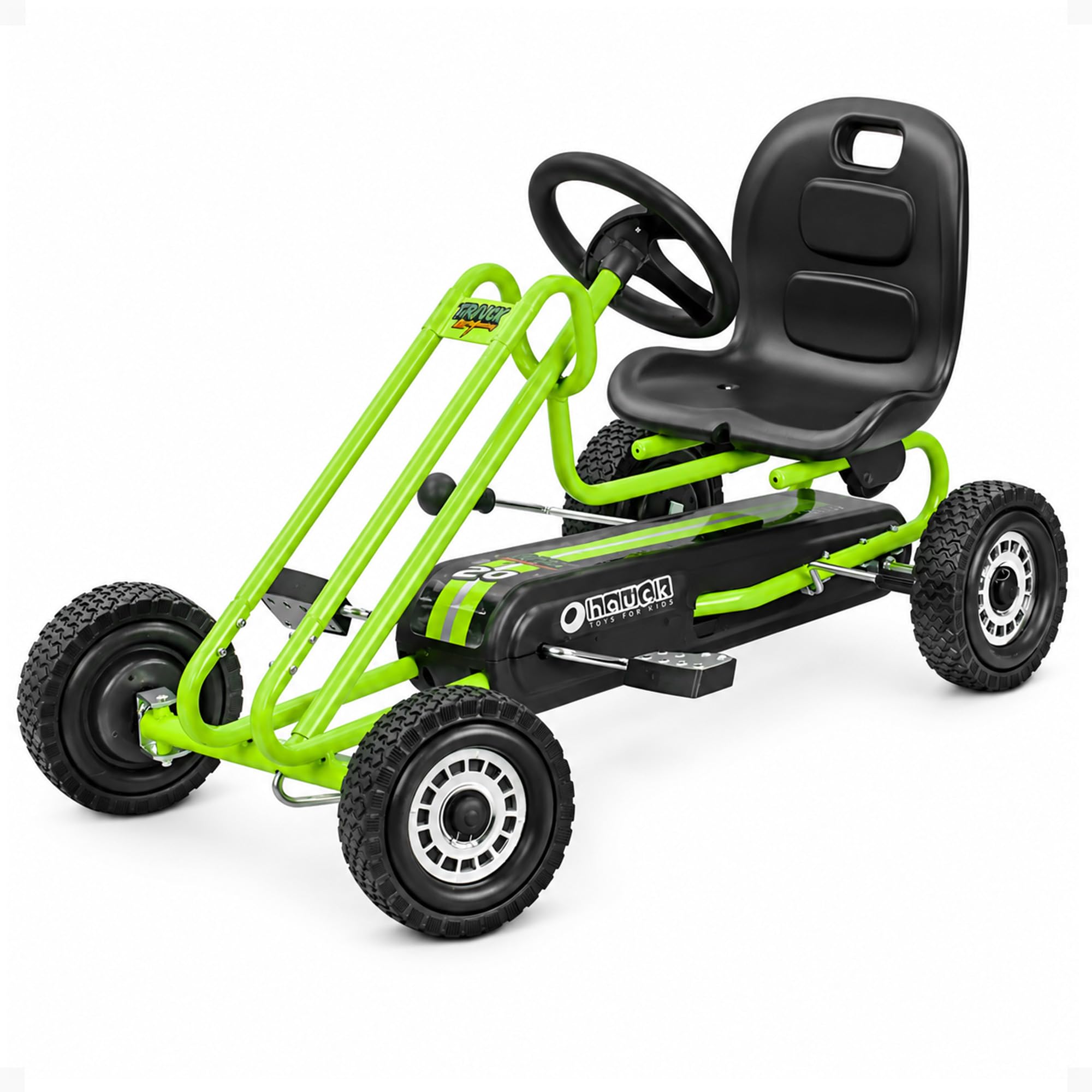
Hauck Lightning Pedal Go Kart
Key Features
- Brake: Handbrake on both rear wheels
- Age range: 4 to 8 years
- Weight limit: 110 lb
- Seat positions: 2, at 44 cm and 51 cm
- Price: Midrange
The handbrake is the whole argument for the Lightning. It grabs both rear wheels, which means a five-year-old can stop where they aimed instead of where the slope decided, and pedal karts live or die on exactly that kind of control.
It is a proper little machine: metal frame, plastic wheels with a rubber profile that roll easily on pavement, and a bucket seat with two positions 44 and 51 centimeters from the pedals, covering roughly four to eight years and 110 pounds. At just over 21 pounds it is light enough to sling into the back of a car, which is not true of anything electric here, and assembly is a screwdriver and half an hour.
One thing to plan around: the Lightning is a four-to-eight kart, and a tall seven-year-old is already near the end of it. If your rider is at the top of that range, the Hurricane is the same idea with more room and better wheels — otherwise this is the one to buy.
Pros
- Handbrake works on both rear wheels
- Light enough to lift into a car
- Two seat positions cover several years
- Metal frame and easy assembly
Cons
- Steering is stiff for small riders
- Pedals keep turning while coasting
For a four-to-eight-year-old on pavement, this is the pedal kart we hand over: the twin handbrake and 21-pound frame make it easy to live with.
Best for Adjustable Electric Drift
KerryYoo K61 Electric Drift Kart
Key Features
- Motor: 24V, 300W
- Top speed: 8.5 mph
- Frame length: 3 positions, 43.3-47.24 in
- Weight limit: 110 lb
- Price: Premium
The frame slides through three length positions between 43.3 and 47.24 inches, and that is the feature that got this kart into the roundup. Kids do not grow evenly, and a kart that can gain three inches of legroom is a kart you are not replacing next spring.
Four speed modes do the rest of the work. A six-year-old can start on the slow setting and a ten-year-old can have the top one, so one purchase covers two very different riders, and the top end of 8.5 mph is toward the quick side of this set. High-density rear drift tires break loose predictably on concrete and asphalt, and the low steel frame with an adjustable belt keeps the whole thing feeling more planted than you expect from a drift kart.
The 300-watt, 24-volt drive is smooth off the line rather than snatchy, which matters for a first driver, and the stated 40 to 70 minutes depends heavily on which mode they are in and how smooth the surface is. Bluetooth is here if your kid wants a soundtrack; the belt and the low seating are the parts that actually matter.
The caveat is electronics. Motors and batteries are the parts of this one that have been least consistent, so buy it somewhere with a straightforward return and put it through a full charge cycle in the first week, while sorting out a problem is still someone else’s job.
Pros
- Three frame lengths span growth spurts
- Four speed modes suit beginners and older kids
- Drift tires slide predictably on pavement
- Adjustable belt and low steel frame
Cons
- 110 lb limit caps older riders
- 54 lb takes two people to move
Buy this one if you want a single electric kart to serve a growing kid: three frame lengths and four speed modes do more for longevity than raw power.
Best for Taller, Heavier Kids
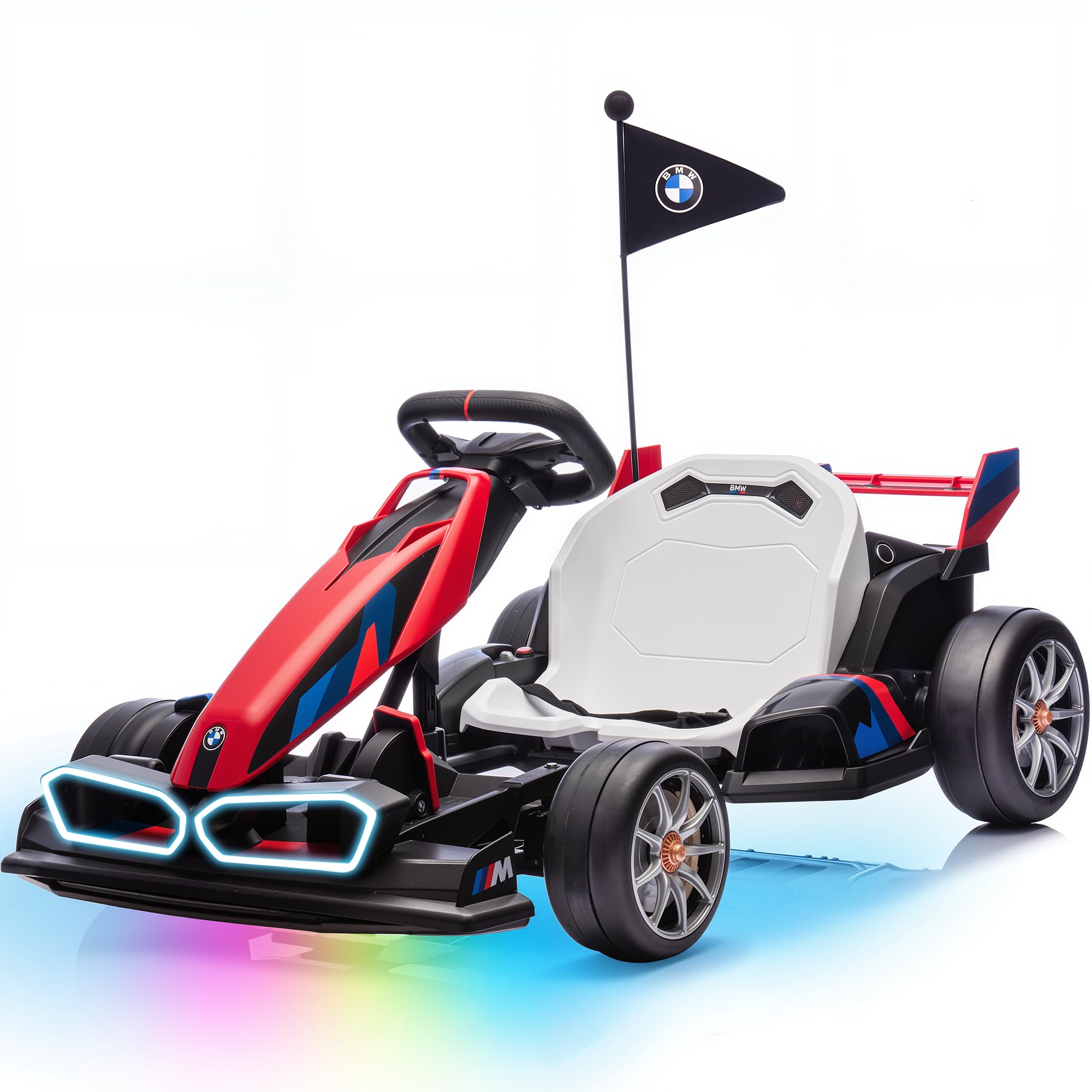
wanan 36V BMW Drift Kart
Key Features
- Motor: Dual 300W, 36V 9Ah
- Top speed: 6.2-8.1 mph
- Frame length: 38.6-50 in
- Weight limit: 132 lb
- Price: Premium
Fifty inches is long for a kids’ kart, and that length is the point. The body extends from 38.6 to 50 inches and the seat is a 15-by-8-inch bench rather than a bucket, so a ten-year-old with long legs sits in it rather than on it.
Underneath is a 36-volt, 9-amp-hour pack feeding two 300-watt motors, for 6.2 to 8.1 mph on the high setting and a low one for learning. Drift mode with EVA front tires and nylon rear drift tires does what it says on pavement, the two-point belt is easy for a kid to fasten on their own, and the steering-wheel light strip and flag are the sort of detail that sells a birthday present.
Where this one earns its place is the top of the size range. Most of the electric karts here top out around 110 pounds; this one carries 132 and gives a tall kid somewhere to put their knees, which is the difference between a kart that gets used and one that gets parked.
The cost is time. Eight to twelve hours on the charger buys about half an hour of riding, so plan charging around the school week rather than expecting a spontaneous Sunday. Reliability has been uneven, so keep the packaging until the first few charges are behind you.
Pros
- Extends to 50 inches for tall kids
- 132 lb limit suits older riders
- Dual motors with a drift mode
- Two-point seatbelt and wide seat
Cons
- 8-12 hours to charge for about 32 minutes
This is the pick for the tall kid who has outgrown everything else here: a 50-inch frame and a 132-pound limit buy a couple of extra seasons.
Best for Growing Pedal Riders
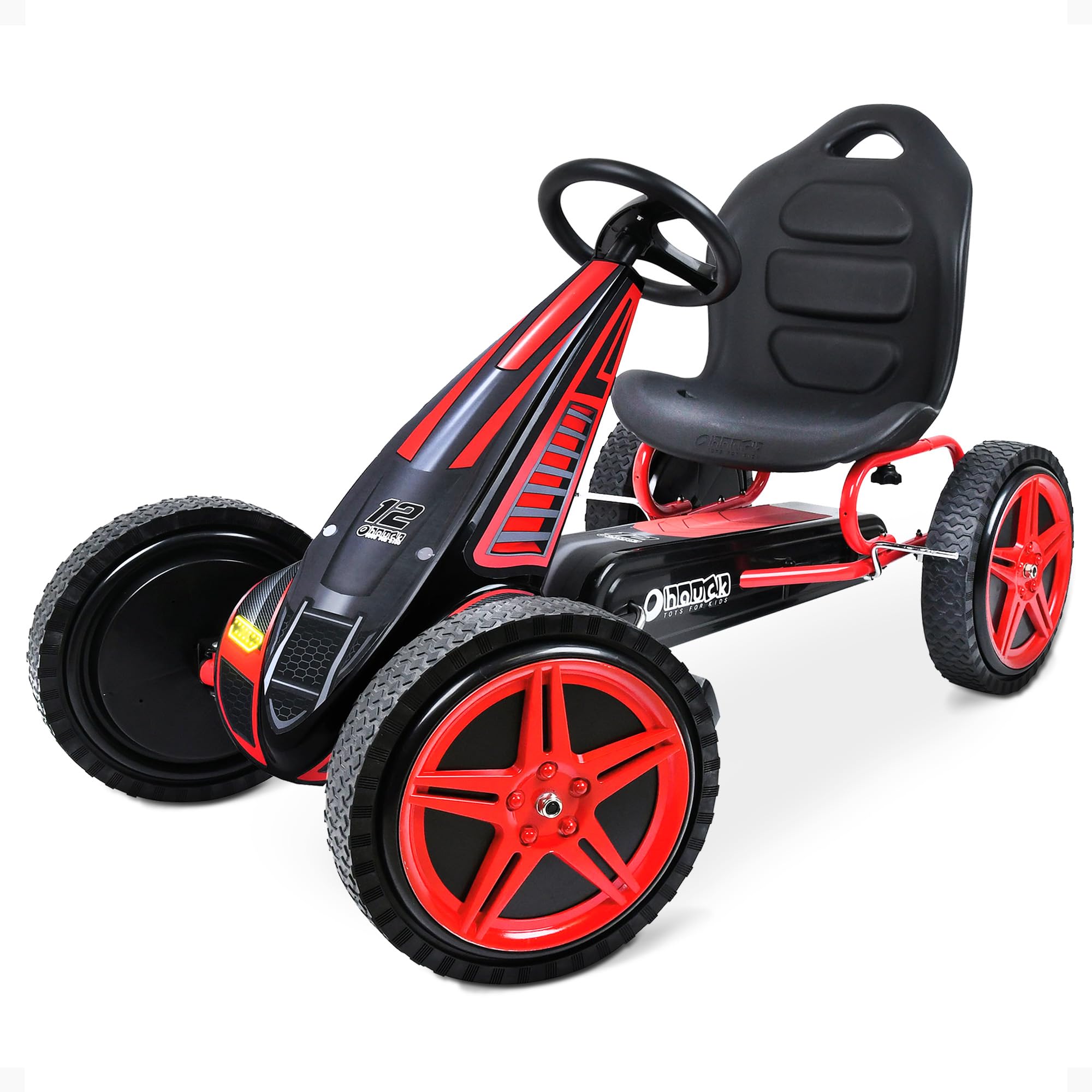
Hauck Hurricane Pedal Go Kart
Key Features
- Seat: Adjustable, high backrest
- Weight: 28 lb
- Wheels: Rubber tires, 2 bearings per rim
- Age range: 4 to 10 years
- Price: Midrange
The Hurricane is the Lightning’s bigger sibling, and the difference that matters is at the corners: rubber tires with two bearings in each four-spoke rim, instead of plastic wheels with a rubber profile. That is the upgrade that makes pedaling easier and lets the kart roll further on one push.
It is roomier, too. The seat adjusts and carries a high backrest, the frame is rated for four to ten years rather than four to eight, and the low-profile wheels and metal frame give it a more grown-up stance than you expect at this size. At 21.9 inches wide it slips past the electric karts for storage, which in a single-car garage is the difference between kept and stored.
For a seven- or eight-year-old who has outgrown the Lightning, this is the one we hand over. The bearings genuinely change how much work pedaling is, the backrest gives a taller kid something to push against on a slope, and the handbrake is there when the driveway runs out. The high backrest is the detail that decides it — the Lightning leaves nothing behind a child’s shoulders.
Pros
- Rubber tires with bearings roll easily
- Adjustable seat with a high backrest
- Fits riders up to about ten
- Sturdy metal frame and handbrake
Cons
- Graphics and decals peel early
For a taller rider who still wants pedal power, this is the better buy: rubber tires on bearings and a backrest the Lightning does not have.
Best for Licensed-Car Fans
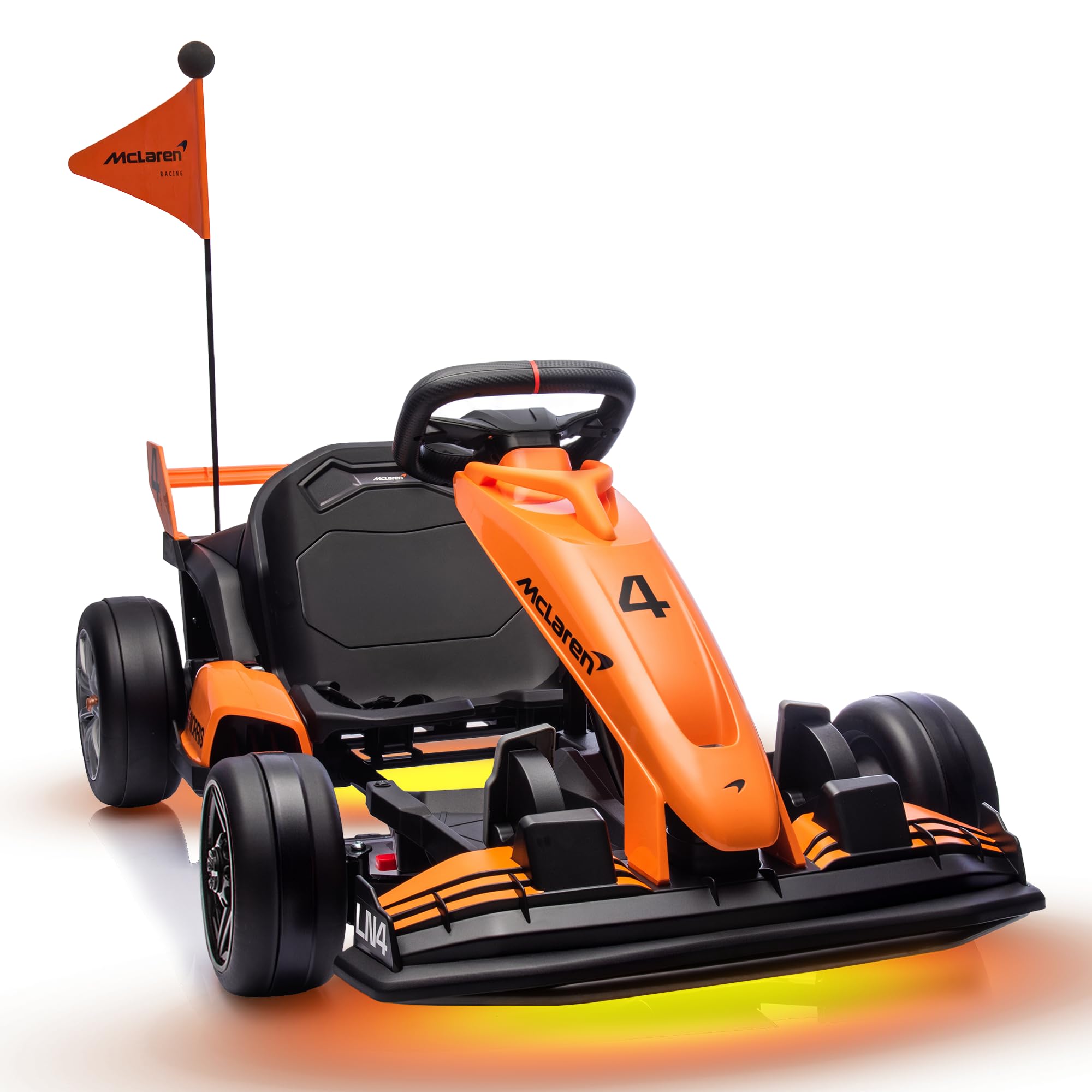
First Ride On McLaren 36V Go Kart
Key Features
- Frame: 3 lengths, up to 5.9 in extra
- Motors: Dual 250W, 36V 9Ah
- Top speed: 5.6-8.7 mph
- Weight limit: 132 lb
- Price: Premium
Orange underglow, red tail lights, a McLaren badge on the nose. This kart is selling theatre and it delivers — of everything here, it is the one a kid points at across a driveway.
The hardware underneath is respectable: a 36-volt, 9-amp-hour pack, dual 250-watt motors, two speeds at 5.6 and 8.7 mph, electronic braking, TPR front tires and nylon rears. Three frame lengths give it room to grow, and the 132-pound limit covers most kids up to twelve.
On pavement the electronic brake makes drifting feel controlled rather than accidental, and the low steel frame with an adjustable belt keeps a novice driver honest. It is also, at just over 70 pounds, the heaviest thing in this group — two adults or a trolley, not a one-person carry.
Buy it knowing you are paying for the look as much as the drive, because you are. The part we cannot vouch for is the third season: put the first few charge cycles through their paces while the return window is open, and keep the box until you are satisfied.
Pros
- Licensed McLaren styling with underglow
- Three frame lengths for growth
- Two speed modes and electronic braking
- 132 lb weight limit
Cons
- 70.6 lb is a two-person lift
Buy it for the kid who wants the car from the poster: the licensed look is the reason to choose this over better-proven electric karts.
Best for Big Kids, 8-12
Aosom 24V Electric Drift Kart

Key Features
- Motor: 24V dual drive
- Top speed: 8.1 mph
- Rider height: 35.4-59.1 in
- Weight limit: 154 lb
- Price: Midrange
A hundred and fifty-four pounds is the highest rider limit here, and it quietly changes who this kart is for. If your eleven-year-old has already outgrown a 110-pound drift cart, most of this category is closed to them; this one is not.
The rest of the package is aimed at that older kid: a 24-volt dual-drive system good for 8.1 mph, high and low modes, a two-position seat that spans roughly 35 to 59 inches of rider height, a soft start so the throttle does not snap, a seatbelt, and a steering wheel with music and a horn. PU front wheels and PE rears handle concrete and asphalt.
It is a 46-pound kart with a forty-minute run time, and the music-and-horn business is exactly the sort of thing a nine-year-old loves and a parent tunes out within a week. The seat adjustment is the more useful feature by a distance, because it is what keeps a fast-growing kid in the kart.
For a big kid who wants to drift and has been told they are too heavy for everything else, this is the sensible answer. Give the electronics a hard first week — that is the part of this one we trust least — and keep the paperwork handy.
Pros
- 154 lb limit, the highest here
- Seat adjusts for 35-59 inch kids
- Soft start and seatbelt for novices
- Music and horn add to the fun
Cons
- Forty minutes of run time per charge
If your eleven-year-old has already outgrown the 110-pound karts, this is the one that still fits — the 154-pound limit is why it is here.
How We Tested the Best Kids Go-Karts
We started with a shortlist of more than 40 karts and narrowed it by age and weight ratings, wheel and brake type, seat adjustability, replacement-part availability, and price relative to what came in the box. That left 12 models—both pedal and electric—that covered the range of what families actually buy. We built each one in a garage with the tools a typical parent owns, timing unboxing to first drive and noting any step that was unclear or needed a second set of hands.
Testing ran for eight months on driveways, a cul-de-sac, and a bumpy backyard path. We set up cone slaloms, practiced repeated starts and stops, and sent riders over a cracked section of pavement to see how much vibration reached the seat and steering wheel. For electric karts, we timed each run from a full charge until power dropped noticeably, then recorded recharge time. For pedal karts, we checked chain tension, tire wear, and whether the steering stayed true after a few weeks of hard use.
We watched how each kart performed on slight inclines, how quickly it stopped, and whether it felt stable when a rider turned sharply. We also noted which kart kids chose without prompting and whether they asked to go out again the next day—our read on fun and enjoyment. After every session, we inspected welds, fasteners, tires, and brake parts; over the eight months, we logged loose bolts, worn pads, cracked plastic, and any motor or battery hiccups.
Value for money wasn’t about the lowest sticker. We compared what each kart included—seat padding, harness, tires, and easy-to-find replacement parts—against how it held up and how often it got used. The karts that rose to the top stayed tight, steered predictably, and kept kids coming back.
How to Choose a Kids Go-Kart
The decision that shapes everything else is not the motor or the top speed — it is whether you want a kart that is always ready or one that is genuinely fast, because those come from two different families of machine.
Pedal, kid-powered, or electric
A pedal or kid-powered kart has no battery, no charger, and no chance of a dead pack on a Saturday morning. It also caps speed low enough for a four-year-old and gives a child something to push against for an hour. Electric buys you 8 to 10 mph, real drift, and a proper brake, and charges you in charging time and a battery that ages.
If your rider is under six, or the kart will live on a driveway in ten-minute bursts, buy pedal or kid-powered. If they are eight or older, have smooth pavement, and will actually ride it several times a week, an electric drift kart earns its upkeep.
Fit that lasts more than one summer
The age on the box is the roughest number on the listing. What matters is seat-to-pedal distance, how many positions the seat or frame offers, and the rider weight limit. The Hauck Lightning gives two seat positions, 44 and 51 centimeters; the KerryYoo K61 slides through three frame lengths; the wanan stretches to 50 inches. A kart with one fixed position is outgrown in a season.
Then read the weight limit honestly. A hundred and ten pounds arrives faster than most parents expect, especially with a tall nine-year-old, and the frame, axles and seat are not built for more than the number says.
Speed, modes, and the ground underneath
The electric picks here run from 5.6 to 10 mph, and every one of those figures assumes a light rider on flat, smooth pavement. Grass, gravel, and a slope will knock a couple of miles an hour off and drain the battery faster. Two speed modes matter more than the headline figure, because a beginner needs a low setting they cannot accidentally override.
Hard plastic and polyurethane wheels do not roll on soft ground at all. If your only riding space is a lawn, the pneumatic-tired Dune Runner is effectively the short list.
Brakes, steering, and drift
Braking is where cheap karts give themselves away. A handbrake acting on both rear wheels, a rear disc, or an electronic brake all stop predictably; feet on the ground are the fallback on kid-powered carts, fine at walking pace and less so at 8 mph. Steering effort matters just as much — a stiff wheel is miserable for a small rider on a long driveway.
Drift comes from the rear end, not the motor. Rear casters or hard drift tires break loose under steering input, which is why every fast kart here has one or the other.
Runtime, charging, and the weekly routine
Battery figures are quoted generously. Realistically you are buying half an hour to just over an hour of riding, and the charger is the other half of the story — one kart here wants eight to twelve hours on it. That is fine if the kart lives in a garage and gets ridden after school; it is a problem if the only riding window is a weekend afternoon.
Sealed lead-acid packs also dislike being stored flat or frozen, so bring the kart inside for the winter and top the battery up monthly.
Frequently Asked Questions
Do kids need a helmet in a go-kart?
Yes, along with closed-toe shoes. The pedal and kid-powered karts top out around running pace, but a fall still puts a head near a wheel arch or a curb, and the electric picks here reach 8 to 10 mph. Any well-fitting helmet is worth more than none.
On the belted electric karts the belt should be done up every single run, not just the first one when it still feels novel.
Can an adult ride a kids go-kart?
Briefly, on the two with the highest limits. The Crazy Cart Shuffle carries 150 pounds and the Aosom 24V carries 154, so a smaller adult can take a turn and prove it works.
The rest sit at 110 to 140 pounds — the KerryYoo K61 and Hauck Lightning are both 110 — so an adult is over the limit and the frame and axles are not built for it. Keep the demonstration short.
How do you move or transport a go-kart?
Weights run from about 18 pounds for the kid-powered Shuffle through 21 for the Lightning and 28 for the Hurricane, up to just over 70 for the McLaren. Anything past 45 pounds — the Aosom, KerryYoo, Dune Runner and McLaren — is a two-person lift and a van or truck bed rather than a trunk.
Length matters as much as weight: these karts run 37 to 50 inches, so measure the space before you assume it fits.
Final Verdict
The Crazy Cart Shuffle is what we tell most families to buy, and the reasoning is boring in the best way: nothing to charge, nothing to lose, and no reason it cannot come out on a Tuesday evening. It fits a four-year-old and still fits them at nine, and the 150-pound limit means the adults get a turn.
Match the kart to the ground before anything else. Riding happens on grass, so the Dune Runner is the alternative that makes sense. Riding happens on smooth pavement with an eight-year-old who wants speed, so an electric drift kart is worth the charging routine. The rest is fit and brakes.
