This post contains affiliate links. We may earn a small commission when you buy through our links — at no extra cost to you.
A kids water bottle has one job: get through a school day without soaking a backpack or getting abandoned at the bottom of it. The failures are rarely dramatic — a straw that flattens after a week of chewing, a lid that works loose in a bag, ice water that’s lukewarm by second period. What you need is something sized for small hands, sealed well enough to trust next to homework, and appealing enough that your kid grabs it without being reminded.
We’ve spent four months with 14 bottles in rotation through real school weeks, and the differences showed up fast — mostly in the small parts, not the bottle body. One thing first-time buyers miss: the straw and the lid gasket wear out long before the bottle does, and a lid that’s easy for you to twist open can be genuinely tough for a six-year-old. The picks below survived drops, dishwasher cycles, and a lot of chewing, and they’re grouped by what each one does best.
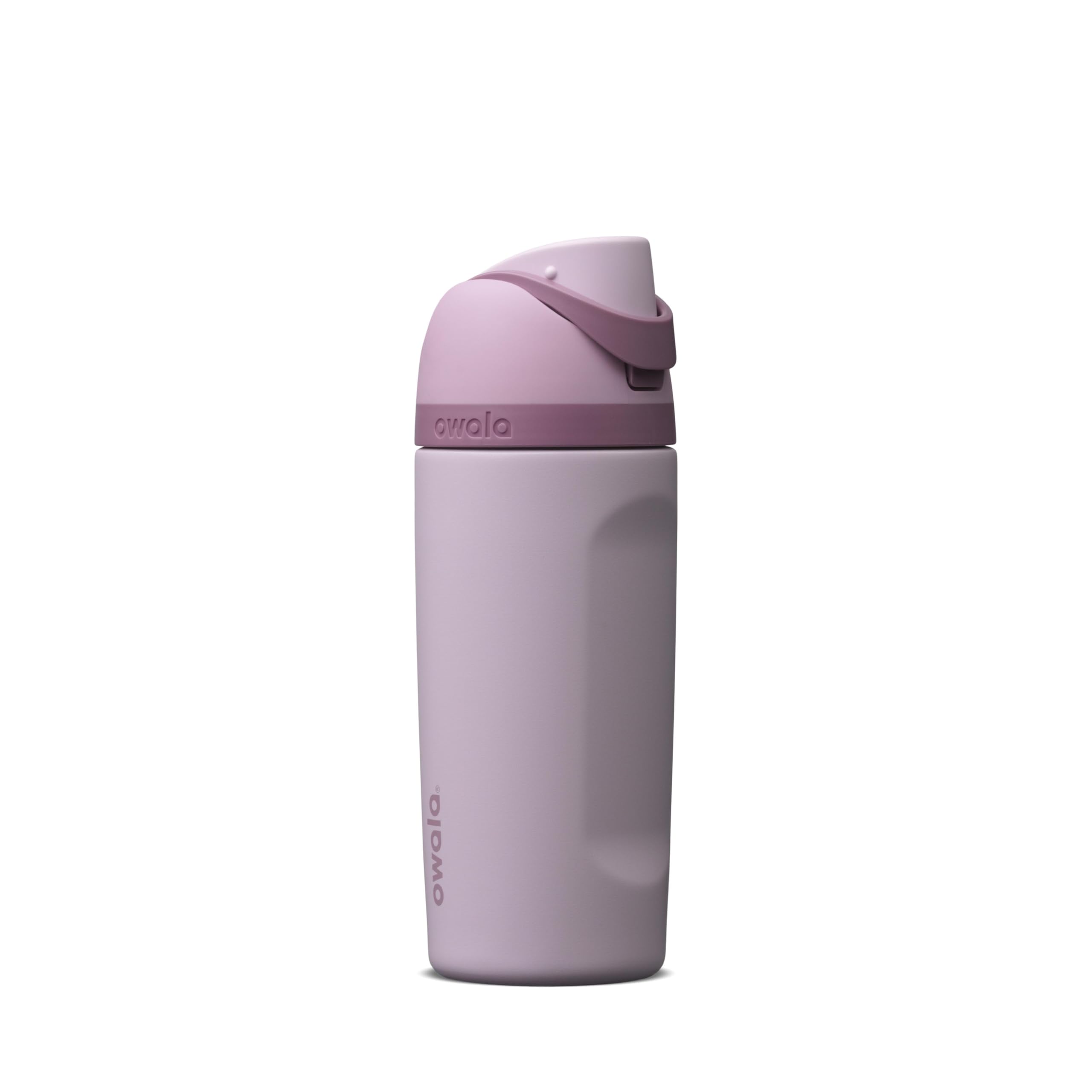


Best for School-Age Kids
Owala FreeSip Kids 16 oz
Key Features
- Lid: FreeSip straw and swig spout
- Capacity: 16 fl oz
- Cleaning: Hand wash cup, dishwasher-safe lid
- Insulation: Double wall, up to 24 hours cold
- Price: Midrange
A FreeSip lid is the reason this bottle is our top pick. The spout holds two openings in one piece: a straw you sip through sitting upright, and a wide mouth you swig from by tipping the bottle back. A five-year-old uses the first, an eight-year-old uses the second, and the bottle does not have to be replaced in between. Nothing else here covers that stretch of childhood with one lid.
The rest is sized for a school day. Sixteen ounces is enough for lunch and recess without dragging a small backpack sideways, the double wall keeps water cold from drop-off to pick-up, and the listing claims up to 24 hours, which outlasts any school day. The base is narrow enough for a car cup holder, and the push-button lid locks shut, so the bottle can go into a bag without a bag around it. We also like that the carry loop doubles as the lock: one motion instead of two.
The friction is cleaning. Owala says hand wash the cup and puts only the lid in the dishwasher. On a bottle that comes home grubby every afternoon, that is a sink job every evening, and the Thermos Funtainer and ThermoFlask picks here both go in the machine whole. If your evenings run on the dishwasher, weigh that honestly before you decide.
What keeps us coming back is the mouth itself: covered when shut, wide enough that a big kid feels like they are really drinking, narrow enough that a small one does not end up wearing it. Fill it with water only, since Owala says no hot liquids, and it handles everything from a nursery bag to a middle-school locker.
Pros
- Two drinking modes in a single lid
- Keeps water cold all day
- Locks shut and fits a cup holder
Cons
- Stainless body dents and the finish scuffs
One lid, two ways to drink: straw for a small kid, swig for a bigger one, in a 16-ounce insulated bottle that suits a school backpack, our default pick.
Best for Toddlers and Preschoolers
YETI Rambler Jr. 12 oz
Key Features
- Lid: Straw cap, leakproof closed
- Capacity: 12 fl oz
- Cleaning: Dishwasher safe
- Base diameter: 3 in
- Price: Premium
Before anything else, we look at two places on a kids bottle: the lid hinge and the base. Those are where cheap bottles fail. The Rambler Jr. is built like outdoor gear at both ends, with 18/8 stainless steel, a straw cap YETI calls shatter-resistant, and a Duracoat finish the company says will not crack or peel. Nothing else here feels as though it was designed for the abuse.
At 12 ounces it is the smallest bottle we recommend, and that is the point. It fits a two-year-old’s hands, the cap shuts with a single push, and the whole thing goes in the dishwasher with nothing to take apart or hand wash. For daycare, the stroller or the car, it is the one we hand over without a second look, and the handle is large enough for a small fist to hook a finger through.
Where it earns its place in the routine is the evening, not the playground. There is no valve to disassemble and no cup to wash by hand, so a grubby bottle becomes a clean one in the time it takes to load the top rack. Leak-proof holds with the cap closed; with the spout open, a straw bottle will wet a bag, so the cap matters. For toddlers and preschoolers, that combination is hard to beat.
Pros
- Dishwasher safe, whole bottle
- Survives drops and playground handling
- Cap and handle sized for small hands
Cons
- 12 ounces is a half-day bottle
Our pick for toddlers: a 12-ounce bottle that shrugs off drops, goes in the dishwasher whole, and seals once the cap is pushed shut.
Best for Two-Kid Families
ThermoFlask Kids 16 oz 2-Pack
Key Features
- Pack: 2 bottles, 2 straw lids
- Capacity: 16 fl oz each
- Cleaning: Dishwasher safe
- Insulation: Double wall, 24 hours cold
- Price: Midrange
Two insulated stainless bottles, two straw lids, dishwasher safe top to bottom, for about the money one premium bottle asks. If you have two kids, or one kid who leaves things on buses, that arithmetic is the whole argument, and it is why this pair is our value pick.
The specifications are the ones that matter at this age. Sixteen ounces each, double-wall insulation rated to 24 hours cold, a wide mouth that takes ice cubes and a bottle brush, and a sturdy handle a small hand can hook a finger through. The base is 3.04 inches, so it sits in most cup holders and backpack pockets, and both bottles go in the dishwasher, not just the lids.
For a family with two kids close in age, this is the most sensible buy on the page. One bottle can be in the machine while the other is in a backpack, and nobody has to wash anything by hand at nine o’clock. For a single child, one better bottle is the better spend.
The wide mouth earns its keep daily: ice goes in without a fight, and so does a brush, which is the difference between a bottle that gets washed and one that gets left in the car until Monday.
Pros
- Two insulated bottles for about one premium price
- Dishwasher safe, lids included
- Wide mouth takes ice and a brush
Cons
- Lid seals vary from bottle to bottle
Two insulated, dishwasher-safe 16-ounce bottles for roughly what one premium bottle costs, the sensible buy for a family with more than one kid.
Best for First School Bottle
Thermos Funtainer 12 oz
Key Features
- Lid: Push-button covered straw
- Capacity: 12 fl oz
- Cleaning: Top-rack dishwasher safe
- Insulation: Vacuum, 12 hours cold
- Price: Budget
Five years. That is the limited warranty Thermos puts on this bottle, and it is the only multi-year backing stated on any pick here, which counts for something in a category where the lid is usually the first casualty. Underneath the paperwork sits a simple 12-ounce stainless bottle: push-button lid, covered straw, vacuum insulation rated to 12 hours cold, and a top-rack dishwasher cycle.
As a first school bottle, we think it is the best-balanced pick here. It is small enough for a four-year-old to carry by the loop, light enough that it does not drag a backpack sideways, and inexpensive enough that losing one is an annoyance rather than an event. The push button opens one-handed, which matters more than it sounds when a child is wearing mittens or holding a lunchbox in the other hand.
Twelve ounces is the limit. For a three- or four-year-old that is a morning and an afternoon with one refill; for a six-year-old it is gone by lunch. We recommend it as the bottle a child learns to open, close and carry themselves, before moving up to the 16-ounce picks rather than as the one they keep until middle school.
Pros
- Five-year limited manufacturer warranty
- One-push lid a toddler can work
- Dishwasher safe and light to carry
Cons
- Push button can be knocked open in a bag
The smallest insulated bottle here, with a one-push lid a preschooler can work and a five-year warranty behind it, our pick for a first school bottle.
Best for Daycare and Preschool
Contigo Aubrey 14 oz 2-Pack
Key Features
- Lid: Spill-proof AUTOSPOUT straw
- Pack: 2 bottles, 2 lids
- Capacity: 14 fl oz each
- Cleaning: Top-rack dishwasher safe
- Price: Midrange
Most kids bottles are only leak-proof with the spout shut. The AUTOSPOUT valve on these is different: a silicone valve sits behind the straw opening and holds water back even with the lid popped, so a bottle that ends up upside down in a cubby leaves a damp patch rather than a puddle. For a two-year-old, that is the entire feature list.
The rest is daycare arithmetic. Fourteen ounces, two bottles per pack, one push of a button to drink, and a lid that hinges open so the whole thing goes on the top rack. The straw stays tethered to the lid, which sounds minor until you have fished a loose straw out of a dishwasher filter. Plastic keeps them light enough for a toddler to carry by the loop. The one first-day chore is adhesive: the bottles can arrive with sticky pads on the barrel that need a warm soapy wash to shift.
For daycare and preschool, this is the pair we choose. Losing one is not a crisis, the valve takes being chewed, and a child can work the button alone at an age when doing things alone matters enormously to them. Past about five, though, 14 ounces runs out before the afternoon, and the classroom day is longer than the bottle.
Pros
- Valve holds with the spout open
- Two bottles per pack
- Toddler can open it one-handed
- Straw stays tethered for washing
Cons
- Not insulated, so water warms over a long day
The pair we hand to a toddler without hovering: a valve that holds water even with the spout open, two bottles per pack, and almost nothing to break.
Best for Older Kids
Owala Princess FreeSip 24 oz
Key Features
- Lid: FreeSip straw and swig spout
- Capacity: 24 fl oz
- Cleaning: Hand wash cup, dishwasher-safe lid
- Insulation: Double wall, up to 24 hours cold
- Price: Premium
Twenty-four ounces is where a kids bottle turns into a commitment. This is our top pick’s lid on a bottle half again as tall, which makes it the answer for the older child who finishes a 16-ounce bottle before lunch and then stops bothering. The FreeSip spout still does both jobs, straw upright or swig tipped back, from one covered opening.
Below the lid: double-wall insulation rated to 24 hours cold, a wide mouth for ice, a base that fits a car cup holder, and a carry loop that doubles as the lock. The Rapunzel artwork runs around the barrel rather than sitting in a sticker, which is the sort of thing a nine-year-old notices and a parent silently approves of.
The size cuts both ways. At just under eleven inches tall it is the tallest bottle here, and a backpack side pocket that swallows a 16-ounce bottle may not take it, so check before you commit or plan on the main compartment. It is also the most expensive pick in this group, which is worth saying out loud for a bottle with licensed art on it.
What it solves is the refill. For a 9-to-12-year-old who drinks a lot and has outgrown the little bottles, 24 ounces of cold water that fits a cup holder is a genuine upgrade, and the FreeSip lid is the best-designed one here. Owala lists this size for adults, and that tells you most of what you need to know: buy it for the big kid, not the small one.
Pros
- Dual sip-and-swig FreeSip lid
- 24 hours cold in a cup-holder base
- Bigger capacity for older kids
Cons
- Cup is hand wash only
- Dents and paint chips with rough handling
For the kid who empties a 16-ounce bottle before lunch: the same dual spout we recommend, scaled to 24 ounces and finished in Disney art.
Best for Cheap Character Bottles
Zak Minecraft 16 oz

Key Features
- Lid: Locking flip spout cover
- Capacity: 16 fl oz
- Cleaning: Top-rack dishwasher safe
- Material: Break-resistant polypropylene
- Price: Budget
This is the least expensive bottle here by a distance, and it is the one that settles the but-I-want-the-Creeper-one argument. Full-wrap Minecraft art, a spout cover that flips up and locks, a silicone straw inside, and a 16-ounce break-resistant plastic body with a built-in loop. If a bottle is going to be lost, dropped in a puddle or left on a bus, this is the one you want it to be.
We think a cheap, character-led bottle has a real job. It is the one a kid actually carries, because it is light and it is theirs, and it is the one you send on a field trip without checking the backpack afterwards. The drinking straw comes out for cleaning, the whole thing goes on the top rack, and the bottle is listed for ages three and up, which is roughly the point a child can work the flip cover.
It does not insulate, so water is at room temperature by lunch, and that is the honest trade for plastic at this price. Set expectations accordingly: this is the bottle for a kid who wants the character and a parent who does not want to mourn a lost bottle, not the one that survives four years of school.
Pros
- Cheapest bottle in this group
- Light enough for a small kid to carry
- Top-rack dishwasher safe
Cons
- Lock can slide open in a lunch bag
- Flip top is the first part to break
The cheapest bottle here and the one that wins the character argument, buy it for the artwork and the light weight, not for a decade of service.
Best for Straw-Free Drinking
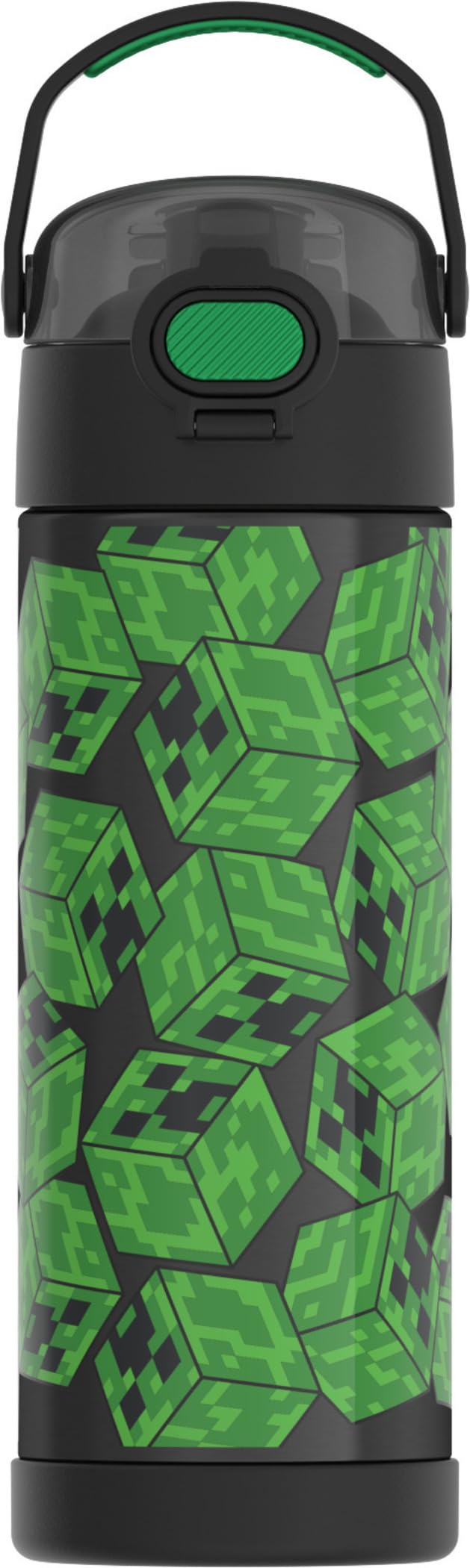
Thermos Funtainer 16 oz Spout
Key Features
- Lid: Wide spout, push-button cover
- Capacity: 16 fl oz
- Cleaning: Dishwasher safe
- Insulation: Vacuum, 12 hours cold
- Price: Budget
No straw. That is the whole idea here: a wide spout you drink from directly, covered by a push-button lid, with nothing inside the bottle to lose, chew or scrub with a tiny brush. If your kitchen drawer is a graveyard of orphaned straws and valves, this is the design that ends the cycle.
Sixteen ounces, 18/8 stainless steel, vacuum insulation rated to 12 hours cold, and 5.6 ounces empty, which is light for the capacity. The base is 3.07 inches, so it sits in most cup holders and backpack pockets, and everything goes in the dishwasher with no disassembly at all. Parents who have owned both Funtainer shapes tend to describe this one as the easier of the two to live with, and we understand why: there is no part to lose.
The seal is the thing to check before you trust it in a bag. A rubber gasket has to sit square over the spout, and when it is off the bottle weeps, so seat it by eye after every wash. Seated properly, it stays dry through a school day.
For a kid who finds straws babyish and drinks fast, this is the most straightforward bottle here, and by far the quickest to clean. It is the one we pack when the dishwasher has not finished and the bus is five minutes out.
Pros
- No straw or valve to lose
- Twelve hours cold at 16 ounces
- Dishwasher safe with no disassembly
Cons
- Lid can crack at the hinge when dropped
A straw-free bottle for kids who drink fast: one wide spout, no valve to lose, and the easiest clean in this group.
How We Chose and Tested 14 Kids Water Bottles
We started with a list of roughly 40 bottles that kept coming up in conversations with teachers, school nurses, and parents, then filtered by capacity — 14 to 20 ounces, the range that suits most elementary schoolers — along with base width (did it clear a backpack side pocket and a car cup holder?), material, and whether the maker actually claimed it was dishwasher safe. That left 14 bottles across a range of budgets.
For four months, those bottles lived in backpacks rather than on a shelf. We filled each one with ice water at 7 a.m., sent it out the door with kids ages five to ten, and checked back at lunch and again at pickup.
Leaks got their own trial: each bottle went upside down inside a tote with a folded paper towel for a 20-minute walk to see what came through the lid and straw valve. We dropped every one three times from waist height onto pavement and noted what cracked, what scuffed, and what popped open. Kids opened and closed each lid themselves, and we counted how many tries it took, how easily the straw pulled loose, and whether it still reached the last inch of water. Chewed straws were checked for bite marks and splits.
Temperature was logged with a thermometer at three points in the day, which separated bottles still holding ice at 3 p.m. from ones that were room temperature by recess. Every bottle ran through at least 20 dishwasher cycles, and we watched for fading, peeling graphics, and the sticky patches left after we peeled off the labels — the kind that quietly collect lint and crumbs. Value got the last word: we set what each bottle cost against how it looked and worked after all of that.
How to Choose a Kids Water Bottle
The lid, not the bottle, decides most of what you will think about a kids water bottle: how old the child has to be, how often it leaks, and how much of your evening it takes.
Pick the lid your child can open alone
A bottle a kid cannot open is a bottle they will not drink from. A covered push-button straw is the easiest starting point: one press, a valve behind the straw, and nothing to unscrew. Wide spouts suit children around five and up who drink fast and resent a straw. Dual designs, like the FreeSip lid on both of our Owala picks, cover the whole stretch, straw while they are small and swig once they are not.
A bite valve asks more of a small child than a straw does, and the valve is the part that fails when a bottle is chewed. Watch what your kid does with the spout in the car before you buy a second one of anything.
Match the ounces to the day
Twelve ounces is a half day: preschool, a stroller, the car. Sixteen ounces covers a school day for most children up to about eight. Twenty ounces and above is for older kids, long days and sport.
Height matters as much as volume. The 24-ounce bottle here runs close to eleven inches tall, and a backpack side pocket that swallows a 16-ounce bottle will not take it. Measure the pocket, not the child.
Insulated or plastic
Stainless keeps water cold for hours, and the insulated picks here claim 12 to 24, at the cost of weight and dents. Plastic is lighter and cheaper and does not insulate at all.
For daycare, where the bottle is empty by noon, we take plastic and save the weight. For a full school day in a warm classroom, insulation earns its place, and the stainless bottles are the ones we refill with ice in the morning.
Check what the dishwasher will take
This is the specification that changes your evenings. Some bottles here go in the machine whole; others say hand wash the cup and only the lid is dishwasher safe. A hand-wash bottle is fine with one child and one bottle. With two kids it becomes a nightly job that nobody wants at nine o’clock.
Read the care line before the capacity. It is the difference most often regretted after purchase, and it does not show up in a photograph.
Leak-proof always comes with a condition
Nearly every bottle here is leak-proof when closed, and none of them is when the spout is open. The meaningful difference is the valve: a spill-proof straw valve holds water even with the lid popped, which is what you want for a toddler who leaves the cap up.
Before a new bottle goes into a backpack, fill it, click it shut and shake it upside down over the sink. Then check the lock. A catch that slides open inside a lunch bag undoes the entire design.
Frequently Asked Questions
At what age can a child move from a sippy cup to a water bottle?
Usually around three, once they can open a lid themselves and drink without tipping the bottle right over. That matches the age listings on the bottles here, where Contigo and Zak both say three and up.
Before that, a trainer cup with a valve is the better tool. The natural next step is a 12-ounce bottle with a covered straw, which a small hand can hold and a small mouth can work.
How often should you replace a kids water bottle?
The bottle usually outlives its lid. Replace it when the straw stops staying seated, the gasket stretches, or the cap no longer clicks shut. On the cheaper bottles here a replacement lid costs about as much as a new bottle, so starting fresh is often the simpler call.
Otherwise keep going until the body dents enough to weep or the finish has given up.
Can you put juice or milk in a kids water bottle?
You can, but wash it the same day. Juice leaves sugar inside the straw and valve, and milk left in a warm backpack is the smell you cannot get back out.
These bottles are built around water, and the insulated ones keep it cold all day. Anything else needs the straw pulled apart and brushed, not just rinsed.
Final Verdict
Buy the Owala FreeSip Kids 16 oz if you want one bottle to last from preschool through elementary school. The dual spout is the only lid here that works for a four-year-old and a nine-year-old without changing bottles, and the insulation handles a full school day.
If your child is under five, start with the YETI Rambler Jr. instead: 12 ounces they can carry themselves and a dishwasher-safe build that survives the dropping phase. Families with two kids get the better deal from the ThermoFlask pair, as long as you check each lid before it goes into a backpack.
