This post contains affiliate links. We may earn a small commission when you buy through our links — at no extra cost to you.
Most kids walkie talkies claim a 3-mile range, but in a typical suburban neighborhood with houses and trees, you’ll be lucky to get half a mile. That’s not a flaw—it’s physics, and the real decision for parents comes down to battery strategy. Disposable-battery sets are cheap upfront but require a steady stream of AAA or AA cells. Rechargeable models cost more initially but eliminate the hassle and long-term expense of buying batteries.
The right choice depends on how often your kids play and your willingness to manage charging. For families with two or three children who play outdoors regularly, a rechargeable 3-pack offers the best balance of convenience and cost. For occasional use or tight budgets, a proven disposable set can still deliver plenty of fun. This guide cuts through the marketing claims to help you pick the right tool for your kids’ play style.


Best for Multiple Kids
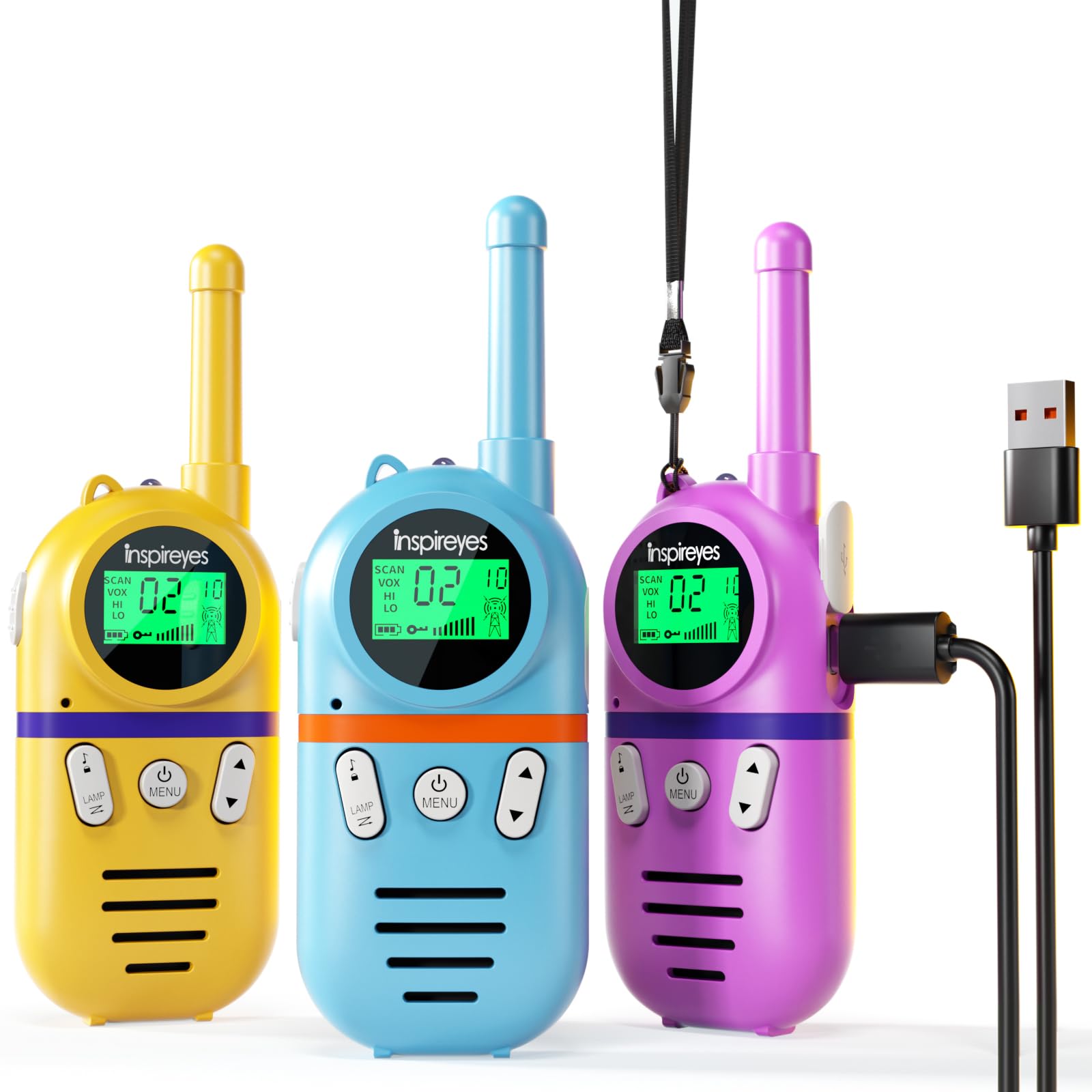
Inspireyes GL-568 3-Pack
Key Features
- Battery Type: Rechargeable Li-Po
- Units per Pack: 3-pack
- Range (Claimed): 3 mi
- Price: $$
Battery lasts through weekend camping trips or days of backyard play, while the sound stays clear across the yard. Range drops in neighborhoods with trees and hilly terrain, often under a mile, but the lightweight 2.9-ounce design fits small hands comfortably, making the walkie talkies easy for kids to carry and use.
Best for families with multiple kids who play within half a mile of each other — especially parents tired of buying AA batteries. Not for kids who need to communicate across a hilly or dense suburban area, as real-world range can fall short of the listed three miles.
Pros
- Rechargeable battery lasts up to 48 hours of play.
- Clear sound and sufficient range for backyard or park use.
- Lightweight design fits small hands comfortably.
Cons
- Range drops significantly indoors and in built-up neighborhoods.
- Included charging cables are short.
Buy this if you want a 3-pack of rechargeable walkie talkies with long battery life for kids playing close to home. Skip it if you need communication over a mile or through hills.
Best for Budget Families
Selieve T-388 2-Pack
Key Features
- Battery Type: Disposable AAA
- Units per Pack: 2-pack
- Range (Claimed): 3 mi
- Price: $
Where the top pick cuts long-term costs with rechargeable batteries, the Selieve keeps the upfront price low but requires 8 AAA batteries (not included) that drain quickly – and the battery compartment cover can pop off mid-play. It also picks up stray radio signals (police, neighbors) on some channels. Best for families on a tight budget who don’t mind buying batteries regularly and can overlook occasional interference.
Pros
- Over 37,000 reviews with a 4.4 average rating – most popular in the category.
- Simple enough for children as young as 3 to use independently.
- Decent sound quality and range for the price point.
Cons
- Batteries drain quickly; requires 8 AAA batteries (not included).
- Battery compartment back falls off easily, causing batteries to drop out.
Buy this if you want the most popular budget walkie talkie set and don’t mind replacing batteries often. Skip it if you prefer rechargeable units or need a more durable battery compartment.
Best for Outdoor Play
Retevis RT628 2-Pack
Key Features
- Battery Type: Disposable AA
- Units per Pack: 2-pack
- Range (Claimed): 0.6 mi
- Price: $
The Retevis RT628 uses standard FRS channels and privacy tones, giving kids a genuine two-way radio experience for outdoor adventures. The rugged camo build and simple controls make it easy for ages 6+ to operate without frustration. The trade-off is the battery system: each unit needs 3 AA batteries (not included), so ongoing costs add up compared to rechargeable options. Best for families who prioritize outdoor durability and radio quality over long-term battery savings and don’t mind stocking alkaline cells.
Pros
- True FRS radio with privacy codes for cleaner communication.
- Sturdy camo casing holds up to drops and rough handling.
- Simple two-button operation works well for kids and adults.
Cons
- Uses 3 AA batteries per unit; no rechargeable option included.
- Occasional quality control variances cause early unit failure.
Buy this if you want a budget-friendly true FRS radio for outdoor play and are fine supplying AA batteries. Skip it if you prefer rechargeable units or long-term convenience.
Best for Video Fun
vilicert Video 2-Pack
Key Features
- Battery Type: Rechargeable Li-Po
- Units per Pack: 2-pack
- Range (Claimed): 305m
- Price: $$
Unlike the top audio-only pick, the vilicert adds a built-in screen for real-time video chat — a hit with kids who love role-play. The 4.7 rating reflects strong video clarity and easy controls for ages 3–8. However, the trade-off is real: indoors you’ll get about 100m range, and continuous video drains the rechargeable battery in roughly two hours. That makes it a better fit for inside play or close backyard games rather than long outdoor treks. Parents should plan for recharging between play sessions. For families who want a screen-based toy that sparks imaginative play without sacrificing basic audio communication, this is a solid middle-ground option.
Pros
- Video chat with voice effects (robot, alien, etc.) encourages imaginative play.
- Rechargeable batteries and simple controls work well for young children.
- Good audio and video quality for a toy price point.
Cons
- 2–2.5 hours of continuous video use before needing a recharge.
- Indoor range limited to about 100m, not suitable for large yards.
Buy this if your kids want video chat for indoor play and short-range outdoor games, and you don’t mind recharging every couple of hours. Skip it if you need reliable all-day range for hikes or camping trips.
Best for Young Kids
QNIGLO Q136 2-Pack
Key Features
- Battery Type: Rechargeable Li-Po
- Units per Pack: 2-pack
- Range (Claimed): 2 mi
- Price: $$
The QNIGLO’s owl design and wearable options (watch band or lanyard) make it a hit with young kids aged 4-8, but the trade-off comes in reliability. Some units become unresponsive until reset, and the owl’s nose (FM radio button) is easy to press accidentally, causing confusion. Battery life holds up well for days of moderate use, and the 22 channels offer enough variety for indoor or light outdoor play. This set works best for parents who want a character-driven toy that kids can wear, not a rugged workhorse for heavy drops or large groups.
Pros
- Adorable owl design with watch or lanyard wearables kids enjoy wearing.
- Rechargeable batteries that last days of moderate use.
- Clear controls and simple operation for ages 4-8.
Cons
- Occasional units become unresponsive, resolved by a reset.
- FM radio button (owl’s nose) is easily pressed by accident, confusing children.
Buy this if your child loves cute character toys and you want a wearable, rechargeable two-way radio for indoor or light outdoor play. Skip it if you need a 3+ pack or maximum drop durability.
Best for Convenience Seekers
Wishouse M8 Rechargeable 3-Pack
Key Features
- Battery Type: Rechargeable AA
- Units per Pack: 3-pack
- Range (Claimed): 5 mi
- Price: $$$
The Wishouse 3-pack skips the hassle of buying AA batteries by including three sets of rechargeables and a multi-charger. Families praise the clear sound and real-world range for neighborhood play, and kids genuinely enjoy them. The trade-off comes from reports of units that stop charging or refuse to power on after a few months, plus a battery indicator that can mislead. Compared to the top pick, you pay more upfront for the rechargeable convenience, but the quality-control variance makes Inspireyes a safer bet for long-term use. Best for groups that want a ready-to-play set and are okay with occasional charging quirks.
Pros
- Comes with rechargeable batteries and a multi-charger for easy daily use
- Clear sound and usable range for neighborhood or park play
- Kids love playing with them, holding attention for hours
Cons
- Some units stop charging or fail to power on after months of use
- Battery indicator can show incorrect status, making charging ambiguous
Buy this if you want a ready-to-go rechargeable 3-pack for family outings and are willing to accept occasional charging oddities. Skip it if consistent long-term reliability is a priority.
Best for Large Groups
Wishouse M8 4-Pack

Key Features
- Battery Type: Disposable AA
- Units per Pack: 4-pack
- Range (Claimed): 5 mi
- Price: $$
This 4-pack gives families and group play a full set of radios without buying multiple boxes, but the savings stops at the shelf—you’ll need 12 AA batteries of your own. Range works well for neighborhood and backyard play, though some units have arrived defective, and the lack of rechargeability is a long-term cost many better-rated alternatives solve.
Pros
- Four radios in one box, ideal for larger groups or outdoor play.
- Solid range in open areas, enough for neighborhood adventures.
Cons
- Requires 12 AA batteries (3 per unit) with no rechargeable option included.
Worth considering if you need exactly four walkie-talkies for group use and are prepared to supply your own AA batteries.
Best for Video Chat
YUSSBCU Video 2-Pack
Key Features
- Battery Type: Rechargeable Li-Po
- Units per Pack: 2-pack
- Range (Claimed): 400m
- Price: $$
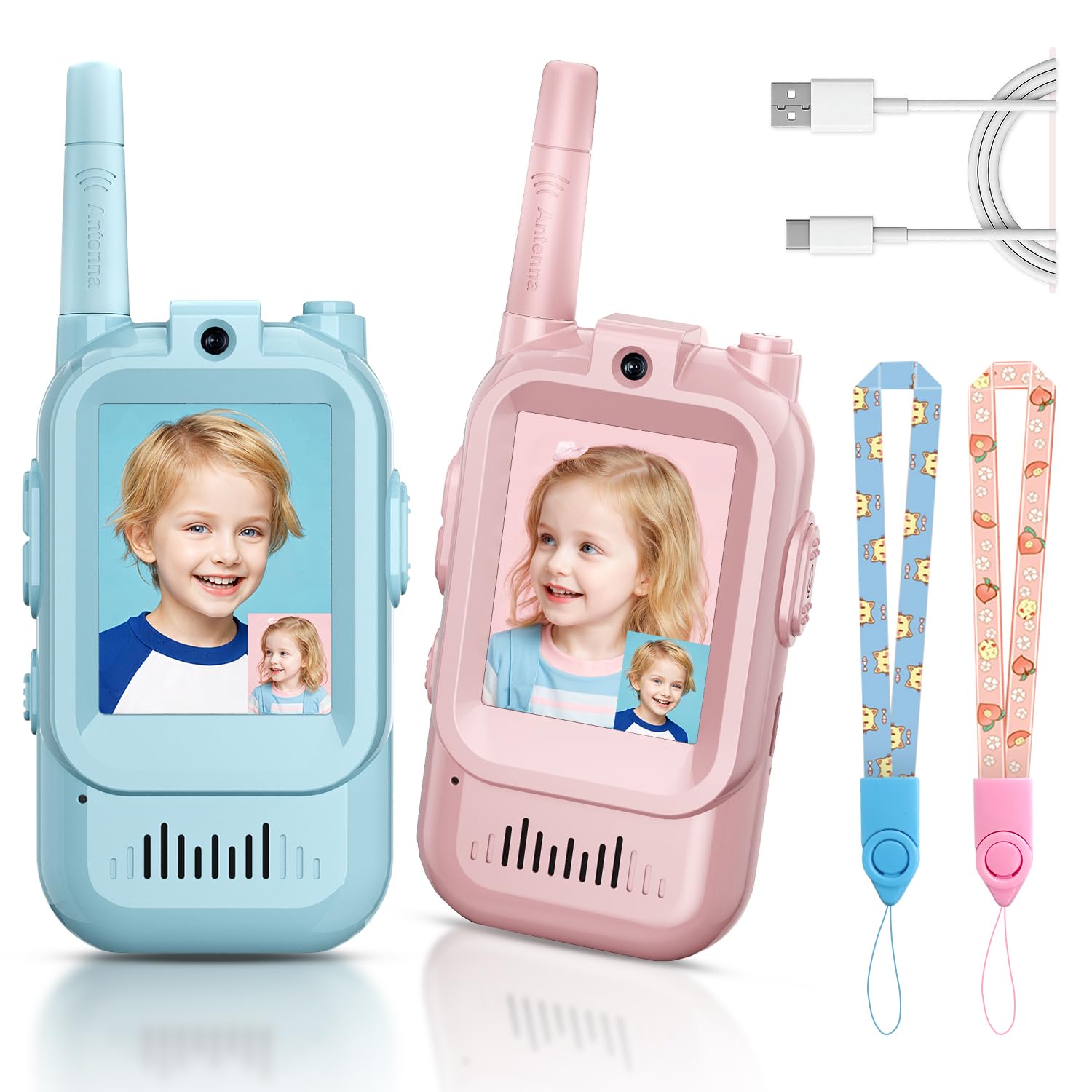
These walkie talkies pair video chat with voice effects, keeping young kids engaged during hide-and-seek. However, the 400m outdoor range drops significantly indoors, and continuous video use drains the battery in 2–3 hours. The lower review count and similar performance to higher-rated alternatives keep them from top honors.
Pros
- Video chat adds visual engagement for kids during play.
- Interface is simple enough for toddlers to operate.
Cons
- Range is limited indoors and battery drains fast with video.
Worth considering if your young kids mostly play indoors and you want a screen-based communication toy.
Best for Three Siblings
Selieve T-388 3-Pack

Key Features
- Battery Type: Disposable AAA
- Units per Pack: 3-pack
- Range (Claimed): 1.9 mi
- Price: $$
Three walkie talkies for the price of most two-packs – ideal for families with three kids. Sound is clear for the price, but each unit eats 4 AAA batteries fast, requiring frequent changes. It also picks up other transmissions, a privacy tradeoff. The battery drain mirrors the 2-pack, so it’s not a top pick, but a functional budget option.
Pros
- Three units for the cost of a two-pack – perfect for families needing exactly three.
- Clear sound and solid build for active play.
Cons
- Requires 4 AAA per unit and drains quickly – frequent battery changes needed.
Worth considering if you need three walkie talkies on a tight budget and don’t mind regular AAA battery purchases.
Best for Bright Colors
SANJOIN T-388 3-Pack

Key Features
- Battery Type: Disposable AAA
- Units per Pack: 3-pack
- Range (Claimed): 1.9 mi
- Price: $$
The SANJOIN three-pack offers vivid color options and simple controls that make it an easy gift for ages 3-8. However, each unit requires 4 AAA batteries (12 total) and drains them fast — expect frequent replacements. Sound can be tinny or static-laden, and some units arrive defective. These limitations make it less consistent than similarly priced alternatives, best for short, budget-conscious play near home.
Pros
- Fun color choices (blue, pink, yellow) and one-button operation make them easy for young kids to use.
- Attractive gift option for children aged 3-8, with 96% positive feedback from gift buyers.
Cons
- Each walkie talkie uses 4 AAA batteries and drains them quickly; many users report short battery life.
Worth considering if your child needs bright, simple walkie talkies for occasional short-range play and you don’t mind buying AAA batteries frequently.
Best for Camo Lovers
Aikmi T-339 2-Pack

Key Features
- Battery Type: Disposable AAA
- Units per Pack: 2-pack
- Range (Claimed): 3 mi
- Price: $$
The Aikmi T-339 stands out with its camo pattern and bonus bracelets, which kids love. However, quality control and compact size (5×2 inches) make it best for supervised, occasional outdoor adventures rather than daily roughhousing.
Pros
- Camo design and bracelets excite kids for outdoor play.
- Decent range when the units work.
Cons
- Inconsistent quality; some units stop working shortly after purchase.
Worth considering if your child loves the camo look and you’ll supervise play; skip if you need radios that withstand daily drops and rough use.
How to Choose
The biggest mistake parents make is believing the advertised range—real-world performance is typically one-quarter to one-half mile in neighborhoods.
Battery Type: Disposable vs Rechargeable
Disposable-battery sets are cheaper upfront but require ongoing purchases. Rechargeable models cost more initially but save money and hassle over time. Look for sets with replaceable rechargeable batteries rather than built-in packs that can’t be swapped if they degrade.
Number of Units
Most families with 2–3 kids need at least three units to avoid fights. 2-packs work for pairs, while 4-packs suit playdates or larger groups. Consider if you’ll need extras for friends.
Real-World Range
Advertised range is measured in ideal line-of-sight conditions. In a suburban setting with walls, trees, and hills, expect 0.25–0.5 miles. For indoor use, range drops further. Choose based on where your kids actually play.
Build Durability
Kids drop things. Look for walkie talkies with solid construction and rubberized exteriors. Battery compartment covers that stay shut are a small but important detail. Avoid sets with frequent reports of units failing after short use.
Ease of Use for Young Kids
Simple controls with lockable channel settings prevent accidental changes. Oversized buttons and lightweight designs help small hands. Some sets have complex menus better suited to older children.
FAQ
Do rechargeable kids walkie talkies last longer than battery-operated ones?
Rechargeable sets with built-in Li-Po batteries typically offer 8–12 hours of intermittent play per charge, compared to disposable batteries that may last 4–6 hours before replacement. Over a year, rechargeable models save money and reduce waste. However, built-in batteries degrade after 300–500 charge cycles and cannot be replaced, so the unit may become unusable after a couple of years.
How far do kids walkie talkies actually work in a neighborhood?
In a typical suburban setting with houses, trees, and mild elevation changes, expect 0.25 to 0.5 miles. Claims of 3 miles are only achievable in open, flat, line-of-sight conditions. Indoor range is even shorter—often 100–200 feet through walls.
Can kids walkie talkies pick up other people’s conversations?
Yes, on standard FRS/GMRS channels without privacy codes, other radios within range can transmit on the same frequency. Some models allow setting CTCSS or DCS privacy codes to filter out unwanted chatter, but this does not guarantee total privacy. For very young children, this is rarely an issue, but older kids or neighborhood play might benefit from privacy code features.
What is the best walkie talkie for a 4-year-old?
A rechargeable model with large buttons, simple operation, and a lockable channel setting is ideal. The QNIGLO owl design or the vilicert video walkie talkie both have intuitive interfaces and wearable options that appeal to young kids. Avoid sets with tiny buttons or complex menus.