This post contains affiliate links. We may earn a small commission when you buy through our links — at no extra cost to you.
The first time you strap a toddler onto the back of your bike, you’ll squeeze the brakes harder than you need to. Trust that instinct: on a child seat, a mount that shifts a quarter inch or a buckle you fumble at the curb is the whole ballgame. You want something that clamps on like it grew there, holds a wriggling four-year-old snug, and still leaves your knees room to pedal. We rode with 12 seats over eight months to find the ones that do.
First-time buyers tend to shop harnesses, but fit decides more. Step-through frames, carbon seatposts, and e-bike battery racks rule out more models than any buckle design ever will, and a seat mounted too close to your saddle turns every ride into a knees-out grind. Price didn’t predict much either — a few mid-priced seats outbuilt the fancier ones, with reclines and footrests our kids actually used instead of ignored. The picks below are the ones that survived a full season.

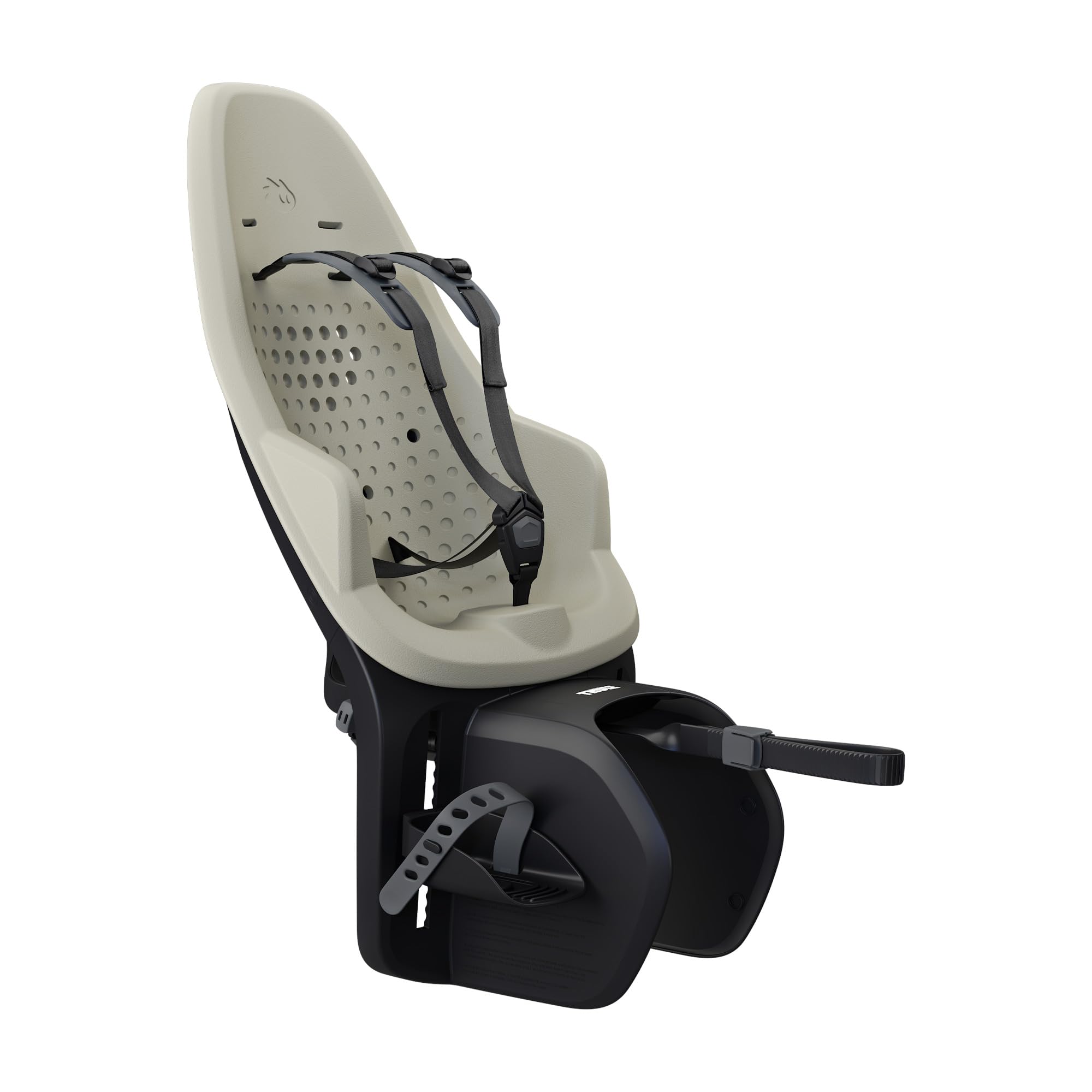

Best for Everyday Family Rides
Schwinn Deluxe Child Carrier
Key Features
- Mount: Rear frame mount
- Harness: 3-point with leg restraints
- Age range: 1 year and up
- Child weight limit: 40 lb
- Price: Midrange
Most rear seats ask you to bolt a rack on first. The Schwinn Deluxe clamps straight to the frame behind the saddle, which is why you see it on so many plain hybrids, cruisers and older mountain bikes that have nothing fitted out back. If the bike is unremarkable and the child is between one and four, that single fact does most of the deciding.
The child’s end of it is well thought out. A three-point harness with a padded cross bar sits in front of the chest, the leg restraints have straps of their own, the footwells adjust as legs grow, and the headrest lifts off when it stops being useful. For a one-year-old whose head still lolls on the first few rides, the cross bar and headrest together are what make this a first seat rather than a second one.
Installation is where it asks for patience. The bracket has to go on square, and the job is quicker with a second pair of hands than alone; after that the seat clicks on and off in seconds and the bracket stays on the bike, where a small rack bag will sit when you ride without a passenger.
What settles it is the combination: harness, headrest, frame mount, and the widest range of ordinary adult bikes in this group. The quick release matters more than it sounds, too. The seat comes off one-handed at the end of a ride, and you are left with a bike that still looks like a bike.
Pros
- Clamps to a plain adult bike, no rack needed
- Harness, leg restraints and removable headrest
- Seat releases in seconds; bracket stays put
Cons
- Not for frames with a welded-on rear rack
Our pick for a first family seat: it clamps to a plain adult bike and carries a one-year-old in a harness with a headrest.
Best for Rack-Equipped Bikes
Thule Yepp 2
Key Features
- Mount: Rear rack mount
- Harness: 5-point, childproof buckle
- Age range: 9 months to 5 years
- Child weight limit: 40 lb
- Price: Premium
The Yepp 2 has one condition before any of its virtues count: your bike needs a rear rack. Given one, it is the easiest seat in this group to live with. The mount clamps around the rack rather than your frame, so it goes on in minutes, comes off in seconds, and never has an opinion about your top tube or your paint.
Two details sold us. The five-point harness has a childproof buckle and padded straps, and it keeps a small child upright in a way a three-point struggles to when they decide to lean sideways; the adjustable footrests and straps stretch the same fit from nine months to five years. The other is the keyed lock, the detail we loved most: it pins the seat to the rack, so a coffee stop does not mean carrying it with you. A built-in reflector and a light mount round it out for commuting.
The price and the rack are really the same objection. A rack that will carry a passenger is a real purchase if the bike has none, and a rack that is too narrow for the clamp leaves you with an expensive seat and nowhere to put it. Check the rack’s stated load and the width of its top platform before ordering. Do that and the price stops being the argument.
Pros
- Five-point harness with a childproof buckle
- Keyed lock pins the seat to the rack
- Rack mount transfers between bikes in seconds
- Footrests and straps adjust from nine months
Cons
- Needs a suitable rear rack already fitted
- Costs more than a frame-mount seat of the same capacity
Worth the money if your bike already has a proper rear rack, because nothing here moves between bikes as easily.
Best for Trail Families
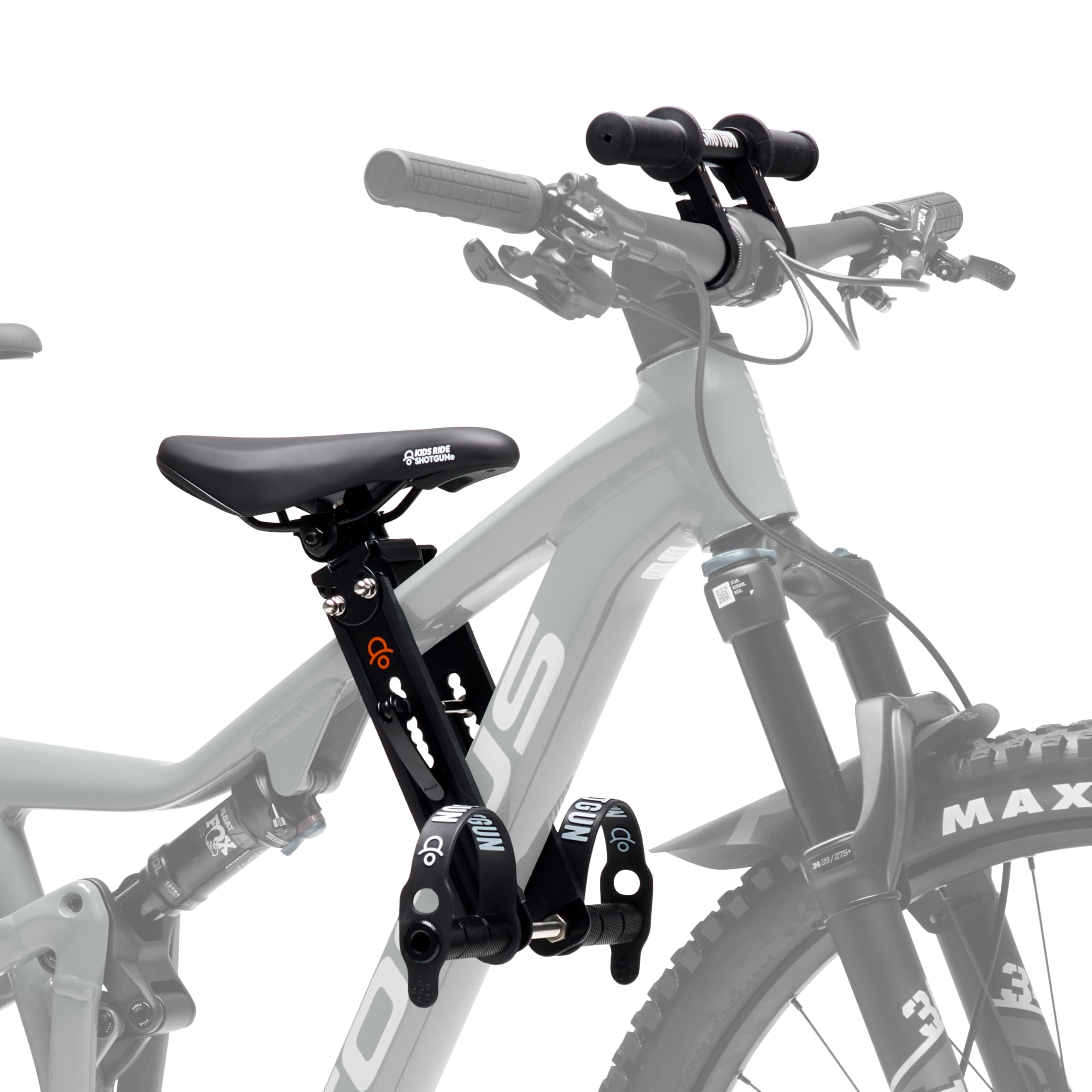
Kids Ride Shotgun Combo
Key Features
- Mount: Front top-tube mount
- Included: Seat and handlebars
- Age range: 2 to 5 years
- Child weight limit: 48 lb
- Price: Midrange
There is no rear seat that lets you talk. The Shotgun puts a two-to-five-year-old on the top tube, between your arms, with their own handlebars clamped to yours and a mudguard keeping their feet out of the front wheel. You hear the whole commentary, and they get the feeling of steering.
We think that is worth the compromises. The seat is a gel-padded saddle rather than a bucket, the contact points are rubber-wrapped so paint survives, and 48 lb of capacity covers a five-year-old. What it is not is a seat with a harness: the child sits in the shaped saddle and holds the bars, so this belongs to a child who sits up confidently rather than one who slumps. Nothing about the design lets you forget that.
Installation is one clamp and a set of handlebars, and the clamp is what decides whether you like the thing. Set it tight and the seat stays where you put it; leave it loose and it rotates under a shifting child. Check the frame first—it is built around modern mountain bikes with a flat or gently sloping top tube, and a road bike with dropped bars and cables across the top is the wrong bike for it.
Pros
- Child rides facing forward, between your arms
- Own handlebars and a front-wheel mudguard
- Gel saddle and rubber-wrapped frame contact
- 48 lb capacity covers a five-year-old
Cons
- No harness; the child holds the bars
- Top-tube mount needs a flat or sloping tube
Buy this if the ride is the outing: a two-to-five-year-old between your arms, with handlebars of their own and no harness to fuss with.
Best for Bigger Kids
Bwcece Rear Child Seat
Key Features
- Frame: Alloy
- Mount: Rear frame mount
- Age range: 18 months to 8 years
- Seat weight: 8.5 lb
- Price: Midrange
Eight years is a long time in bike-seat years. Most rear seats in this group top out at 40 lb, which arrives somewhere around preschool; the Bwcece is built for 18 months to 8 years, with armrests that move outward as the child fills the seat. If you have a five-year-old and a younger one, that span is the whole argument.
It is a proper bucket, too: backrest, handrail, foot pedals and padded cushioning on an alloy frame. Install is the part that surprised us. The kit arrives with the tools and the frame clamp goes on without drama, and because the seat mounts to the frame your rear rack stays free for panniers—which matters if this is also the shopping bike.
The trade is weight and bulk. At 8.5 lb it is a lump to lift on and off, and a small rider on a small frame will feel it behind them on a climb. Sizing runs on age rather than a stated weight limit, so check the child against the seat—shoulders inside the handrail, feet on the pegs—before you plan a long ride.
Pros
- Age range runs from 18 months to 8 years
- Backrest, handrail, foot pedals and padding
- Frame clamp installs with the included tools
- Leaves the rear rack free for panniers
Cons
- Adds 8.5 lb to the bike
The rear seat to buy when your youngest is already out of the baby stage: it carries a child up to eight years old in a proper bucket.
Best for Tight Budgets
Bell Cocoon 300

Key Features
- Mount: Rear rack mount
- Harness: 5-point
- Bike fit: 26–27 in, no rear suspension
- Child weight limit: 40 lb
- Price: Budget
The Cocoon 300 is the least expensive way to put a child on the back of a bike in this group, and the safety basics are all present: a five-point harness, a molded spoke guard over the rear wheel and a reflector. For a first seat on a cheap bike, that is a real proposition.
What the price costs you is your own evening with the tools. The bracket and the bucket fight tight clearances, road frames are the worst of it, and you should allow more time than the instructions suggest. Once it is on, the shell and the hardware feel built to a price in a way the Schwinn’s do not—the bucket is there to hold a child, not to be admired.
So the geometry is the buying decision, and you can measure it before ordering. If you are short in the leg and riding a simple 26- or 27-inch bike with no rear suspension, the fit works and the money is hard to argue with. If you are tall, or there is a rack welded into the frame, the savings disappear into extra brackets and a saddle you sit on the nose of.
Pros
- Five-point harness and a molded spoke guard
- The lowest-priced seat in this group
- Wraparound bucket shape holds a small child
Cons
- Mounts close behind the saddle; heels can clip
The cheapest seat here, and a fair one if your bike and your legs are simple; tall riders should walk past.
Best for E-Bikes and Carbon
Kids Ride Shotgun Pro

Key Features
- Mount: Front, zero frame contact
- Age range: 18 months to 5 years
- Frame fit: MTB, e-bike, carbon
- Child weight limit: 60 lb
- Price: Premium
Carbon frames, wide down tubes and e-bike batteries are where most front seats give up. The Shotgun Pro sidesteps all three by clamping to the headset and the seat post and touching nothing else, so a frame you have spent real money on never gets shimmed, clamped or rubbed.
It is the standard Shotgun idea with a bigger envelope: 18 months to five years, 60 lb of capacity rather than 48, and handlebars and a mudguard in the kit. The mounting is what you are paying for—a seat that goes on and comes off without leaving a mark on the paint, on a bike where a mark is expensive.
What you give up is a harness. This is a saddle with handlebars: the child sits up and holds on, which is why the range starts at 18 months and really begins when they can sit confidently for a whole ride. A wriggler or a napper belongs in a rear bucket instead, whatever the frame is made of.
That leaves the price, which is the highest here by a long way, and worth it in exactly one situation: an e-bike with a battery on the down tube, or a carbon frame you are not willing to clamp. On an ordinary alloy hardtail the standard Shotgun does the same job for a lot less, and it is the one we buy.
Pros
- Zero frame contact protects carbon and paint
- Designed for e-bikes, wide down tubes and carbon
- 60 lb capacity, more than the standard Shotgun
- Handlebars and mudguard in the kit
Cons
- Most expensive seat here by a wide margin
For carbon frames and e-bikes with a battery on the down tube, the zero-frame-contact mount justifies the premium.
Best for Budget Front Seat
Alaxciax Front-Mounted Seat

Key Features
- Mount: Front top-tube mount
- Included: Seat, bars and foot pedals
- Age range: 2 to 5 years
- Seat weight: 3.5 lb
- Price: Budget
The box is the pitch: a front seat, a set of handlebars and foot pegs, one Allen key, and no second trip to the bike shop. For the money the seat itself is the good part—an aluminum frame with a leather-covered saddle that clamps to a flat or gently sloping top tube.
The extras are where the fettling happens. The handlebar clamps come without rubber shims, so they can work loose on a painted bar, and the foot pegs sit loosely on some frames. We kept the Allen key in a pocket for the first week of rides rather than in the toolbox, and that is the right instinct with this one.
The rider’s side of it is the good news. Once everything is tight, the seat holds a three- or four-year-old steady and the position between your arms is the reason to buy a front seat at all. Judge it as a top-tube seat for a mountain bike—the design assumes a flat or slightly sloping tube, so a step-through town bike or a road frame is out.
Pros
- Seat, handlebars and foot pegs in one box
- Aluminum shell with a leather-covered saddle
- Steady once the clamps are tight
- Inexpensive way to try a front seat
Cons
- Handlebar clamps can slip without shims
- Foot pegs mount loosely on some bikes
A cheap, complete way to try a front seat on a mountain bike, as long as you check the clamps for the first week.
Best for Front-Facing Toddlers
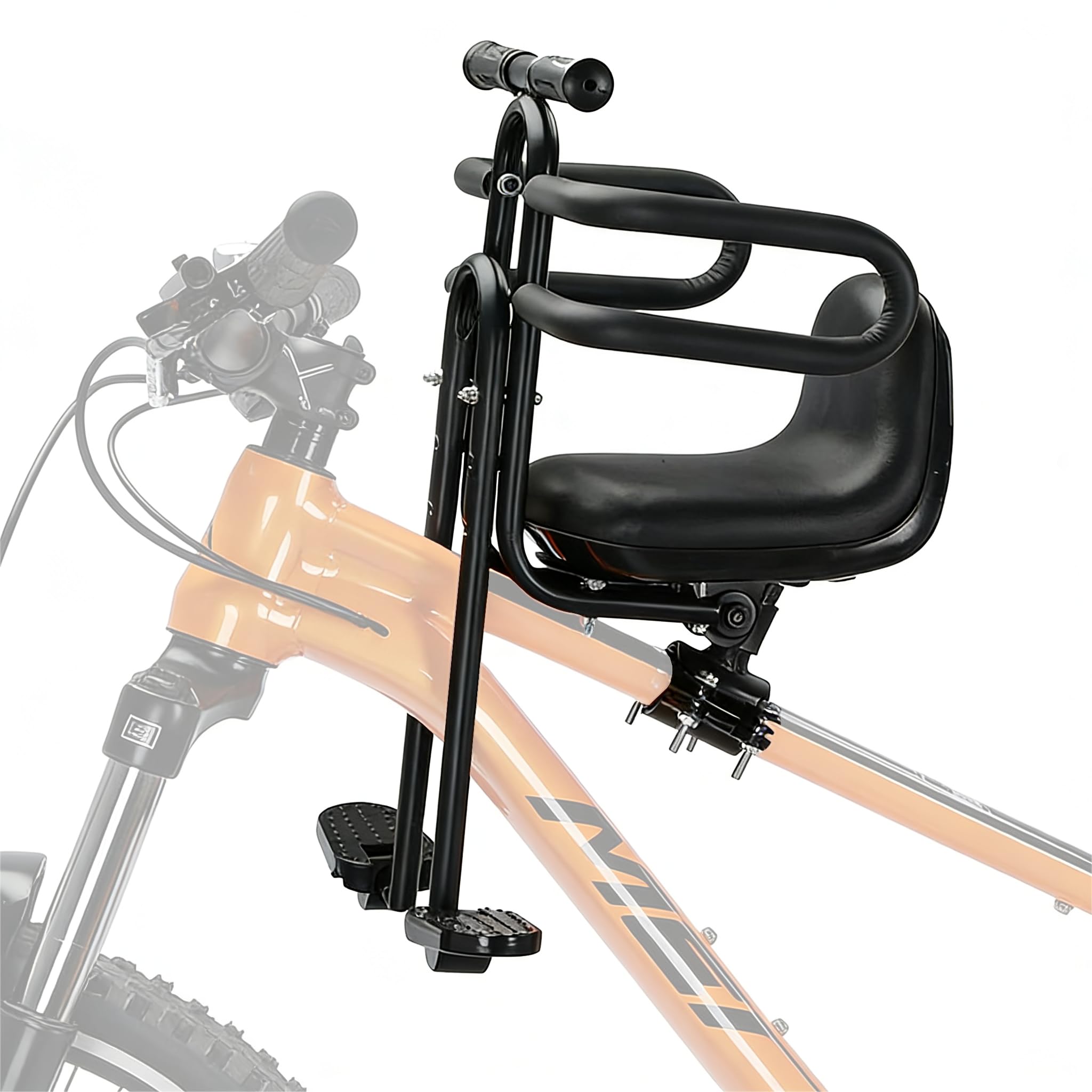
Fediman Front-Mounted Seat
Key Features
- Mount: Front seat-tube mount
- Age range: 2 to 5 years
- Foot pegs: Foldable
- Height settings: 3
- Price: Budget
Most front seats ask the child to do some of the work: sit up, hold the bars, lean with you. The Fediman is shaped for the ones who cannot yet. There is a semi-enclosure fence with a chest pad, a padded backrest, a safety belt, and three height positions so the same seat still fits two years later. The foot pegs fold away when nobody is aboard.
For a two-year-old who slides sideways halfway through a ride, that enclosure is the feature that matters, and it makes this the front seat we hand to parents of a wriggler rather than a chatterbox. The trade is bulk: the fence and backrest take up cockpit space that a saddle-style seat leaves alone, so check the distance from the saddle to the bars on your own bike.
Fediman lists 2 to 5 years and no weight limit, so size the child against the seat rather than the calendar—shoulders inside the fence, feet on the pegs, and enough room behind for your knees to pedal. It mounts to the seat tube, and the listing includes cruisers, folders and commuter bikes, which is broader than most top-tube seats manage.
Pros
- Semi-enclosure fence with a chest pad
- Three height positions as the child grows
- Foot pegs fold away when not in use
- Seat-tube mount suits cruisers and folders
Cons
- No stated weight limit
- Bulkier than a saddle-style front seat
The front seat we suggest for a toddler who won’t hold on, thanks to the fence and chest pad, if the bulk doesn’t crowd you.
How We Chose and Tested Kids Bike Seats
We started with roughly 40 seats sold in the U.S. and read the frame-fit charts before anything else, because a seat that doesn’t match your bike is a return waiting to happen. That alone cut the field in half. From there we filtered for build quality — thick molded shells, metal mounting hardware instead of plastic — and dropped anything with a harness we couldn’t adjust one-handed. Twelve seats made the cut, and we’ve ridden them for eight months.
Installation came first. Each seat went onto a hybrid, a step-through city bike, and a hardtail, and we timed the first install using only the tools in the box, then timed it again on a second bike a week later. After the first 20 miles we grabbed each seat and tried to rock it side to side, and we repeated that check after a month of daily school runs to see whether the bracket had crept.
Then the kids got in. We buckled a 30-pound two-year-old and a 42-pound five-year-old, first bare-handed and again in winter gloves, noting which buckles clicked on the first try and which needed two hands and a knee. On the bike we watched for the things you feel rather than measure: knee room at the top of the pedal stroke, how much the seat swayed when a kid leaned out to wave, and whether the footrests and recline positions earned their keep. Every kid was asked, bluntly, whether they wanted to go again.
Value came last, and it wasn’t about the sticker. We compared what each seat included against what we had to buy separately, moved every harness and footrest between both kids to see how much growing room there really was, and left each one out in a rain shower to check whether water pooled in the padding. The seats that scored highest were the ones we eventually stopped thinking about.
How to Choose a Kids Bike Seat
The seat is the fun part of this purchase; the mount is the part that decides whether you ride at all, so start by looking at the bike you already own.
Front or rear changes the ride, not just the view
If you want to talk to your child while you pedal, a front seat is the only way to get it. The trade is support. Saddle-style front seats have no harness and nothing behind the child’s head, so they suit a two-year-old who sits up and holds on rather than a one-year-old who naps. Rear seats carry a younger child in a bucket with a harness, a backrest and often a headrest, but you ride with a passenger you cannot see. Decide by the child’s age and temperament before you look at anything else.
Front seats also put the load between your arms, which some riders love and others find cramped. Sit on your own bike and check how much room there is between the saddle and the bars—a tall rider on a small frame has the least to spare.
The mount decides which bikes fit
Three mounts cover almost every seat. A rear frame mount clamps behind the saddle and works on a plain adult bike with nothing bolted on; it is the most broadly compatible option here. A rear rack mount goes on faster and moves between bikes faster, but only if your bike has a rack that is wide enough for the clamp and rated to carry the load. A front seat needs a flat or gently sloping top tube, or in one case a headset mount that touches no frame at all.
Before ordering, look for the three things that rule seats out: rear suspension, a rack welded into the frame, and cables running along the top tube. Each one quietly eliminates half the options.
Harnesses, age limits and the child who leans
Every seat here ships with a stated age range and, usually, a weight limit, and both are worth reading before you look at photos. The harness does the real work: a three-point with leg restraints is the minimum on a decent rear seat, and a five-point with a childproof buckle is the most secure design here—worth having if your child is small or likes to lean sideways mid-ride.
Front saddle seats skip the harness altogether and rely on the child holding the bars. Ask a pediatrician before riding with a child under one, and go by the seat’s stated minimum rather than by how big your baby looks.
Feet, spokes and heel clearance
Two leg problems decide whether a seat is pleasant to own. The first is the child’s: footwells with straps and a spoke guard or mudguard keep small feet out of the wheel, and they are the parts that wear first. The second is yours. A rear seat that mounts close behind the saddle pushes the child’s feet into the space where your heels swing, which is where the cheapest rear seats here fall down. If you are tall, or your frame is small, judge the gap before you buy.
What a passenger does to the bike
A rear seat puts weight behind the back wheel and makes the front end feel light, most noticeably on a climb or a loose surface. A front seat puts the weight between your hands and makes the steering heavier at low speed. Neither is a fault, but both change a familiar bike, and the first few rides with a child aboard should be short ones on quiet roads.
A quick-release mount earns its keep if the seat comes off often, either to free the bike for solo rides or to swap it to a second bike.
Frequently Asked Questions
What else do I need to buy with a kids bike seat?
A second mounting bracket is the usual extra. It stays on the other bike and lets one seat move between two adults in under a minute, which is cheaper than a second seat. If you pick a rack-mount seat, price the rack as part of the purchase and check it is wide enough for the clamp and rated for the load.
A helmet that clears the seat’s headrest finishes the job—some high-backed seats push a helmet forward if it is the wrong shape.
Can a child fall asleep in a bike seat?
Yes, and rear seats handle it better. A high back, a headrest and a five-point harness keep a slumped child upright once the neck goes; saddle-style front seats have nothing behind the head at all, so a sleepy toddler is the wrong passenger for one.
Time longer rides for after a nap, and plan to stop when the head starts to drop rather than pressing on.
How long will my child fit in a bike seat?
Several seats here are rated to 40 lb, which many children reach somewhere around four or five years old. If your child is already close to that, choose a seat with a longer stated span—the Bwcece runs to eight years by age—rather than buying twice.
Weigh the child and read the seat’s own limit before anything else; age ranges are a guide, weight limits are the rule.
Final Verdict
For most families the Schwinn Deluxe Child Carrier is the seat to buy. It clamps to a plain adult bike, holds a one-year-old in a harness with a cross bar and headrest, and asks for nothing you don’t already own.
The alternative is about your bike, not your child. If a rear rack is already fitted, the Thule Yepp 2 is the nicer thing to live with: five-point harness, keyed lock, and a seat that comes off in seconds. If your child is already four, look at the Bwcece for the extra years.
