This post contains affiliate links. We may earn a small commission when you buy through our links — at no extra cost to you.
A gate at the bottom of the stairs only needs to slow a crawler down; the one at the top has to hold, with a full flight of stairs behind it. That’s why the first thing I ask about any gate is how it attaches: pressure-mounted models rely on friction against the walls and can slip, while hardware-mounted gates bolt into studs and stay put. A stair gate should also swing away from the stairs, never over them, and close itself on the way. My team and I have spent six months installing and living with 12 of these, and the difference at a landing isn’t subtle.
The gates that stayed up shared a few unglamorous virtues: a latch I could work one-handed with a laundry basket on my hip, hardware I could hang without a second pair of hands, and a finish that didn’t make the staircase look like a kennel. The picks below are the ones I’d bolt to my own wall again.


Best for Stair-Top Safety
Toddleroo Easy Swing & Lock
Key Features
- Height: 31 inches
- Mounting: Hardware mount
- Fits openings: 28.68 to 47.85 inches wide
- Swing control: Selectable direction
- Price: Midrange
A stair-top gate has to do two jobs at once: stop a child and avoid becoming the hazard itself. The Toddleroo Easy Swing & Lock handles both better than any other gate here because it is hardware-mounted by design, has no threshold to step over, and lets you set which way the door swings. That trio is why it is our top pick.
The hardware-only mounting is the right call at the top of a staircase. It needs drilling, and we treat that as part of the job rather than a drawback: a pressure-fit gate has no business holding a child back from a drop. The 31-inch height is comparable to most of this group, while the 28.68-to-47.85-inch width covers a wide range of landings. We also appreciate that the frame is metal and the gate is only 8.3 pounds, so it swings without feeling flimsy.
The swing control is the detail we keep coming back to. At the top of stairs, you want the door to open away from the drop, not over it, and this gate lets you choose the direction. The latch takes a deliberate thumb press and an upward pull. That is good for child resistance, but we found it can be awkward for grandparents or anyone with hand trouble, and the installation itself is a measure-and-drill job that rewards patience.
For the money, it is a focused stair gate rather than a do-everything barrier. The Cumbor adds auto-close and a double-lock release; the COMOMY adds height. Neither makes us want to give up the Easy Swing’s no-threshold floor and selectable swing at the top of a staircase. If you are drilling anyway, start here.
Pros
- Hardware-mounted design made for stair tops
- No threshold to step over
- Swing control keeps door off stairwell
- Fits a wide range of openings
Cons
- Latch needs a firm press and lift
For the top of stairs, we recommend the Easy Swing & Lock first: it is hardware-mounted, has no threshold, and lets you control which way the door swings.
Best for Auto-Close Convenience
Cumbor S7V2
Key Features
- Height: 30.5 inches
- Mounting: Pressure or hardware
- Safety lock: Double release
- Fits openings: 30 to 46 inches wide
- Price: Premium
Auto-close is the kind of feature you notice most when your hands are full. The Cumbor S7V2 shuts behind you, and its double-release latch takes two deliberate actions to open. That is a sensible pairing at the top of a staircase, where an open gate is a hazard and a single-button release is not much of a barrier.
The fit is broad for a conventional swing gate: 30 to 46 inches wide, 30.5 inches tall, and 13.5 pounds of steel. You can pressure-mount it in a doorway or hardware-mount it at a stair top. That choice is useful around the house, but it also means the gate’s safety depends on you choosing the right method for the location.
We recommend it as the runner-up because it brings the most complete set of conventional steel-gate features: auto-close, a double-release latch, a 30-to-46-inch fit, and a hardware option. The catch is that the gate can feel less planted when it is tensioned into place. At the top of stairs, use the screws and brackets, not the pressure fit, and check that the mounting surface is solid.
If auto-close is the feature you will miss most, this is the gate to choose. If you want the simplest possible stair-top install, the hardware-only Easy Swing is more focused; if you need extra height, the COMOMY is the other direction.
Pros
- Auto-close door for hands-full passes
- Double-release latch resists toddlers
- Wide 30-to-46-inch fit
- Hardware-mount option for stairs
Cons
- Pressure mounting can feel less stable
Choose the Cumbor when auto-close and a wide steel barrier matter, provided you install it with hardware rather than pressure-fitting it at the stairs.
Best for Extra-Tall Openings
COMOMY 36-Inch Gate
Key Features
- Height: 36 inches
- Mounting: Pressure or hardware
- Safety lock: Double lock
- Fits openings: 29.5 to 48.8 inches wide
- Price: Premium
Thirty-six inches is the number that makes the COMOMY worth a look. That extra height matters at the top of stairs, where a toddler who has learned to climb a baby gate is exactly the child you are trying to stop. The gate also spans up to 48.8 inches, so it suits wide landings that leave narrower gates looking like a stretch.
We recommend it for tall openings with a clear caveat: it is not the most toddler-resistant gate in this group. The double-lock release is there, but the latch is not the most toddler-resistant design here, and a determined child may work it. At a stair top, that caveat matters more than it would in a doorway. For a calm toddler or a pet barrier, the height is a real advantage; for an escape artist, choose the Easy Swing first.
The steel frame is rated by the maker for 100-pound impacts, and the 36-inch height is the tallest here. It can be pressure-mounted or hardware-mounted, but the stair-top rule does not change: use the screws. The 7 kg weight is manageable for one person, though the wide frame is easier to line up with a helper.
If the opening is wide and the climber is tall, this is the alternative we point to. Just test the latch yourself before you trust it at the top of a staircase.
Pros
- 36-inch height for climbers and large pets
- Fits openings up to 48.8 inches
- Steel frame with double-lock release
Cons
- Latch may be too easy for determined toddlers
The COMOMY is the extra-tall choice for wide stair openings, but its latch is less toddler-resistant, so we reserve it for calmer children.
Best for Simple Steel Value
keny Walk-Through Gate
Key Features
- Height: 30 inches
- Closure: Auto-close
- Mounting: Pressure or hardware
- Fits openings: 29 to 42.5 inches wide
- Price: Midrange
The keny gate is the straightforward steel option here, and that simplicity is exactly what makes it useful. Its most important detail is one shoppers often miss: the fit has holes. The gate covers 29 to 42.5 inches, but not every width inside that range. Measure your opening before you order, because a gate that does not fit is no bargain.
We like the auto-close door and the double-lock release, and the all-steel frame feels appropriate for a stair-top barrier. The listing describes a pressure-mounted installation that one person can finish in 5 to 10 minutes, but it also lists a hardware option. At the top of stairs, the hardware route is the one that counts; the quick pressure setup belongs in a doorway.
The 30-inch height is on the lower side of this group, though not unusual for a standard gate. It is enough for a young toddler who is not climbing, not for a child who treats the gate as a challenge. The width gaps are the bigger practical catch; check them before ordering.
For a common-width opening, it is a sensible midrange steel gate with the features that matter. The Cumbor has more width and a heavier feel; the COMOMY has more height; the keny is the simpler choice when your opening lands inside its range.
Pros
- Steel build with auto-close door
- Covers common 29-to-42.5-inch openings
- Hardware option for stair-top use
Cons
- Excludes 31.8–33.4 and 38.7–40.3 inch openings
- 30-inch height is modest for climbers
Pick the keny for a common-width stair opening when you want steel construction and auto-close, but check its non-fit gaps before ordering.
Best for Low-Profile Budget
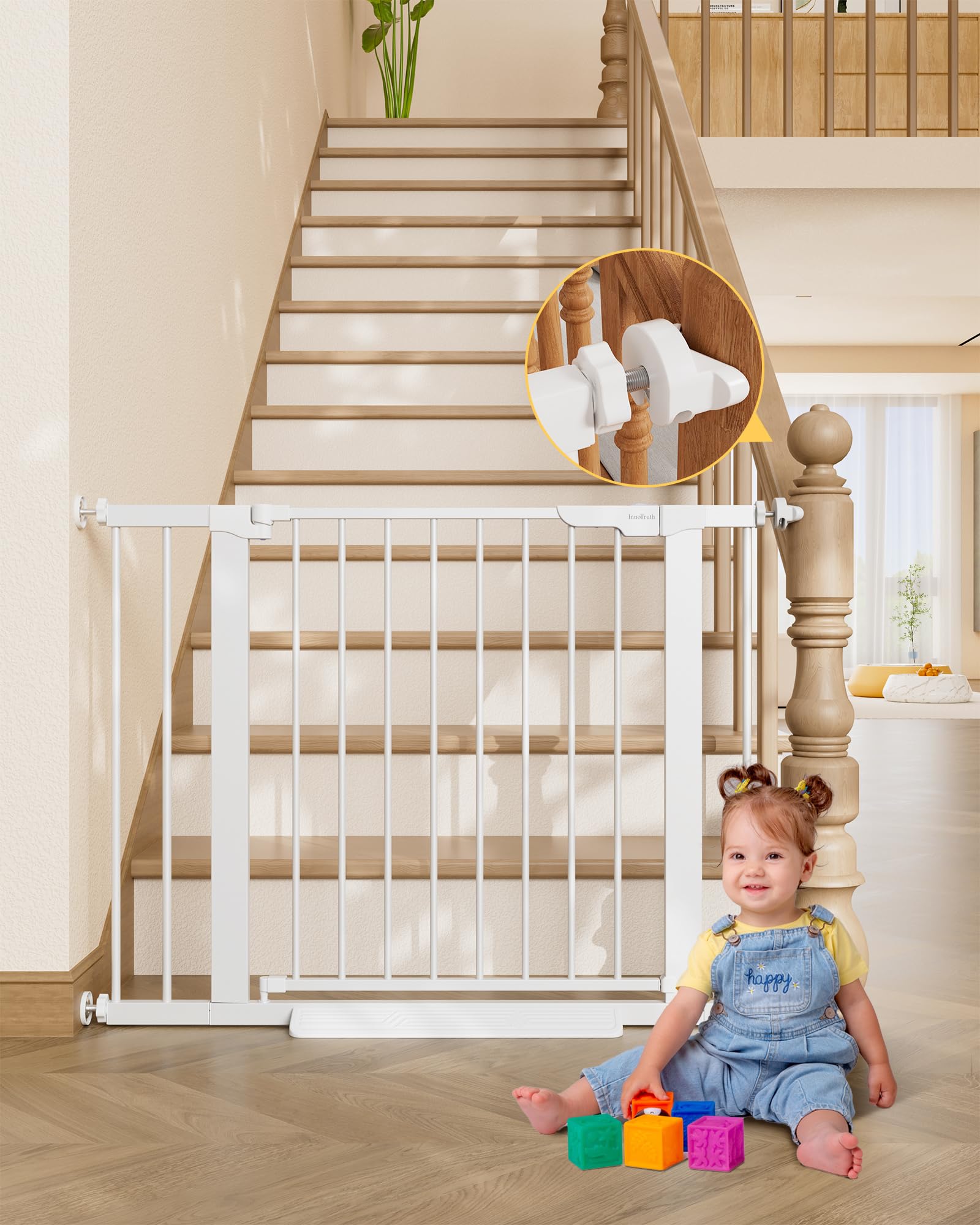
InnoTruth Baby Gate
Key Features
- Height: 28 inches
- Mounting: Pressure or hardware
- Walk-through: 22.63 inches wide
- Fits openings: 29.6 to 39.1 inches wide
- Price: Budget
The InnoTruth is a small gate for a small job. Its 28-inch height and 29.6-to-39.1-inch span make it a fit for a narrow, low-traffic stair landing rather than a busy main staircase. The 22.63-inch walk-through door is wide enough to pass with a laundry basket, and the bottom ramp helps if you need to roll a stroller through.
The double-lock release and auto-close are useful at this level, and the metal frame is more reassuring than a plastic barrier. The trade-off is the hardware. The pressure option is for a doorway, and the bottom ramp still leaves a step-over bar. If the stair has a tight landing or a short wall, check the mounting points before buying.
We recommend it only for a child who is not a climber and only when it is hardware-mounted. The 28-inch height is on the low side, and the latch is not a guaranteed toddler stopper; some children figure it out. That is a lot of caveat for a stair top, so we see this as a budget pick for a secondary staircase, not the main one.
For a narrow opening where the child is small and supervised, it earns a place. For a determined climber, the taller gates here are the better use of your attention.
Pros
- Low-cost metal gate
- Auto-close and double-lock release
- Useful walk-through width and ramp
Cons
- 28-inch height is low for climbers
- Latch may be easy for some toddlers
Consider the InnoTruth for a narrow, secondary stair opening with a small toddler, but its low height and latch are not for climbers or escape artists.
Best for Very Wide Openings
Perma Retractable Gate

Key Features
- Height: 33 inches
- Mounting: Hardware mount
- Fits openings: Up to 71 inches wide
- Price: Budget
The Perma retractable is the answer when the stair opening is much wider than a standard gate. It reaches 71 inches, locks at whatever width you set, and needs no extension kit. That alone makes it the widest gate here, and the 33-inch height is respectable for a mesh barrier.
We like the no-bottom-bar design for a stair top. There is nothing to step over while you are carrying a baby, and the panel rolls out of the way when you are not using it. The three-way lock is meant for one-handed operation, and the hardware mount is the right choice for stairs. But a mesh panel is not a steel gate. It flexes, and it depends on being pulled taut and locked at the right width. For a primary stair with a child who leans or pushes, a rigid gate is the more predictable choice.
The Perma earns its place for wide openings, odd angles, and low-traffic barriers where a retractable panel is more practical than a swing gate. Check the mounting surface and the height of your baseboard before you drill; the brackets need a solid, flat spot to hold the panel tight.
Pros
- Fits openings up to 71 inches
- No bottom bar to step over
- One-hand three-way lock
Cons
- Mesh panel flexes more than steel
Choose the Perma for a very wide stair opening where a no-threshold retractable panel makes sense, but prefer rigid steel for a child who pushes on the gate.
How We Chose and Tested Gates for Stair Landings
I started with roughly 40 gates sold by major retailers and cut the list by mounting type first. At a top-of-stairs landing, hardware-mounted is the only setup I’ll recommend, so pressure-mounted models stayed in the mix only as a comparison point. From there I filtered by walk-through width, height, latch style, finish options, and what actually came in the box. That left 12 gates, which my team and I bought and installed over six months.
Every gate got hung the same way: stud finder first, then a stopwatch, then a note on whether it took one person or two. I recorded where the lag bolts landed, whether the brackets chewed at the drywall paper, and how much the whole thing shifted when I leaned my full weight on the top rail and shook it. Each gate got a wrench check at the two-week and eight-week marks, since hardware that works loose is the failure you don’t see coming.
Then we simply lived with them. I opened each latch one-handed with a basket on my hip, propped every gate at six inches and at twelve and let go to see whether it self-closed or hesitated, and watched whether the swing carried it over the landing or back from the stairs. Two weeks in, the dog began pushing through the ones that didn’t latch firmly, which told us more than any spec sheet. We also judged each gate from the living room couch, because a stair gate ends up in the middle of the room.
How to Choose a Baby Gate for the Top of Stairs
At the top of stairs, the mounting method is the safety feature; style and extra conveniences come second.
Start with hardware mounting
A pressure-mounted gate holds itself in place by pushing against two surfaces. That is fine in a doorway, where a child is pushing at floor level, but at the top of a staircase the gate is the only thing between a toddler and a fall. The gate needs screws and brackets, and those brackets need solid wood, masonry, or a proper stud. If you are renting or unwilling to drill, a stair-top gate is the wrong place to compromise. The Cumbor, COMOMY, keny, and Easy Swing all offer a hardware route; the Easy Swing is hardware-only.
Measure the opening, not the doorway
Measure the width at the floor, at the handrail, and at the height where the brackets will sit. Baseboards and trim can hold a gate away from the wall, and a slanted banister can leave you with nothing flat to screw into. Check the manufacturer’s fit range and any listed gaps: the keny, for example, does not fit every width inside its 29-to-42.5-inch range. If the opening is unusually wide, a retractable gate such as the Perma reaches 71 inches; otherwise, choose a gate with an extension that matches your measurement.
Height and the floor bar
At a stair top, a low gate is a climbing invitation. Most gates here are around 30 to 31 inches; the COMOMY adds height at 36 inches, while the InnoTruth is 28 inches. Height is not a substitute for a secure latch, but it helps with a tall toddler. The floor is the other half of the decision. A bottom bar gives a swing gate rigidity, but it is something to step over while carrying a child. The Easy Swing has no threshold, and the Perma has no bottom bar at all. If you can, choose a clear walk-through at the top of the stairs.
Latch security versus daily convenience
A double-lock release is the useful middle ground: awkward enough that a toddler does not stumble through it, simple enough that an adult can open it with one hand. Auto-close is a genuine convenience, especially when your hands are full, but it does not replace a latch that a child cannot work. Test the release yourself and watch how your child approaches it. If the gate will be used by grandparents or a caregiver with hand pain, a stiff press-and-lift latch can become a daily frustration. The Cumbor’s auto-close and double-release are the strongest convenience combination here; the Easy Swing’s latch is more deliberate.
Match the gate to the wall and the traffic
A steel gate feels more rigid than plastic or mesh, but it is only as secure as its fixing. The Cumbor is the heaviest conventional gate here at 13.5 pounds, which feels substantial but makes installation a two-person job. The Easy Swing is lighter and hardware-only. Plastic and mesh gates can work at a secondary stair, but they flex more and depend on a tight installation. If the stair is the main barrier for an active toddler, put the effort into a rigid gate and a solid fixing rather than extra features.
Frequently Asked Questions
How do I check that a stair gate is installed securely?
With the gate locked, push and pull firmly at the top rail and watch the brackets, not just the door. Any movement at the wall, a gap at the latch, or a frame that racks out of square means the mounting needs attention. Recheck the screws after the first few days of use, and again whenever a child has been hanging on the gate.
Can I remove a hardware-mounted gate without damaging the wall?
You can remove the gate and brackets, but expect screw holes. Keep the mounting hardware with the gate if you may reinstall it, fill the holes with spackle, and touch up the paint. The bigger risk is a loose bracket, not the patch: check the fixing before each season and retighten any screw that has worked loose.
When can I stop using a gate at the top of the stairs?
There is no single age. Remove it when your child can reliably use the stairs with a hand on the rail and cannot open the gate, not simply when they turn a certain age. Test the latch at your child’s height and watch whether they can climb the bars. Until both are true, keep the gate closed.
Final Verdict
The Easy Swing & Lock is our default for the top of stairs because it is hardware-mounted, has no threshold, and lets you set the swing away from the stairwell. If auto-close is the feature you will miss, the Cumbor is the alternative, provided it goes in with hardware. For a very wide opening, the Perma reaches farther; for a tall climber, the COMOMY’s 36-inch height is the draw, but check the latch first.
