This post contains affiliate links. We may earn a small commission when you buy through our links — at no extra cost to you.
A teaching clock looks like a toy and works like a tool, and most of the ones I’ve handed to a kid fail on the second part. A pretty face with painted-on numbers is fine until someone grabs the minute hand, gives it a spin, and it comes back slack — or slides around the dial without dragging the hour hand with it, teaching the opposite of how a clock actually works. What you want is a clock that survives being handled and keeps the big hand and the little hand honest with each other.
I’ve spent plenty of mornings on the kitchen floor pointing at the 3 and saying "that’s fifteen minutes," and the clocks that got through were the ones with labeled minute numbers and gears that moved the hands as a pair. We tested 16 of them over four months, from wooden sorters to silent wall clocks. One thing I’d tell any first-time buyer: color coding helps early on, but a clock that only works in color becomes a crutch the moment a kid faces the oven clock. The picks below split that difference in a few different ways.


Best for First Lessons
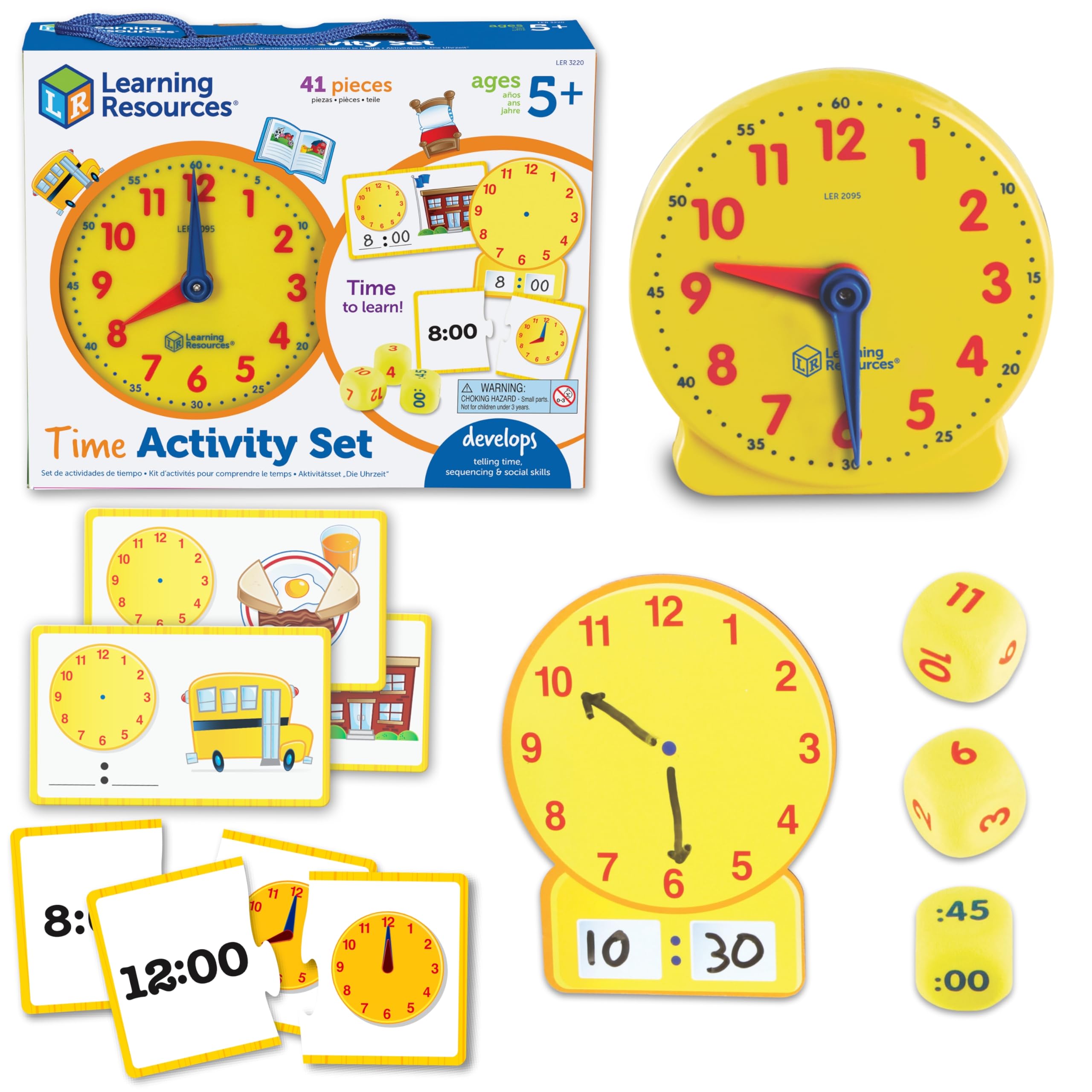
Learning Resources Time Activity Set
Key Features
- Players: 1-4
- Age range: 5 – 8 years
- Set contents: Two clocks, cards, puzzles, dice, guide
- Price: Budget
A clock on the wall asks a child to do one thing: look. This set asks them to move the hands, write the answer, roll a die, and fit a puzzle piece, and that’s why it’s the one we hand to families first. In the box you get a geared teaching clock, a write-and-wipe clock, double-sided activity cards, puzzles, dice, and an activity guide, which adds up to a whole lesson plan for less than most single wall clocks here.
The two clocks do different jobs, and the pair is the point. Turn the minute hand on the geared one and the hour hand travels with it, which is the lesson a worksheet can’t teach: at 4:45 the hour hand sits three-quarters of the way to the 5, not parked on the 4. The hands are linked, so you can’t fake a time by putting the hour hand wherever you like. A drill like "show me 7:10" has to go through the minute hand, the way a real clock works. The write-and-wipe clock covers the other direction: draw the hands, write the digital time, wipe it, go again.
One wrinkle to know about: the clock face starts each hour’s minute count at 60, while the cards and dice print it as 00. That takes one explanation, the same moment written two ways, but it does snag a beginner, so get it out of the way early. After that the set runs on its own, with cards to match, dice to roll, and a guide full of short lesson ideas. It’s the most complete teaching tool here and the one we keep coming back to.
Pros
- Two clocks, cards, dice, and a guide in one box
- Geared hands show how the hour hand travels
- Cards and dice turn drills into a game
Cons
- Minute hand can break if forced backward
- Aimed at ages 5 to 8, not toddlers
Start here. One box gives you a geared clock to handle, a write-and-wipe clock to draw on, and cards and dice that make the practice feel like a game.
Best for Daily Practice
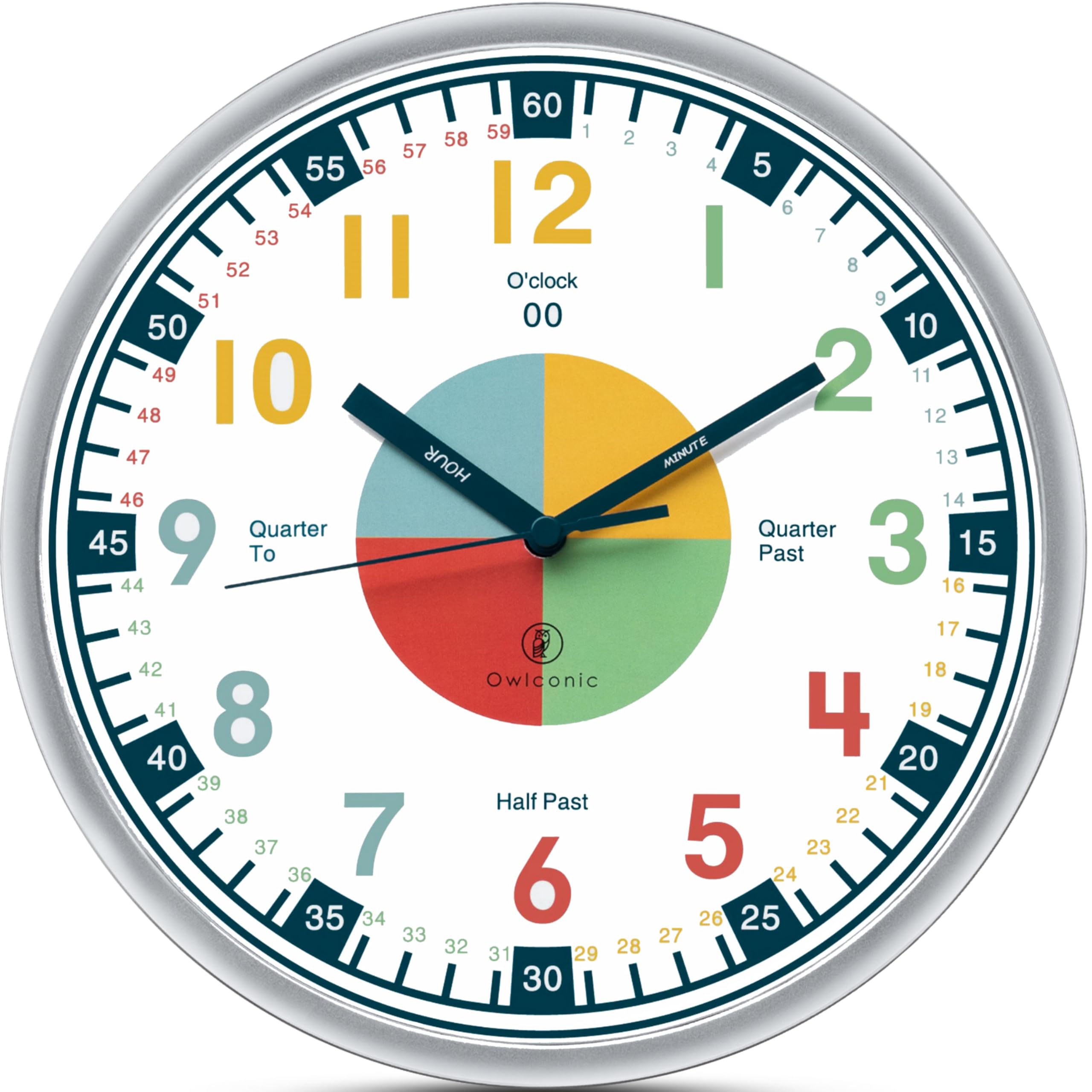
OWLCONIC Kids Wall Clock
Key Features
- Power: 1 AA battery
- Movement: Silent quartz sweep
- Face size: 10 inches
- Battery cover: Screw-secured
- Price: Midrange
Read the face and you can see what a child sees: every number colored to match its hour, the hands printed with the words HOUR and MINUTE, and the quarter hours spelled out around the dial, quarter past, half past, quarter to. That is why it’s the wall clock we recommend. It keeps explaining when there’s nobody in the room to help.
The details suit a bedroom more than a classroom. The movement is a silent sweep, so there’s no tick to fixate on at nine o’clock at night, and the battery cover is held by a screw, a small thing that matters in a house where a toddler investigates everything with a fingernail. Ten inches of face is big enough to read from a bed or across a small kitchen, and the acrylic face wipes clean with a damp cloth.
Ten inches is also the ceiling. From the back of a classroom the printed words go small, and the fourteen-inch clocks exist for exactly that reason. Hung at your child’s eye level, though, it becomes the clock they check before they ask you, which is the whole point of putting one on a wall instead of in a drawer.
Pros
- Color-coded hours, labeled hands, printed quarter hours
- Silent sweep movement suits a bedroom
- Screw-secured battery cover for small fingers
Cons
- Wall-mounted, so the hands never move
Our pick for the wall: the labels do the teaching when you’re not in the room, and the silent movement and screwed-down battery cover suit a kid’s bedroom.
Best for Ages 2 to 4
Melissa & Doug Shape Sorting Clock
Key Features
- Size: 9.0 x 9.0 x 4.5
- Age range: 3+ years
- Number pieces: 12 numbered shapes
- Price: Midrange
Nobody learns to read a clock from this one, and that’s the point. The Shape Sorting Clock is a wooden twelve-piece puzzle with a clock face on it. Each number is a chunky shape that drops into a recessed well, and the hour and minute hands turn above them. It’s nine inches square and heavy enough to stay put on a table while small hands work at it.
For a two- or three-year-old, that makes it the right first clock. They get numbers, shapes, colors, and the pinch-and-place that builds a pencil grip, and by the time they can count to twelve the face is already an old friend. The hands are simply the last thing to learn. We like it as the year-before clock: buy it when your child is naming shapes, not when they’re asking about minutes.
The extension activities carry it further than the box suggests, from sorting by color to counting the pieces to matching shapes, and only then naming a time. Where it stops is actual time-telling. When your child is ready for "half past," the wooden face is the thing they already know, and one of the geared clocks here becomes the next step.
Pros
- Twelve chunky shapes teach numbers, shapes, and colors
- Movable hands make the face familiar before time matters
- Extension activities grow with a toddler
Cons
- Number pieces can chip with heavy play
For a two- or three-year-old, this is the right first clock: numbers, shapes, and colors now, and a familiar face waiting when time clicks later.
Best for Classroom Lessons
Learning Resources Write & Wipe Clock
Key Features
- Surface: Dry-erase write-and-wipe
- Mounting: Tabletop stand
- Face size: 12 inches
- Price: Budget
This is the least expensive thing in the guide, and it looks it: a flat twelve-inch face, a plastic stand, and a blank panel to the right of the dial where a digital display would sit. That blank panel is the whole idea.
Write 7:45 in it with a dry-erase marker, set the hands to match, wipe, and go again. Seeing the two notations side by side is how the analog and digital versions of the same moment finally connect for a lot of kids, and it’s why we reach for this board ahead of bigger, fancier demonstration clocks. The face is readable from across a small classroom, and it stands on a table or hangs flat on a wall.
It’s a teaching board rather than a toy: an adult runs the lesson, the child answers, and the board wipes clean in between. Twelve inches is a little large to balance on a lap, so plan on a table or an easel, and keep the marker with it, because the panel is the reason this one is on the list. For a co-op class or three siblings at the kitchen table, it does most of what a big classroom clock does in a fraction of the space.
Pros
- Dry-erase panel pairs analog and digital times
- Twelve-inch face reads across a classroom
- Least expensive clock in this guide
Cons
- Hands are stiff to turn and bend easily
Best value here for a classroom or a kitchen table: write the digital time, set the hands, wipe it clean, and go again.
Best for Big Walls
Oyster&Pop 14-Inch Wall Clock

Key Features
- Frame: Wood-effect
- Power: 1 AA battery
- Movement: Silent sweep
- Face size: 14 inches
- Price: Premium
Fourteen inches of clock is a commitment. On a playroom or classroom wall it reads from the doorway, and every one of the sixty minutes is numbered, so a child who’s still counting by fives can simply read the answer. Set it beside a ten-inch clock and the difference isn’t subtle: the numbers are bigger and the minute ring is legible from twice as far.
It’s also the best-looking clock here. The wood-effect frame and round face read as room decor rather than a teaching chart, which matters if it’s going above a sofa instead of a whiteboard. The movement is silent, so a bedroom works too, and each hour carries its own color so the quarters are easy to point at.
The risk is the movement. The failure that turns up with this clock is one that quits after a month or two, and a teaching clock that stops is worse than no clock at all, because a child who has just learned to trust it gets burned. The one we tested kept time without complaint, but hang it where a dead face would be obvious and keep the receipt for the first month.
Pros
- Fourteen-inch face with every minute numbered
- Wood-effect frame reads as decor, not a teaching aid
- Silent sweep movement for bedrooms
Cons
- Premium price for a wall clock
Buy it for the size and the looks: a fourteen-inch face numbered minute by minute earns its wall space, as long as you keep the receipt.
Best for Group Teaching
Carson Dellosa Judy Clock

Key Features
- Size: 13.5 x 13.5 x 1.35 inches
- Stand: Metal stand included
- Age range: 4 – 8 years
- Price: Midrange
Where the Learning Resources board is flat and gets propped against a wall, the Judy clock is furniture: thirteen and a half inches across, about an inch and a half thick, standing upright on a metal stand so a group can gather around it.
The color-coding is the part teachers will recognize. The minute hand and the tick marks around the rim share one color, and the hour hand and the numerals share another, so counting by fives has something to point at. The numerals are large and the whole face stays legible from the back of a room, which is the reason to pay for the size.
It weighs a little over a pound, light enough to carry from a cupboard to the table, though at this footprint it wants a shelf rather than a drawer. The stand holds it steady on a flat surface, and the whole clock turns toward whoever is looking at it.
Buy it if you teach a group and want one object at the front of the room that everyone can see. That’s the job it does better than anything else here, and it’s the reason the size is worth the shelf space. For a single child at a desk, the geared clock in the Time Activity Set covers the same lesson in a smaller package, and the write-and-wipe board handles the digital comparison without taking up a whole table.
Pros
- Thirteen-inch face readable across a room
- Color-matched hands and tick marks
- Metal stand holds it upright for a group
Cons
- Minute hand can slip out of position
This is the clock for a group: freestanding, thirteen inches across, and color-coded so you can point at the tick marks while you count by fives.
Best for Solo Practice
BEST LEARNING Talking Clock

Key Features
- Modes: Time, quiz, sleep
- Age range: 36 months – 6 years
- Batteries: 3 AAA (included)
- Night light: 12 colors with timer
- Price: Premium
This is the only clock here that can run a lesson with no adult in the chair. Set a time on the dial, press the button, and a voice reads it back two ways, the simple version first and then the fuller one, so a four-year-old who can’t read yet can check an answer alone.
The quiz is the part that earns its keep. The clock asks for a time, the child moves the hands, a green light confirms it, and a wrong answer gets three patient tries before the clock moves on. Ask, try, confirm: it’s the loop a grown-up runs with a flashcard, and here it runs itself.
It’s a nightstand object too, with ten lullabies, twelve glow colors, a sixty-minute fade-out timer, and two volume levels, all on three AAA batteries that come in the box. Plenty of toys bolt a night light on as an afterthought. This one is soft and quiet enough to leave running.
The mechanism is the gamble. The hour hand can stop clicking into its positions, and when it does the clock no longer knows what time it’s showing, which takes the quiz down with it. Run the hands through a full twelve hours in the first week, and buy this for the talking and the quizzing rather than as the clock the household runs on.
Pros
- Voice reads the time aloud two ways
- Self-running quiz with three tries
- Lullabies and a fading night light
Cons
- Premium price for a plastic toy
Worth it if you want a child practicing without you in the chair: the talking quiz does real teaching, and the night light earns its nightstand.
Best for Small Bedrooms
Roymnie 8-Inch Wall Clock

Key Features
- Power: 1 AA (not included)
- Movement: Silent quartz
- Face size: 8 inches
- Price: Budget
The face on this eight-inch clock says the quiet part out loud: every minute is numbered, the quarter hours are spelled out, quarter past, half past, quarter to, and each hour gets its own color. A child who can read those words can answer "what time is it?" without counting anything first.
Eight inches is the right size for a bedroom wall, hung at a child’s eye level, and the silver-tone frame keeps it from looking like a classroom castoff. It’s silent, it runs on one AA, and once it’s low enough to read from the bed it becomes the clock a kid actually checks.
At the bottom of the price range, this is the least expensive way here to put a labeled clock in a small room, and the labeling is done as carefully as on the pricier clocks here. The caveat is the movement: these can arrive dead or quit within weeks, so keep the packaging and the receipt until it has run for a month. Buy it as an inexpensive first wall clock, not as the clock the household runs on.
Pros
- Quarter-hour words printed on the face
- Silent movement in a small footprint
Cons
- Too small to read across a classroom
The cheapest way to put a properly labeled clock in a small bedroom, provided you go in knowing the movement is the gamble.
How We Tested the Best Teaching Clocks
We started by pulling every teaching clock we could find that showed a full set of minute numbers, then filtered out anything whose hands turned independently of each other — a surprising number failed that one. Standing versus wall-mounted, face size, and build material narrowed the field to 16.
Testing ran four months, roughly a semester, in the places these clocks actually live: the wall above our kitchen table during the morning rush, a first-grade classroom corner and small-group table, a homeschool desk, and a bedroom where the lights stay off until the last story is read. A rotating cast of kids ages 3 to 8 did most of the handling.
For the hands, I turned the minute hand through a full twelve hours and watched whether the hour hand arrived at each numeral on cue, then tried to move the hour hand by itself to see whether it would budge. Durability meant counter-height drops onto tile, a wipe-down with a damp cloth, and a week of unsupervised use at the classroom table. We checked timekeeping against a phone at the start and again at the end, and listened to the quiet ones from a pillow in a dark room.
Playability we judged by whether kids picked a clock up without being asked; the educational side, by covering the color cues and seeing who could still read the time. A clock also had to stay put — we watched whether a stand tipped or a wall hanger pulled loose when a small hand pushed the minute hand. At the end we set what each one could do next to what it cost, and the quiet, sturdy, fully labeled ones were the easiest to recommend.
How to Choose a Teaching Clock
The first decision isn’t brand or size. It’s whether you want a clock your child reads or one your child handles.
A Clock to Read and a Clock to Handle
Both teach, but they teach different halves of the skill. A labeled wall clock gives a child a reason to look: dinner, bedtime, and the school bus all hang on the time, so reading it becomes useful rather than academic. A manipulable clock gives them a chance to build a time with their own hands, which is where the hour hand’s position finally clicks.
The families who get there fastest use both, a clock on the wall and a geared clock on the table. If you’re buying one thing first and your child is five or older, buy the one they can hold.
Geared Hands or Independent Hands
On a geared clock the hour hand travels as you turn the minute hand, which is the single most useful thing a teaching clock can show: at 4:45 the hour hand sits three-quarters of the way between the 4 and the 5, not on the 4. On a clock with independent hands you can set any time you like, which is better for speed drills but teaches nothing about how the two hands relate.
Start geared, and add a free-handing clock when your child is ready to be quizzed rather than taught.
Match the Face to the Distance
Eight to ten inches is right for a bedroom wall or the kitchen, where your child is a few feet away. A group needs twelve inches or more: a classroom, a co-op table, three kids on one couch. The mistake to avoid is buying a small clock for a class because it costs less. From the back row an eight-inch face is a colorful blur, and the labels that make it a teaching clock stop doing any work.
Silence, Batteries, and Height
A ticking clock in a bedroom becomes a problem at nine o’clock at night, so look for a silent sweep if the clock lives anywhere near sleep. Check the battery compartment too: a cover held by a screw is the difference between a clock and a small-parts temptation in a house with a toddler.
Then hang it low. A learning clock mounted at adult eye level is decoration; at a child’s eye level it’s a tool they use without being asked.
The Hands Are the Weak Point
Almost everything that goes wrong with a teaching clock goes wrong at the hands: snapped on a toy, bent on a demonstration board, or slipped out of position on a big classroom model. Teach the grip before you hand it over. Turn from the center hub, and never push a hand backward.
On a battery clock, the second thing to watch is the movement itself. Run it against your phone for the first week and keep the receipt until you know it holds time.
Frequently Asked Questions
What age should a child start using a teaching clock?
Most children can handle the numbers at three and the hands at five or six. The useful test isn’t age but whether they recognize the numerals and can count to twelve; once they can, start with hour-only times, like 3 o’clock and 7 o’clock, and add half hours when those come without counting. Before that, a shape-and-number clock earns its place by making the face familiar.
Can a teaching clock double as the family clock?
Sometimes. A labeled wall clock with a quartz movement keeps time like any other clock, and it’s the easier sell to a child because the household actually uses it. A demonstration board or an activity set is a teaching tool rather than a timekeeper, so don’t hang one in the hallway and count on it to get everyone out the door.
What is a Judy clock?
It’s the trade name that became the everyday term for a big geared classroom clock on a stand, and it’s the name on the Carson Dellosa model here. Shopping for one, look for a face of twelve inches or more, hands and tick marks that share a color, and a stand that holds the clock upright on a table.
Final Verdict
If you buy one thing, buy the Learning Resources Time Activity Set: a geared clock to handle, a write-and-wipe clock to draw on, and cards and dice that hold a six-year-old at the table longer than a worksheet does. It covers the lesson and the practice in one box.
Put the OWLCONIC on the wall so the reading keeps happening between lessons. If you’re teaching a group instead of a child, the twelve-inch write-and-wipe board is the better tool, and the Judy clock is the one to stand at the front of the room.
