This post contains affiliate links. We may earn a small commission when you buy through our links — at no extra cost to you.
At 4 a.m., halfway through a feed, I once counted out a postnatal vitamin the size of a small stone and wondered if it was worth the nausea. The bottle promises recovery, energy, hair, and milk support, but the daily test is simpler: can you swallow it, digest it, and afford to keep taking it? We spent eight months with 12 postnatal formulas, including softgels, tablets, and gummies, with nursing and bottle-feeding moms in the mix.
Labels are where shoppers get stuck. DHA and iron are common headline ingredients, but form matters—methylated folate versus folic acid, how much iron a serving carries, and whether a gummy skips iron entirely. I also unscrewed every cap and sniffed before committing, because a strong fish or herbal odor can make a formula impossible to face before coffee.
We tracked taste, pill size, and side effects such as nausea, then asked nursing moms to note any perceived supply changes without treating a vitamin as a lactation guarantee. The picks below are the ones we could live with.



Best for Simplest Daily Routine
Nature Made Postnatal + DHA
Key Features
- DHA: 200 mg
- Supply: 60 days
- Serving size: 1 softgel daily
- Key nutrients: 20 vitamins and minerals
- Price: Budget
One softgel, once a day, and 60 days to a bottle. That arithmetic is most of why this is the postnatal vitamin we recommend first: the year after birth is not a moment when anyone needs a supplement that asks for three swallows and a separate fish-oil capsule. This one carries 200 mg of DHA alongside 20 vitamins and minerals, including iron, calcium, iodine and vitamin D3, so the omega-3 is already in the swallow.
The DHA is the part we care about most. Keeping up with a second omega-3 bottle is the step that quietly falls off the list, and folding 200 mg into the same softgel removes a decision from a day that is already full of them. Nature Made also doses this higher in vitamins A, C, D and E than its own prenatal, which is the reason to switch rather than finish the bottle from pregnancy. Because it is higher, it should not be stacked with another multivitamin.
Where it is plain rather than fancy: this is a core panel, done well, without the choline or herbal extras the premium bottles here lead with. For most buyers that is exactly right, since the nutrients that matter in the fourth trimester are on the label. If your provider asked for methylated folate by name, check the label before you order.
The price of consistency is the other argument. A 60-day supply that costs less than most of the bottles here, one swallow, DHA included, is the combination that actually gets finished. Everything else on this list is a specialist tool by comparison.
Pros
- One softgel covers the whole daily routine
- 200 mg of DHA, so no second bottle
- 20 nutrients including iron, calcium and iodine
- 60-day supply at a low cost per day
Cons
- Softgel only, with no gummy alternative
We recommend it first because it finishes the whole job, 20 nutrients plus 200 mg of DHA, in one softgel at a cost per day that is easy to keep up.
Best for Breastfeeding Moms
Mama’s Select Postnatal Plus
Key Features
- Iron: Included
- Biotin: Biotin-free
- Testing: Third-party tested, US-made
- Folate form: Methylated folate
- Price: Midrange
The detail that turned out to matter most is a small one: this formula is biotin-free. Biotin sits in almost every hair-and-nail supplement on the shelf, and it is also the vitamin that can throw off thyroid test results, an annoyance in any year and a genuine problem in the one when a lot of women are having thyroid levels drawn for the first time. Leaving it out is deliberate, and it tells you this brand was thinking about postpartum rather than repackaging a prenatal.
There is more to like. It pairs iron with methylated folate, the active form, which is what to look for if your provider has mentioned absorption or an MTHFR variant. The capsules are easy to swallow, which sounds like a small thing until you are taking one at 3 a.m. with a baby on your shoulder. The label is clean too: no caffeine or stimulants, no gluten or major allergens, made in a US facility that third-party tests each batch.
The milk-supply language on the bottle deserves a raised eyebrow. No multivitamin makes milk, that is feeding frequency, hydration and rest, and the fenugreek and moringa this brand talks about are sold separately rather than folded into the capsule. We actually prefer that arrangement: you get a complete postnatal panel, and you decide whether to add herbs and at what dose, instead of having three of them buried in a serving you cannot adjust.
Two months of capsules at a mid-pack price is the other argument. The one thing worth knowing before you start: give it two weeks. The panel is full, the capsule is small, and the first few days are not the ones to judge it on.
Pros
- Methylated folate and iron in one capsule
- Biotin-free, so thyroid labs stay accurate
- Small capsules that are easy to swallow
- Lactation herbs sold separately, so you control the dose
Cons
- Herbal lactation support is a separate purchase
If you want methylated folate and iron without a horse pill, this is our pick: an easy capsule, a clean label, and lactation herbs kept where you can add them yourself.
Best for Allergy-Sensitive Moms
One A Day Postnatal
Key Features
- DHA: Included
- Allergens: Free of 7 major food allergens
- Folic acid: Included
- Serving size: 1 softgel daily
- Price: Midrange
Seven major US food allergens are deliberately left out of this softgel, egg, wheat, dairy, peanut and tree nut among them. If there is a food allergy in your house, that line is the first one to read on any label and often the thing that rules a bottle out entirely, which is most of the reason this one is here.
It is also the simplest one-a-day in the group alongside our top pick, and the more straightforward of the two: a single softgel taken with food, carrying folic acid, omega-3 DHA and the B vitamins, from a brand that has been formulating this kind of thing for decades. We like it for the mom who wants a big-name postnatal and does not want to think about it again after breakfast. The softgels arrive in blister packs, which travel well in a diaper bag and feel like a lot of packaging next to the coffee maker.
Where it gives ground is in the detail. The label lists DHA without saying how much, so if your provider gave you a number to hit, count with a bottle that prints it. Odor is the other wildcard with any omega-3 softgel; if fishy burps have bothered you before, keep the pack in the fridge and take it with your biggest meal rather than with coffee.
None of that is disqualifying. This is a well-behaved, allergen-aware softgel from a brand you can find anywhere, and for a lot of households that settles the decision on its own.
Pros
- One softgel daily, taken with food
- Free of seven major US food allergens
- Folic acid and omega-3 DHA included
- Blister packs travel well in a diaper bag
Cons
- DHA amount is not stated
- Heavy packaging for daily home use
The one to hand a household with food allergies: a single softgel, seven major allergens excluded, DHA inside, and nothing to think about after breakfast.
Best for Food-Based Nutrition
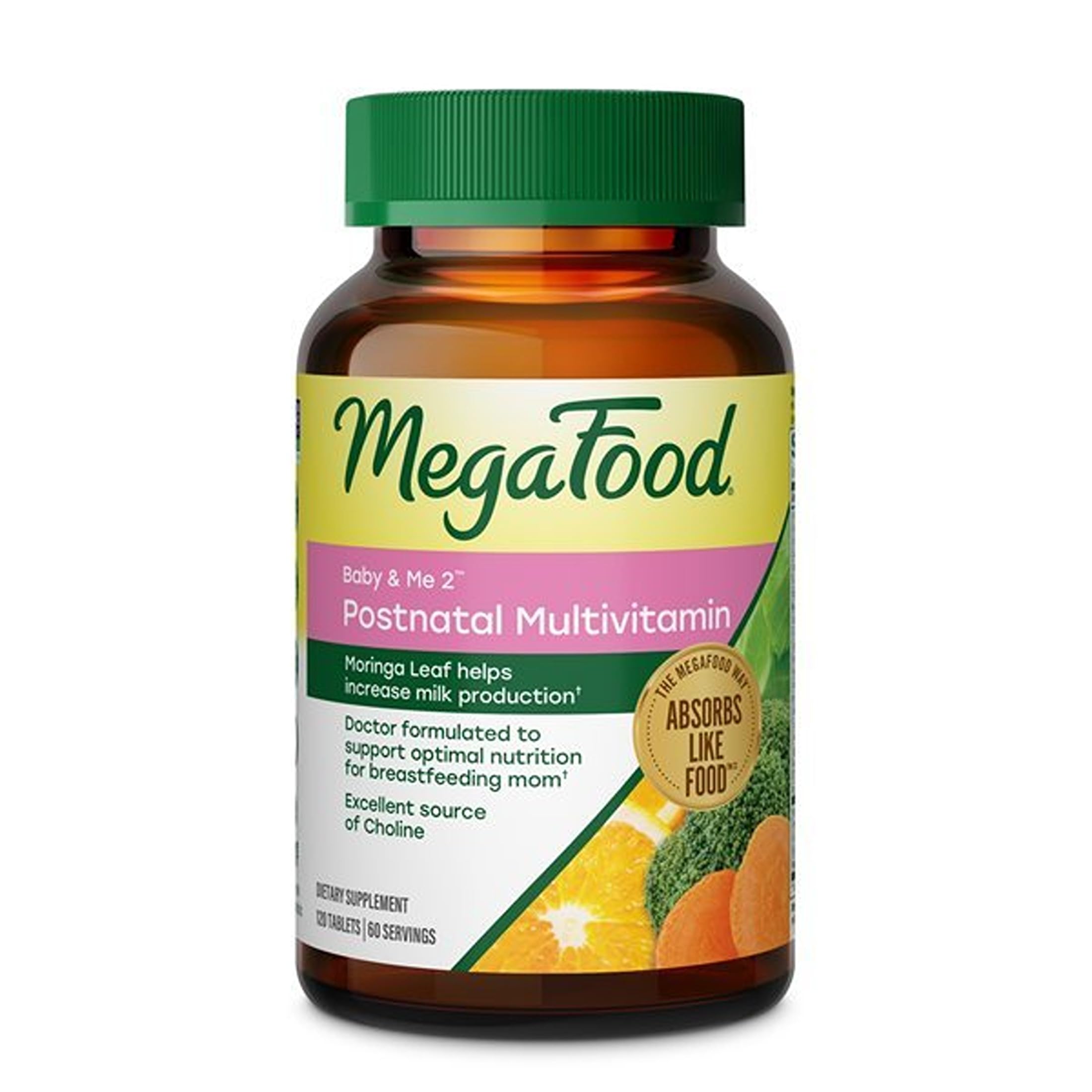
MegaFood Baby & Me 2 Postnatal
Key Features
- Choline: Included
- Allergens: Made without 9 allergens
- Folate form: Methylated folate
- Serving size: 2 tablets daily
- Price: Premium
Choline is the nutrient most postnatal formulas skip, and it is named on this label alongside methylated folate, iodine, B12, vitamin C, D3 and chromium. There is moringa leaf and actual food in the blend too, oranges, carrots, broccoli, which is either the reason you will buy this or the reason you will roll your eyes at the price.
The claim that lands hardest for us is the dosing instruction: two tablets, any time of day, with or without food. Anyone who has been pregnant remembers the prenatal that had to go down with a full meal or not at all, and a postnatal you can take at 2 p.m. on an empty stomach is worth real money in a house with a newborn. It is doctor-formulated, vegetarian, tested for 150 chemical substances and made without nine allergens.
The tablets are the catch. They are big, two of them is a genuine swallow, and if large pills have ever been a problem for you, this is the one to skip. The empty-stomach promise also does not hold for everybody: start with one tablet for a few days and build up rather than taking both on day one. Taste is the other divider, since the food-based blend does not hide itself.
What we keep coming back to is that any-time-of-day label. It is the detail that decides whether the bottle gets finished, and it is the reason this one earns its premium for the right household.
Pros
- Choline and methylated folate on the label
- Can be taken with or without food
- Whole-food blend with moringa leaf
- Made without nine common allergens
Cons
- Large tablets, two per serving
- Unpleasant taste for some
Choline, methylated folate and a dose you can take on an empty stomach: our choice for moms who want whole-food nutrition and can handle two big tablets.
Best for Whole-Food Purists
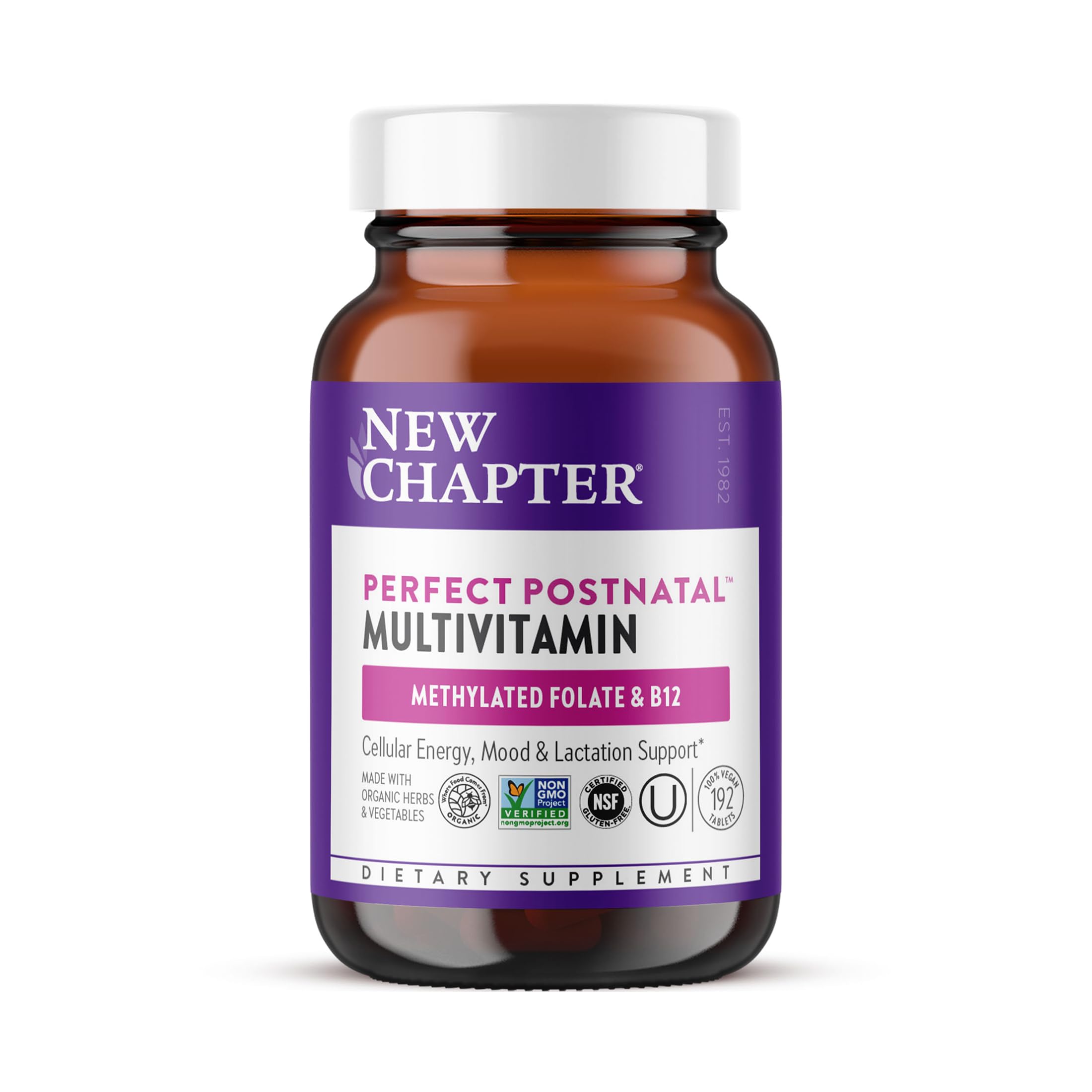
New Chapter Perfect Postnatal
Key Features
- Count: 192 tablets
- Herbal blend: Turmeric, oats, kelp
- Serving size: 3 tablets daily
- Certifications: Organic, Non-GMO, vegan
- Price: Premium
Three tablets a day is the whole story here, and it is why this one sits below the softgels despite a formula we like a lot. At 192 tablets, a bottle runs about two months at full dose, and full dose is the hard part in the fourth trimester, when the day disappears and the bottle is in the other room.
What you get for the effort is the most considered whole-food panel in the group: fermented so it does not need a meal behind it, certified organic, Non-GMO, vegan, kosher and gluten-free, with organic turmeric, oats and kelp rounding out the blend. Digestibility is where this one earns its keep. Of the tablets here, it is the gentlest on an empty stomach, which matters on the mornings when breakfast is theoretical.
Our reservation is the kelp. It is the only formula here that leans on a seaweed source, and iodine is the nutrient most tightly tied to thyroid function, which is precisely what gets monitored in the months after birth. If you have any thyroid history, show the label to your doctor before you start; if you do not, it is a non-issue. Either way, start it on an ordinary week rather than the week you go back to work.
It is also one of the priciest ways to get your postnatal nutrients on this page, and what you are paying for is sourcing and fermentation rather than anything the label can measure. If organic and whole-food matter to you, the trade is fair. If you just want the nutrients, a softgel gets you there for less.
Pros
- Certified organic, Non-GMO and vegan
- Fermented and gentle on an empty stomach
- Turmeric, oats and kelp in the blend
- 192 tablets, about two months of doses
Cons
- Three tablets every single day
- Premium price for whole-food sourcing
The whole-food, certified-organic option, and a good one, as long as three tablets a day fits the routine you actually have.
Best for Budget Breastfeeding
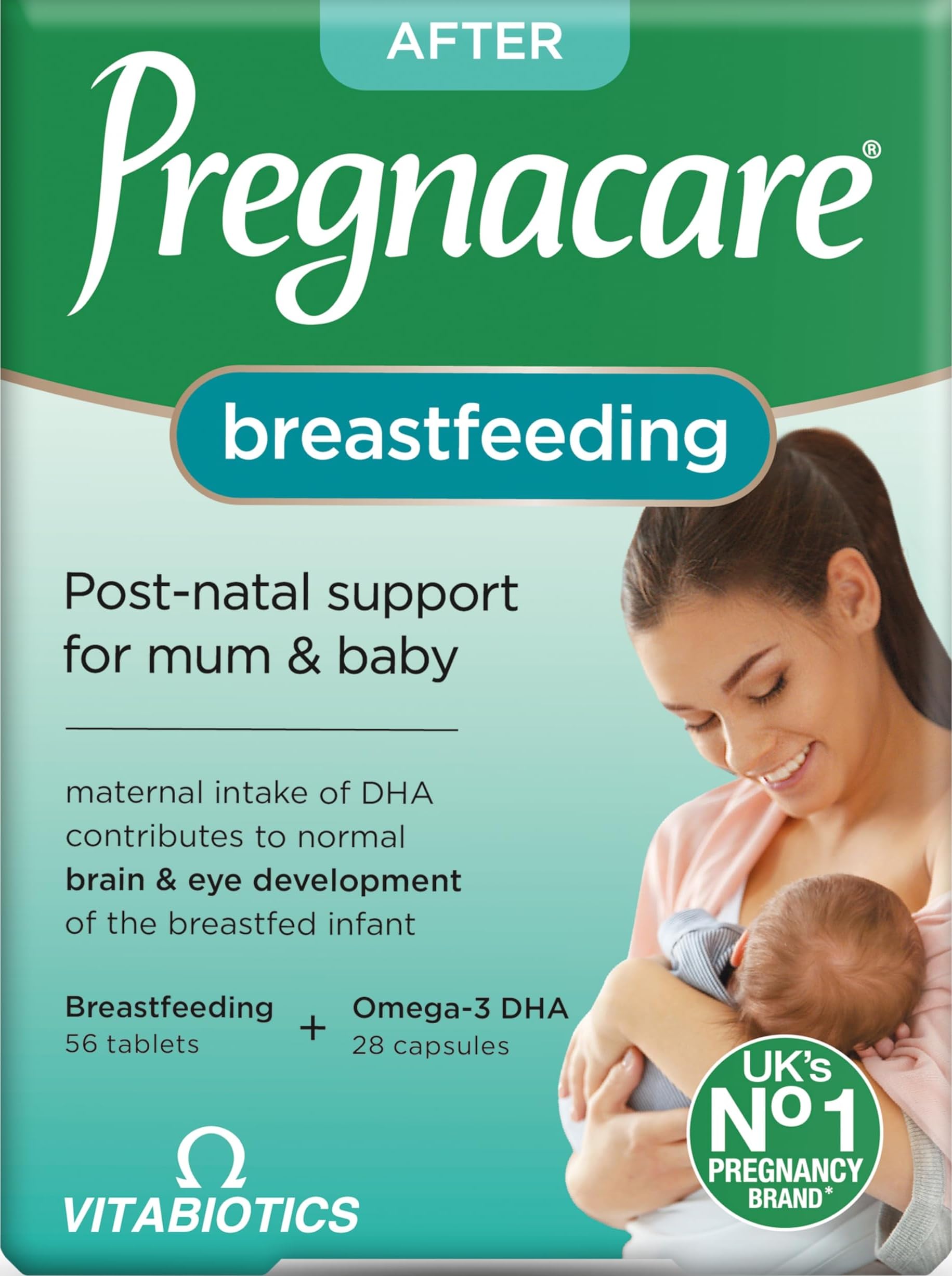
Pregnacare Breast-Feeding
Key Features
- Count: 84 tablets
- Vitamin D3: 10 mcg
- Iron and B vitamins: Included
- Price: Budget
Eighty-four tablets for one of the lowest outlays in the group is the reason to look at this bottle, and the reason we kept it: it is the one you can buy a backup of without thinking about it. Inside is a broad micronutrient panel with 10 mcg of vitamin D3, iron and the B complex, positioned as the follow-on to a prenatal and fine to take for six to nine months after birth.
The emphasis is iron, B vitamins and vitamin D rather than omega-3s, which is worth knowing before you order if DHA is the reason you are shopping. If you already take a fish oil you trust, that is not a loss, it is money not spent twice. If you do not, one of the softgels above handles both jobs in a single swallow.
It is a tablet rather than a softgel, and there is nothing here aimed at lactation beyond general postnatal nutrition. For a mom who is formula-feeding or combo-feeding and mostly wants the iron and B vitamins back, that is a feature rather than a gap: you are not paying for herbs you do not need.
One practical note: tablets rattle, and 84 of them do not belong in a diaper bag. Decant a week into a small pill case and leave the bottle in the kitchen.
Pros
- 84 tablets at one of the lowest prices here
- 10 mcg vitamin D3 plus iron and B complex
- Broad micronutrient panel for breastfeeding
- Labeled for six to nine months of use
Cons
- Tablet form, with no softgel option
- Nothing beyond the basic nutrients
Our value pick for breastfeeding: a broad panel with 10 mcg of vitamin D3, iron and B vitamins, in the biggest tablet count for the money.
Best for Vegan Dha
Pink Stork Total Postnatal
Key Features
- DHA: 200 mg, algal
- Iron: Chelated iron
- Testing: Third-party tested, cGMP facility
- Folate form: Methylated folate
- Price: Midrange
The 200 mg of DHA in this capsule comes from algae rather than fish, which means the burps that make people abandon omega-3s do not arrive with it. For anyone who gave up on fish oil during pregnancy, that is the pitch in one line.
The rest of the label is strong. Methylated folate, active B12, chelated iron, the form usually chosen when ferrous sulfate does not sit well, plus a Clean Label Project purity award and third-party testing in a cGMP facility in the US. That is a more documented supply chain than most of the bottles here carry, and it is worth paying for if purity testing is the thing you care about.
The trade-off is your stomach. Nausea and heartburn show up with this capsule the way they do with MegaFood’s tablets, and it is not a small thing when you are already running on four hours of sleep. Take it with your biggest meal rather than with coffee and a granola bar, and give it a week before you decide. The citrus scent is deliberate and polarizing, and it is a solution to a problem nobody had.
Pros
- Vegan algal DHA, no fishy aftertaste
- Methylated folate and chelated iron
- Clean Label Project purity award
- Third-party tested in a US facility
Cons
- Nausea and heartburn for sensitive stomachs
- Citrus scent divides people
For anyone who quit fish oil over the burps: vegan algal DHA, methylated folate and chelated iron in one capsule, with a clean-label award behind it.
Best for Pill Avoiders
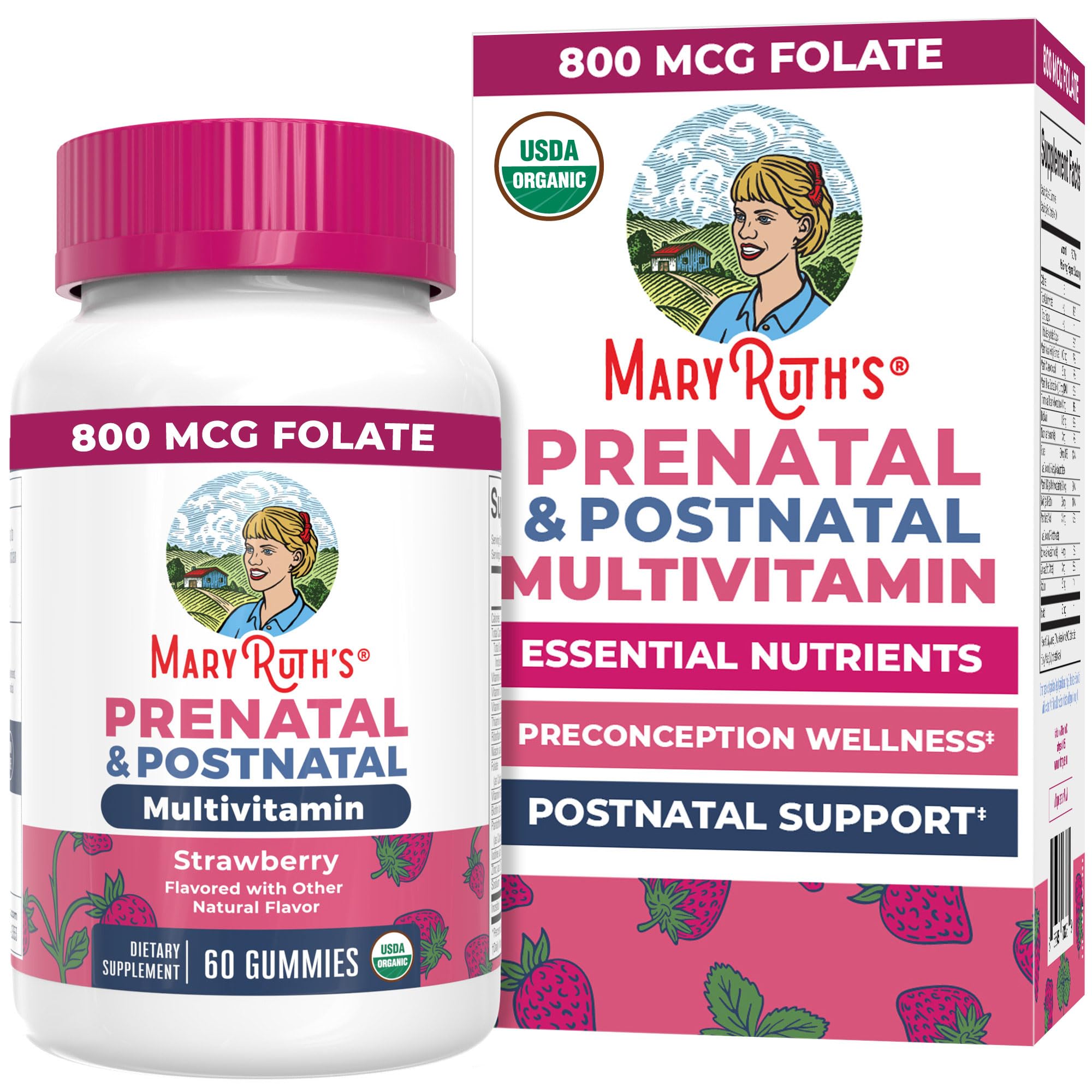
MaryRuth’s Prenatal & Postnatal Gummies
Key Features
- Form: Strawberry gummy
- Folate: 800 mcg methylated folate
- Serving size: 2 gummies daily
- Certifications: USDA Organic, vegan
- Price: Midrange
Two strawberry gummies a day, no water, no swallow. For the mom who gagged her way through nine months of prenatals, that is the entire argument, and it is a better one than it sounds, because the bottle you actually finish beats the bottle with the better panel.
The nutrition is real but narrow. There is 800 mcg of methylated folate, a meaningful dose in the active form, plus six B vitamins including methyl B12, and vitamins C, D and A with zinc and iodine. It is USDA Organic, Non-GMO, pectin-based and vegan, and the gummy base means it does not need a meal behind it, which is more than the iron-heavy capsules here can say at 6 a.m.
What it cannot do is carry the iron most postpartum women are trying to rebuild after delivery, and it is not where your DHA comes from. Think of it as the folate-and-B-vitamin half of the job, with iron and omega-3 coming from somewhere else, or as the pick for the mom who cannot face another pill and will take a gummy where she would take nothing. Both are legitimate reasons to buy it. Neither makes it a full postnatal replacement.
The taste is the other thing: strawberry, soft, not too sweet, the kind of gummy you do not dread. That sounds like a small advantage until you remember how many bottles go unfinished.
Pros
- Gummy form, no pills to swallow
- 800 mcg of methylated folate
- USDA Organic, vegan and pectin-based
- Pleasant strawberry taste and soft texture
Cons
- Gummies do not deliver the iron recovery needs
- Only a 30-day supply per bottle
The gummy we recommend when pills are the obstacle: real methylated folate in a strawberry chew, as long as your iron and DHA come from somewhere else.
Best for Hair and Energy
Pregnacare New Mum

Key Features
- Count: 56 tablets
- Energy: Iron, B6, B12
- Hair and skin: Biotin and zinc
- Price: Budget
The pitch here is narrower than the rest: biotin and zinc for hair and skin, iron with B6 and B12 for the flat, tired feeling that settles in after the first few weeks. It is aimed at the mom whose main complaints are a hairline in retreat and energy that never came back, rather than at breastfeeding specifically.
Fifty-six tablets and the smallest price tag in the group make it the easiest one to try. It is also the least specific: the emphasis is on the nutrients that show up in hair, skin and energy rather than on DHA or a wide postnatal panel. If you want one bottle that does the entire job including omega-3s, this is not it. If you already take a fish oil and want the iron and B vitamins in a cheap tablet, it is a sensible pairing.
Our hesitation is that ideal at any point after childbirth is doing a lot of work in the description. This is a general postnatal, not a breastfeeding formula, and nothing in it is aimed at lactation, so if you are nursing and shopping for milk support, the picks above are the ones to read. What it is genuinely good at is the unglamorous part: iron and B vitamins for the tiredness, biotin and zinc for hair and skin, in the cheapest bottle here.
Pros
- Iron, B6 and B12 for tiredness
- Biotin and zinc for hair and skin
- Lowest price of anything in the group
- Compact 56-tablet bottle
Cons
- No lactation-specific ingredients
A cheap, focused tablet for hair, skin and tiredness after birth; we like it as the second bottle in a plan, not the only one.
How We Tested Postnatal Vitamins
We began with a list of more than 40 postnatal formulas sold in the U.S. and narrowed it to 12 by reading labels for nutrient form, serving size, DHA and iron content, and clear sourcing or third-party testing information. I recruited a panel of postpartum testers with a mix of feeding routines—nursing, combination feeding, and bottle-feeding—and we spent eight months rotating through the shortlist, giving each formula two to three weeks of daily use.
Testers took each formula at breakfast, then repeated it on an empty stomach and alongside coffee to see what changed. We logged nausea, cramping, burping, and fishy repeat within a few hours; sniffed every bottle at opening and again after two weeks; and lined each pill or gummy up next to a dime to judge size and serving count. For taste, we held coated tablets until the coating dissolved and chewed gummies slowly, noting chalkiness, sweetness, and aftertaste.
Nursing testers kept a simple feeding log and noted any perceived change in milk supply, with the reminder that a vitamin is not a lactation guarantee. We also compared cost per serving, watched whether testers actually finished the bottle, and asked them to rate energy, hair, and nail changes over the weeks—subjective measures, but useful ones when a supplement only works if you keep taking it.
How to Choose Postnatal Vitamins
The best postnatal vitamin is the one you are still taking in six months, and that comes down to three things: how many pills it asks for, whether the DHA is already inside, and whether it sits well on a stomach that has been through a lot.
Count the swallows before the nutrients
The most reliable predictor of whether a bottle gets finished is how many pills it takes. One softgel with breakfast is a habit; three tablets a day is a project. Nature Made and One A Day do the whole job in a single softgel, MegaFood asks for two tablets, and New Chapter asks for three. None of those numbers is wrong, but be honest about the morning you are actually going to have and buy the count you will keep.
Decide where the DHA comes from
Postnatal formulas either fold omega-3s in or leave them to a second bottle, and the difference is one more thing to remember at 6 a.m. Nature Made and Pink Stork both put 200 mg of DHA in the capsule; Pink Stork’s is algal, which is the version to choose if fish oil has ever left you with aftertaste. If you already take a fish oil you like, a formula without DHA is money you do not need to spend twice.
Read the folate and iron lines
Folic acid and methylated folate do the same job by different routes, and the methylated form is the one to look for if your provider has mentioned absorption or an MTHFR variant; Mama’s Select and MegaFood both state it. Iron matters just as much after delivery, and chelated iron is the gentler form. One trap worth knowing: biotin, common in hair-and-nail blends, can skew thyroid test results, so mention every supplement to whoever draws your labs.
Let your stomach vote
A prenatal that was fine at 30 weeks can turn on you three weeks postpartum, and nausea is the reason most bottles get abandoned. Take the dose with your largest meal, split it across the day if the label allows, and give a new bottle a week before you judge it. Formulas built to go down without food, like MegaFood and New Chapter, are worth the premium if your mornings start long before you eat.
Price it per day, not per bottle
A 60-day supply of softgels and an 84-tablet bottle are not the same purchase, and the headline price hides that. Divide what is in the bottle by the daily serving before you commit: the MaryRuth’s gummies are a 30-day supply, the softgels run two months, and 192 New Chapter tablets last about the same at a three-a-day dose. The cheapest bottle is often not the cheapest month.
Frequently Asked Questions
Can I keep taking my prenatal vitamin after the baby is born?
Often, yes, but hold the label up against a postnatal. Nature Made’s postnatal deliberately raises vitamins A, C, D and E above what its own prenatal carries and adds 200 mg of DHA, which is the gap a prenatal tends to leave. If your prenatal already lists DHA and iodine, finishing the bottle is fine. If it does not, switch rather than taking both.
Do postnatal vitamins increase milk supply?
No multivitamin makes milk. Supply responds to how often you feed or pump, hydration and rest; iodine, vitamin D and B12 support the system rather than drive it. Buy a postnatal for the nutrient gap, not for the supply language on the bottle, and talk to a lactation consultant if supply is the actual concern.
How long should I take postnatal vitamins?
Plan on taking one for at least the first six months, and longer if you are breastfeeding. Pregnacare labels its breastfeeding formula for six to nine months of use; the rest here are built for ongoing daily use. At the one-year mark, reassess with your doctor. Plenty of women keep the DHA and iron and drop everything else.
Do I need postpartum vitamins if I am formula-feeding?
Your body spent nine months lending nutrients to the baby, and delivery takes iron with it, so recovery happens whether or not you nurse. What changes is the extras: lactation herbs and moringa exist for milk production and do nothing for a formula-feeding mom. A straightforward multivitamin with iron, vitamin D and DHA covers the rest.
Final Verdict
Nature Made Postnatal + DHA is the bottle we point most people to, because it finishes the whole job: 20 nutrients, 200 mg of DHA, one softgel a day, at a cost per day that does not sting in month four. If methylated folate and a gentler capsule matter more than the price, Mama’s Select is the upgrade. If choline is the nutrient you are chasing, MegaFood is the one.
Whichever you land on, buy the count that matches a habit you can keep and put the bottle where you already stand every morning. Postnatal vitamins only work if they get taken.
