This post contains affiliate links. We may earn a small commission when you buy through our links — at no extra cost to you.
There’s a moment parents know: you buy a small upholstered chair so your kid stops stealing yours, and within a week it’s the most fought-over seat in the house. That’s the real job of a kids recliner. It has to be small enough that a 4-year-old can climb in unassisted and sturdy enough that a 9-year-old can flop into it after school without the frame complaining.
Over the past six months, my team and I built, sat in, and lived with 12 of these chairs in living rooms, bedrooms, and one very crowded playroom. The failures were rarely dramatic: a recline that slammed back, a cup holder too shallow for a real cup, a side pocket that split at the seam, upholstery that scuffed before the return window closed.
The age range on the box is optimistic, by the way. A chair built for a toddler and one built for a 10-year-old are different pieces of furniture, and seat height tells you more than the label does. Faux leather wipes clean after a juice spill; fabric breathes better and hides scuffs but holds crumbs. Below are the ones that held up.


Best for Ages 3-12
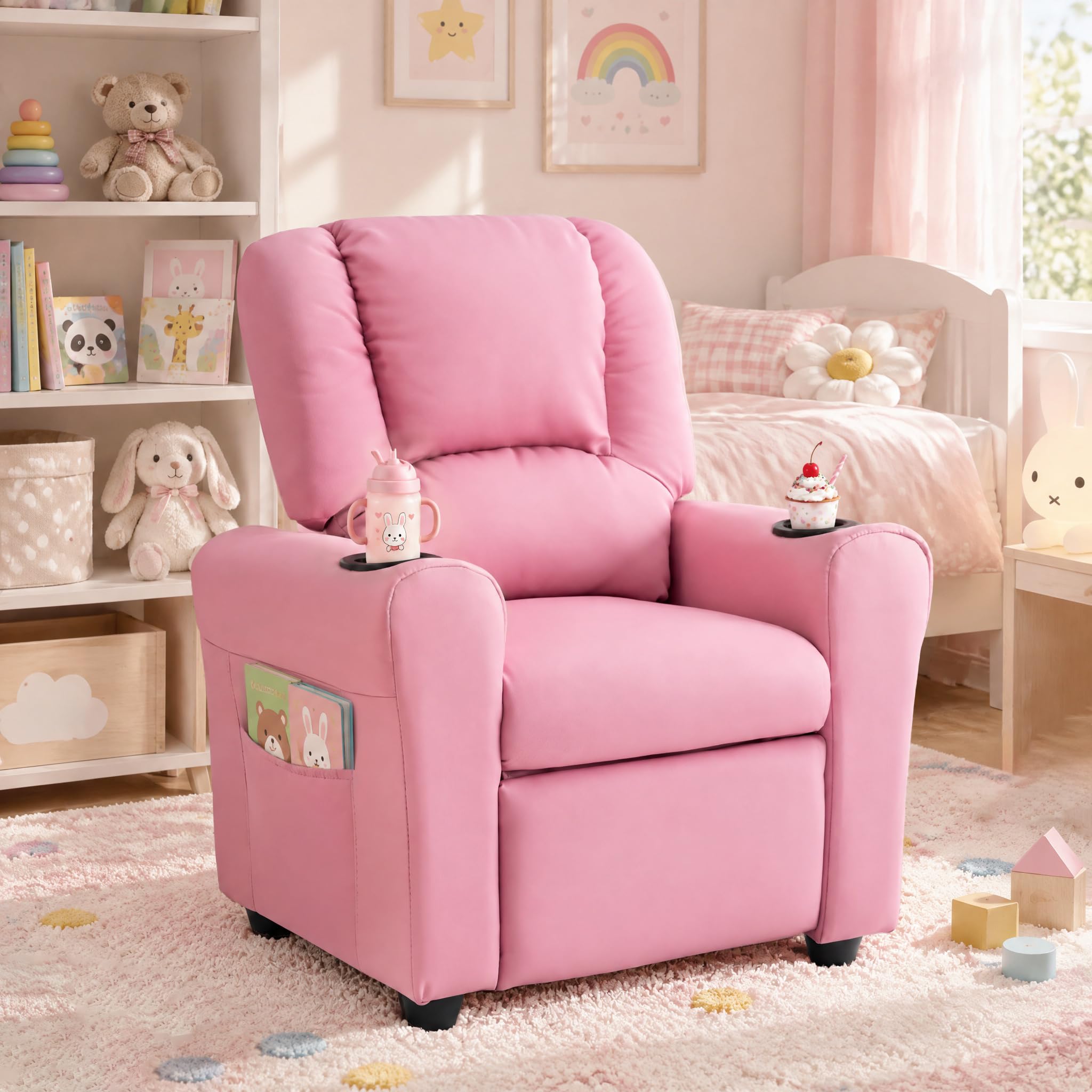
Costzon Big Kids Recliner
Key Features
- Seat depth: 16 inches
- Upholstery: PU leather
- Cup holders: 2
- Weight capacity: 120 lb
- Price: Midrange
Sixteen inches is the number that decides this chair. That’s the seat depth and the seat height both, and together they add up to the roomiest perch here apart from the MCombo — enough that a nine-year-old sits back with their knees still bent at the edge of the cushion. The back runs 22 inches above the seat, so a school-age kid gets a headrest instead of a lump behind the shoulders.
Size is why this is our default for most families. The frame is rated to 120 pounds and the maker sizes it for ages 3 to 12, which covers the long stretch between a preschooler and a kid who’s nearly ready for the grown-up furniture. We also like that the PU leather is genuinely wipe-clean — juice, yogurt, marker, one damp cloth — and that the two cup holders sit in the armrests where a reclined kid can actually reach them. The side pockets hold a couple of books.
The recline takes some muscle at first. It’s a pushback: the child leans back, the back drops to 130 degrees and the footrest rises with it. It’s stiff when new, and a smaller kid will want a hand for the first couple of weeks until the hinge loosens. Work it a dozen times yourself before you hand the chair over.
Assembly is about five minutes — four legs screw into the base and the back slides down onto the seat. At 32 pounds it’s a one-person carry between rooms, and heavy enough that a 3-year-old won’t drag it across the floor. The black upholstery hides the most, which counts for more than it should in a house with a toddler in it.
Pros
- Roomiest seat here after the MCombo
- Wipe-clean PU leather
- Two cup holders plus side pockets
Cons
- Seam splits and back-frame failures show up here
Our pick for most families: the seat is big enough for a 10-year-old, the faux leather wipes clean, and two cup holders keep drinks off the floor.
Best for Tall Kids 3+
MCombo Big Kids Recliner
Key Features
- Frame: Hardwood and steel
- Seat depth: 17 inches
- Chair weight: 51 lb
- Weight capacity: 120 lb
- Price: Premium
Two years is the longest warranty on any chair in this guide, and it’s the clearest signal of what MCombo built: a hardwood-and-steel frame, a 120-pound rating, and a chair that weighs 51 pounds before anyone sits in it. That’s more than double most of the chairs here, and it’s why this one feels like furniture rather than a scaled-down toy.
The seat is the part that matters. At 17 inches deep it’s the deepest here, and the maker sizes the chair for kids 31 to 47 inches tall and 30 to 120 pounds. A tall 6-year-old gets their thighs supported all the way to the knee instead of hanging off the front edge, which is exactly where the smaller chairs give out. Two cup holders and four pockets mean the water bottle, the book and the tablet all have a home.
Velvet is the trade-off we keep coming back to. It’s soft enough that kids fall asleep in it, and it’s spot-clean only — no quick wipe after a juice box. If the chair lives in a bedroom, that’s a fair trade for how it feels; if it lives in the living room where snacks happen, the faux leather on the Costzon is the more forgiving choice. The pushback is firm at first, the same as every other chair here.
Pros
- Roomiest seat here at 17 inches deep
- Hardwood and steel frame
- Longest warranty here at two years
- Two cup holders and four pockets
Cons
- 51 pounds makes it a chore to move
Spend the extra if your kid is tall for their age: 17 inches of seat depth and a steel-and-hardwood frame are what the higher price buys.
Best for First Chair
The Crew Furniture Kids Recliner
Key Features
- Assembly: None required
- Upholstery: Polyester linen
- Seat height: 12.5 inches
- Weight capacity: 110 lb
- Price: Budget
Cheapest chair here, and the only one that shows up fully assembled — no hex key, no bag of bolts, no forty minutes on the floor. For a chair that’s going to get jumped on, that matters more than it sounds: there’s nothing to overtighten and nothing to leave loose.
The seat sits 12.5 inches off the floor, the lowest here, which is exactly the height a 2-year-old needs to climb in without a boost. The stated range stops at 5, but the 110-pound rating and a 13.75-inch seat depth carry it to a first-grader; past that, knees start to climb. And it looks like furniture — rolled arms, a tufted back, a linen-look polyester — instead of a character chair, which is why it ends up in the living room.
Recline is where it gives ground. The footrest takes a firm shove to come up, and a 30-pound kid isn’t going to manage it alone for a while — expect to do it for them for the first few months, or to teach them to brace both feet against the floor and push.
Pros
- Arrives fully assembled
- Lowest seat here for small climbers
- Looks like furniture, not a toy
Cons
- No cup holders or pockets
- 90-day warranty is the shortest here
The one we point first-time buyers to: it arrives in one piece, sits low enough for a 2-year-old to climb into, and costs the least here.
Best for Ages 1-3
JC Home Kids Recliner
Key Features
- Seat depth: 12.6 inches
- Upholstery: Faux leather
- Cup holders: 2
- Weight capacity: 90 lb
- Price: Budget
Twenty-one pounds, two cup holders, two pockets, and about ten minutes of assembly with no tools. Before any of that, though, the numbers that matter are 14.6 and 12.6 — seat height and seat depth, both sized for somebody who still needs a boost onto the couch.
That’s the whole case for it. A 1-year-old can get in and out unassisted, and a 3-year-old’s back actually lands against the backrest instead of sliding forward into a slouch. The faux leather is the same wipe-clean story as the Costzon, the armrests are rounded with nothing to catch a shin, and at 21 pounds it slides out of the way when the living room needs to be a living room again.
The pushback recline is workable for a toddler sooner than on the other small chairs here, though the lightest kids still need help at first. Stitching and upholstery hold up — this is one of the few chairs here where we don’t have a durability reservation — and the cotton-pink leather is a softer look than the usual kids’ chair.
Pros
- Toddler-scaled seat a 1-year-old can manage
- Two cup holders and two pockets
- Ten-minute, tool-free assembly
Cons
- Short 15.6-inch backrest is outgrown fast
Buy it for a 1- to 3-year-old: the 14.6-inch seat height lets them climb in alone, and the faux leather shrugs off a sippy cup.
Best for First Recliner
Flash Furniture Vana Kids Recliner

Key Features
- Seat depth: 11 inches
- Upholstery: LeatherSoft
- Safety recline: Yes
- Weight capacity: 90 lb
- Price: Midrange
The mechanism is the story here: the back won’t release unless a child is sitting in the seat. That removes the failure you worry about with a pushback chair — a toddler leaning on the footrest, a kid clambering over the back — and it’s the reason this one makes sense in a room with younger children in it.
The catch is size. The 36.5-inch depth in the specs is the chair fully laid out; seated, the cushion is 11 inches deep and the back is 15 inches tall, which makes this one of the shallowest perches in this guide. A 2- or 3-year-old fits it well. A 6-year-old is perched on the front edge. Measure the seat against your kid before ordering, because the numbers read bigger than the chair does.
What it gets right: LeatherSoft, a polyurethane-and-leather blend, wipes down with a water-based cleaner, the headrest is genuinely oversized, and there’s a hardwood frame behind a one-year warranty. One cup holder and no pockets, so the book ends up on the floor. For a 2- or 3-year-old in a house with a baby in it, this is the chair we stop worrying about.
Pros
- Recline lock prevents accidental tip-back
- LeatherSoft wipes down easily
- Oversized headrest
Cons
- Recline is stiff for smaller kids
The pick for a 2- or 3-year-old you want reclining safely: it won’t release unless a child is seated, and the LeatherSoft wipes clean.
Best for Tight Spaces
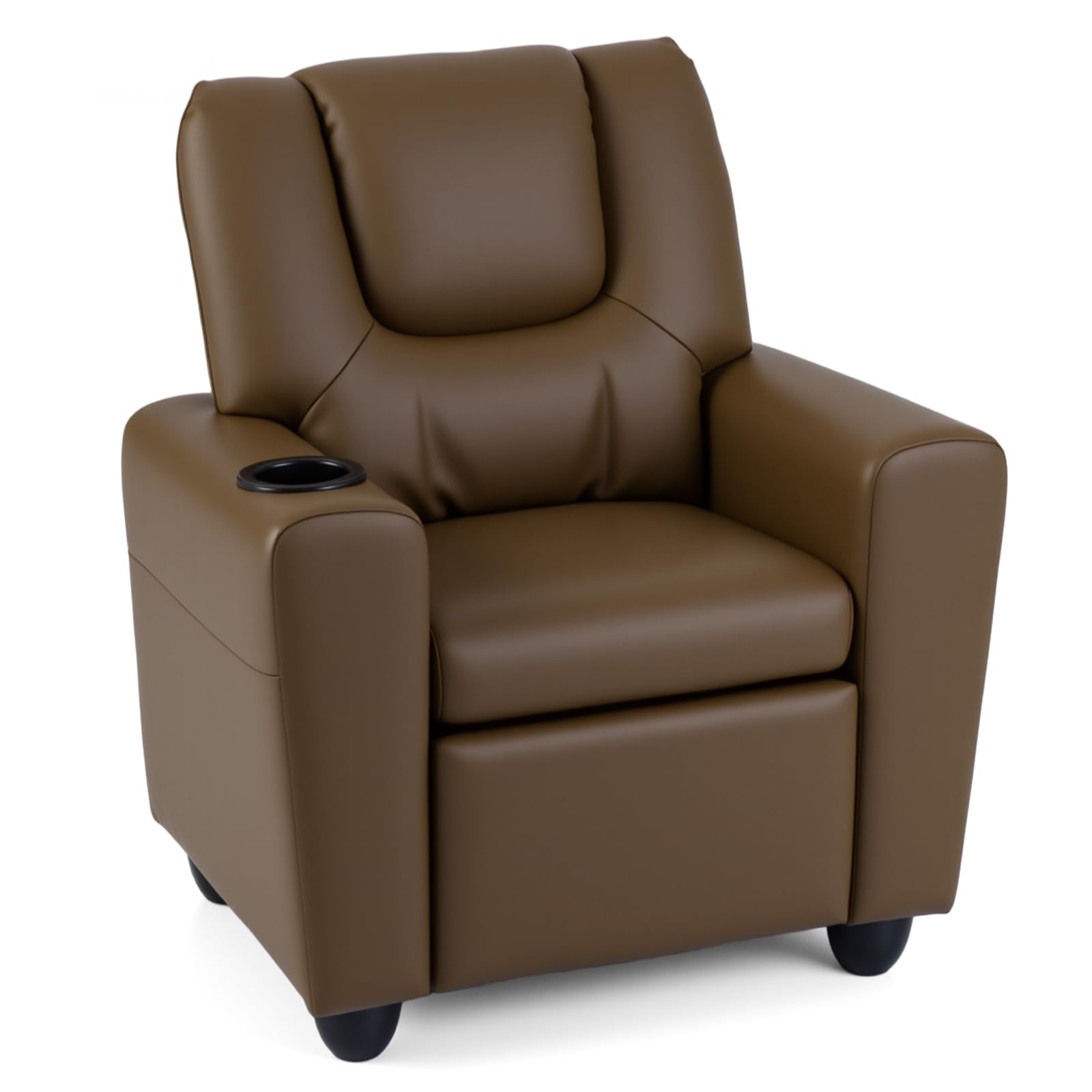
Costzon Kids Recliner, Brown
Key Features
- Seat depth: 10.5 inches
- Cup holders: 1
- Recline angle: 139 degrees
- Weight capacity: 150 lb
- Price: Budget
One hundred fifty pounds is the highest weight rating in this guide, and it hangs on one of the smallest chairs — 21.5 inches wide, 23 pounds, a footprint that tucks into the corner of a bedroom. The FSC-certified wood frame is overbuilt for the size, so an older, heavier kid gets a chair with margin in it rather than one that’s working at its limit.
The recline goes back to 139 degrees, the deepest here, and that’s where the trouble starts. Reaching the laid-back position is fine; holding it there is the part that varies, with the back and the footrest slipping up under a kid’s weight. Work the mechanism a dozen times the day it arrives, and if it won’t stay put with your child in it, send it back inside the return window instead of living with it.
Everything else is straightforward — one cup holder, a tool-free two-step assembly, wear-resistant PU that wipes clean, and upholstery that reads closer to a miniature club chair than a nursery piece. For a 3- or 4-year-old in a small room, it’s a lot of chair for the budget end of this guide.
Pros
- Highest weight rating here at 150 pounds
- 23 pounds, easy to reposition
- Two-step, tool-free assembly
Cons
- 10.5-inch seat depth is very shallow
A 150-pound rating in a 23-pound chair is the reason to look here, though the shallow seat and a recline that slips keep it out of our top tier.
How We Picked and Tested Kids Recliners
We started with more than 40 chairs and narrowed by reading listings closely: published weight limits, seat height and depth, stated age range, upholstery, and whether the recline was a push-back or a handle. Anything that didn’t state a weight capacity came off the list. That left 12 recliners, which we built, sat in, and lived with for six months.
I assembled each one alone at the kitchen table with a timer running, noting whether the hardware came sorted, whether the instructions were pictures only, and whether an armrest needed a second set of hands. Then each chair went where it would actually live — a living room corner, a bedroom reading nook, a playroom shared by two siblings — and got used the way kids use things: after-school snacks, Saturday cartoons, homework balanced on the armrest, playdates.
Sturdiness got tested by circumstance as much as by plan. Kids flopped in with backpacks on, stood on footrests, and dragged chairs across the rug; I also leaned my full weight onto one armrest of each and listened for creaking. For recline, I pushed every chair back by hand and had kids do it themselves, checking how far it tilted, whether it dropped hard or eased down, whether a kicking 5-year-old could collapse the footrest, and whether a smaller kid could get it upright alone. I measured seat height and depth against kids ages 2, 4, 6, and 9 to find each chair’s real ceiling.
Child-friendly details came down to small things: pinch points at the hinge, sharp edges under the armrests, cup holders tested with a sippy cup, a juice box, and a can of sparkling water to see what tipped, and side pockets stuffed with books until the seams said something. Spills were cleaned per the maker’s instructions and rechecked a week later for rings. At six months we looked at pilling, scuffs, flattened cushioning, and whether the chair still looked like it belonged in the room — the honest measure of value.
How to Choose a Kids Recliner
The chair that fits a 2-year-old is a footrest with a backrest by the time that kid turns 7, so the first decision isn’t brand or color — it’s which stage of childhood you’re buying for.
Start With the Seat, Not the Age Range
Seat height and seat depth decide whether a chair works long before the age printed on the box does. Toddler-sized chairs run about 12.5 to 14.5 inches from floor to cushion with 12 to 14 inches of depth. Big-kid chairs go to 16 or 17 inches deep and about 16 inches high. The measurement that settles it: have your child stand against a wall and measure from the floor to the crease behind their knee. That’s roughly the seat height you want, and it’s how you avoid buying a chair they have to climb.
The other trap is the weight rating. Ninety pounds sounds generous until you remember plenty of 8-year-olds clear it without being unusually large. If you want one chair to run from preschool into grade school, buy on depth and weight rating rather than the age range, which tends to be optimistic at the top end.
Understand the Recline Before You Buy
Almost every chair in this guide is a pushback recliner — no lever, no handle, no button. The child leans back against the cushion until the mechanism gives, and the footrest rises with the back. It’s simple and there’s very little to break, but a pushback is stiff when new. Expect to work it yourself for a week or two, and expect a small child to need help for longer than that.
Two variations are worth knowing about. A recline lock, like the one on the Flash Furniture Vana, won’t release unless someone is seated, which removes the accidental tip-back entirely. A very deep recline, like the 139 degrees on the compact Costzon, gets closer to flat but is more likely to slip out of position under a heavier kid. Whichever you pick, work the mechanism a dozen times on arrival; if it won’t hold with your child in it, return it.
Pick Upholstery You Can Wipe
Faux leather — PU or LeatherSoft — is the practical finish for a chair that will host snacks. A damp cloth handles juice, yogurt and marker, and there’s no pile for crumbs to work into. Velvet and polyester linen feel softer and look more like grown-up furniture, but both are spot-clean finishes, and a spill that sits until morning leaves a ring.
Shape matters as much as fabric. Rounded arms and a smooth back give a spill nowhere to hide, while deep tufting and long seams give it somewhere to sit. If the chair is going in a bedroom where drinks aren’t allowed, velvet is the nicer thing to sit in — the MCombo’s is genuinely soft. If it’s going in the living room, buy the wipe-clean.
Weigh the Chair, Not Just the Box
These run from about 21 to 51 pounds, and that spread changes how you live with one. A 21-pound lounge chair moves from playroom to living room with one hand. A 51-pound chair stays where you put it, which is fine in a bedroom and frustrating in a room that gets rearranged. Check the assembled footprint too: most here are roughly 22 to 28 inches wide, but the depth grows to almost 40 inches with the footrest out, so the chair needs clear floor in front of it, not just beside it.
Assembly is worth asking about before you order. The Crew Furniture chair arrives in one piece; the Costzon and JC Home models are a handful of screws and a back that slides into place, 10 to 15 minutes without tools. None of them are hard. All of them are easier before a child sees the box.
Frequently Asked Questions
Are kids recliners safe for a 1-year-old?
Yes, with the right chair. Look for a seat height around 12 to 14 inches so a toddler can climb in and out without a boost, and go by the stated weight limit rather than the age on the box. The real risk is the footrest: kids stand on it, and a chair light enough to move is light enough to tip forward when they lean over the end. Keep it out of the traffic path and teach them to sit back before they push.
Is a kids recliner worth it compared with a beanbag?
It is if you want the chair to stay in one place and hold a drink. A beanbag is cheaper and gets dragged everywhere; a recliner gives a child a seat that is theirs, at furniture height, with a footrest and a cup holder, and it reads as furniture rather than a toy. The trade-off is space and money — a recliner claims a fixed corner, and the good ones cost more than the biggest beanbag. If your kid already lives on floor cushions, save the money.
How do I keep a kids recliner from sliding on hardwood?
Put something between the feet and the floor. A low-pile rug under the chair is the simplest fix; felt pads or the stick-on rubber feet sold for furniture legs work on bare floors and cost less than a rug. Chairs with anti-slip feet, like the MCombo, solve it outright, so if the chair is headed for hardwood, check that detail before you order rather than after.
Final Verdict
Buy the Costzon Big Kids Recliner for most families. It has the widest usable range here — a 120-pound rating and a 16-inch seat that a 10-year-old still fits — plus two cup holders and faux leather you can wipe with one hand while holding a toddler with the other.
If your child is tall for their age, spend the extra on the MCombo: 17 inches of seat depth and a hardwood-and-steel frame are what the money buys. And if you’re buying for a 1-year-old, start with the JC Home, which is scaled so they can climb in on their own.
