This post contains affiliate links. We may earn a small commission when you buy through our links — at no extra cost to you.
A kids desk is never just a desk. It’s the homework spot, the sticker factory, the snack tray, and the place where a coloring book turns into a whole afternoon. What surprised me most while shopping for one is how quickly a cute design stops mattering if the table wobbles when a kid leans on it or the chair is too tall for their feet to reach the floor. The right desk gives a child a space that fits them now, holds up to daily chaos, and still feels worth the money after the novelty wears off.
I’ve set up more than a few of these at home, and the difference between a desk kids love and one they ignore usually comes down to size, sturdiness, and how painless assembly is. Over the past six months, we tested 12 kids desks and chair sets, from simple activity tables to height-adjustable homework stations, and paid attention to the details families actually live with. The picks below are the ones that earned their spot.


Best for Ages 2 to 8
CuFun Adjustable Kids Table and Chairs Set
Key Features
- Tabletop: Wipe-clean, paintable surface
- Seat Heights: 3 levels
- Table Height: 18.9 to 23.6 inches (7 levels)
- Recommended Ages: 2 to 8 years
- Price: Midrange
A kids desk has an awkward job. It has to fit a 2-year-old who needs help getting into the chair and a 7-year-old spreading out homework, and most desks are built for one of those children. This CuFun set is built around the problem: the table has seven height positions between 18.9 and 23.6 inches, each of the two chairs has three seat heights, and the set moves up in steps as a child does.
What settles it for us is the arithmetic of ownership — one purchase that runs from toddler snacks through early homework instead of a second desk at the next growth spurt. Assembly is genuinely easy, with a single screw size for the entire build and instructions that match the parts, and the two chairs mean siblings can sit down at the same time without a negotiation.
The top is the other reason it holds first place. It takes water-based paint and erases again, so it’s an art table on Tuesday and a homework desk on Wednesday, and marker, crayon and spilled juice all come up with a damp cloth. The rounded arc corners are the sort of detail you stop noticing until a toddler pulls up on the edge of one.
Our reservation sits under the table: on wood and laminate the chairs slide when a child pushes back, and the table’s rubber feet don’t help them. A pack of felt pads on the four chair legs fixes it in a minute. The top is also fixed and flat, so a third grader doing cursive — or a kid who likes to draw at an angle — wants the tilting Mount-It! instead.
Pros
- Seven table heights, three seat heights
- Wipe-clean top takes water-based paint
- Two chairs in the box
- Simple build with one screw size
Cons
- Chairs slide on hard floors
The one we point most families to: a single adjustable set that fits a 2-year-old and still works for early homework, with two chairs included.
Best for Toddlers
Delta Children Minnie Mouse Chair Desk
Key Features
- Storage: Pull-out bin and cup holder
- Weight Limit: 50 lb
- Recommended Age: 3 years and up
- Assembled Dimensions: 20.47 x 22.83 x 23.23 inches
- Price: Budget
The storage bin is what earns this desk its floor space. It pulls out from under the seat and holds the cars, crayons and half-finished coloring pages that would otherwise colonize your kitchen counter. Up top, a built-in cup holder does the same job for a sippy cup or a fistful of markers, and the seat sits about 23 inches high — low enough that a 3-year-old climbs in without a boost.
The frame is engineered wood with a scratch-resistant, wipe-clean finish, and the Minnie graphics sit under that finish rather than on top of it, so a wet cloth takes off applesauce without taking off the artwork. Assembly is panels and screws with printed instructions, and ours went together in one sitting without a second pair of hands.
We recommend it without hesitation as a first desk. What it does better than anything else here is give a small child a place of their own in a room that isn’t a playroom: the toys live in the bin, the drink goes in the holder, and nothing has to be cleared off the dining table first. The build is the part to keep an eye on — hard use shows at the seat and leg joints sooner than solid wood would.
Pros
- Pull-out bin holds toys and art supplies
- Built-in cup holder
- Wipe-clean, scratch-resistant finish
- Low 23-inch height toddlers reach alone
Cons
- Outgrown by kindergarten at 50 pounds
Our pick for a first desk: a low chair desk with storage under the seat that a 2- or 3-year-old can climb into and use without help.
Best for School-Age Study
Mount-It! Kids Desk and Chair Set
Key Features
- Desk Height: 21.3 to 29.9 inches
- Desktop Tilt: Up to 40 degrees
- Tabletop Size: 26 x 18 inches
- Desk Weight Capacity: 165 lb
- Price: Premium
The desktop tilts to 40 degrees, and that one feature tells you who this desk is for: a child who is actually writing, drawing and reading at a table for an hour at a stretch. A flat desk puts paper where a kid has to hunch over it. Angling the surface brings the work up toward their eyes, and after a few sessions of homework the difference is obvious.
The construction is the most substantial in this group. The desk is rated to 165 pounds, the top measures 26 by 18 inches, and a pencil drawer tucks underneath — small things, but they’re what make it feel like school furniture rather than toy furniture. The desk climbs from 21.3 to 29.9 inches and the chair adjusts with it, which is why this set turns up in home-school rooms and for children who need the seat at one specific height. The illustrated directions match the parts in the box.
We think the extra money buys function here, not just a heavier box: this is the one desk in the group a 9-year-old still sits at comfortably. The caveat is the height locks. They hold once they’re fully seated and can slip out of position when a child changes a setting without pushing them home, so set the height yourself and rock the chair on all four feet before you hand it over.
Pros
- Desktop tilts up to 40 degrees
- Desk and chair rise to school-age height
- 165-pound desk rating
- Pencil drawer under the top
Cons
- Priciest desk in this group
- 26 x 18-inch top fills up fast
Worth the premium once your child is school-age: the tilting top and the full height range are things no other desk in this group can do.
Best for Art and Play
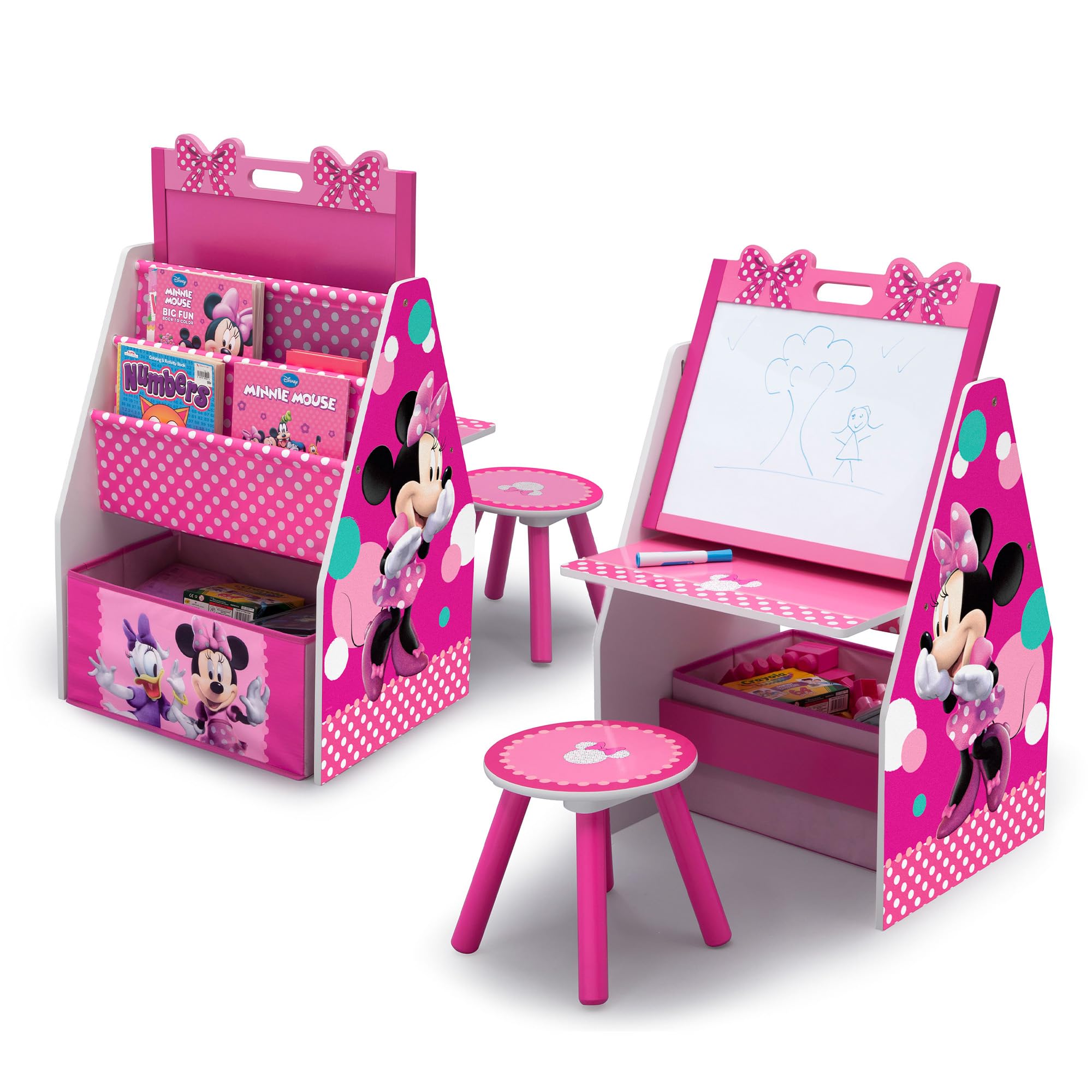
Delta Children Deluxe Art Table and Easel
Key Features
- Included: Dry-erase board, stool, fabric toy bin
- Stool Height: 11 inches
- Stool Weight Limit: 50 lb
- Assembled Dimensions: 20 x 19.5 x 34.5 inches
- Price: Midrange
The best thing about this Delta station is that it puts the mess somewhere other than your table. The easel board adjusts up for painting and retracts to leave a flat desktop; a removable fabric bin on the reverse side swallows the paper, crayons and books; and a stool tucks in underneath. Three jobs in a footprint of 20 by 19.5 inches — which is the entire argument for it in a small house.
The arrangement is smarter than the parts. A child paints at the vertical board, then sits at the desk below it, and the organizer on the back keeps supplies visible enough that a 4-year-old puts things away without being asked twice. The magnetic dry-erase board is the surface that gets the most use, and the stool — 11 inches high, rated to 50 pounds — puts a preschooler at the right height for the desktop instead of kneeling on the seat.
The stool is the piece we trust least: it does its job for a seated 3-year-old and flexes when a bigger child leans back on it. The easel height doesn’t move either, so this is art furniture for the preschool years rather than a desk that follows a child into second grade. The CuFun is the one that adjusts; this one is the one that’s more fun.
Pros
- Easel retracts to a flat desktop
- Removable bin holds supplies and toys
- Dry-erase board and stool included
- Only 20 inches wide
Cons
- Diagram-only instructions with no written steps
- Stool is the least solid piece
A smart buy for a playroom: easel, desktop and supply bin are one piece of furniture, and it keeps paint and crayons off your table.
How We Tested Kids Desks for Homework, Art, and Everyday Chaos
We started by researching the kids desks shoppers actually compare: activity tables with chairs, chair desks with storage, height-adjustable homework stations, and art tables with built-in easels. We filtered by age range, tabletop size, seat height, adjustable range, and price, then narrowed the list to 12 desks and chair sets that could reasonably fit a bedroom, playroom, or small classroom corner.
For six months, those 12 units lived with families and kids ages 2 to 10. We set them up in homework corners, art spaces, and playrooms, then watched the same routines repeat: after-school worksheets, weekend coloring sessions, snack breaks, puzzle time, and the inevitable climb-in-and-out. We timed assembly from unboxing to first sit, followed the instructions step by step, noted where hardware or diagrams got confusing, and checked whether the desk still felt solid after a week of daily use.
We leaned on edges, pushed chairs in and out, and watched what happened when a kid climbed up or dropped a book on the tabletop. We wiped up marker, crayon, glue, and cracker crumbs, then looked for scratches, swelling, loose joints, and rough edges. To judge size and value, we measured seat height against each child’s leg length, checked whether feet reached the floor, and asked parents whether the desk earned its footprint and price. We also let the kids vote with their feet: which desk did they return to without being asked?
How to Choose a Kids Desk
Buy for the height your child will be in two years, not the height they are today — that one question decides more of this purchase than any finish or character graphic.
Start With the Chair, Not the Desktop
A child sits well when their feet rest flat on the floor and the desktop lands somewhere near elbow height. That makes seat height the number to check first: a seat that sits too high leaves legs dangling and sends a child sliding forward, and no amount of desk adjustment rescues it. The chair wants to adjust on its own — the CuFun’s seat has three positions and the Mount-It! chair rises with the desk.
On a one-piece toddler chair desk such as the Delta, the whole unit is sized to the child instead, which is simpler and works perfectly until it doesn’t. If two children will share the desk, check the seat range against the smaller one, not the taller one.
How Much Growing Room You’re Actually Buying
Adjustability is where the money goes. The desks here run from around 19 inches at the low end to nearly 30 at the top, and where a model lands on that range decides how many years you get. A fixed desk in the low twenties covers preschool and the first year or two of school; a set that climbs into the high twenties still fits a nine- or ten-year-old.
The trap is the word toddler. A toddler desk is usually a two- or three-year purchase, not a decade one, so treat a low fixed height as a stage rather than an investment. If you want one desk to carry a child from age 2 to age 8, you are shopping for an adjustable set and nothing else.
Flat, Tilting, or Easel
A flat top is the most versatile and the least helpful for handwriting, because paper lies down where a child has to hunch over it. A desktop that tilts, like the Mount-It!’s 40-degree surface, brings the page up toward their eyes and is the difference between a homework desk and a coloring desk. An easel station such as the Delta art table trades adjustability for a vertical board, a supply bin and a stool in one footprint.
Match the top to the job you actually see happening. Homework and reading want the tilt, painting and play-dough want the easel, and a flat top with a couple of chairs handles snacks, puzzles and everything in between.
Storage and the Parts That Wear
Bins, cup holders and drawers are what stop a desk from turning into a shelf. Closed or removable storage beats an open tray once crayons are involved, because a child can carry the whole bin to the table and back. Look at what sits under the seat or behind the board — that space is doing more work than the desktop in most kids’ rooms.
Then look down. Chair feet are where these sets disappoint: several of the chairs here slide on wood and laminate when a child pushes back, and stick-on felt or rubber pads are a two-minute fix. Check the seat and leg joints on any engineered-wood model as the years go on; that is where hard use shows up first.
What Setup Actually Involves
Every desk here arrives flat-packed, and the difference is in the instructions rather than the hardware. The Mount-It! and CuFun sheets are illustrated and match the parts in the box; the Delta art table ships diagrams with no written steps, and that is the one build worth recruiting a second adult for.
Once it’s together, set any adjustable height yourself and rock the chair on all four feet before a child climbs on. A lock that isn’t fully seated is why an adjustable desk can feel wobbly on day one, and it’s the first thing to check before you blame the desk.
Frequently Asked Questions
How much floor space does a kids desk need?
The desks in this group run from 20 inches wide and 19.5 inches deep for the Delta art table up to 26 by 18 inches of tabletop on the Mount-It!, with the CuFun at roughly 23.6 inches square. None of them needs a whole wall.
Measure the spot, then add room behind the chair for a child to push back and climb in — that clearance, not the desktop, is what usually makes a small bedroom feel crowded.
How do I get marker and paint off a kids desk?
A damp cloth handles water-based markers, washable paint and crayon on every top here; the CuFun surface is made to be painted on and erased. Hold the cloth against dried marker for a minute before you scrub at it.
Skip abrasive pads on printed graphics. They dull the finish and lift color faster than any marker does, and on the character desks the artwork is the part you can’t replace.
Do kids desks come with a chair?
All four desks here include seating of some kind: two chairs with the CuFun set, a built-in seat on the Delta chair desk, an adjustable chair with the Mount-It!, and a stool with the Delta art table.
That makes this one purchase rather than two. It also means the seat height is fixed by the set you choose, so if you already own a child-size chair, buy for the desktop height and plan to match the chair to it.
Final Verdict
Buy the CuFun set if you want one purchase to cover the toddler-to-second-grade years. The adjustable heights, the second chair and the wipe-clean top are what most families end up needing, and nothing else here covers that span of ages.
If your child is already school-age and posture is the point, spend the extra on the Mount-It! — the tilting top and the 29.9-inch ceiling are worth it. For a 2- or 3-year-old in a small room, the Delta chair desk or the art easel does more with a corner than a full-size desk can.
