This post contains affiliate links. We may earn a small commission when you buy through our links — at no extra cost to you.
The glider is the one piece of nursery furniture you actually sit in at 3 a.m., so a squeak or a stiff armrest stops being a minor annoyance fast. It has to do two jobs: settle a baby who has decided the night is over, and hold up as a real seat once the nursery turns into a playroom. I’ve logged feedings, story hours, and plenty of contact naps in these chairs, and the good ones are quiet, easy to stand up from with a sleeping baby in your arms, and look like furniture rather than baby gear.
Over eight months, my team and I tested nine gliders and rockers, from compact swivel chairs to full-size recliners. The differences came down to things a showroom can’t show you: a cushion that stays supportive after months of use, a glide that stays silent on hardwood, a recline you can work one-handed. First-time buyers also tend to forget that the glide arc adds inches — a chair with a 32-inch footprint can need 40 inches of clearance once it’s moving. Here’s what earned the floor space.


Best for Nursing and Storytime
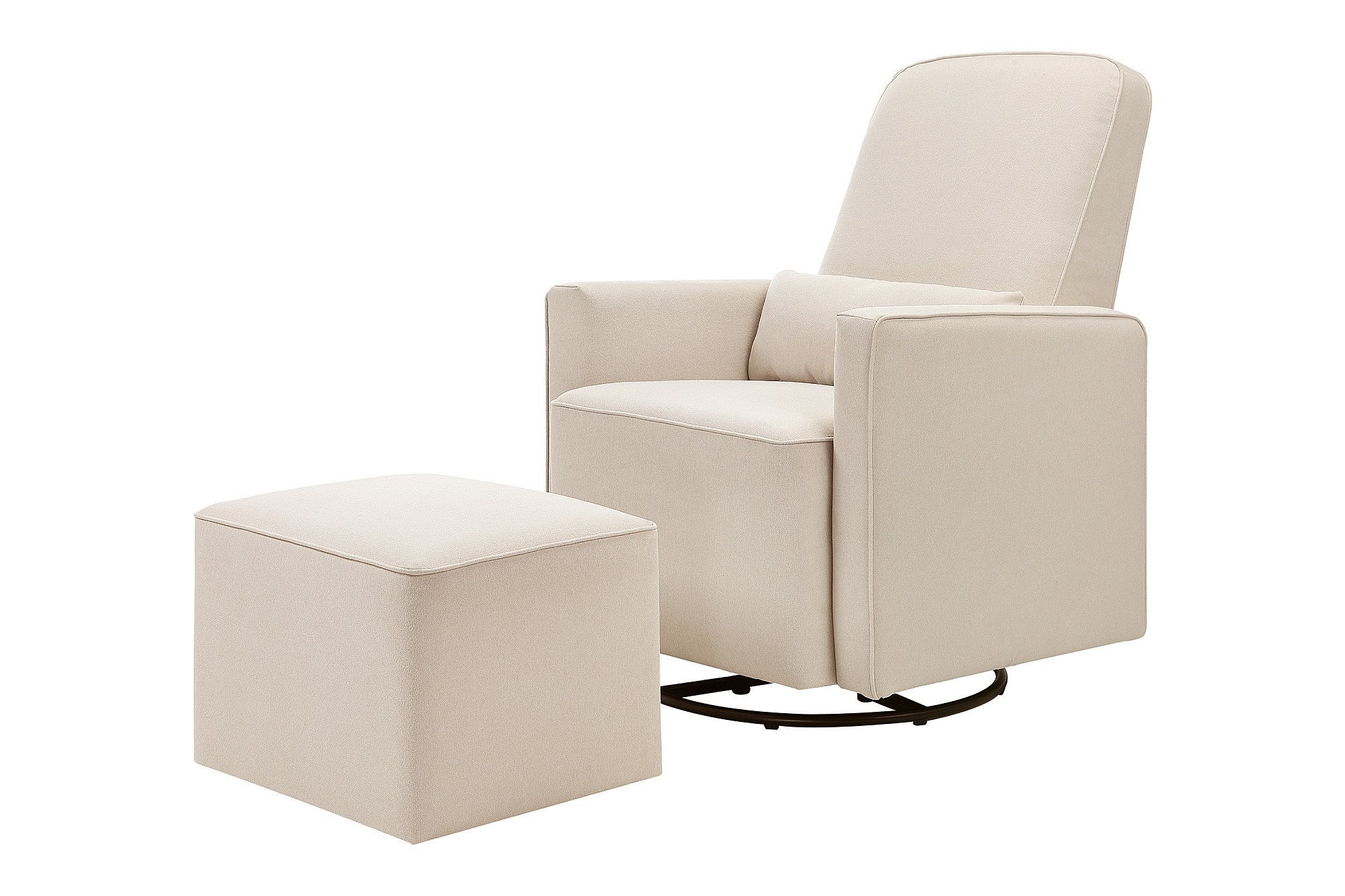
daVinci Olive Glider
Key Features
- Motion: Glide, rock, 360° swivel
- Ottoman: Storage ottoman, stationary
- Assembly: Arrives assembled
- Weight limit: 242.5 lb
- Price: Premium
One chair has to cover nursing, the 2 a.m. wake-up and the story before bed, and this is the one we hand that job to. The Olive glides, rocks and swivels a full 360 degrees, includes a storage ottoman and arrives already assembled — a combination no other chair here puts together. The swivel is the part we underrated: you can turn toward the bassinet without standing up, which matters when someone has just fallen asleep on you.
The ottoman is where the practical thinking shows. It’s a storage box first and a footrest second, with a lid that holds burp cloths, a spare blanket and the pump you don’t want to look at at 4 a.m. The thing to know is that it doesn’t glide with the chair — it stays put while you push it with your feet, which is fine for feeding and less satisfying if you like a long, rolling rock.
The number to check before you buy is the weight rating: 110 kg, the lowest in this group. Two adults of very different sizes sharing one chair are better served by the 300-pound options. Everyone else gets a cream polyester chair that spot-cleans, a lumbar pillow that lands where a lower back actually needs it, and GREENGUARD Gold certification that means something in a small, closed nursery.
Pros
- Glides, rocks and swivels a full 360°
- Storage ottoman keeps feeding kit to hand
- Arrives fully assembled
- GREENGUARD Gold and FSC certified
Cons
- Seat runs narrow for broader frames
- Can develop squeaks and clicks
We point most people to the Olive: it swivels, glides and rocks, stores the nursery clutter in its ottoman and shows up assembled — the easiest default for a first nursery.
Best for Tight Nurseries
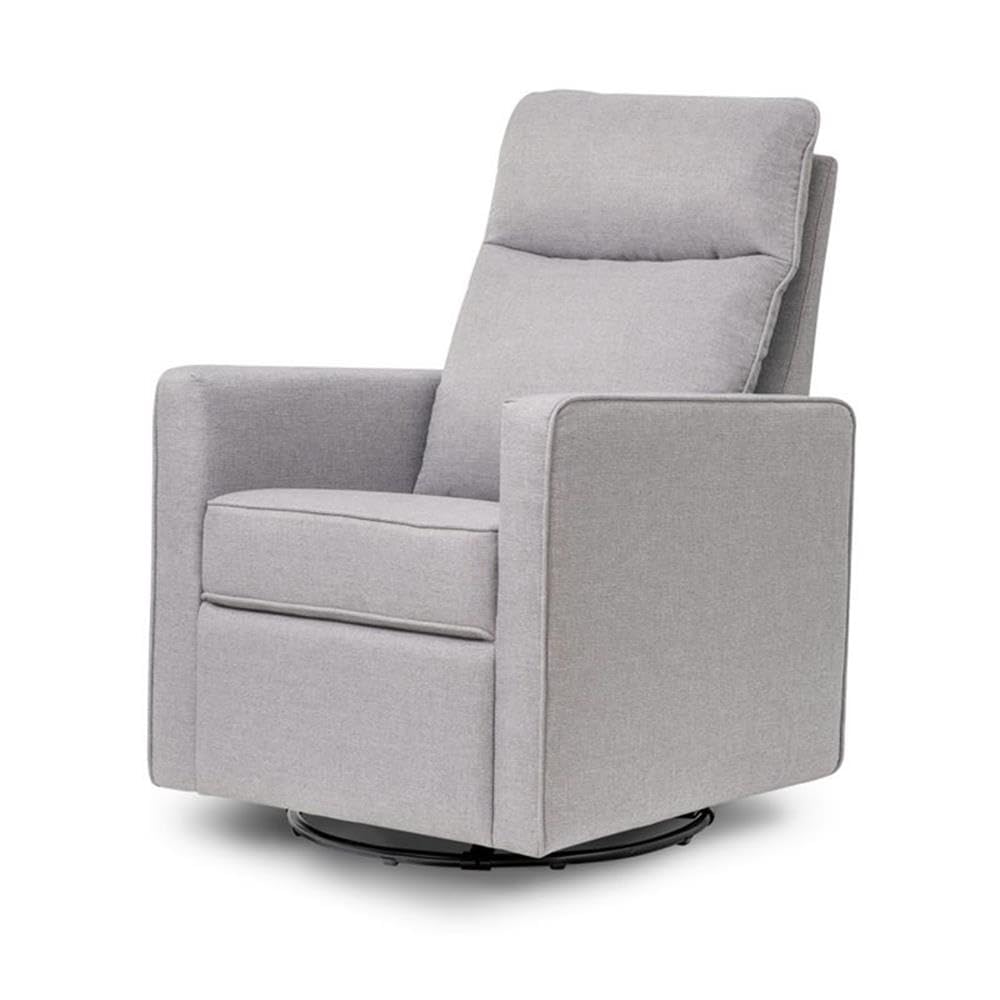
daVinci Gabby Glider
Key Features
- Motion: Glide, rock, 360° swivel
- Assembly: Base and back only
- Weight limit: 300 lb
- Overall height: 41.25 in
- Price: Midrange
Forty-one and a quarter inches of back on a chair that’s 27 inches wide is an odd pair of numbers, and it’s why the Gabby earns a place here. The pillowback is tall enough for a very tall sitter to rest a head against, and the footprint slips into a corner that won’t take anything bigger. There’s no ottoman in the box.
We recommend it as the second chair — the one in the bedroom or the living room rather than the dedicated nursery rocker. It glides, rocks and swivels, the back is firm in the way that supports rather than swallows you, and at 300 pounds it carries a heavier sitter than the Olive does. Attach the base to the back and you’re done; this is a chair you build while the kettle boils, not an afternoon project.
The trade is a footstool you supply yourself, plus creaks that can arrive a month or two in rather than on day one. Neither changes who this chair is for: the room with 27 inches to give, a tall sitter, and no floor space for an ottoman to live in the middle of the room.
Pros
- Tall pillowback with lumbar support
- 27-inch width fits small rooms
- 300-pound weight rating
- Two-piece assembly
Cons
- Narrow seat won’t suit broader frames
We recommend the Gabby when the room is tight and the sitter is tall: a 41-inch pillowback on a 27-inch footprint, rated to 300 pounds, with no ottoman to work around.
Best for Reclining and Reading
CANMOV Swivel Recliner
Key Features
- Seat: 21 x 21 in
- Motion: Glide, rock, 360° swivel, recline
- Recline: 90° to 150°
- Weight limit: 300 lb
- Price: Midrange
A recliner earns its floor space by going further back than a glider can, and this one reaches 150 degrees — close enough to flat that a bad night can be spent in it. The side lever runs the back and the footrest together, the base swivels a full 360 degrees, and the chair rocks once the footrest is down.
That range costs space and weight. It’s 37 inches deep and 95.7 pounds, so it’s a two-person delivery and a chair you place rather than move; the seat is 21 inches square, generous for one adult and tight for two. The grey polyester wipes clean and reads as living-room furniture rather than nursery equipment, which is the point of buying a recliner in the first place.
We recommend it to the household that wants one chair to do nursery duty and then stay in the den. The seat holds you upright for feeding instead of letting you sink, the swivel turns you toward the crib without standing, and the recline is quiet enough not to wake anyone. If you want to disappear into something at the end of the day, this isn’t that chair.
It does arrive in pieces, and the base is easier with a second pair of hands, though the build is the straightforward kind. The chair’s real advantage shows up after the nursery years, when the other picks here go to the guest room and this one stays in the living room with the footrest up.
Pros
- Reclines from 90° to 150°
- 360° swivel plus rocking
- 300-pound weight capacity
- Wipe-clean polyester in a neutral grey
Cons
- Footrest needs a firm push to close
For a chair that has to work in the nursery and then live in the den, this is the pick: 150 degrees of recline, a 360-degree swivel and a 300-pound rating.
Best for Long Feeding Sessions
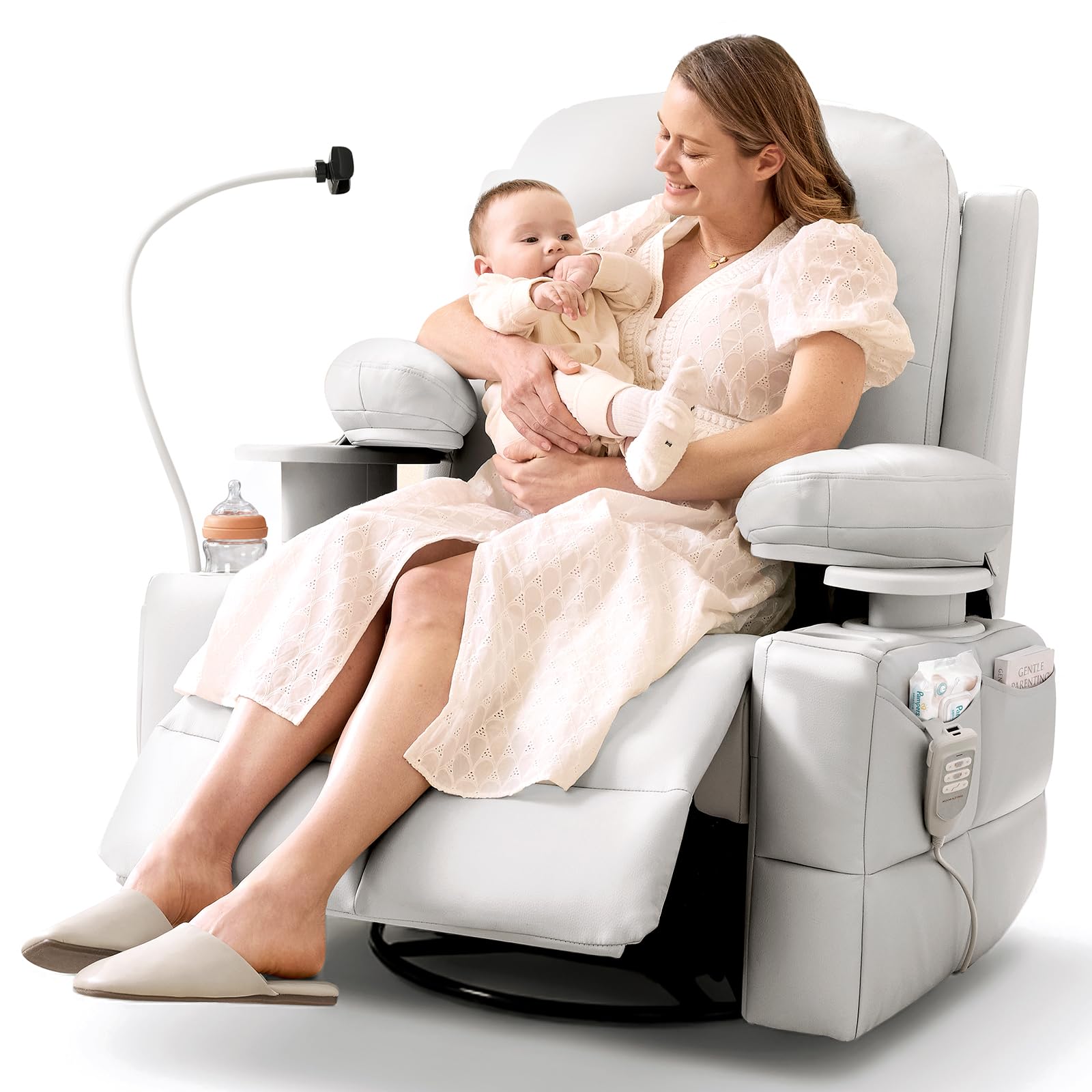
Mamazing Lullapod
Key Features
- Motion: Power recline, 270° swivel, rock
- Charging: USB and USB-C
- Upholstery: Leather
- Weight limit: 300 lb
- Price: Premium
The Lullapod is the only chair here that moves to meet you. Its armrests run on their own motors, traveling from 7.1 to 13.4 inches and rotating inward, so your elbows come up under a nursing pillow instead of a folded blanket doing the work. That adjustment is worth more than the rest of the feature list, and it’s why this chair holds its place despite what it costs.
The other motors are less surprising but still useful: back and footrest run separately through 105 to 135 degrees, the base swivels 270 degrees and rocks through 30, and the movement is quiet enough for a sleeping baby. Leather wipes down in one pass, USB and USB-C ports sit on the side for a pump or a phone, and assembly takes about ten minutes.
The cost is physical as well as financial. At 38.9 inches wide and 140 pounds it’s the biggest chair in this group, so measure the doorway before you fall for it, and it takes up floor a small nursery may not have. Feed a baby in it for a week, though, and the armrests stop looking like a gimmick — this is the chair for a household where feeding has turned into a shoulder problem.
Pros
- Powered armrests adjust to nursing height
- Triple-motor recline and footrest
- USB and USB-C charging ports
- Leather wipes clean
Cons
- Armrests can drift out of position
- Back sits too upright for some sitters
Buy it when feeding has become a posture problem: the powered armrests do something no other chair here can, and the size and price are what that costs.
Best for Second Chairs
SAETSFEG Nursery Rocker
Key Features
- Motion: Rock on wooden runners
- Upholstery: Teddy fabric
- Chair weight: 27 lb
- Weight limit: 300 lb
- Price: Budget
At the bottom of the price range sits a 27-pound rocker in grey teddy fabric, and it’s a more useful chair than the money suggests. One person can carry it, the box goes together in ten or fifteen minutes, and it fits through a doorway without being taken apart.
The frame is iron with FSC-certified wooden runners and a 300-pound rating, which is more than the Olive offers in a chair about a third of its weight. The teddy is soft, wipes clean and hides the ordinary mess of a nursery, and the profile stays narrow enough for a small bedroom.
It’s a rocker rather than a glider: curved wooden runners carry the chair back and forward across the floor instead of sliding on bearings, so leave clearance behind it and put a rug down if the floor is hardwood. The seat sits at 21.25 inches, high enough that most adults can stand up without pushing off the arms.
We point to it for a second chair, a grandparent’s house, or a nursery that will be repurposed in a couple of years — anywhere the motion matters more than the furniture. It does the one thing you asked for without asking for much space.
Pros
- Light enough for one person to move
- 300-pound rating at the lowest price tier
- Quick one-person assembly
- Soft teddy fabric that wipes clean
Cons
- Back too low for head support
- Firm seat cushion
A 27-pound rocker with a 300-pound rating and the lowest price here; we recommend it for second chairs, small rooms and anyone who wants the motion without the furniture budget.
Best for Certified Mid-Price Pick
Evolur Raleigh Glider

Key Features
- Motion: Glide, rock, 360° swivel, manual recline
- Upholstery: Polyester
- Weight limit: 250 lb
- Certification: GREENGUARD Gold, FSC
- Price: Midrange
Certification is the reason to start here. The Raleigh carries GREENGUARD Gold and FSC-certified wood at a mid-range price, which matters when the chair goes into a small, closed nursery and you’d rather not add another source of emissions to the room.
It glides, rocks and swivels a full 360 degrees, the light sand polyester is soft to the hand, and the 39-inch back with lumbar support holds a tall sitter. At 84 pounds and 32 inches wide, it’s a chair one person can assemble and shift between rooms.
The chair is for someone who will rock and swivel far more than they recline. The lever works, but the footrest is the weak part of the design and a deep recline doesn’t hold on its own; if lying back is the point, the CANMOV does it better in about the same space. As a soft-seated rocking chair with a clean certificate, it’s a sensible mid-price buy.
Pros
- GREENGUARD Gold and FSC certified
- Soft polyester over a supportive seat
- 360° swivel with glide and rock
- Side pocket for nursery essentials
Cons
- 250-pound weight limit
For a small nursery that needs clean-air certification and a soft seat, the Raleigh is the mid-price answer — as long as you’re buying it to rock, not to recline.
Best for Style-First Rooms
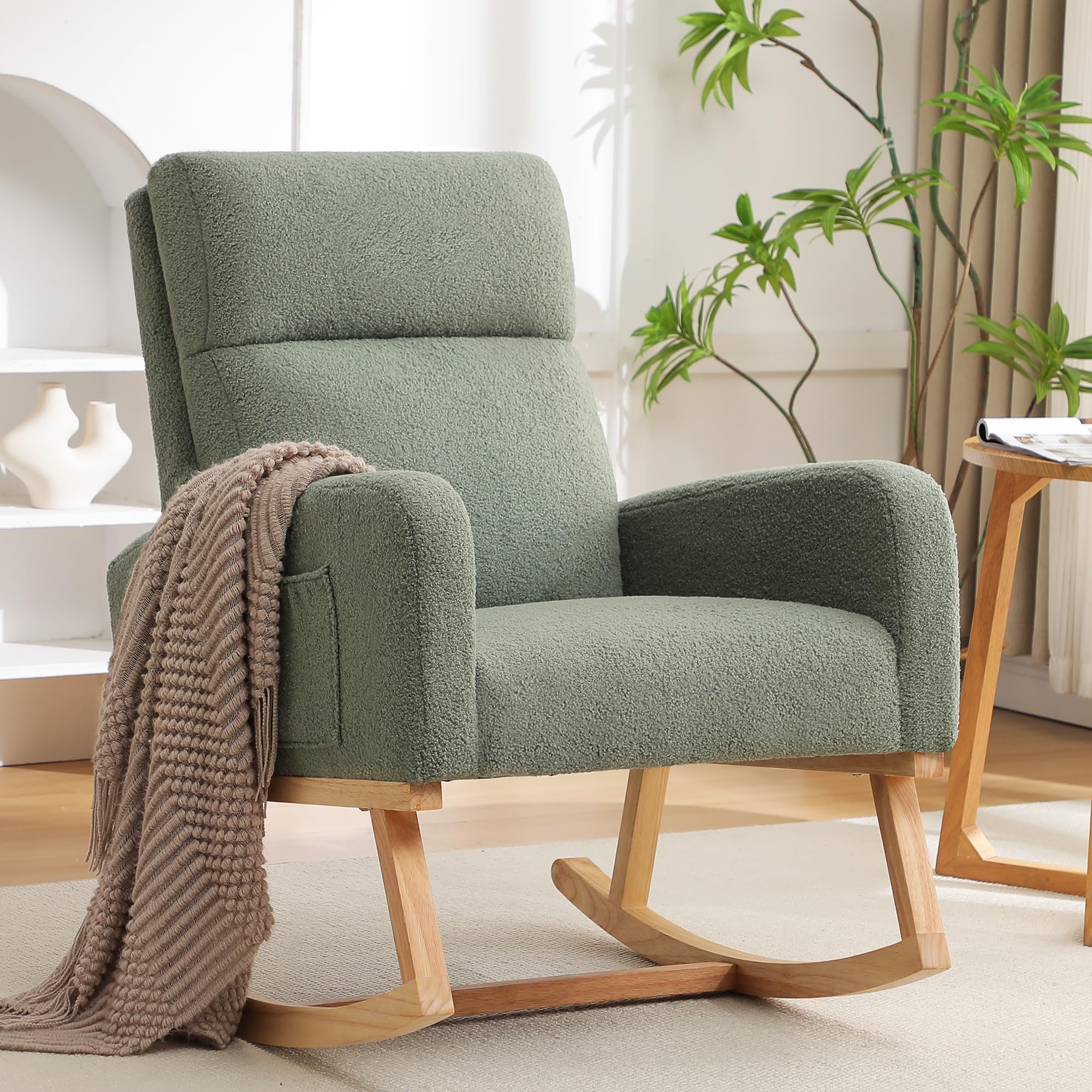
HCHAIRH Boucle Rocker
Key Features
- Arms: Armless
- Motion: Rocking motion, wood frame
- Upholstery: Boucle
- Weight limit: 300 lb
- Price: Budget
Take the arms off a rocking chair and it stops reading as nursery equipment. The HCHAIRH is boucle in light green with a wing back and a soft, teddy-ish pile, and it’s the pick here for a nursery that has to look like the rest of the house.
It’s compact where it counts: 27.5 inches wide, 37.8 inches tall and 39.7 pounds, so it moves between rooms and fits where a recliner won’t. The wood frame carries a 300-pound rating, and there’s a side pocket for a phone within reach of the seat.
Sit in it before you commit if you’re tall. The seat is 17.3 inches deep and the backrest itself is 25.9 inches, so a long-legged, long-torso sitter ends up with nothing behind the head and not much under the thighs.
What it does better than anything else here is disappear into a room. If nursing support comes first, the Olive or the Gabby will serve you better; if you want a chair that survives the nursery years as a piece of furniture, this is the one in this group that manages it.
Pros
- Boucle finish with a wing back
- Compact 27.5-inch footprint
- 300-pound weight rating
- Side pocket within reach
Cons
- No arms to rest forearms during feeds
We recommend it to the household where the chair has to look good for a decade and only work hard for two years, and to anyone who wants a rocker that doesn’t announce itself as baby furniture.
Best for Larger Sitters
NIOIIKIT Footrest Rocker
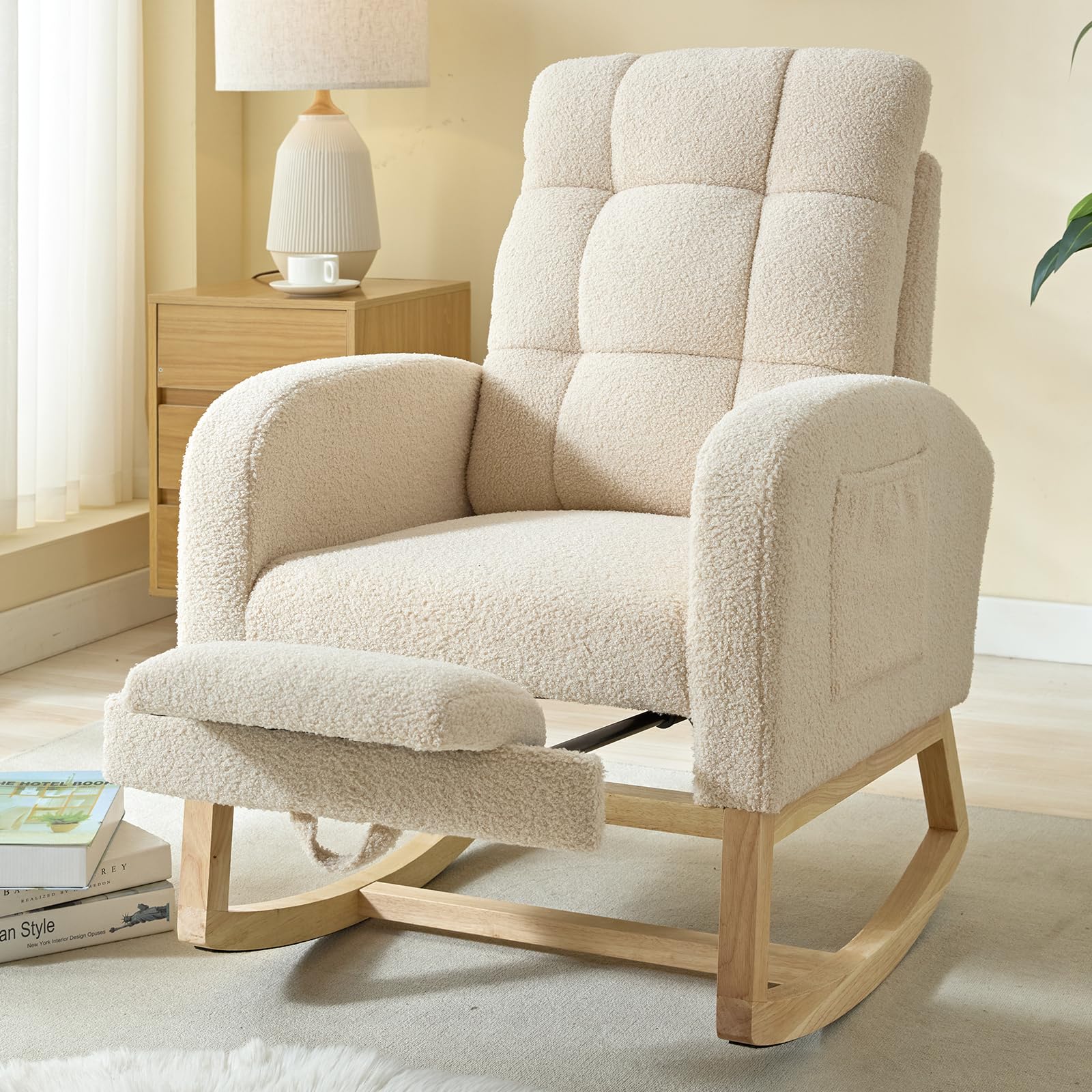
Key Features
- Motion: Rocks and glides
- Footrest: Extends from under the seat
- Upholstery: Teddy fabric
- Weight limit: 350 lb
- Price: Budget
Instead of a separate ottoman, this chair builds the footrest in: a padded panel that extends from under the seat. In a room where an ottoman would be one more thing to step over, that’s a genuine advantage, and it’s why this is the budget chair for a tight floor plan.
The case for it is capacity and cushioning. It’s rated to 350 pounds, the highest in this group, over high-density foam that gives more than the firm seats here, and at 41 pounds it’s still light enough for one person to move between rooms. For a bigger sitter, or a chair two adults share, that combination is hard to beat at this end of the group.
Assembly takes minutes and the frame is wood rather than the steel of the recliners, which is where the 41 pounds comes from. At 24.8 inches wide it slips into spaces the CANMOV can’t use, and the beige teddy hides the ordinary traffic of a nursery.
Pros
- 350-pound weight capacity
- Generous high-density foam
- Built-in extending footrest
- 24.8-inch width fits tight rooms
Cons
- Footrest flexes under your legs
- Short rocking arc
For a bigger sitter on a small budget, this is the one: a 350-pound rating, generous foam and a built-in footrest in a 24.8-inch footprint.
How We Tested Gliders and Rockers
To build the shortlist, I pulled more than 30 gliders and rockers from the major nursery brands, then cut anything with a weight rating under 250 pounds, a footprint that wouldn’t clear a standard doorway, an assembly that clearly needed two people, or a price that didn’t match its frame and upholstery. That left nine chairs, which we assembled and lived with for eight months.
Assembly happened in a bare nursery with a stopwatch and only the tools in the box; we counted every step, noted whether the hardware came labeled, and timed how long one person took to go from flat carton to sit-able chair. We then glided each one for 100 strokes in a silent room and listened for squeaks at the joints and the base, repeating the test on carpet and on hardwood. Stability got checked the way it actually fails: leaning full body weight on one armrest while standing up, and letting a 30-pound toddler climb in unsupervised.
Comfort was judged over 45-minute stretches, including a few 2 a.m. feedings, with notes on whether the seat cushion bottomed out or the lower back started aching. Recline and ease of use were tested holding a 10-pound weight to mimic a sleeping baby — could we adjust it one-handed, and did it lock firmly. For size and fit, we taped each chair’s footprint plus its glide arc on the floor and rolled it through a 30-inch door. Finally, we spot-cleaned every fabric with a baby wipe and a simulated spit-up stain, then checked how the chair looked a week later, because value and appearance both come down to how the upholstery and frame hold up rather than the showroom shine.
How to Choose a Nursery Glider or Rocker
The chair that earns its place is the one you can get out of without waking a baby, so we start with motion and seat height and leave fabric until last.
Pick the motion before the fabric
It’s tempting to shop by swatch, but the motion decides how the chair lives in your house. A glider runs on bearings or rails in a flat, quiet arc and keeps your weight centered, which makes standing up with a sleeping baby easier. A rocker pivots on curved wooden runners, travels further through the arc, and needs clear floor behind it. A recliner adds a footrest, and its mechanism is where most of the friction in this category comes from — a manual lever is something you work with your heels at three in the morning.
Choose the motion you’ll repeat twenty times a night, then add a swivel if two people will share the chair. The swivel is the feature we underrated going in: it turns you toward the bassinet without a stand-up.
Fit it to the room and to the person feeding
Two measurements do most of the work: footprint and seat height. The chairs here run from 24.8 inches wide to 38.9, and the recliners are 31 to 37 inches deep before the footrest goes out. A rocker needs clearance behind it; a recliner needs clearance behind and in front. Seat heights run 18.5 to 21.25 inches, and feet flat on the floor is what lets you stand without pushing off the arms.
The trap: compact in a listing describes the chair, not the space it needs to operate. Measure the floor the chair will actually occupy, including the arc of a rocker and the swing of a footrest, before you fall for a small footprint.
Upholstery, cushions and month six
Polyester that spot-cleans is the practical default in a nursery. Leather wipes down in one pass and feels cool at first; boucle and teddy are the prettiest and the least forgiving of a spilled bottle, so keep a cloth within reach of the chair. Cushion complaints are the long-term story in this category, and thin padding in the seat and arms is what makes a chair feel tired first.
If the chair has to survive past the toddler years, spend on foam and frame rather than trim. A firm seat with decent depth outlasts a plush one that has already flattened by the time your baby is crawling.
Certification, assembly and lifting
GREENGUARD Gold and FSC certification are worth paying for in a small, closed room: the first covers chemical emissions, the second the sourcing of the wood. Assembly ranges from nothing at all — the daVinci Olive arrives built — to two pieces to attach, to a fifteen-minute build on the small rockers.
Then check the chair’s own weight, not just its rating. A 71-pound glider can be shifted by one person; a 140-pound power recliner is a two-person delivery that stays where you put it.
Frequently Asked Questions
Is a glider worth it, or will a comfortable armchair do?
An armchair can work if the arms are high enough and the seat is low enough. Test yours with a pillow across your lap: if your elbows land below the pillow, you’ll hold the baby’s weight with your shoulders through every feed, and if your feet don’t reach the floor you’ll rock yourself forward to stand. A glider adds the motion and the seat height.
If your armchair passes both tests and your baby settles without movement, keep the armchair and spend the money on a footstool.
Can a nursery glider move to the living room later?
Yes, and the plain silhouettes travel best. An armless boucle rocker or a leather recliner reads as living-room furniture; a cream glider with a matching ottoman tends to stay where it started.
Choose the color for the second room rather than the nursery. A mid-grey or a warm neutral survives the move, while a pale cream shows every mark by the time the chair gets there.
Why does my glider squeak, and what can I do about it?
Most squeaks come from three places: hardware that loosened in the first weeks, the swivel bearing under the seat, and wood joints flexing. Tighten every bolt after the first week and again at the first sign of noise, and put a drop of silicone lubricant on the bearing rather than oil, which collects dust.
If the noise only appears on a hard floor, a rug under the chair changes it.
What weight limit should I look for?
Weigh the heaviest adult who will use the chair and leave headroom. Ratings run from 110 kg on the daVinci Olive to 350 pounds on the NIOIIKIT, and the number covers one person — not a person plus a toddler on the lap. If a four-year-old will climb up for stories, aim for 300 pounds or more.
Final Verdict
The daVinci Olive is the chair we point most people to: it swivels a full turn, glides, rocks, keeps the nursery clutter in its ottoman and arrives assembled. Its limits are a narrow seat and a 110 kg rating, so a heavier sitter should look at the Gabby instead.
If you want to lie back, the CANMOV reclines to 150 degrees and still swivels; if the room gives you 27 inches and the sitter is tall, the Gabby. And when the budget is the binding constraint, the SAETSFEG rocks well, weighs 27 pounds and carries 300.
