This post contains affiliate links. We may earn a small commission when you buy through our links — at no extra cost to you.
A learning tower solves one problem: your toddler wants to be at counter height, elbow-deep in the flour, and you only have two hands. Folding ones add a second question — whether the hinge that lets the whole thing collapse against a wall also brings a wobble you feel every time a 2-year-old leans over the edge. That’s the tradeoff we tested for.
We’ve spent eight months with 11 of them — wood, plastic, and metal — folding each several times a day, adjusting platform heights, wiping jam off them, and reassembling a couple after moves. The spec shoppers overrate is weight capacity on the box; real stability comes from base width relative to platform height. A high platform on a narrow footprint is where tips happen.
The picks below run from compact metal steppers you can tuck beside the fridge to full wooden towers with safety nets and chalkboards. Some are built to disappear between uses, others are furniture you’ll leave out, and that difference is much of what you pay for. All got the same treatment at the hinge, the base, and the handrail.


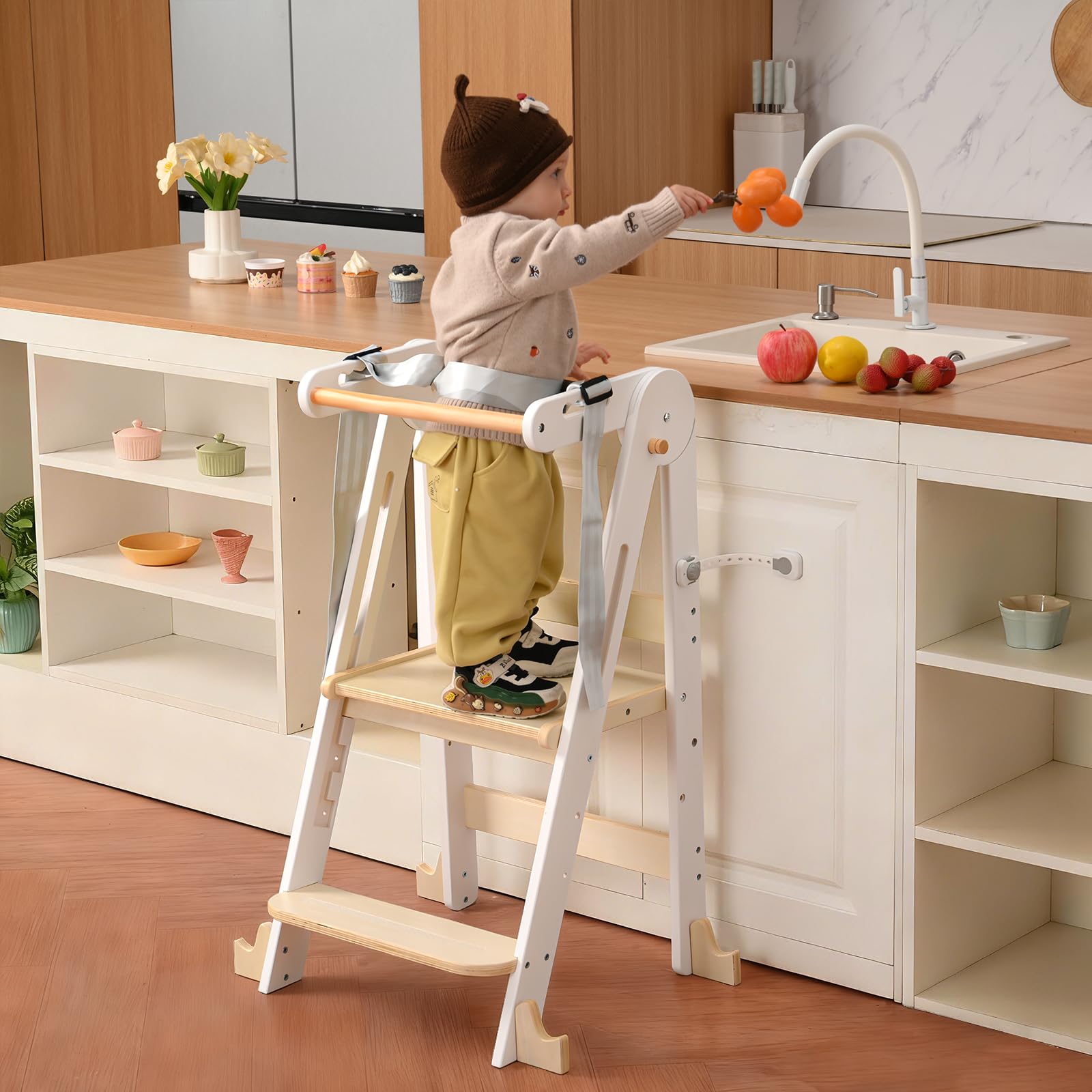

Best for Everyday Counter Work
Guidecraft Kitchen Helper Contemporary
Key Features
- Weight: 26.8 lb
- Weight capacity: 125 lb
- Platform heights: 15" or 18"
- Assembled dimensions: 23"L x 23"W x 36"H
- Price: Premium
Folding a wooden tower that stands 36 inches tall and weighs 26.8 pounds is a small engineering trick, and Guidecraft’s version is the one we trust most here: the frame swings shut and stands slim against the wall until the next meal. That behavior matters more than it sounds. A learning tower that can’t be put away becomes furniture, and furniture in a small kitchen gets resented.
Two platform settings, 15 and 18 inches, carry a child from 18 months to about five, and the rail plus the included Keeper panel close all four sides — there’s no open back for a toddler to reverse out of mid-stir. GREENGUARD Gold certification is the detail that surprised us, since it’s a third-party indoor-air standard rather than a sticker, and this is a piece parked where you chop onions.
The weight cuts both ways. Moving it from counter to sink is a two-handed carry, and the non-slip feet grip hard enough that it slides rather than glides across tile. Check the plywood standing platform when it comes out of the box — that base plate is the part that has split on some units — and treat the five-year limited warranty as the backstop if it has.
Pros
- Folds slim against the wall
- Four enclosed sides plus a Keeper panel
- Two platform heights, 15 and 18 inches
- GREENGUARD Gold and a five-year warranty
Cons
- Heavy at 26.8 pounds to reposition
- Costliest tower in this group
We recommend the Guidecraft to a household that folds the tower away between meals: it encloses a toddler on four sides, adjusts to two heights, and feels like furniture rather than a gadget.
Best for Tight Kitchens
Little Partners Foldable Toddler Tower
Key Features
- Weight: 18.7 lb
- Height levels: Four adjustable levels
- Weight capacity: 150 lb
- Assembled dimensions: 22.28"L x 19.56"W x 33.50"H
- Price: Premium
At 22.28 inches deep and 19.56 inches wide, the Little Partners is about three inches narrower and a couple of inches shorter than our top pick, and that gap is the reason we keep it on the list. Folded, it slides under a counter overhang or beside the island stools; at 18.7 pounds, one adult can move it to the sink with a hand on each side.
Four platform levels, the lowest at 12.36 inches, are the other half of the appeal. You’re not choosing between a platform slightly too low and one slightly too high, and the tower keeps fitting a child who grows two inches a season — it’s rated from age two to six, with a 150-pound capacity and a limited lifetime warranty.
Two things to know. The snugness is real: the same narrow frame that disappears under the counter leaves a big five-year-old less room to shuffle at the counter. And four wooden legs want a level floor — on uneven tile the base rocks, and a felt pad under the short leg settles it. Edge paint is the wear item, not the frame.
Pros
- Slides under an overhang when folded
- Four platform heights from 12.36 inches
- Light enough for one adult to move
- 150-pound capacity and lifetime warranty
Cons
- Paint chips at the edges with use
For a kitchen with no spare floor, this is the folding tower we point to: narrow, 18.7 pounds, and four platform heights that keep fitting a growing child.
Best for No-Assembly Setup
HBTower Kids 2-Step Step Stool
Key Features
- Weight: 10 lb
- Folded size: 39.8 x 18.5 x 3.3 inches
- Weight capacity: 250 lb
- Assembled dimensions: 16"D x 18"W x 37"H
- Price: Budget
It arrives folded and it opens with a foot: press the pedal, hear the click, and the A-frame locks into place. No hardware bag, no hex key, no forty minutes on the kitchen floor. For a rental, a grandparent’s kitchen, or anyone who has sworn off flat-pack furniture, that’s the whole pitch, and it’s the feature we appreciate most on this one.
Folded, the frame is 3.3 inches front to back — thin enough to stand behind a door — though it stays tall at about 40 inches, so plan a stretch of wall rather than a shelf. At 9.9 pounds it’s the easiest thing here to carry one-handed, and the 250-pound frame rating is the highest in this group by a wide margin.
The compromise is enclosure: two wide steps and a rail rather than four walls. That rewards a child who can climb in and out alone and worries the parent of one who can’t yet — the listed range starts at 18 months, and the raised non-slip bumps on the platform are a sensible touch for a climb usually made in socks. One year of warranty is the shortest commitment on this page.
Pros
- No assembly, opens with a pedal
- Folds to 3.3 inches deep
- Under ten pounds to carry
- 250-pound frame rating, highest here
Cons
- One-year warranty is the shortest here
If the tower has to vanish between uses and you don’t want to own a screwdriver, the HBTower opens in one motion, folds to three inches, and carries a 250-pound rating.
Best for Leaning Toddlers
Jcmairui Foldable Toddler Tower
Key Features
- Weight: 11.5 lb
- Height settings: 3
- Weight capacity: 150 lb
- Assembled dimensions: 20"D x 15"W x 40"H
- Price: Budget
A harness and buckle is the one thing this tower has that nothing else in the group does. For a child who stands up and leans over the rail the second your back is turned, that strap is the difference between a tower you use and a tower you stand next to — and it’s why this one earned a place despite a modest overall rating.
The harness is the headline; the dimensions are what sold us. Fifteen inches wide is the narrowest full-height frame here, so it slips into the gap between the fridge and the wall that no wooden tower will take, and 11.5 pounds means one hand carries it to the bathroom sink.
Setup is short — the tower arrives essentially built, with only a few screws left to you — and the anti-tip base and non-slip feet keep it planted. Three height settings are the part that carries it from toddler to school age, and the 40-inch frame reaches counter height without stacking a step stool on a step stool.
Pros
- Only pick here with a harness and buckle
- Three adjustable height settings
- 15-inch width fits tight gaps
- Arrives almost fully assembled
Cons
- Harness means a two-clip job every climb
- Narrow standing area for older kids
We reach for the Jcmairui when a child won’t stay put in a tower: the harness is the difference, and at 15 inches wide it fits where other towers won’t.
Best for Counter-Side Play
JUZBOT Foldable Toddler Tower
Key Features
- Height settings: 2
- Weight capacity: 150 lb
- Folded thickness: 6.7 inches
- Assembled dimensions: 28.1"D x 23.7"W x 35.43"H
- Price: Premium
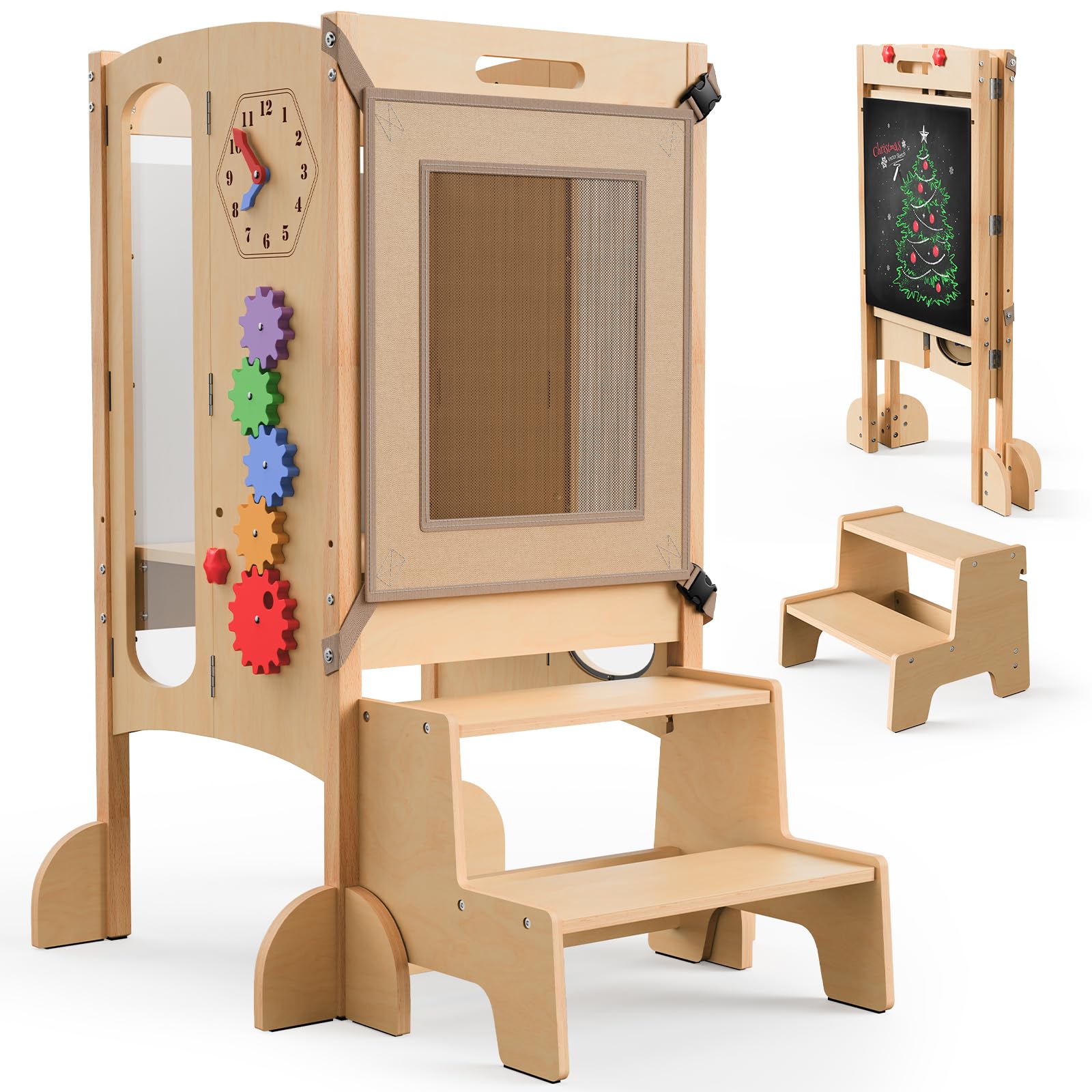
A toddler tower is mostly a place a child waits while you finish chopping, and the JUZBOT treats the waiting as the design problem. Movable clock hands, spinning gears, a magnetic maze, a chalkboard, and a whiteboard all live on the side panel, and the back is a taut mesh panel instead of an open gap.
The step is the smarter piece of engineering. It locks under the tower so a child can climb in, then detaches as a standalone two-step stool — the part that keeps working after the gears lose their novelty. The fold is genuinely one-handed and closes to a 6.7-inch profile, slim enough to tuck behind a cabinet door.
Depth is the trade: 28.1 inches makes this the deepest tower in the group, so pace out the walkway between the island and the fridge before you commit. Two height settings also mean it grows in bigger jumps than the four-level wooden towers, and the play panel is a want rather than a need — you’re paying for entertainment as much as for elevation.
We rate it above the plain wooden options for a child who genuinely parks at the counter, and below them for one who climbs in, looks around, and climbs out. If your toddler’s attention is measured in minutes rather than half hours, the extra panel is money that would be better spent on a smaller footprint.
Pros
- Five built-in activities on the panel
- Detachable step becomes a standalone stool
- One-hand fold to a 6.7-inch profile
- Mesh back closes in the standing area
Cons
- Deepest footprint at 28.1 inches
- Only two height settings
The JUZBOT is for the family whose toddler stands at the counter for twenty minutes at a time: the play panel and detachable step earn the deepest footprint here.
Best for Messy Kitchens
Forbena Foldable Toddler Tower
Key Features
- Step heights: 17.3 or 15.3 inches (3-step), 10.4 inches (2-step)
- Weight capacity: 200 lb
- Assembled dimensions: 24"D x 25.6"W x 34"H
- Price: Midrange
Plastic is usually the compromise in this category. On the Forbena it’s the argument: yogurt, marker, and peanut butter all wipe off a molded panel with a damp cloth, and there’s no sealed finish to cloud or chip at the edges the way painted wood does.
The conversion is the bit we keep coming back to. Adding the third step drops the platform to 10.4 inches, which is hand-washing and tooth-brushing height for a small toddler; take it out and you’re at 15.3 or 17.3 inches for counter work. One tower for the kitchen and the bathroom sink is a real reduction in clutter.
It’s a substantial object: 25.6 inches wide is broader than the wooden towers here, and folded it still eats a corner of a closet, so the space-saving pitch has limits. The 200-pound capacity is the second highest in this group, the safety net closes the back, and CPC certification is on the label rather than implied.
Pros
- Wipes clean, no finish to chip
- Platform drops to 10.4 inches for sinks
- 200-pound weight capacity
- CPC certified with a safety net
Cons
- Wider footprint than the wooden towers
- Still bulky when folded
For a house where the tower will wear applesauce, the Forbena is the one we hand over: wipe-clean plastic, a two-step conversion, and a 200-pound capacity.
Best for Kitchen and Bath
Onasti Foldable Toddler Tower
Key Features
- Steps: 3, converts to 2
- Weight capacity: 110 lb
- Assembled dimensions: 25"D x 24"W x 32"H
- Price: Midrange
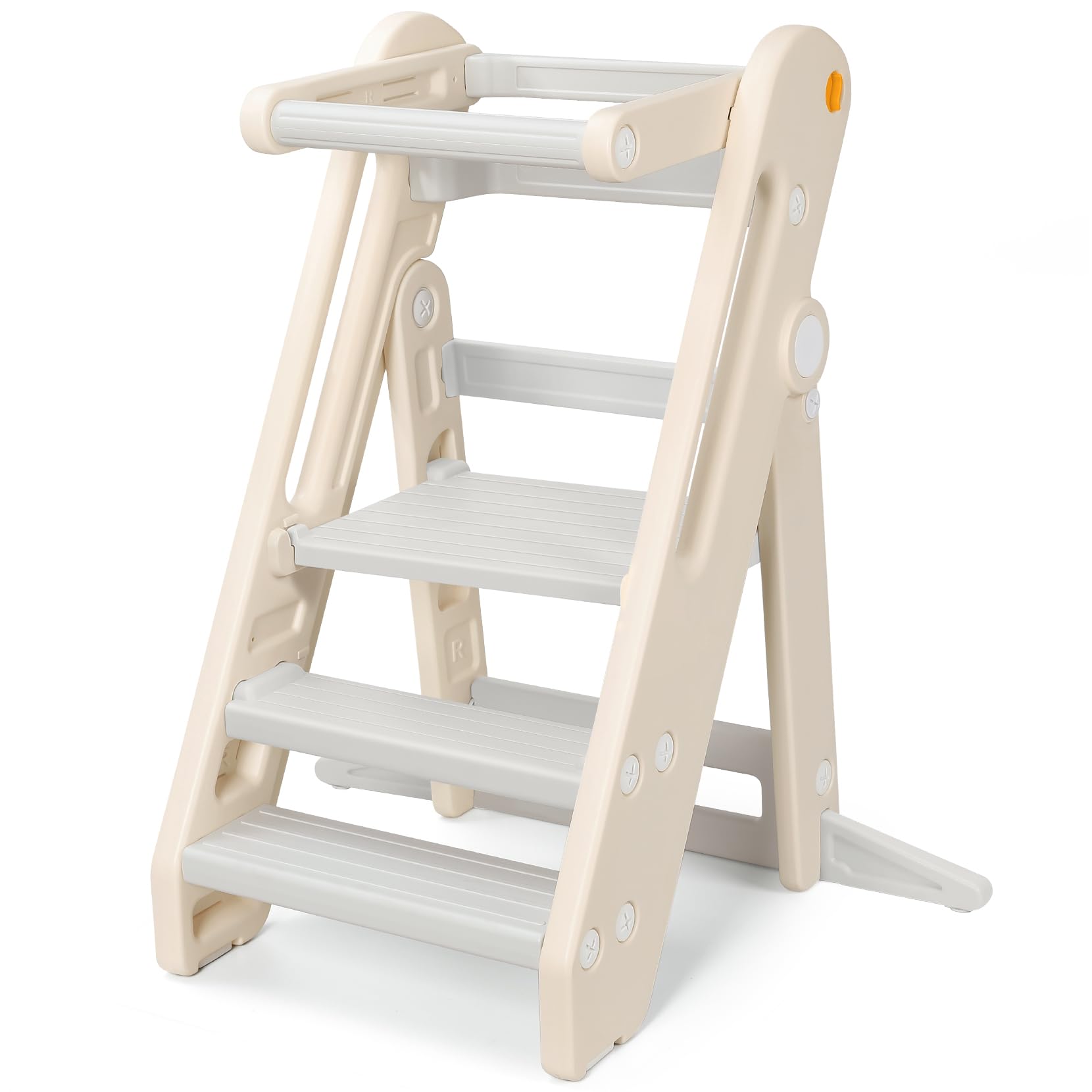
The Onasti sits between the budget picks and the wood: more than the metal HBTower, less than the Guidecraft, and what the middle of that range buys is a rail that moves.
What we noticed first is the rail. It lifts so a child can be set inside, then drops behind them; once they’re climbing in and out unaided, it flips down and out of the way, which is the rare feature that stops being useful at exactly the right time. Turning the top step converts the three-step frame to a two-step one for a smaller child.
Our take: the movable rail is worth the money, and the rest is ordinary. The A-frame and widened non-slip pads keep it planted on a hard floor, but 110 pounds is the lowest capacity in this group — fine for one toddler, not for two — and folding takes three deliberate moves rather than one.
Pros
- Rail lifts for entry, then folds away
- Converts from three steps to two
- Folds flat for storage
Cons
- Lowest weight capacity here at 110 pounds
- Fold takes three separate steps
If you want a rail that disappears as your child grows, the Onasti does it for midrange money, though 110 pounds is the lightest rating on this page.
Best for Art and Chalk Play
Cravenook 4-in-1 Foldable Tower
Key Features
- Weight: 15.2 lb
- Weight capacity: 150 lb
- Assembled dimensions: 24.7"D x 28.2"W x 34"H
- Price: Budget
The wood on this one is bare — no sealed finish — and that single fact explains the price and the upkeep. Sauce that hits the platform isn’t coming out with a wipe, and the surface wants a coat of child-safe sealer before the first session if you care how it looks next year.
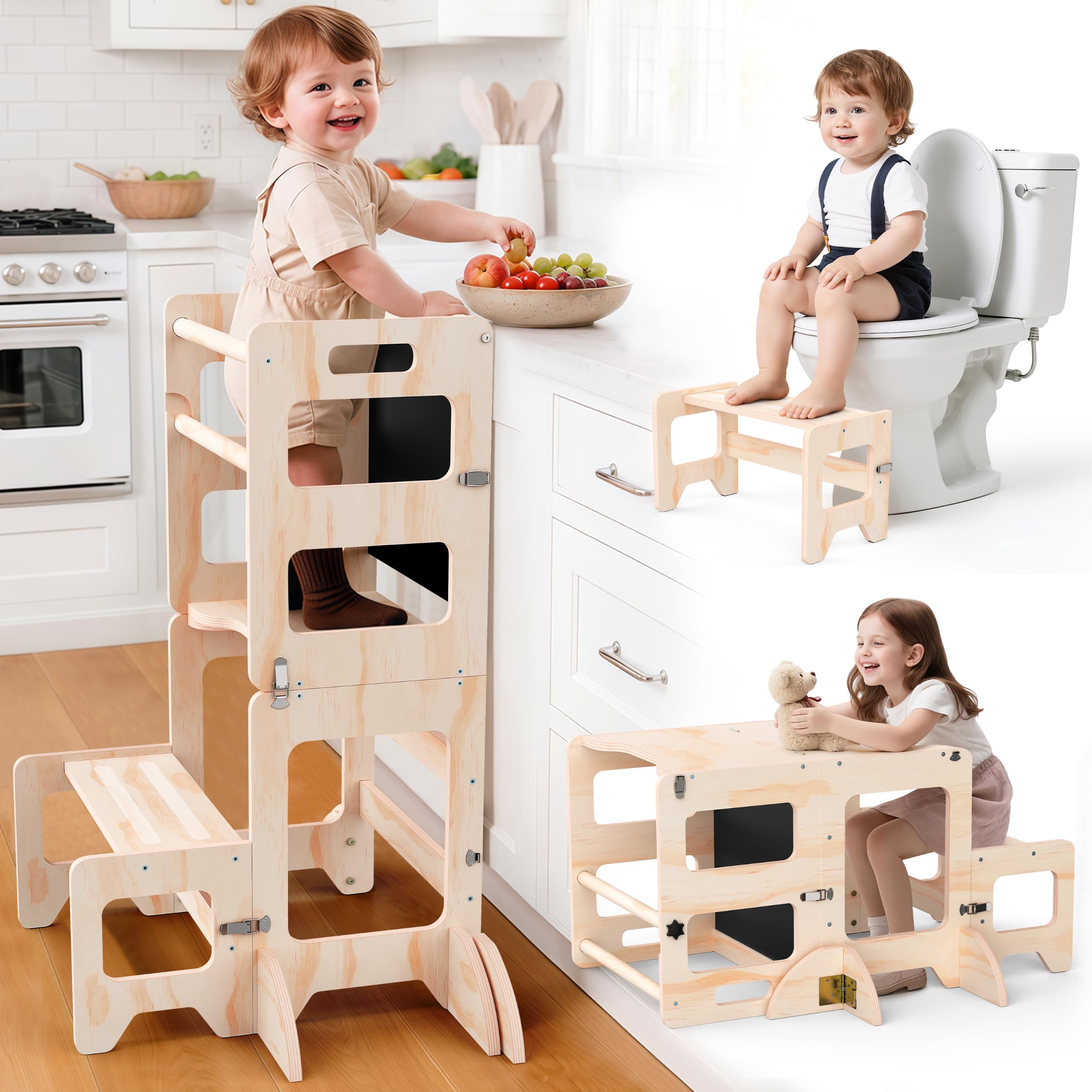
What the money buys is range, and it’s more than we expected at the bottom of this group: the frame converts through four modes, including a chalkboard art station and a toilet-training stool, the base has an anti-tip support, and it carries CPC certification rather than a slogan.
At 15.2 pounds it’s light for a wooden tower, and 150 pounds of capacity is generous for the size. The build is where it asks you to be forgiving: fit and finish are rougher than the wood towers above it, and the folding hardware needs a check after the first week.
Our verdict is narrower than the marketing: this is the right buy for a household that wants one object to be a tower, an easel, and a potty stool, and is willing to spend twenty minutes sealing it. If you want a tower that only has to be a tower, the extra modes are clutter and the bare wood is a chore.
Pros
- Converts to art station and potty stool
- Anti-tip base and CPC certification
- Light at 15.2 pounds for wood
Cons
- Unfinished wood stains without sealing
- Widest footprint here at 28.2 inches
Buy the Cravenook if you want a tower that turns into an art station and a potty stool, and you don’t mind sealing the wood yourself.
How We Tested (and Refolded) 11 Folding Learning Towers
We started by pulling every folding tower we could find from the major retailers and reading reviews for patterns — assembly complaints, hinges that worked loose, towers too bulky to store. From about 30 candidates we narrowed to 11 on fold mechanism, platform adjustability, footprint, and price, and bought each at retail rather than accepting samples from manufacturers.
Assembly came first: I built each tower alone with only the included tools and timed it, noting whether the hardware matched the instructions and how many steps needed a second person to hold a panel. Then I ran a hand along every edge, checked joints for glue squeeze-out and screws already backing out, and rechecked those screws monthly to see which frames stayed tight.
Then they went into the kitchen, where each one lived at the counter through dinner prep and moved to the bathroom sink for handwashing. I folded and unfolded each tower at least twice a day for eight months — the only fair test of a folding design — logging how long it took one-handed, whether the latch caught on its own, and where fingers could get pinched. For stability I stood on each platform myself and leaned over the counter to see how much the frame flexed, then checked whether the anti-tip base reached past the footprint, whether the rail or net sat high enough to keep a determined 3-year-old from climbing out, and whether the top platform setting actually met our counter edge. We weighed every tower, measured the floor space it took open and closed, and judged value the boring way: whether the wood looked like furniture or paint over particleboard, and whether we’d leave it out or fold it into a closet.
How to Choose a Folding Learning Tower
The fold is the easiest thing to compare and the hardest thing to judge from a product photo: what matters is where the folded tower goes, whether it stands up while it’s folded, and whether the frame still feels rigid once it’s open.
Measure the folded tower, not the open one
A frame that closes to three inches deep can still stand forty inches tall once it’s folded, so "folds flat" rarely means "fits in a closet." Pick the storage spot first — behind a door, under a counter overhang, beside the fridge — and match the folded dimensions to it. Weight matters just as much. The lightest tower here is around ten pounds and goes from kitchen to bathroom in one hand; the heaviest is 26.8 pounds and takes two.
Then check the lock. A folding frame is only as steady as its hinge, so look for one that clicks or latches into the open position rather than a frame that simply rests there.
Match the platform height to your counters
Standard counters sit at 36 inches, and a platform 15 to 18 inches off the floor puts a toddler’s chest at the level where both hands can work. Two settings cover roughly 18 months to five years; four settings let you fine-tune, which matters for a child who spends a season between sizes. If you also want the tower at a bathroom sink, look for a model that converts to a lower step — one here drops to 10.4 inches, which is hand-washing height rather than counter height.
Decide how much enclosure your child needs
This is where these towers differ most: four solid sides, a mesh net, a single rail, or a harness. A child who leans over the edge needs the first two. A confident climber is often happier with a rail they can clamber past on their own. A net or a harness buys you a moment of margin, but neither replaces a hand on the frame, and a harness adds a buckle to every climb-in. Match the enclosure to the child you have, not to the one in the box photo.
Stability is a floor question as much as a frame question
Nearly every wobble story about a toddler tower ends with the floor. Wide feet, an anti-tip base, and non-slip pads do their job on tile and hardwood; on a thick rug or an uneven threshold the same frame rocks. Set it up where you’ll actually use it, push the top rail hard with one hand, and slip a felt pad under the short leg if it moves. Run that test before the return window closes, not after.
Wood, plastic, or metal, and what the finish costs you
Wood is the warmest option and the heaviest, and its finish is the wear item: painted edges chip, and bare wood takes a stain the first time a spoon goes over the side. Plastic wipes clean in one pass and never needs touch-up, at the cost of looking like plastic next to wood cabinets. Metal folds thinnest and carries the highest weight ratings. Whichever you pick, a low-emission certification such as GREENGUARD Gold is worth having on a piece that parks in the kitchen.
Frequently Asked Questions
Why buy a learning tower instead of a regular step stool?
A step stool gives a toddler somewhere to stand and nothing to hold. A tower puts the child at counter height inside a frame, which frees both hands for stirring, pouring, or Play-Doh. The difference matters most between about 18 months and three years, when balance is still unreliable; a stool is fine for a ten-second reach at the sink. Either way, an adult stays within arm’s reach.
Does a folding learning tower need to be anchored to the wall?
No. These toddler towers are freestanding, with anti-tip bases and non-slip feet, and none of the models here is designed for wall fixing. What they need is a hard, level floor and a fully engaged hinge: set the tower down, press the top rail firmly with one hand, and return it if it rocks.
Can two children use one learning tower at the same time?
Rarely well. The platforms are sized for one small child, and the weight ratings in this group run from 110 to 250 pounds — generous for a toddler, not a license for a four-year-old plus a two-year-old. Two children also put weight high and off-center. Give the older child a stool at the counter instead.
How do I know my toddler is ready for a learning tower?
Three signs: standing unaided for a few minutes, taking a cue to hold the rail, and climbing in with one hand from you. Most makers set 18 months as the floor, and the platform heights start there for a reason. Begin on the lowest setting so the rail sits near chest height, and move up once your child stops leaning out to see.
Final Verdict
Two things decide this purchase: where the tower goes when it’s folded, and how much enclosure your child needs. On both counts the Guidecraft Kitchen Helper Contemporary is the one we stand behind. It folds slim, closes on four sides, and adjusts through two heights without feeling like a contraption.
If your kitchen can’t spare the floor, the Little Partners is the narrower, lighter version of the same idea. And if the tower will live behind a door and come out for ten minutes at a time, the HBTower’s one-motion fold and 9.9-pound frame make more sense than any wooden tower here.
