This post contains affiliate links. We may earn a small commission when you buy through our links — at no extra cost to you.
Choline is the nutrient most prenatals leave out. Pregnancy raises the recommendation to roughly 450 milligrams a day, and since your baby draws on your own stores, the gap tends to show up as foggy afternoons and lost words before it shows up anywhere else. My OB raised it at a routine visit, and what struck me was how hard it is to fit a real dose into a prenatal already carrying calcium and iron — which is exactly what a standalone choline supplement solves.
My team and I spent four months with 14 choline supplements, in capsules, tablets, and softgels. The label is where the real decisions get made: choline bitartrate and phosphatidylcholine are not interchangeable, and many bottles list their dose per serving rather than per capsule, so a three-month supply can vanish in three weeks.
We also cared about the unglamorous things: whether a capsule is small enough to swallow first thing in the morning, whether it repeats on you an hour later, and what a month of it costs. The picks below held up on all counts.



Best for One-Capsule Routine
Solgar Choline 350 mg
Key Features
- Diet: Vegan, kosher
- Form: Choline bitartrate
- Count: 100 capsules
- Choline per capsule: 350 mg
- Price: Budget
Solgar’s 350 mg capsule is the one we reach for first for pregnancy because the dose is clear and the routine is simple. One vegetable capsule gives 350 mg of choline as choline bitartrate, and you can fill the rest of the day’s target with eggs, dairy, or meat. That leaves room to adjust without overshooting, which is exactly what we want from a supplement you may take for months.
The rest of the label is just as sensible: 100 capsules per bottle, vegan, kosher, and free of gluten and dairy. We like that it doesn’t add inositol or a blend of other ingredients, so you know exactly what you’re taking alongside a prenatal. The bottle is a full 100-day supply at one a day, so the value holds up.
Compared with the 300 mg NOW capsule, Solgar gives a little more choline per pill and a longer track record; compared with Nested Naturals, it’s less explicitly prenatal but easier to dose. For most readers, that balance is why it earns the top slot.
Pros
- Clear 350 mg choline per capsule
- One-capsule daily routine
- Vegan, kosher, gluten- and dairy-free
- No added inositol or blends
Cons
- Large capsule can be hard to swallow
We tell most pregnant readers to start with Solgar’s 350 mg capsule: one clear daily dose, a reputable brand, and room to get the rest of your choline from food.
Best for Budget Daily Dose
NOW Choline 300 mg
Key Features
- Count: 100 capsules
- Serving size: 1 capsule
- Certification: GMP, third-party certified
- Choline per capsule: 300 mg
- Price: Budget
At the other end of the price scale, NOW’s 300 mg capsule is the one we keep as a budget default. One capsule gives 300 mg of choline, so a single capsule plus choline-rich food is a realistic daily routine, and two capsules still stay well under the upper limit. We like that kind of flexibility.
The bottle is 100 capsules, which is more than three months at one a day, and the capsules are ordinary-sized and easy to swallow. The label also carries NOW’s GMP and third-party certification language, which is reassuring when you’re stacking a supplement with a prenatal. We did not find a strong reason to pay more for a plain choline capsule.
The catch is dose: 300 mg is below the roughly 450 mg daily target many pregnancy guidelines use, so you’re counting on food or a second capsule. That’s the trade-off for the low price. The 300 mg dose is the limitation; the price and flexibility are why it stays in the rotation.
Pros
- Lowest-cost daily option here
- 300 mg in one small capsule
- 100-day supply at one a day
- GMP and third-party certified
Cons
- 300 mg falls short of a full daily target
We keep NOW’s 300 mg capsule as the budget pick: a low-cost, easy-to-swallow daily dose that works as a building block alongside food or a prenatal.
Best for Prenatal-Focused Pick
Nested Naturals Choline Bitartrate
Key Features
- Diet: Vegan, non-GMO
- Count: 180 capsules
- Testing: Third-party tested
- Choline bitartrate per serving: 500 mg
- Price: Premium
Nested Naturals is the one product here that puts pregnancy on the label. The bottle is a two-pack of 180 capsules, and the serving is 500 mg of choline bitartrate, not 500 mg of elemental choline. That distinction matters: check the Supplement Facts for the actual choline number before you count it toward your daily target.
What we like is the positioning and the form: vegan, non-GMO, third-party tested, and easy to work into a prenatal routine. The serving is split across two capsules, which makes it easier to take one at a time if nausea hits, and the two-pack means you’re not reordering every month. We just wish the label were more explicit about elemental choline.
The bigger caveat is smell. These capsules can carry a fishy odor, and that’s a real problem when pregnancy already has your stomach on edge. If you’re sensitive, sample a small amount first or keep them with food. For readers who want a prenatal-labeled bottle and don’t mind the smell, it’s a strong alternative to the plain single-ingredient picks.
Pros
- Explicit prenatal positioning
- Vegan, non-GMO, third-party tested
- Two-capsule serving can be split
- Two-pack value
Cons
- Label lists bitartrate, not elemental choline
We point readers who want a prenatal-labeled bottle to Nested Naturals: a vegan 500 mg bitartrate serving, with a fishy-smell caveat and a label that needs a closer read.
Best for Higher-Dose Serving
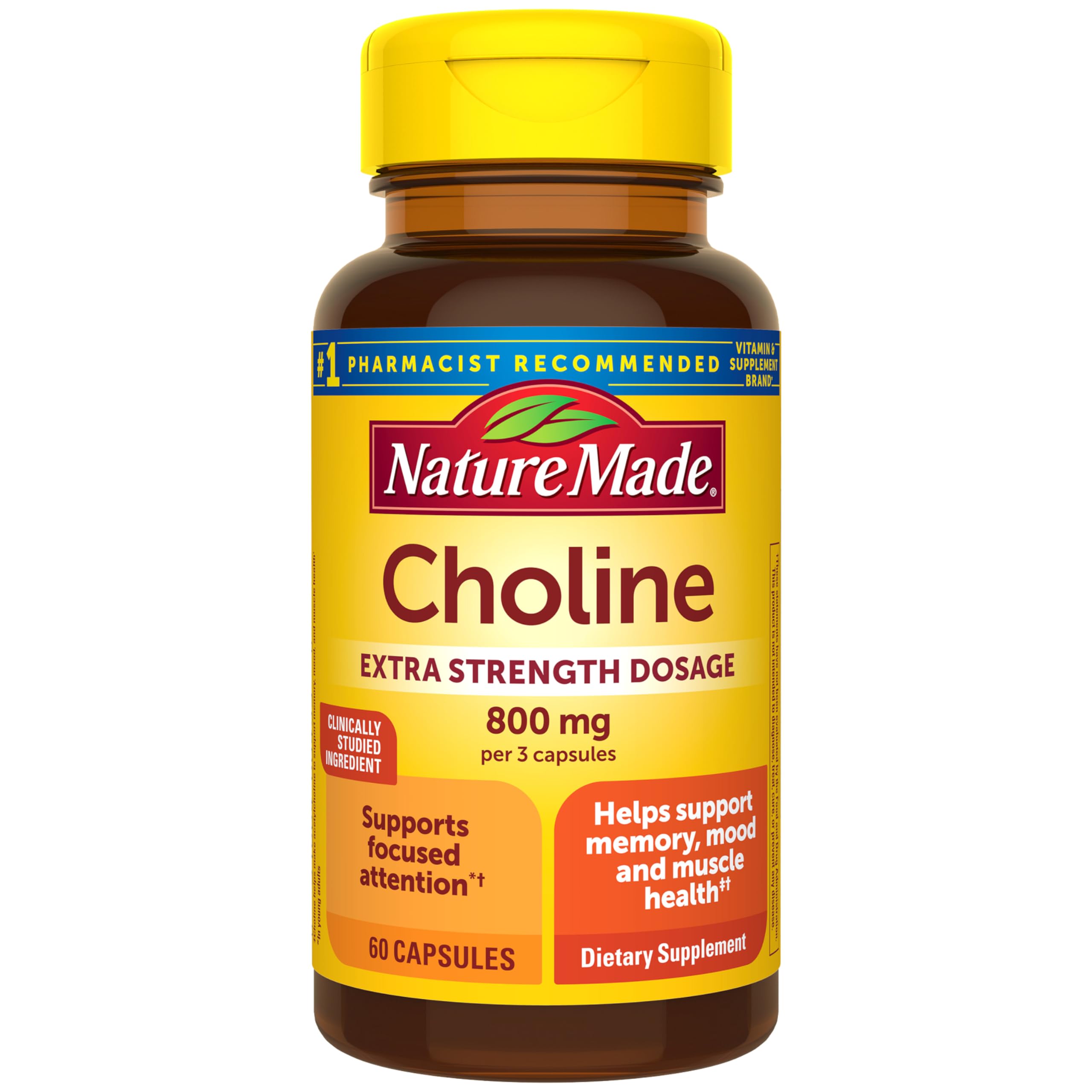
Nature Made Extra Strength Choline
Key Features
- Diet: Vegetarian, gluten-free
- Count: 60 capsules
- Serving size: 3 capsules
- Choline per serving: 800 mg
- Price: Midrange
Nature Made’s Extra Strength bottle is built around a three-capsule serving: 800 mg of choline per day. The bottle contains 60 capsules, so the supply is shorter than the one-capsule bottles here.
What we like is the clarity: 800 mg is spelled out, the capsules have no odor or aftertaste, and the formula is vegetarian and gluten-free with no artificial colors or preservatives. If your OB has asked for a higher dose, this is the simplest way to get there without stacking two bottles. We also appreciate that it’s one daily serving, even though it’s three pills.
The trade-off is pill load. Three large capsules at once can be a lot during early pregnancy. We prefer it for readers who specifically need 800 mg, not for anyone who just wants a small daily top-up. For that, the 300 mg or 350 mg picks are easier.
Pros
- Clear 800 mg choline serving
- No odor or aftertaste
- Vegetarian and gluten-free
- One daily serving
Cons
- Short 20-day supply
We reserve Nature Made’s 800 mg serving for readers whose clinician has asked for a higher dose; it’s clear and odorless, but it’s a three-pill commitment.
Best for Split Dosing
Standard Process Choline
Key Features
- Diet: Vegetarian, gluten-free
- Form: Choline bitartrate
- Count: 90 tablets
- Choline per serving: 180 mg
- Price: Midrange
Standard Process takes the opposite approach from the high-dose bottles: 180 mg of choline per tablet, with directions to take one tablet per meal. That’s a split-dose routine, not a one-and-done capsule, and it’s the reason this one stays in the guide.
The tablets are vegetarian, gluten-free, non-dairy, and made with choline bitartrate. We like the flexibility: three tablets across the day give 540 mg total, and you can drop to two if you’re getting more choline from food. For anyone who feels best with smaller amounts spread out, that’s a real advantage over a single 800 mg serving.
Our reservation is the tablet routine and the bottle size. You’re taking three tablets a day to hit the label’s schedule, and 90 tablets per bottle means a 30-day supply. We still recommend it for readers who want to split the dose and don’t mind a tablet routine.
Pros
- 180 mg per tablet for flexible dosing
- Can split across meals
- Vegetarian and gluten-free
- 90 tablets per bottle
Cons
- Bitter taste on some tablets
We like Standard Process for split dosing: 180 mg tablets let you spread choline across meals, with a bitter-tablet caveat and a 30-day bottle.
Best for Phospholipid Value
Double Wood Phosphatidyl Choline

Key Features
- Diet: Gluten-free, dairy-free
- Form: Phosphatidylcholine
- Count: 210 softgels
- Phosphatidylcholine per softgel: 420 mg
- Price: Midrange
Double Wood’s bottle is phosphatidylcholine, not choline bitartrate, and the label math is different: 420 mg of phosphatidylcholine per softgel, not 420 mg of choline. That’s the first thing to understand before comparing it with the bitartrate picks.
We like it for readers who specifically want a phospholipid form. The softgels are gluten- and dairy-free, the bottle has 210 of them, and the price per softgel is reasonable for a phosphatidylcholine product. It’s a practical way to try the form without jumping to a premium brand.
The trade-off is the dose math. Because the choline is bound up in phosphatidylcholine, you’re not getting 420 mg of choline per pill. If you want a simple one-capsule choline number, stay with bitartrate; if you prefer phospholipids, this is the value pick in this group.
Pros
- 420 mg phosphatidylcholine per softgel
- 210 softgels per bottle
- Gluten- and dairy-free
- Good value for a phospholipid
Cons
- Large softgels
We make Double Wood’s phosphatidylcholine our value pick for the phospholipid form, as long as you’re ready for larger softgels and different label math.
Best for Certified Phospholipid
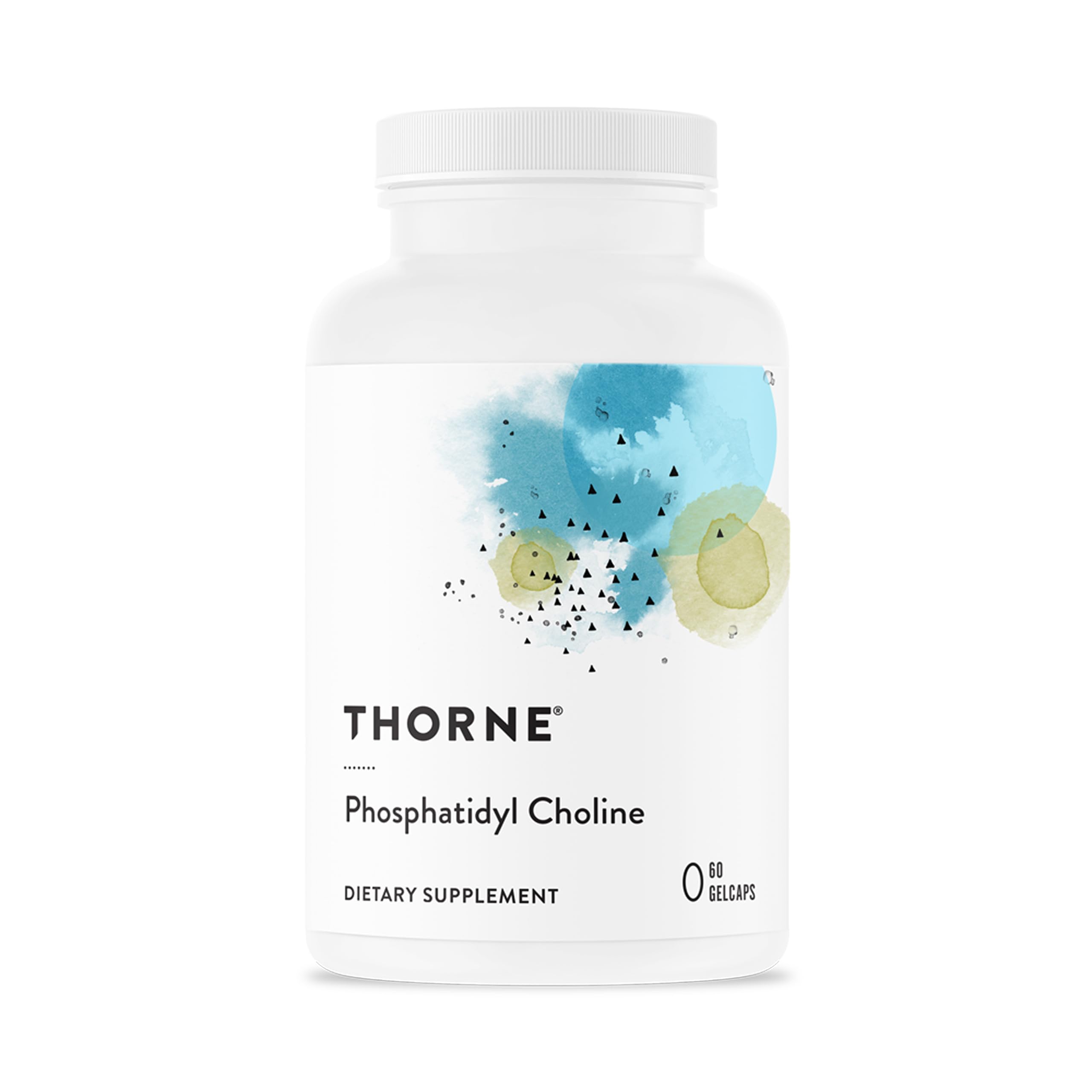
Thorne Phosphatidyl Choline
Key Features
- Diet: Gluten-free, dairy-free
- Count: 60 softgels
- Certification: NSF Contents Certified
- Phosphatidylcholine per softgel: 420 mg
- Price: Premium
Thorne’s phosphatidylcholine is the certified option here: 420 mg per softgel, 60 softgels, and NSF Contents Certified.
We appreciate the transparency. The label is clear about the phosphatidylcholine amount, the softgels are gluten- and dairy-free, and the NSF mark means an outside body has verified the contents. For a supplement you’re taking during pregnancy, that kind of documentation is worth something.
The bottle is only 60 softgels, so a two-softgel daily routine runs out quickly. The label also lists phosphatidylcholine, not elemental choline, so the same dose math applies here as with any phospholipid.
Our verdict is that this is the one for readers who want a certified phospholipid. If you want the simplest dose math, the bitartrate picks are easier to compare. But if certification is the deciding factor, Thorne is the strongest choice in this group.
Pros
- NSF Contents Certified
- 420 mg phosphatidylcholine per softgel
- 60 softgels per bottle
- Gluten- and dairy-free
Cons
- Premium price
We choose Thorne’s phosphatidylcholine when certification matters more than price; the NSF mark is the reason it’s here.
Best for Choline Plus Inositol
Solgar Choline/Inositol

Key Features
- Count: 100 capsules
- Serving size: 2 capsules
- Choline per serving: 500 mg
- Inositol per serving: 500 mg
- Price: Budget
Solgar’s choline/inositol capsule is the one combination product we kept in the guide. Each two-capsule serving gives 500 mg of choline and 500 mg of inositol.
The appeal is convenience: if your clinician has already suggested inositol, this combines it with a solid choline dose in one bottle. The capsules are vegetarian and kosher, and the 100-count bottle gives 50 servings. We like that the choline number is clear on the label, which isn’t always true of combination products.
The 500/500 ratio is straightforward, and the two-capsule serving is easy to split if you want to start slowly. It sits in a different slot from the single-ingredient picks, which is why we don’t treat it as a default.
We recommend this one for readers who specifically want both ingredients. For everyone else, the 350 mg Solgar or 300 mg NOW capsule is the cleaner starting point. It’s a good formula, but it’s a narrower buy.
Pros
- 500 mg choline plus 500 mg inositol
- 50 servings per bottle
- Vegetarian and kosher
- Clear two-capsule serving
Cons
- Not a pure choline supplement
We see Solgar’s 500/500 combo as a narrow pick for readers who specifically want choline and inositol together; it’s a clear formula, but not a pure choline pick.
How We Tested the Best Choline Supplements for Pregnancy
We started with a wide sweep of the category, reading the supplement facts panels rather than the marketing copy, and cut anything that buried its choline inside a proprietary blend, dosed below a meaningful contribution to the 450-milligram pregnancy target, or leaned on a vague purity claim instead of naming a third-party testing program. What survived was a spread of forms — bitartrate capsules, tablets, and phosphatidylcholine softgels — along with a range of price points, which is how we ended up with 14 bottles to live with for four months.
Each tester took one supplement at a time for two weeks before rotating, so nobody was stacking forms or blaming one bottle for another’s aftereffects. We took them two ways, with breakfast and on an empty stomach, because that’s how people actually take them, and we logged nausea, burping, and any lingering aftertaste within the hour. The bitartrate capsules were the ones most likely to come back on us; the softgels mostly didn’t.
We opened a capsule from every bottle and smelled it, swallowed one with only a sip of water to judge the size, and counted the servings in the bottle against the label to get a real cost-per-day figure instead of a shelf price. We counted capsules per dose too, since a three-capsule serving is a harder habit to keep than a single softgel. The memory question was the least scientific and the most interesting: each of us kept a running note of word-recall slips at the end of the workday, and while nobody turned into a genius, a good month and a bad month were easy enough to tell apart.
How to Choose a Choline Supplement for Pregnancy
The right supplement is the one that fits the choline gap your prenatal and diet leave, your stomach, and the number of pills you can face each day.
Start With the Dose, Not the Front Label
Pregnancy guidelines commonly point to about 450 mg of choline a day from food and supplements combined, and most prenatal multivitamins contain little or none. That means a standalone supplement doesn’t have to carry the whole target: a 300 mg or 350 mg capsule plus eggs, dairy, or meat can be a sensible split. Read the Supplement Facts for elemental choline, not the weight of the bitartrate salt, and keep total intake below the 3,500 mg daily upper limit. If your prenatal already lists choline, add that before you choose a dose.
Know Which Form You’re Comparing
Choline bitartrate is the straightforward choice for most readers because the label usually states choline in milligrams. Phosphatidylcholine is a different molecule: a softgel listing 420 mg of phosphatidylcholine is not giving you 420 mg of choline, so don’t compare those numbers directly. If you want a simple one-capsule dose, stay with bitartrate. If you prefer a phospholipid form, plan on reading the label more carefully and possibly taking more softgels to reach the same choline amount.
Make It Tolerable With Pregnancy Nausea
Pregnancy nausea makes capsule size and smell part of the buying decision. A single 300 mg or 350 mg capsule is easier to keep down than a three-capsule serving, and a split-dose tablet can be spread across meals when one big dose feels like too much. Fishy odors are a real issue with some choline capsules; if smell is a trigger, take the capsule with food and don’t buy a large bottle before you know you tolerate it. A lower dose per pill gives you more room to adjust.
Check Quality and Cost Per Serving
Third-party testing and cGMP manufacturing are worth checking when you’re taking a supplement during pregnancy. NSF Contents Certified, cGMP, and third-party testing are the labels to look for; the specific mark matters less than the fact that someone outside the brand has checked the contents. Compare cost per serving, not bottle price, because a cheap bottle with a short supply can cost more per day. A premium certified product can be worth it if documentation is your priority, but a well-made budget capsule can still be a sound choice.
Decide Whether You Want a Combination
A pure choline supplement is easier to adjust than a combination product. If you want to change your choline dose without changing anything else, choose a single-ingredient capsule. A choline-inositol combo makes sense only if your clinician has already suggested inositol; otherwise you’re adding a second ingredient you didn’t plan for. The Solgar 500/500 formula is the combination pick here, but most readers will do better with a plain bitartrate capsule and a separate decision about inositol.
Frequently Asked Questions
Can I take a choline supplement with my prenatal vitamin?
Yes, but check the total first. Many prenatals contain little or no choline, so a standalone can fill the gap; if yours already lists choline, add that to your daily total before choosing a dose. Keep total choline below 3,500 mg a day and ask your OB what target is right for you.
Why do some choline capsules smell fishy?
Choline compounds can carry a fishy odor, and capsule quality varies. If smell triggers your nausea, take the capsule with food, keep the bottle closed, and try a small pack before committing. The Nested Naturals bottle is the one in this group with a fishy-smell caveat, so sample it cautiously.
What should I do if choline gives me a headache?
Stop and ask your OB. Some people tolerate a lower dose with food better; others need a different form. Don’t push through a severe or persistent headache, and don’t add a second choline product until you’ve talked it through.
Final Verdict
Solgar Choline 350 mg is our default for pregnancy because it gives a clear, single-capsule dose and leaves room for choline from food without adding inositol or a blend. If budget is the deciding factor, NOW Choline 300 mg is the lower-cost way to build the same routine. If your clinician has asked for a higher dose, talk through Nature Made’s 800 mg serving before you buy; it’s a different job, not a better default.
