This post contains affiliate links. We may earn a small commission when you buy through our links — at no extra cost to you.
A changing pad liner has a thankless job: catch the mess, stay soft against a baby’s skin, and come out of the wash looking like it never happened. I’ve changed enough diapers to know that a liner that bunches, soaks through, or pills after two washes only adds to the chaos. The right one buys you a calmer diaper change and less scrubbing on the changing pad itself.
Over four months, we tested 16 liners in real nurseries and diaper bags, paying attention to how they felt against skin, how much liquid they held, and how they survived blowouts, diaper cream, and repeated laundry. We also checked whether they shrank or curled at the edges, and whether the price matched the abuse they could take. The picks below are the ones that made the mess easier and held up beyond the first few weeks.


Best for Everyday Changing Table
BlueSnail Quilted Liners
Key Features
- Care: Machine wash
- Size: 13" x 27"
- Pack count: 3 Count
- Face fabric: 70% polyester, 30% rayon
- Price: Midrange
A liner makes its case in one moment: the diaper comes off, something arrives on the mat, and you either drop a small quilted square into the hamper or start working a wet cover off the pad. BlueSnail’s version handles that moment better than anything else here, mostly because of its footprint. Each liner is 13 by 27 inches, long enough to run the length of a standard changing pad and wide enough that a miss at the edges still lands on fabric rather than on the pad.
The face is a polyester-rayon blend with a soft, faintly silky hand, quilted so air is trapped between the stitches. That quilting does more work than it sounds like: it keeps the surface from feeling like a sheet of plastic against a bare back, and it holds a puddle in place long enough for you to finish the change. Underneath is a breathable waterproof layer, and the practical result is no crinkle when a baby shifts, which is what we noticed before anything else, and no damp patch where they were lying.
Washing is where reusable liners get found out, and this one comes through the cycle well as long as you keep the heat down. Hot water and a hot dryer are what bring on pilling, and the finish dulls faster that way; wash cool, skip the dryer or use low heat, and the face stays smoother for longer.
What you aren’t getting is padding. This is a barrier with a soft face, not a cushion for a dresser-top changing station, and the quilting is thin enough that you can feel each layer when you pinch it. For everyday changing-table duty, though, a three-pack at this coverage is the arrangement we keep coming back to: one on the pad, one in the wash, one in the drawer, and far fewer cover changes.
Pros
- Covers a standard pad at 13 x 27 inches
- Quilted face stays soft and holds spills
- Waterproof layer with no plastic crinkle
- Three-pack keeps a clean liner in reach
Cons
- Thin padding — a barrier, not a cushion
- Sheds lint after months of washing
The liner we recommend first: a 13 x 27 quilted three-pack that covers a standard pad, holds a messy change, and washes clean.
Best for Messy On-The-Go Changes
Peekapoo Disposable Liners
Key Features
- Size: 24" x 18"
- Scent: Fragrance-free, no dyes
- Layers: 5
- Pack count: 50 Count
- Price: Premium
Skip the laundry entirely and the decision gets simple: these are the disposables we reach for when a change happens away from the changing table. Part of that is the size. At 24 by 18 inches, each one is the largest disposable footprint in this group and big enough to cover a full changing pad rather than the strip under a newborn.
Five layers do the work: a quilted nonwoven top that stays soft against skin, an absorbent core, and a waterproof layer underneath, with the edges sealed. They’re fragrance-free and made without dyes or inks, which matters on a newborn’s skin and in a diaper bag that already smells like a diaper bag. Folded, a stack of ten takes up less space than a spare onesie, so keeping several in the bag costs you nothing.
The trade-off is cost per change, which is higher here than on the other disposable packs, and the fact that every change ends in the bin. A 50-pack is a lot of changes, though, and the ones you save are the 3 a.m. kind, when the alternative is rinsing a cloth liner in the bathroom sink. For travel, for the first raw weeks, or for a changing station shared with a grandparent, that trade is easy to make.
Pros
- 24 x 18 inches covers a full changing pad
- Five layers with sealed waterproof backing
- Fragrance-free with no dyes or inks
Cons
- Costs more per change than other disposables here
- Single-use, so the bin fills quickly
The disposable to buy if you want coverage and no laundry: 24 by 18 inches, five layers, and genuinely soft against a newborn.
Best for Budget Backup Stash
TILLYOU Cotton Liners
Key Features
- Care: Machine wash
- Size: 27" x 13"
- Pack count: 6 Count
- Face fabric: 100% cotton flannel
- Price: Budget
Six liners in the pack, where most reusable sets here give you three. The count is the whole pitch: it buys a buffer for the days when the washer doesn’t get run, and it means you can keep one in the diaper bag, one in the car, and still have a clean one on the pad.
The face is 100% cotton flannel, which is the softest thing against skin at this end of the price range, with a waterproof backing behind it. What the liner doesn’t have is any grip. On a vinyl or polyurethane pad it slides when a baby kicks, so plan on tucking the ends under the pad or threading it under a safety strap. It also works as a sheet protector under a crib sheet, which is how plenty of households end up buying a second pack.
Thin is the catch. The flannel is thirsty for a small spill, but this isn’t the liner for a soaking overnight diaper, and it will feel closer to damp than dry afterwards. As a stack of spares for a change-heavy first year, though, six cotton liners for about what the three-packs here cost is the value pick in this group, and the ones that stain are the ones that live in the car.
Pros
- Six liners per pack — double most sets
- Soft 100% cotton flannel face
- Doubles as a sheet protector under a crib sheet
Cons
- Thin flannel gives modest absorbency
The best value in reusable liners: six soft cotton squares that cover a standard pad, provided you don’t expect them to handle a flood.
Best for Wiggly Babies
Moonsea Non-Slip Liners
Key Features
- Size: 26" x 13"
- Backing: Non-slip
- Pack count: 3 Count
- Face fabric: 100% viscose
- Price: Budget
Nearly every reusable liner here will skate across a vinyl pad the moment a baby kicks. This one doesn’t, because the back is a grip layer rather than plain fabric, and that single detail changes how a change goes: the liner stays where you laid it, so you aren’t chasing it with one hand while the other hand holds a pair of ankles.
The rest is solid rather than fancy. It’s 26 by 13 inches, quilted with a viscose face and a polyurethane middle, and it absorbs quickly enough for a normal change. Three to a pack, and they come out of the wash looking much as they went in, with the grip still doing its job after repeated cycles. If your changing pad lives on a dresser and your baby has discovered the joy of kicking, this is the pair of problems it solves at once.
Pros
- Grip backing keeps it in place
- Quilted face absorbs quickly
- Holds up through repeated washes
Cons
- 13-inch width leaves the pad’s edges bare
For a wriggly baby on a slick pad, the non-slip back earns its place: this is the liner that stays where you put it.
Best for Full-Pad Coverage
FOOK FISH Cotton Pads
Key Features
- Size: 22" x 27.5"
- Pack count: 3 Count
- Construction: 3-layer, cotton face with TPU barrier
- Price: Premium
At 22 by 27.5 inches, this is the biggest reusable liner in this group, and the shape is the point. It’s nearly square, so it covers the wide part of a contoured pad and still drapes over the edges, which is the difference between catching a mess and wiping one off the pad afterwards. On a dresser-top changing station with no sides, that extra fabric is what stops a spill running off the back.
Three layers do the work: a cotton face, a breathable TPU barrier in the middle, and a soft backing. The cotton is genuinely pleasant and gets softer with each wash rather than rougher, and the barrier doesn’t feel like plastic sheeting underneath. We also like that the size means one liner covers the pad plus the margin where a surprise actually lands.
Two things to expect. It draws in slightly after the first wash, so buy it for coverage rather than for the exact measurement, and the edges want to curl coming out of the machine, so smooth them flat while damp and they settle. For the money you’re getting coverage nothing else here matches.
Pros
- 22 x 27.5 inches — the largest liner here
- Cotton face softens with each wash
- Breathable TPU barrier, no plastic feel
Cons
- Edges curl out of the wash
Buy this one for coverage: it’s the only liner here that gets close to edge to edge across a wide contoured pad.
Best for High-Volume Households
Rocinha Disposable Pads

Key Features
- Size: 17" x 13"
- Backing: Sealed PE film
- Pack count: 100 Count
- Absorbent core: Polymer resin and fluff pulp
- Price: Midrange
A hundred pads in a box changes how you use them. Instead of treating a disposable as a special-occasion item for the diaper bag, you keep a stack by the changing table and reach for one whenever the alternative is rinsing cloth at midnight. The pads are blue rather than white, which is a small mercy when you are half awake.
The footprint is the thing to think about. At 17 by 13 inches it covers the working area under a baby, bottom, legs, and trajectory, but not a whole changing pad, and for a toddler it is a postage stamp. If your baby is small and stays put, that is fine. If you are changing a 20-pound wriggler who has discovered rolling, you want one of the bigger disposable options.
Inside is a polymer-and-fluff core that absorbs quickly, and the edges are sealed with a waterproof film, so a puddle stays where it landed instead of running onto the pad. They aren’t indestructible; grab one by a corner in a hurry and it can tear, so pick it up flat.
As a bulk buy for a household that goes through changes fast, this is the sensible economics: a box that covers weeks of changing and a pad you throw away rather than wash. It is the workhorse of the disposable picks here, not the softest and not the biggest, but the one that keeps the laundry basket empty.
Pros
- 100 pads per box
- Polymer core absorbs fast
- Sealed edges keep liquid on the pad
Cons
- Tears if you grab it by a corner
Bulk convenience for a busy changing table: 100 sealed pads that soak up a change and go straight in the bin.
Best for Diaper Bag Duty
mushie Muslin Liners
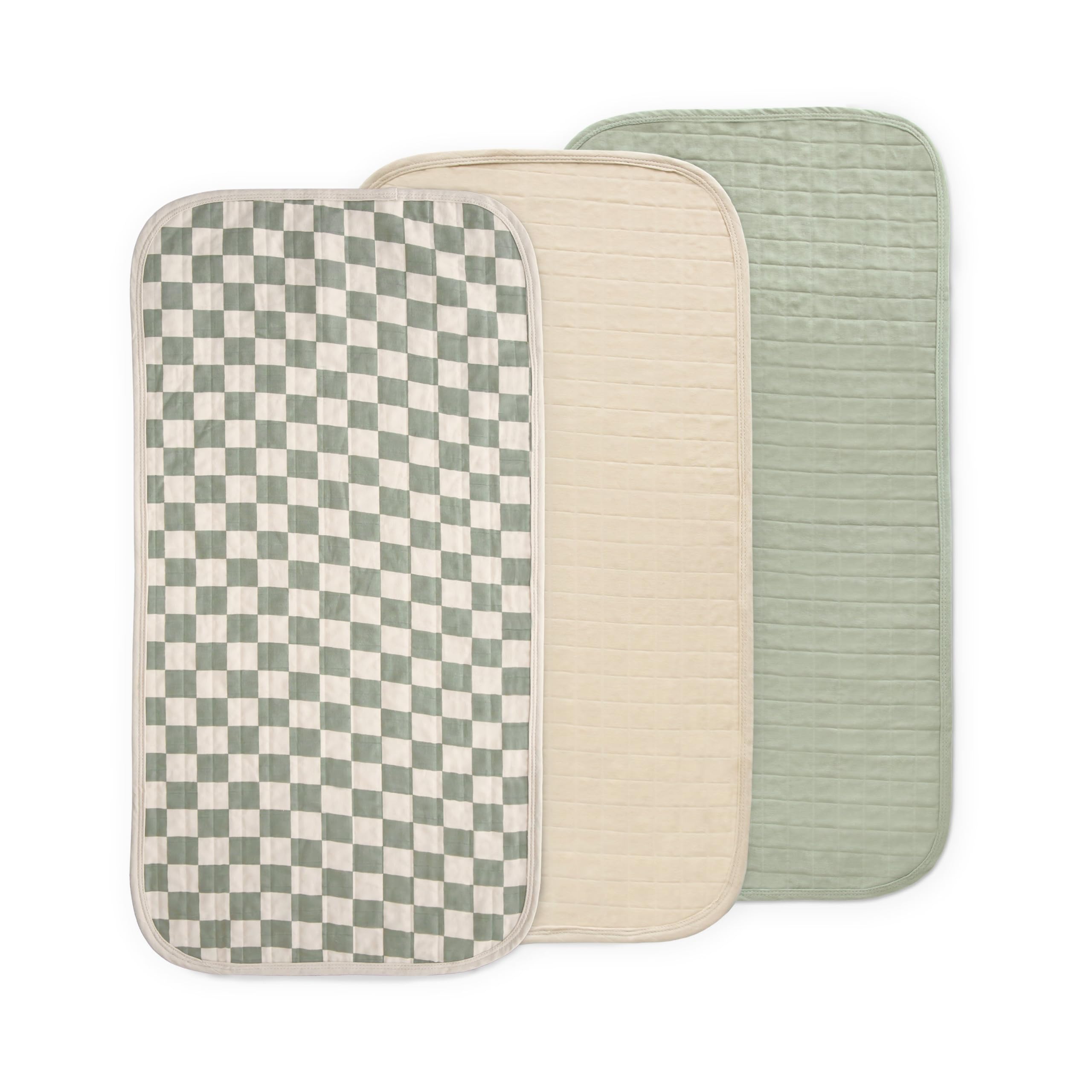
Key Features
- Size: 27.5" x 14"
- Pack count: 3 Count
- Face fabric: Organic cotton and bamboo viscose
- Water resistance: Water repellent
- Price: Midrange
Most liners look like medical supplies. These don’t. The olive check print is the sort of thing you leave on top of the changing pad when the changing pad is in the living room, and the muslin face is soft enough that it doesn’t announce itself as a barrier.
Under the print is 40% organic cotton and bamboo viscose, with a TPU layer that repels water rather than sealing it out, which is the trade for a fabric this soft. At 27.5 by 14 inches it covers a standard pad, and it folds flat enough to live in a diaper bag without bulking it up.
So it’s a lifestyle liner, and we mean that as a compliment rather than a dismissal. For the parent who wants three good-looking liners for the basket in the nursery and the bag by the door, the fabric and the print earn the premium. For a household that needs a liner to survive a blowout and a hot wash, the quilted cotton picks above do more for less.
Pros
- Printed muslin looks good left out
- Soft organic cotton and bamboo face
- Folds flat for the diaper bag
Cons
- Repels water rather than blocking it
- Air-dry only — a dryer shrinks and curls it
The liner you leave on display: pretty muslin, soft against skin, and water-repellent enough for ordinary changes rather than disasters.
Best for Compact Travel Changes
Buyockss Disposable Pads

Key Features
- Size: 13" x 18"
- Layers: 5
- Material: Cotton and polymer fluff
- Pack count: 100 Count
- Price: Midrange
Thirteen by eighteen inches, five layers, sealed on all four sides, and a hundred to the box: this is a compact disposable built for the places a changing pad isn’t. One lives in the car seat, one goes in the diaper bag, one goes under a baby on a hotel bed. The pink tint makes them easy to spot in a bag full of white baby things.
Where it falls down is coverage. Thirteen inches wide and eighteen long is the area under a baby, not the whole pad, so on a full-size changing table you will be wiping down the uncovered ends. As a travel and backup pad, though, the sealed edges and the fluff core are more protection than the size suggests, and a box this size lasts through weeks of outings. Keep a stack in the bag and save the big liners for the table.
Pros
- Sealed on all four sides
- Five-layer core, latex-free
- 13 x 18 inches fits any diaper bag
Cons
- Covers only the area under the baby, not a full pad
Buy the box for the car, the bag, and the grandparents’ house — a compact disposable with sealed edges, not a full-pad liner.
How We Tested Changing Pad Liners
To build our shortlist, I started with liners that were widely available, sized for standard changing pads, and priced so that owning a few wouldn’t feel like a splurge. We ruled out anything that felt stiff out of the package or came only in one odd size, then bought 16 liners to use at home over four months. They lived on changing tables, in diaper bags, and on the floor during frantic post-bath changes — wherever a diaper change actually happened.
During the day, we noted whether each liner stayed flat while a wriggling baby kicked and rolled, and whether it was large enough to cover the usual mess zone without hanging over the edges. At night, we checked absorbency by pouring a measured splash of water onto the surface and watching whether it spread, pooled, or soaked straight through to the pad. We also paid attention to softness, both by hand and against a baby’s bottom, and to whether the material felt flimsy or substantial after a few weeks.
Washability got its own round of abuse: we ran each liner through repeated laundry cycles with diaper cream, spit-up, and the occasional blowout, then checked for shrinking, curling corners, thinning fabric, and stains that wouldn’t lift. We compared how they held up after multiple washes against their price, since a cheap liner that dies after five cycles isn’t a bargain. The ones that scored best stayed soft, fit the pad after drying, and made the next change feel less like cleanup duty.
How to Choose Changing Pad Liners
The right liner is the one that matches your changing pad’s surface and your tolerance for laundry; everything else is a detail.
Reusable or disposable?
Start with how much laundry you’re willing to do. A reusable liner costs more up front and less over a year, and it’s the better default for the changing table you use twenty times a week. A disposable costs more per change and nothing in effort, which is why it wins for the diaper bag, for travel, and for the first few weeks when everything is happening at once.
Most households end up with both: a three-pack of quilted reusable liners in rotation at home and a pack of disposables in the bag. The mistake is buying only one kind and discovering the gap at the worst possible moment.
Measure the pad, not the baby
Coverage is where liners disappoint. Most flat changing pads run around 16 inches wide and 32 inches long, and the widest liner in this group is 14 inches, so nothing here covers a pad edge to edge. What you’re choosing is how much margin surrounds the baby.
A 13 by 27 inch liner runs the pad’s length and leaves a strip of pad at each side; a 13 by 18 inch disposable covers the landing zone and nothing else. Measure across the pad at its narrowest point and buy a liner at least that wide if you want the edges protected.
What keeps it in place
Changing pads are slick, and a liner that bunches under a wriggling baby is worse than no liner, because the mess goes where you aren’t looking. Three designs handle it: a grip backing, a strap or elastic that anchors the ends, or enough length to tuck under the pad on both sides.
Cotton and muslin liners without grip will slide, so plan to tuck them. If your baby has started to roll, buy the grip.
Wash for the backing, not the fabric
A waterproof layer dies in the dryer before the fabric wears out. Hot water and high heat are what pill a quilted face, break down a coated back, and shrink a cotton liner out of shape. Wash liners cold on a normal cycle, skip fabric softener, which coats the fibers that do the absorbing, and either hang them or tumble on low.
That’s the reason a six-pack makes sense if you plan to machine dry: you’ll always have two or three that haven’t been through the cycle yet.
Frequently Asked Questions
Do changing pad liners go over or under the pad cover?
Over it. The liner is the layer you lift off and wash, so it belongs on top of the cover, directly under the baby. If your changing pad itself isn’t waterproof, put a second liner underneath the cover as a backstop, which is cheaper than replacing a pad that has been soaked through.
How many changing pad liners do I need?
Three per changing station is the working number: one on the pad, one in the wash, one in the drawer. If you tumble dry or change a dozen times a day, double it, because six cotton liners let you skip a laundry day without running out. For disposables, one box in the nursery plus a folded stack in the diaper bag covers both jobs.
Can I use puppy training pads instead?
They’re cheaper and bigger, and plenty of parents do. But they’re built for floors: the top sheet is rougher, the backing crinkles, and they slide on a vinyl pad. Use them under a sheet or on the floor for naked-baby time, and keep a proper liner on the changing table where a baby’s skin rests against it.
Do I still need a waterproof changing pad if I use liners?
Yes. A liner covers the middle of the pad and shifts when a baby kicks; the pad is the backstop for the change where everything misses. If your pad is already waterproof, liners are about cutting down how often you wash the cover, not about adding protection the pad doesn’t have.
Final Verdict
Our default is the BlueSnail three-pack. It covers a standard pad, holds a messy change without soaking through, and comes out of a cool wash ready for the next one, and three of them keep the rotation going without a midnight load of laundry.
If you want to take laundry out of the equation entirely, keep a Peekapoo box in the bag; its 24 x 18 inch footprint covers a whole pad. And if your baby has learned to roll, the grip backing on the Moonsea liners is the difference between a liner and a heap of fabric at the end of the pad.
