This post contains affiliate links. We may earn a small commission when you buy through our links — at no extra cost to you.
Six o’clock, the baby’s already fussy, and a pot of sweet potato is steaming on the stove. That’s usually the moment parents start wondering whether a dedicated baby food processor actually earns its counter space. The good ones steam and blend in the same vessel, so a meal takes fifteen minutes instead of an hour. The bad ones leave lumps a 7-month-old can’t manage, leak, or hold onto carrot stains long after the jar is washed.
I made baby food the old way for months — steam in a pot, blend in a jar, scrape with a spatula — and never went back once a machine did it all in one container. Since then my team and I have spent six months with 12 baby food processors, from bare-bones purée makers to multi-part steamers that also warm bottles. One thing first-time buyers don’t expect: the widest jar isn’t the easiest to use — it’s whether the blade lifts out cleanly that decides if you’ll bother at 7 a.m. The picks below are the ones that never left my counter.



Best for Everyday Feeding
EVLA’S Baby Food Maker
Key Features
- Wattage: 120 W
- Controls: Touch screen
- Included: 6 reusable food pouches
- Functions: Steam, blend, puree, self-clean
- Price: Midrange
The self-clean cycle is why this one is our top pick. After a batch you add water, start the program, and the jug sees to the worst of it instead of you scraping sweet potato out of a corner at nine at night. Everything else about the machine follows the same logic: steam and blend in one vessel, few parts, nothing to pour while it’s hot.
The 120 W motor is the smallest in this group, and on food that has just been steamed that’s fine — the cooking has already done the structural work, and the blend only has to finish it. This isn’t a machine for raw carrots or a fistful of kale; it’s a machine for cooking a portion and puréeing it, which is the job you’re buying.
Operation is a touch panel with a short list of programs, and the body is small enough to leave out between feeds rather than packing away. We appreciated that most on the days when we made three small batches instead of one big one, which is how the first months of solids actually go.
Six reusable pouches come in the box, and they turned out to be the extra we used most: fill them all on a Sunday and the week’s food is portable, not just made. That’s the pattern with this machine — it removes the small frictions that have you reaching for a jar instead.
Pros
- Steams, blends and self-cleans in one jug
- Least cleanup of any machine here
- Six reusable pouches included
- Touchscreen controls with simple programs
Cons
- Costs more than the other steam-and-blend machines
We recommend it to nearly anyone starting solids: one jug steams, blends and cleans itself, and the daily time it saves at the sink beats every other machine here.
Best for Stain-Free Steaming
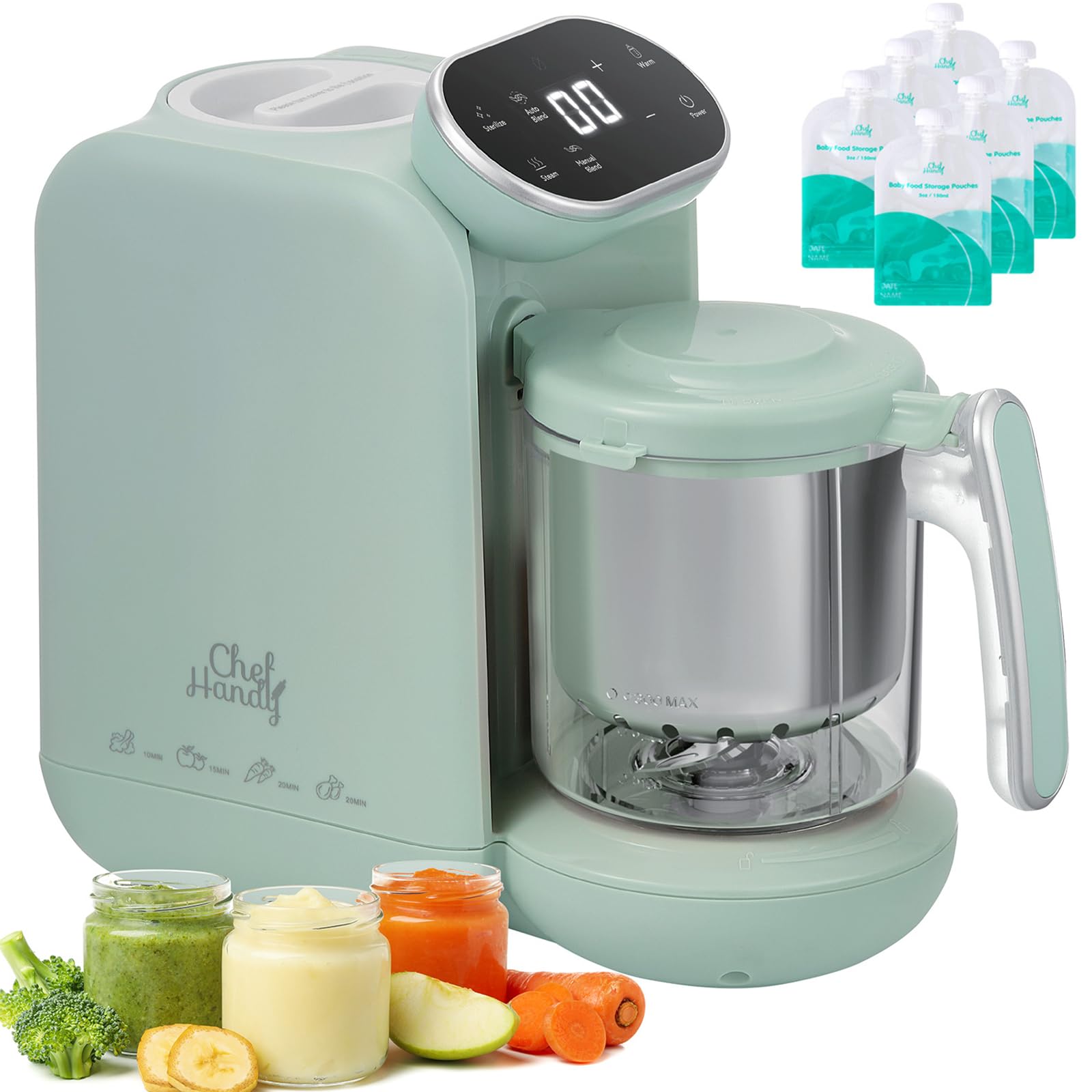
Chefhandy Baby Food Maker
Key Features
- Wattage: 300 W
- Functions: Steam, auto blend, manual blend, warm, sterilize
- Steam basket: Stainless steel
- Bowl capacity: 0.75 L
- Price: Midrange
The difference between this and our top pick comes down to what the steam basket is made of. Chefhandy’s is stainless steel, and a metal basket doesn’t take on the orange cast that plastic ones do after a sweet potato or two, or hold onto the smell of it afterward.
Inside that basket sits a 0.75 L bowl driven by a 300 W motor — mid-pack on capacity here, near the front on power — and the two blending modes are the part we rate most. Automatic does the weekday carrot-and-potato batch; manual lets you stop before a purée turns to soup, which matters once your baby wants a little resistance. It also warms bottles and sterilizes parts, extras that earn their place in the first year rather than sitting unused.
The catch is the maker’s care instructions: hand wash, not dishwasher. That’s ten minutes a day if you cook daily, and it’s the reason this sits behind the EVLA’S despite a better basket. Six pouches and a recipe guide come in the box, and it costs less than our top pick — so if the metal basket and the manual control are what you care about, the trade is an easy one to make.
Pros
- Stainless steam basket resists stains and odors
- Manual blending for real texture control
- Warms bottles and sterilizes accessories
- Six pouches and a recipe guide included
Cons
- Hand wash only, per the maker
Buy this one if you want a stainless steam basket and manual control over texture; we think it’s the better choice for anyone cooking daily who doesn’t mind hand washing.
Best for Small Kitchens
Grownsy Baby Food Maker
Key Features
- Bowl capacity: 300 ml
- Bowl material: BPA-free Tritan
- Blending modes: Auto and manual
- Price: Midrange
Three hundred milliliters is the number to sit with before you buy this one. That’s the basket, and it’s small: enough for a few days of purée for one baby, not a fortnight in a single session. If your freezer already holds a week of cubes, you’ll be running it more often than you’d choose to.
What that buys you is a machine that’s easy to live with. The bowl is BPA-free Tritan, there are auto and manual blending modes, and the body is compact enough to leave out or put away without clearing a cupboard. We like it most for the parent just starting solids who wants to cook a little, often, rather than batch-cook once a month — and it handles meat as comfortably as vegetables, which isn’t true of every small machine.
Steaming is done in an elevated basket so the food sits above the water rather than in it, and the whole thing is a sensible first machine rather than a last one. Just go in knowing the basket is plastic and the long-term record is the least settled part of the package.
Pros
- Compact enough to keep on the counter
- Auto and manual blending modes
- BPA-free Tritan bowl
Cons
- Plastic steam basket discolors quickly
- Some units stop working within six months
We like it for small, frequent batches — 300 ml is a few days of purée, and the compact body earns its place on the counter.
Best for Weekly Batch Cooking
Babymoov Duo Meal Station
Key Features
- Wattage: 500 W
- Functions: Steam, blend, defrost, sterilize, reheat, warm bottles
- Bowl capacity: 4.6 lb
- Blending speeds: 3
- Price: Premium
This is the machine for a household where baby food is a production run: twins, a stocked freezer, or a baby who has moved on to thicker food and needs volume. It’s the most expensive thing here by a distance, and it’s the only one that steams two different foods at once in separate baskets — which is precisely what the money goes to.
The 500 W motor and three blending speeds give you more texture control than anything else in this group, so you can take a first-smooth purée and later leave something with a bit of resistance in it. Add defrost, sterilize, reheat and bottle warming, removable parts that go in the dishwasher, and a lifetime warranty, and it’s easy to see where the cost went.
The trade is space and commitment: it’s a big appliance that wants a corner of counter to call its own, and it’s priced for a family that will run it hard. One baby eating a few ounces a day doesn’t need it. Two babies, or a freezer being restocked every Sunday, absolutely do.
Pros
- Steams two foods at once in separate baskets
- Three blending speeds for texture control
- Dishwasher-safe removable parts
- Lifetime warranty
Cons
- Lid and tray can crack after months of use
For twins or a weekly cook-and-freeze session, the two steam baskets and three speeds justify the outlay; we wouldn’t buy it for one baby eating a few ounces a day.
Best for Low-Cost Steam and Blend
AMZBabyChef Baby Food Maker

Key Features
- Wattage: 330 W
- Controls: Mechanical knob timer
- Functions: Steam, blend, defrost, reheat
- Bowl capacity: 2 L
- Price: Budget
If the brief is simply steam and blend, for as little as this category allows, this is the machine that answers it. The bowl is the largest here at two liters, the motor is 330 W, and everything runs off a mechanical knob with a timer rather than a menu.
That knob is either a virtue or a nuisance depending on you. There are no presets and no touch panel — you set a time and come back — which is one less thing to break and one more thing to remember. Auto shut-off and a safety lock cover the obvious risks, and the one-year warranty is worth knowing about before you buy.
Where it earns its place is capacity for the money: two liters of bowl and 330 W at the bottom of this group’s price range is a lot of appliance, and it’s the pick for someone who wants big batches without the Babymoov’s price or footprint. It’s a machine you run by feel rather than by program, and for a lot of parents that’s exactly right.
Pros
- Two-liter bowl, the largest here
- Lowest-cost steam-and-blend machine in this group
- Auto shut-off and safety lock
Cons
- Bowl seam can leak after a couple of months
- Knob and timer only, with no presets
The lowest-cost way into steam-and-blend, with the biggest bowl in the group; we recommend it for batch cooks who want simple controls.
Best for Complete Starter Kit
Nuby Mighty Blender

Key Features
- Wattage: 200 W
- Set size: 22 pieces
- Steam basket: Microwave-safe
- Bowl capacity: 15.55 fl oz
- Price: Budget
Twenty-two pieces is the pitch, and unlike most box counts this one is mostly useful: two blades, a batch bowl, a microwave-safe steaming basket, a short cup, stay-fresh lids, storage containers, a spatula and a cookbook.
The milling blade is the piece we didn’t expect to care about. Porridge, oats and cereals are exactly what a standard blender blade pushes to the side of the jug and leaves there, and having a second blade for them means those first breakfasts aren’t a workaround with a spoon.
The cookbook is organized by weaning stage rather than by recipe mood — purées for four to six months, chopped food from seven, meals from ten — which is more useful than it sounds when you’re deciding what a seven-month-old can actually handle. The 15.55 fl oz bowl is right for one baby, and the whole set breaks down into a cupboard.
For someone who wants the blending, the storage and the recipes settled in one go, that’s a fair trade. The motor is the part to keep an eye on — it’s what gives out first on these — so buy it as a workhorse for the purée year rather than something to hand down.
Pros
- 22 pieces covering blending, steaming and storage
- Second milling blade for oats and cereals
- Cookbook organized by weaning stage
Cons
- Steam basket goes in the microwave, not the base
- Jams on small batches without scraping down
A complete kit rather than a single appliance — we recommend it for the family who wants blending, storage and a recipe book sorted in one purchase.
Best for Most Functions per Inch
MOMYEASY Baby Food Maker

Key Features
- Safety: Auto shut-off and safety lock
- Wattage: 300 W
- Functions: Steam, blend, defrost, warm bottles, grind
- Water tank: Wide-mouth stainless steel
- Price: Midrange
The extras are the pitch here: steam, blend, defrost, grind and warm a bottle, all from a body measuring roughly 4.7 by 9.8 by 8.6 inches. On paper it’s the most function per inch of counter in this group, and for a small kitchen that counts for a lot.
The water tank is wide-mouthed stainless steel, which makes filling and wiping it easier than a narrow plastic reservoir, and the blade lifts out for a proper wash rather than being fished around in place. Auto shut-off and a safety lock are both there, and the steam basket sits inside the same jug the blending happens in.
Where we hesitate is reliability. Units that stop working turn up early and often enough that it’s the risk you’re accepting for this much function at this price, and the value question follows from it. Buy it for the function list if bottles and food in one machine is what you need; don’t buy it expecting the last appliance you’ll own.
Pros
- Five functions including bottle warming and grinding
- Wide-mouth stainless steel water tank
- Compact footprint for the function count
Cons
- Some units fail within the first weeks
It packs the longest function list into the smallest body, and we recommend it to parents who want bottles and food handled by one machine.
Best for Small Kitchens
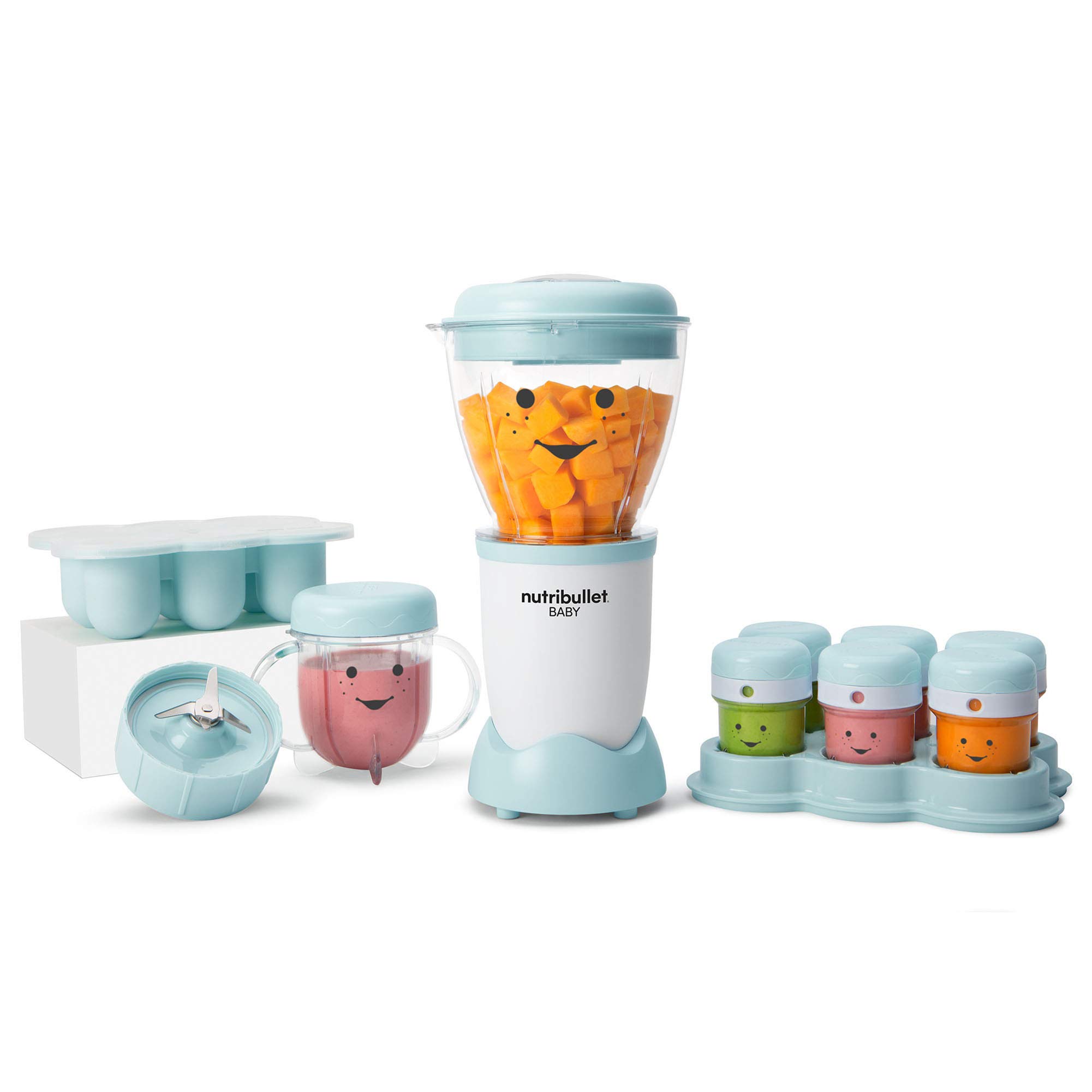
NutriBullet Baby Food-Making System
Key Features
- Speeds: 1
- Wattage: 200 W
- Included: Batch bowl, short cup, storage cups, tray
- Batch bowl: 32 oz
- Price: Budget
There’s no steamer in this box, and that’s the first thing to understand: you cook the food, then blend it. If you already steam on the stove or in the microwave, that isn’t a compromise at all. If you wanted one button to do both, it is.
What you get instead is the most thought-through storage here: a 32 oz batch bowl for bigger batches, a 12 oz handled cup, storage containers with a date dial on the lid, and a silicone tray, all dishwasher-safe. The date dial is a small thing that changes how you use the freezer, because you can see at a glance what needs eating first.
The 200 W motor and single speed are enough for cooked vegetables and soft fruit, and the footprint — about 5.4 by 5.2 by 11 inches — means it can live on a counter without taking it over. It’s the machine that fits in a small kitchen or a grandparents’ house without a negotiation.
For a second machine or a first flat, that adds up nicely. The plastic coupling under the blade is the part that wears, so treat this as a machine for the purée year rather than something to pass on to the next baby.
Pros
- Storage cups with date dial plus a freezer tray
- Dishwasher-safe parts
- Small footprint for small kitchens
Cons
- Needs scraping down for a smooth purée
Choose it if you already steam on the stove: it blends well, stores brilliantly and takes up almost nothing, as long as you accept it’s a one-year tool.
What We Put Every Baby Food Processor Through
We started with every machine we could find that steams and blends in one container, then narrowed by capacity, whether the bowl and blade are dishwasher-safe, how many parts actually touch food, and price. Jars too narrow for a spoon to reach, or blades that don’t detach, came off the list early. That left 12 units, which we ran for six months.
Each machine went through the same week: a Sunday batch of sweet potato, squash, peas, and apple; weekday single servings; and the 9 p.m. wash-up after both kids were down. We timed every batch from raw chunks to a purée a spoon holds, and noted whether we had to add water to get there — a machine that needs half a cup of liquid to smooth out a carrot is thinning the food, not blending it. We also filled each bowl, ran it, and watched the seams and lid for leakage, then pushed thick mixtures like lentil purée to hear whether the motor strained or the blade stalled.
Cleanup got timed too, by hand and on the dishwasher’s top rack, and we deliberately ran a carrot-and-blueberry batch through every machine to see which bowls were still orange or purple a week later. Over six months of near-daily use we watched for the problems that show up late: a gasket that stops seating, a blade that wobbles, a steam basket that cracks. Models that also warm bottles got their own check — how evenly they brought a chilled bottle up to temperature, and whether the extra function made the main controls harder to figure out at 2 a.m. In the end, value came down to cost per use: the ones worth keeping were still being reached for in month five.
How to Choose a Baby Food Processor
The deciding question isn’t how powerful these machines are — it’s how many parts you’ll be washing at ten at night and whether the thing is still running when your baby hits finger foods.
One jug, or two steps?
Most machines here steam and blend in the same vessel, which means no pouring hot food between containers and one less thing in the sink. A blender-only system costs less and often stores better, but you cook on the stove first. The trap is a steamer that doesn’t blend at all: it does half the job and leaves you shopping for a blender anyway. If you already own a steamer basket you like, blending is the only thing you need to buy.
Match the batch to how you feed
Bowls here run from 300 ml to two liters, and bigger isn’t automatically better. A wide bowl with two ounces of food can’t blend — the blades spin past it — so a big machine pushed to make one serving frustrates more than a small one. Match the size to your rhythm: a few days of purée at a time sits around 300 ml to 0.75 L, while a weekly cook-and-freeze for two babies wants the largest bowl you can house. Buy for the batch you’ll actually make most weeks, not the biggest one you might attempt once.
Cleanup decides how often you use it
The machine you start avoiding is the one with five parts and a narrow seal. A self-clean cycle, a jug that goes in the dishwasher and a lid without crevices matter more than another preset. Two details are easy to miss: dishwasher-safe usually covers the jug, basket and lid but not the base or blade hub, and plastic steam baskets take a permanent orange cast from carrots and sweet potato in a way stainless steel doesn’t. If discoloration would nag at you, pay for the metal basket.
Texture control as your baby moves on
First purées need smooth; by nine or ten months you want something with a bit of resistance left in it. A single-speed machine gives you one texture, and the usual fix is more water — which thins the food along with the flavor. Automatic and manual modes, or the three speeds on the Babymoov, let you stop the blend where you want it. If you plan to cook through the whole weaning year rather than for six weeks, that control is worth paying for.
The extras: bottles, sterilizing, defrost
Bottle warming, sterilizing and defrosting sell machines and get used least after the first month. They’re worth having if you’re warming a bottle every night anyway, and the Babymoov and Chefhandy handle them properly. But on the multi-function machines here, warming a bottle is the job most likely to disappoint — lukewarm rather than warm — so don’t choose on that line alone. Buy for the steaming and blending you’ll do twice a week and treat the rest as a bonus.
Frequently Asked Questions
Can I just use my regular blender or food processor?
For batches of a cup or two, often yes. The problem is small amounts: a full-size processor’s blades need food around them to work, so a single serving of sweet potato gets thrown to the sides and never touches the blade. A dedicated machine’s narrow jug is built for that quantity, and most steam in the same vessel.
If you’re making food twice a week in real batches, your blender will do. If you’re making two ounces at a time, it won’t.
Is it safe to open the lid straight after a steam cycle?
No. The food and the jug are hotter than boiling water, and the steam that comes out when the lid lifts can scald. Let the cycle finish, give it a minute to vent, then open the lid away from your face before you blend.
A safety lock that stops the machine running with the lid unseated — the Chefhandy and MOMYEASY both have one — is the feature to look for if you’ll be operating it one-handed with a baby on your hip.
How long does homemade purée keep?
Refrigerate what you’ll use within a day or two and freeze the rest in portions, using it within a month or two. Cool the food before freezing, label each container with the date, and don’t refreeze anything you’ve thawed.
A tray or a set of lidded cups portions it faster than spoons, which is where the storage extras earn their keep — the date dial on the NutriBullet Baby’s cups is made for exactly this.
Final Verdict
Start with the EVLA’S. It’s the machine that makes homemade food the easier option on a tired evening: one jug, a touch panel with a couple of programs, and a self-clean cycle that takes the job you’d otherwise do at the sink. Nothing else here is as easy to live with day to day.
Two exceptions are worth knowing. If you’re feeding twins or stocking a freezer weekly, the Babymoov’s two steam baskets and three speeds do a job the EVLA’S can’t. And if a stainless steam basket plus manual texture control matters more to you than a self-clean cycle, the Chefhandy is the better buy.
