This post contains affiliate links. We may earn a small commission when you buy through our links — at no extra cost to you.
The basal body thermometer is the least glamorous tool in cycle tracking, and it’s the one that has to perform at 5:47 a.m., before you’ve sat up or said a word. Basal body temperature moves by fractions of a degree, so a thermometer that reads to a hundredth, holds that number where you can see it half-asleep, and beeps quietly enough not to wake anyone is quietly doing real work.
My team and I spent four months taking morning readings with 14 of them, and the differences showed up in the small stuff. A backlight you can read without turning on a lamp matters more than any spec sheet suggests, and big digits beat an elegant display at that hour every time.
Worth knowing before you shop: the hundredths on the box are only half the story. You’re really buying a routine you’ll keep — a comfortable tip, memory that saves the reading when you doze off again, and, if you like charts, an app that syncs without a fight. The picks below were chosen with exactly that in mind.


Best for Daily Charting
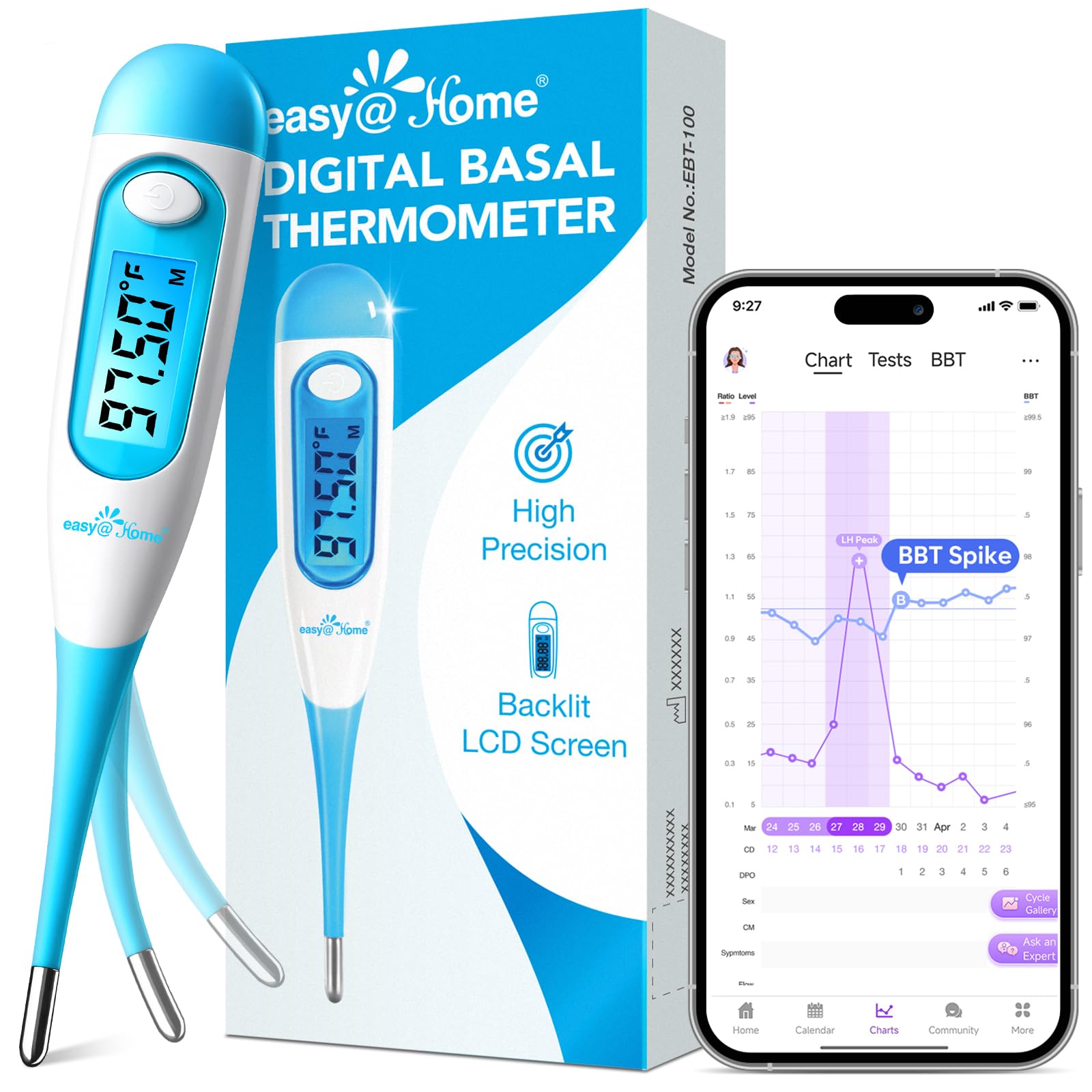
easy@Home Digital BBT
Key Features
- Memory: 30 readings
- Display: Backlit LCD
- Precision: 1/100°F
- Reading time: 90 seconds
- Price: Budget
The easy@Home EBT-100B earns the default spot because it gets the small things right: a flexible silicone tip that’s easier to hold under your tongue, a backlit screen for a dark bedroom, and 30 readings of memory for when you fall back asleep before you’ve written anything down. It reads to two decimal places, and the soft beep tells you when the 90 seconds are up.
The Premom app accepts a scan of the display or a manual entry. We didn’t mind the extra step; the memory is the real safety net. The backlight is bright enough for a dark room, and the soft beep is a gentle cue that the read is finished.
BBT is fussy: the same time, same spot, and a still tongue matter more than the extra decimal. We like that the flexible tip makes it easier to stay still for the full read. If you want a faster read or a brighter display, the iProven BBT-127 is the step up; if you want automatic charting, the Bluetooth easy@Home is the one.
Pros
- Flexible tip is comfortable to hold
- 30-reading memory saves groggy mornings
- Backlit display is easy to read in the dark
- Premom accepts scan or manual entry
Cons
- No Bluetooth auto-sync
- Backlight fades after a couple of seconds
We recommend the easy@Home for most people charting: the flexible tip, backlight, and 30-reading memory make early-morning tracking easy, and the 90-second read is a fair trade for the price.
Best for Fast Morning Reads
iProven BBT-127
Key Features
- Memory: 30 readings
- Display: Backlit jumbo LCD
- Precision: 1/100°F
- Reading time: 60 seconds
- Price: Budget
Sixty seconds is the number that separates the BBT-127 from the easy@Home top pick. The read is quicker, and the jumbo backlit display puts the two-decimal number in large digits that are easy to find at 5:30 a.m. It stores 30 readings, so you can log later.
That combination makes it the runner-up we recommend when speed and a bright display matter more than the largest track record. The BBT-127 also comes with a 100-day replacement policy, which is a useful backstop if the unit acts up. The body is plain plastic, and the beep is loud enough to wake a light sleeper, but the speed and display are the features we notice every morning.
Pros
- 60-second readings cut morning wait
- Jumbo backlit display is easy to read
- 30-reading memory covers oversleeping
- Includes a 100-day replacement policy
Cons
- Some units stop working after a few months
- No app sync; manual charting only
The iProven BBT-127 is the pick when 90 seconds feels too long: 60-second readings, a bright jumbo display, and 30-reading memory, backed by a 100-day replacement policy.
Best for Auto Charting
easy@Home Bluetooth BBT
Key Features
- Memory: Unlimited in app
- Accuracy: ±0.09°F
- Connectivity: Bluetooth to Premom
- Reading time: 1.5–2 minutes
- Price: Premium
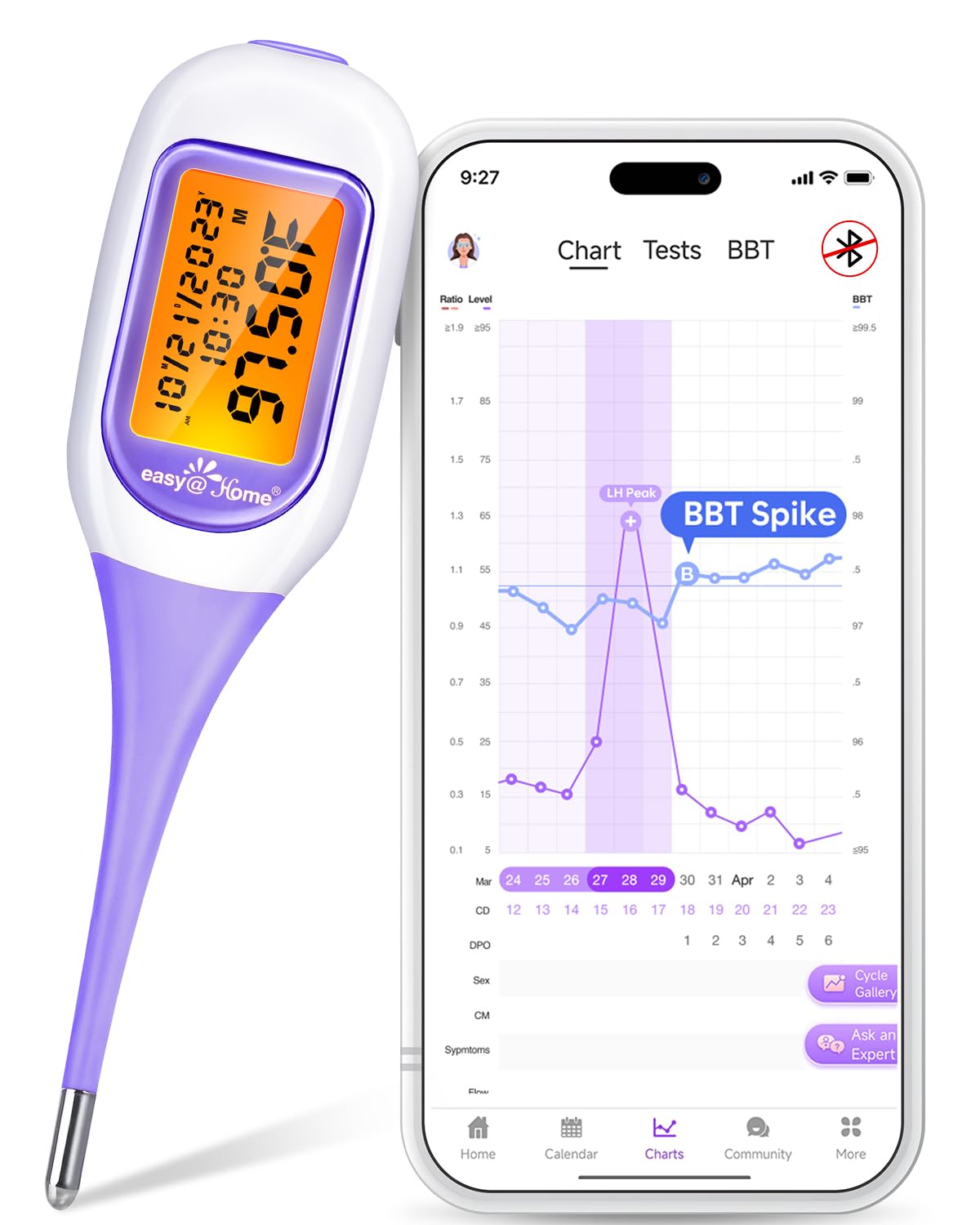
The EBT-300 is the only pick here that pairs with your phone. It sends readings to Premom over Bluetooth, and the app charts them and generates a coverline without you typing a number. That’s a genuine convenience if you tend to log your temperature hours later—or not at all.
The app is the reason to choose it: readings land in Premom and the coverline draws itself. The backlit screen and gentle beep are still there, and the cloud keeps unlimited records. It’s a more involved routine than a standalone thermometer, but the payoff is a chart that’s already built.
We recommend it for the app-first charter, not for someone who wants the simplest possible device. If you don’t mind typing a number into an app, the easy@Home top pick does the same job with a faster 90-second read. The Bluetooth model earns its place only when hands-off charting is the point.
Pros
- Auto-charts BBT and coverline in Premom
- Unlimited cloud records in the app
- Backlit screen and gentle beep
Cons
- Two-minute reading time feels long
- Bluetooth pairing can drop between uses
The easy@Home Bluetooth is for charters who want Premom to draw the coverline automatically; it’s the most hands-off option here.
Best for No-Frills Budget
iProven BBT-113Ai
Key Features
- Display: Not backlit
- Warranty: 100-day replacement
- Precision: 1/100°F
- Reading time: 60 seconds
- Price: Budget
The BBT-113Ai is the one we point to when the budget is tight. It reads to two decimal places in 60 seconds, which is the core job, and the 100-day replacement policy is longer than most here. The rest is deliberately plain.
The small tip is comfortable, and the memory recall holds the last reading if you forget to log it. There’s no app sync, so you’ll type the number into your chart. The accuracy can vary between units—some settle into a steady pattern, others bounce around—so give it a few mornings and compare the trend, not a single number.
It’s a good choice if you want to spend the least and don’t mind a manual chart. If you need a lit display, the shecare is the next step up; if you want a faster, brighter read with more support, the iProven BBT-127 is worth the extra.
Pros
- 60-second readings with two-decimal precision
- Includes a 100-day replacement policy
- Simple one-button operation is easy to learn
- Last-reading memory recall saves a step
Cons
- No backlight for dark-room reads
- Accuracy can vary between units
The iProven BBT-113Ai is the budget charter’s pick: a 60-second, two-decimal read and a 100-day replacement policy, with a plain display that keeps the cost down.
Best for Backlit Budget
shecare Digital BBT

Key Features
- Probe: Waterproof flexible
- Display: Backlit LCD
- Accuracy: ±0.05/0.09℉
- Warranty: 1 year
- Price: Budget
The shecare checks the boxes we look for first: two-decimal precision, a backlit LCD, a flexible waterproof probe, and a one-year warranty. It’s the kind of spec sheet that makes you wonder why the better-known models cost more.
That spec sheet is why we keep it in the budget conversation: you get the backlight and flexible probe without paying for Bluetooth. The app takes manual entries, and the thermometer’s memory isn’t specified, so plan to log each reading. We recommend it as a backlit spare rather than the default; the track record is thinner than the easy@Home’s, but the price is low and the flexible tip is comfortable.
Pros
- Backlit LCD for dark mornings
- Flexible, waterproof probe is easy to clean
- One-year warranty adds coverage
- Two-decimal precision for charting
Cons
- Manual app entry, no Bluetooth sync
- Memory recall not specified
The shecare is a low-cost way to get a backlit, two-decimal BBT thermometer with a flexible waterproof probe; it’s a smart budget alternative.
How We Tested the Best Basal Body Thermometers
We started by pulling every basal body thermometer we could find with a hundredth-degree readout, then filtered by the things that come up again and again in listings and reviews: a backlight, a large display, enough memory to hold at least a week of readings, and app or Bluetooth syncing on the models that offer it. That left us with 14 thermometers, which we rotated through four months of real mornings.
Testing happened where these actually live — on a nightstand within arm’s reach, used in the dark at roughly the same time each morning before getting out of bed, and tossed in a toiletry bag for the occasional trip. We timed each one from button press to beep and noted how long we had to hold still. We checked whether the display was legible without switching on a lamp, and whether the backlight stayed lit long enough to actually read the number.
For accuracy, we took back-to-back readings on the same morning and compared how far apart the numbers landed, then ran each thermometer alongside a second one across several cycles to see whether the day-to-day pattern held. We tested memory recall by doing what everyone does — leaving the reading on screen and checking hours later whether it was still stored. On the app-connected models we counted how many taps a sync took and whether the number transferred correctly. Finally, we judged build quality after months of handling: whether the tip flexed without feeling flimsy, whether the buttons still clicked cleanly, and what each one included for what it cost.
How to Choose a Basal Body Thermometer
The best BBT thermometer is the one that gets you a precise, readable number before you’re fully awake—and remembers it if you fall back asleep.
Precision and Reading Time
Basal body thermometers are not just oral fever thermometers with a different label. Charting depends on shifts of a few hundredths of a degree, so look for a readout that goes to two decimal places—0.01°F or 0.01°C. A fast 9-second fever thermometer that resolves only to 0.1°F will smooth away the very change you’re trying to see. Expect a dedicated BBT read to take 60 to 120 seconds; that’s the trade-off for the extra precision.
Reading time matters because you’re doing this before coffee, not at your most patient. A 60-second model such as the iProven BBT-127 is easier to stick with than a two-minute Bluetooth model, but a 90-second read is still workable if the rest of the design suits you. If a thermometer takes more than two minutes, be honest about whether you’ll still use it every morning.
Backlight and Memory
Most BBT readings happen in a dark bedroom, so a backlight is not a luxury. It lets you read the number without turning on a lamp or unlocking your phone. The catch is that some backlights time out quickly; read the display before you set the thermometer down. A backlight that fades after a couple of seconds is still useful, just not a night-light.
Memory recall is the other feature we prioritize. Thirty readings is enough to cover a cycle’s worth of mornings if you forget to log a few. If you tend to fall back asleep after taking your temperature, memory is the difference between a usable chart and a gap. A model without memory can still work, but you’ll need to enter the number immediately.
App Integration: Bluetooth vs Manual
Bluetooth sounds like the obvious upgrade, but it introduces a second thing that can fail before you’ve had coffee. The easy@Home Bluetooth model syncs readings to Premom and draws the coverline for you, which is genuinely useful if you chart on your phone. The trade-off is pairing: connections can drop, and you may need to reopen the app or re-pair. Manual entry and display-scanning apps are less elegant, but they have fewer moving parts.
Choose Bluetooth only if automatic charting is worth the troubleshooting. If you’re happy to type a number into an app or a paper chart, a manual model is simpler and usually less expensive. The top pick’s Premom scan is a middle ground: you still take a step, but you don’t have to key in every digit.
Probe Comfort and Cleaning
A flexible, waterproof tip is easier to hold still for a full minute and easier to clean afterward. BBT thermometers are used orally or vaginally; whichever site you choose, stay consistent from day to day so the readings are comparable. A rigid probe can work, but a flexible one is more comfortable for most people, especially in the dark.
Clean the probe with a wipe or alcohol after each use, and don’t switch between oral and rectal use without proper cleaning. A storage case is a small thing that keeps the probe clean and the thermometer from getting lost in a nightstand drawer.
Reliability and Warranty
BBT thermometers are small electronics that get used every morning, and some units drift or stop working after a few months. A 100-day replacement policy or a one-year warranty is a meaningful backstop, but it doesn’t replace a steady reading. Give a new thermometer a few mornings and compare the trend; one wild number is usually technique, not a broken device.
If readings seem stuck, replace the battery and test the thermometer against a known-good fever thermometer. A device that consistently reads far off or won’t hold a pattern is a candidate for replacement, not a charting quirk.
Frequently Asked Questions
When should I take my basal body temperature?
Take it immediately after you wake, before you sit up, talk, drink, or check your phone. You need at least three hours of uninterrupted sleep for the reading to be comparable, and you should take it at roughly the same time each morning. If you wake an hour early, take the reading and note the time; don’t skip it and guess later.
Why does my BBT bounce around from day to day?
A single high or low number is usually not the signal—sleep, alcohol, illness, travel, room temperature, and a different wake time can all move it. Look at the three-day trend and the overall pattern across the cycle. Keep the probe in the same spot, take the reading before you get out of bed, and note anything unusual so you don’t misread a one-off.
How long should I chart before I can see a pattern?
Chart every morning for at least one full cycle; a clear ovulation pattern is a sustained rise over three or more readings, not a single high number. Many people need two or three cycles to learn their own baseline. Keep the same wake time and site, and note disruptions so the pattern is easier to read.
Final Verdict
For most people charting at dawn, the easy@Home Digital Basal Body Thermometer is the one we recommend. The flexible tip, backlit screen, and 30-reading memory make the routine easier, and the two-decimal read is what you need for a usable chart. If the 90-second wait feels too long, the iProven BBT-127 cuts it to 60 seconds and adds a brighter jumbo display. Choose the easy@Home Bluetooth only if automatic Premom charting is worth the extra cost and the pairing fuss.
