This post contains affiliate links. We may earn a small commission when you buy through our links — at no extra cost to you.
The potty chair sat in our bathroom for three weeks before anyone used it for its intended purpose; mostly it held a towel, and once a snack. What finally turned things around wasn’t a sticker chart — it was a book my kid demanded we read eleven times in a row. The right one does the persuading for you, making the potty look like an ordinary, slightly funny part of the day and handing a 2-year-old the words for what’s happening.
We’ve spent the last three months reading 18 of them: board books built for chewing, lift-the-flap titles, a rhyming dinosaur story, a sound book, even a picture book or two with real paper pages. Two things surprised me. Flaps sell a book and then destroy it — a toddler who loves a flap loves it right off the page, so reinforcement matters more than flap count. And if you dread reading a book aloud, it won’t get read aloud, and a book that stays on the shelf teaches nothing.
Here are the ones that survived three months of rereading, grabbing, and one trip through the washing machine.


Best for First Potty Book
Potty (Leslie Patricelli)
Key Features
- Size: 7.01 x 0.59 x 7.01 inches
- Pages: 28
- Format: Board book
- Reading age: 1-3 years
- Price: Midrange
Word count is the first thing we check in a potty book, and this one wins by using almost none. Most spreads carry a few words and one big, funny illustration, so a 15-month-old who can’t follow a plot still gets the message: the potty is a normal thing in this house, and everybody uses it. That’s the whole job at this stage, and the book does it without a single lecture.
It’s a board book, thick-paged and rounded at the corners, which matters more than it sounds. This is a book that ends up on the bathroom floor, gets grabbed with wet hands, and rides in a diaper bag, and there’s nothing on it to break: no flaps to tear, no battery compartment to give out. We also don’t flinch when it’s handed over for a fourth reading in a row, and the same can’t be said for every title here.
What it won’t do is teach the order of things. Nobody in this book pulls down pants, wipes, or washes their hands; the child is still deciding, which is exactly right for a first book and frustrating for a 3-year-old who wants a procedure. That’s the point where we move families to Dino Potty for the steps, or to P is for Potty if the child needs something to do with their hands. As the book that starts the conversation, nothing here beats it.
Pros
- Few words per page suit a 1-year-old
- Board pages survive bathroom handling
- Funny enough that parents don’t mind rereading
- Starts the potty conversation early
Cons
- No step-by-step routine for older toddlers
The one we tell every family to buy first: a handful of words per page, a board-book build that shrugs off wet hands, and a joke that makes the potty ordinary instead of scary.
Best for Song-Led Routines
Daniel Tiger’s Potty Time!
Key Features
- Size: 5.75 x 0.75 x 8.75 inches
- Pages: 10
- Format: Sound board book
- Reading age: 1-3 years
- Price: Budget
The buttons play pieces of the Daniel Tiger potty song, including the flush-and-wash line, and that’s the whole reason this one earns a place. A toddler who knows the tune from the show hears it in the bathroom and starts narrating their own routine without being told twice. The book is small, roughly the size of a thin paperback, with pages thick enough to take a shove from a 2-year-old.
Ten pages goes fast, and that’s the trade-off. When a child is bored on the potty, the buttons buy another minute or two, which in our testing is often the difference between a sit and a stand, and the story lands on washing hands, the step everyone skips. Beyond the sound effects there isn’t much book, and the module is the weak point: the volume runs louder than we want in a small bathroom, and a hard drop can silence the buttons for good.
If your child has never watched the show, the song is just a jingle, and the simpler Potty board book does more teaching. In a Daniel Tiger house, this is the one that gets carried to the bathroom and pressed until the tune is stuck in everyone’s head, and that repetition is the mechanism. The routine sticks because the song does.
Pros
- Song ties the routine to something familiar
- Small enough for a toddler’s lap
- Ends on handwashing, the step kids skip
- Short enough for a wiggly child
Cons
- Buttons can die after a hard drop
- Volume runs loud in a small bathroom
Buttons, a familiar tune, and ten pages that fit a lap: our pick when a child already knows the song and needs the routine attached to something they love.
Best for Squirmy Toddlers
P is for Potty!
Key Features
- Size: 7.99 x 0.31 x 9.02 inches
- Pages: 12
- Format: Lift-the-flap board book
- Reading age: 1-3 years
There’s something to lift on nearly every spread, a door, a cabinet, a roll of toilet paper, and that small physical job is what holds a squirmy child on the seat. Twelve pages isn’t many, but each one has a flap, so a potty break gets filled with hands and not just words.
That’s the reason to buy this one: in our testing, the hands-busy factor bought more sit-time than any amount of encouragement, and Elmo and the other characters make the potty look like something their friends already do. Where it loses ground is the reading. This is a longer, chattier story than the board books here, and the vocabulary runs ahead of a young 2-year-old, so plenty of spreads need a parent paraphrasing on the fly.
It’s also a physically bigger book, around eight by nine inches, which is fine on an adult’s lap and clumsy in small hands, and the flaps themselves are thin enough that a determined toddler can tear one. None of that stopped it from being one of the most-requested titles in our group; we just don’t start a 1-year-old on it. Save it for the child who is already sitting and needs a reason to stay.
Pros
- Flaps on nearly every spread hold attention
- Familiar Sesame Street characters
- Handwashing folded into the story
- Long enough to fill a potty break
Cons
- Text is long and above a young toddler’s level
- Thin flaps can be torn
The flaps do the work: a toddler who won’t sit still for a story will sit for Elmo, and there’s enough to lift here to fill a real potty break.
Best for Learning the Steps
Dino Potty
Key Features
- Size: 7 x 0.7 x 6.9 inches
- Pages: 18
- Reading age: 2-3 years
- Price: Budget
If you want a book that teaches the order of operations, this is the one we hand over. A small dinosaur works through the whole sequence in rhyme, pants down through washing hands, and it’s one of the few titles here that tells a child how to relax their body so something can actually happen.
The rhyme is simple enough to read aloud half-asleep at six in the morning, and eighteen pages is a good length for a young 2-year-old: long enough to cover the steps, short enough that nobody bails halfway through. The character is gender neutral, which we appreciate in a category where so many titles split by girl and boy.
The art is bright and dinosaur-forward, the hook for a kid who won’t pick up a book with a baby on the cover, and the tone never makes a child feel behind. It doesn’t have the comedy of the Patricelli board book or the star power of Ms. Rachel, and it doesn’t need either. This is the one we reach for when the goal is teaching the mechanics rather than selling the idea.
Pros
- Walks through every step in order
- Gender-neutral character and language
- Simple rhyme reads aloud easily
- Good length for a 2-year-old
Cons
- Aimed at ages 2 and up, so it’s too much for a 1-year-old
The clearest how-to in the group: a small dinosaur rhymes through pants down, sit, relax, wipe, flush, and wash, and a 2-year-old can follow every step.
Best for Anxious Toddlers
Potty Time with Bean
Key Features
- Size: 7.44 x 0.75 x 7.5 inches
- Pages: 32
- Format: Board book
- Reading age: 2+ years
The tone is the selling point. Ms. Rachel writes to a toddler the way she talks to one on screen: short sentences, plenty of reassurance, no rush. Bean’s wobbliness about the potty is treated as an ordinary thing to feel rather than a problem to fix, and that framing is what makes a nervous child willing to try.
Thirty-two pages is on the long side for this age, but the language moves, and the tips for the grown-up at the back are the most practical pages in any book here, the kind of guidance that usually takes a whole parenting book to find. We were also pleased by how solid the little book feels: a board book with a hand-friendly trim, gentle enough to read at bedtime as well as on the potty.
What it isn’t is a manual. There’s no walk-through of wiping and washing, so a child who wants the exact steps is better served by Dino Potty or Let’s Go to the Potty!. What this one gives you is the emotional half of the job, which is usually the half that stalls. A child who has stopped being scared of the potty tends to get on with it.
Pros
- Gentle, reassuring language for anxious kids
- Practical potty tips for parents at the back
- Simple enough for a 2-year-old to follow
- Sturdy board book with an easy trim
Cons
- Story, not a step-by-step guide
Ms. Rachel’s tone does the heavy lifting, short patient sentences that treat a nervous toddler as normal, plus a page of practical tips for the grown-up at the back.
Best for Poop Reluctance
Everyone Poops
Key Features
- Size: 8.6 x 0.38 x 9.6 inches
- Pages: 36
- Format: Picture book
- Reading age: 1-3 years
- Price: Premium
Before you buy, know what’s on the page: the drawings are anatomically correct, and some of them show animals and children in the act. That’s the line that divides families. If you keep books modest, this isn’t the one. If you don’t mind, no book here does a better job of defusing the idea that pooping is strange, private, or something to hold in.
That’s the real use case. A child who pees on the potty but saves a bowel movement for naptime doesn’t need a procedure; they need proof that everybody does it, and the book makes that argument page after page as a joke rather than a lesson. We found the humor lands with the adult reading it too, which helps on the ninth repetition of an afternoon.
It’s a picture book, larger and thinner than the board books here, so it works as a read-aloud rather than a bathroom toy. There are no steps, no wiping, no handwashing, and no attempt to be a training manual. Buy it beside a practical title, not instead of one, and the pair covers more ground than either does alone.
Pros
- Normalizes pooping as a fact of life
- Humor that adults don’t tire of
- Useful for a child who withholds
Cons
- Anatomically correct drawings put some families off
Not a how-to, a funny, blunt case that everybody does it, which is exactly what a toddler who holds a bowel movement needs to hear.
Best for Thorough Walk-Throughs
Let’s Go to the Potty!

Key Features
- Size: 8.25 x 0.37 x 8.25 inches
- Pages: 50
- Reading age: 2-3 years
Fifty pages is a lot of book for a 2-year-old, and that’s the honest trade-off: what the length buys is the most complete walk-through in this group. A child, a family, a potty chair, and a rhyme that covers sitting, waiting, wiping, flushing, and washing, plus a song kids pick up after a couple of reads.
We found the illustrations clear enough to talk through, the kind where you can point at a page and ask what comes next, and the repetition is the point. A child who has seen the same spread five times knows the order without being coached. It suits a 2 1/2- or 3-year-old with the patience for it; for a young 2-year-old, or a child who shuts the book after two pages, Dino Potty covers the same ground in eighteen.
We also found it reads aloud well, which matters when a toddler asks for it on repeat; the rhyme keeps the pace up even when the page count doesn’t. Think of it as the thorough option rather than the first one. Start with something shorter, then move here once your child is sitting and wants to know what happens next.
Pros
- Complete, step-by-step sequence
- Song toddlers memorize and sing
- Clear illustrations to talk through
Cons
- Long at 50 pages for a young toddler
The most thorough walk-through here, fifty pages of rhyming steps and a song, and a better fit for a patient 3-year-old than a wiggly 2-year-old.
Best for a Girl Character
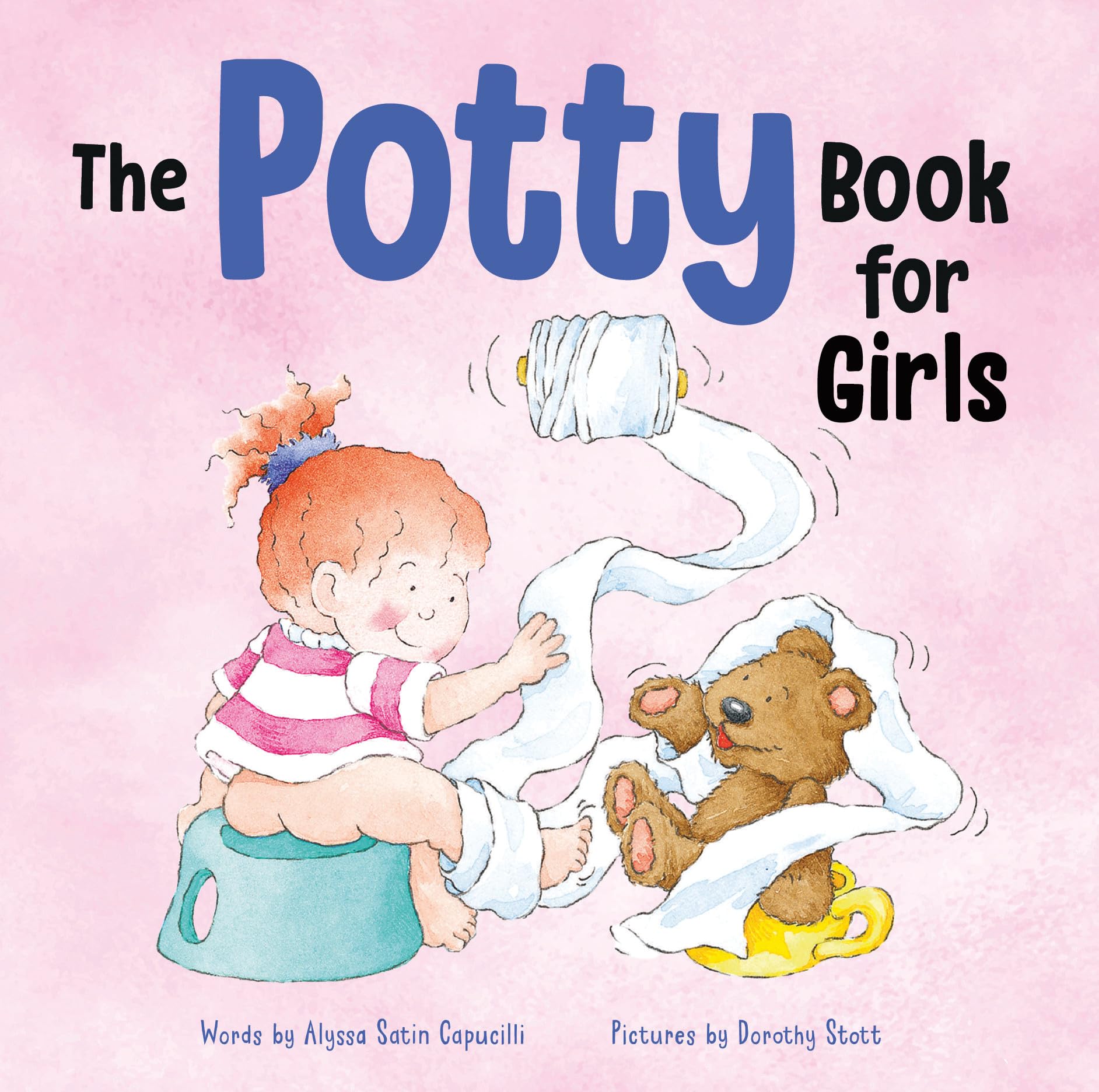
The Potty Book for Girls
Key Features
- Size: 6.75 x 0.35 x 6.69 inches
- Pages: 40
- Reading age: 1-3 years
- Price: Budget
Hannah is the reason this one works. She’s a specific child with a stuffed animal, a family that cheers her on, and a pair of pants she’s pleased with, and a toddler who sees herself in the character is more willing to try. This is the pick when your daughter wants a story about a girl rather than a gender-neutral dinosaur.
Forty pages sounds long, but the rhyme carries it, and the illustrations show the mechanics clearly enough that a child can narrate them back: pants down, sitting, wiping, washing. We found it reads older than the board books here, with a sweet spot around 2 1/2 to 4, so a 1-year-old will mostly be in it for the pictures. The small square trim makes it easy to hold on a lap.
What we appreciated most is the encouragement built into the story. Hannah’s family treats each attempt as a step forward, and the book ends with her in underwear and pleased with herself, which is the arc a child takes away. If a girl-specific book isn’t what you’re after, the Patricelli board book and Dino Potty are both gender neutral and shorter.
Pros
- Rhyming story a child can follow
- Illustrations show the actual steps
- Encouraging family dynamic
- Small square trim is easy to hold
Cons
- Suits 3- and 4-year-olds better than 1-year-olds
Hannah’s rhyming path from diapers to underwear is the warmest read here, and the one we hand to a girl who wants a character to copy.
Best for Diaper Refusals
Big Girl Panties

Key Features
- Size: 7.01 x 0.51 x 7.01 inches
- Pages: 24
- Reading age: 1-3 years
- Price: Midrange
There is no potty in this book. It’s a rhyming celebration of the move from diapers to underwear, with only babies wear diapers as the refrain, and it works on one specific child: the girl who can use the potty but doesn’t see why she should give up a diaper to do it.
For that child, the identity pitch lands harder than any step-by-step title, because the argument isn’t about skill, it’s about being big. We treat it as a companion rather than a standalone: read it in the week you plan to switch, pair it with a pack of underwear, and let the book do the selling.
It rhymes well enough to survive a week of rereading, and it slips in colors, patterns, and days of the week along the way, which gives a child something to point at beyond the message. The limits are real, though: nothing about wiping, washing, or what actually happens when she sits down, and the whole thing is written for girls. If your daughter needs the mechanics, start with Dino Potty and use this one for morale in the last stretch before the diapers go away.
Pros
- Refrain gives a child a reason to switch
- Rhyme and bright pictures hold attention
- Slips in colors, patterns, and days of the week
Cons
- No potty scene or step-by-step guidance
A motivational rhyming book, not a how-to: it sells the switch to underwear, and it works on a girl who’s capable but not yet willing.
How We Read, Reread, and Stress-Tested 18 Potty Training Books
I started with a long list of roughly 40 titles: catalog bestsellers, books that come up repeatedly in parenting forums, and the hand-me-downs friends pressed on me. I dropped anything too wordy for a 2-year-old, anything out of print, and anything that read like it was written for the parent instead of the kid. What remained was a deliberate mix — board books and paper pages, lift-the-flap and plain, step-by-step guides and straight stories, plus one sound book. That left 18, which my family lived with for three months.
Reading aloud is the whole ballgame. I read every title at least a dozen times — at bedtime, in the car, and, most tellingly, mid-sit on the potty — and noted where the rhyme tripped me up, whether there was an actual story with a beginning and an end or just a string of scenes, and whether I minded being asked for it again. Any book I quietly slid to the bottom shelf got marked down for readability, no matter how nice the pictures were. Illustration quality I judged by my kids’ behavior: did they point at the page and name things, or flip past the art to get to the end? The books they found cutest were also the ones they asked for by name.
For content, I watched for the full sequence — pants down, sit, wipe, flush, wash hands — and whether my toddler started narrating those steps on her own or asked to sit down after a reading. I also noted how accidents were handled, since a book that treats them as normal and survivable does more for a nervous kid than one that skips straight to success.
Then I handed the books over. Flaps got opened by toddlers rather than adults, and I counted how many were still attached after a month of unsupervised use. The sound book was pressed a few hundred times to check button resistance, whether the speaker stayed clear over a noisy room, and whether small thumbs could work it alone.
How to Choose a Potty Training Book
What makes a toilet training book worth its shelf space is the job you need it to do this month, not the number of stars beside it.
Match the book to the job you have
A potty book does one of three things: it introduces the potty to a child who has never used one, it teaches the sequence step by step, or it talks a reluctant child into the idea. Those are different books. An introduction needs few words and big pictures, a how-to needs a clear order of events, and a motivational story can skip the potty entirely and still do its work.
Decide which of the three you’re short of before you shop. A shelf of introductions won’t teach a child to wipe, and a step-by-step book handed to a toddler who is still frightened of the bathroom is homework nobody asked for.
Count the words on a spread, not the pages
Page count misleads. A 12-page lift-the-flap book can carry more reading than a 28-page board book with four words per spread, and the book a toddler can use alone is the one with a sentence or less per page. The Patricelli board book on this list is the shape to look for: few words, one picture, done.
Preview a middle spread before you buy. If it runs past three sentences, an adult is doing the reading, which is fine for bedtime and wrong for a child who needs something to do with their hands while they sit.
Know what flaps and buttons do, and what breaks
Interactivity isn’t decoration; it buys sit-time, and sit-time is where training happens. It also breaks. Lift-the-flap pages tear with rough handling, and a sound book that takes a drop can lose its buttons for good.
If you buy a sound book, press every button when it arrives, check the battery compartment is screwed shut, and keep spare coin or button cells well out of reach. A torn flap is annoying. A dead sound module just turns the book back into a book.
When the obstacle is specific, buy for the obstacle
Most training problems are narrower than needs a potty book. A child who pees happily but holds a bowel movement needs proof that pooping is normal. A frightened child needs reassurance more than instruction. A child who can use the potty but won’t surrender the diaper needs a reason, which is a different book again.
Name the obstacle first, then buy one book that addresses it and one general title. Everything else can wait until something changes.
Frequently Asked Questions
When should we start reading a potty book to our toddler?
A few weeks before you plan to start training, not the day you retire the diapers. Read it during the day with clothes on, at bath time or whenever your child already sits down, so the potty is familiar before anything is expected of them.
If your child is in daycare, use the same words their teachers use. Matching the two routines is worth more than any single book.
Where should the potty book live?
Keep one short board book in a basket beside the potty and a longer story on the bedtime shelf; they do different jobs. The bathroom book is a reason to sit, so rotate it every couple of weeks, because a book that’s always there stops being a reason.
Expect to read the bathroom one a dozen times a day, and choose it with that in mind.
What if our toddler won’t sit still for a book on the potty?
Try it outside the bathroom first. Read the book in the living room, act it out with a stuffed animal, and let your child turn the pages or work the flaps. Once the book is a known quantity, it becomes something to hold while they sit.
For a child who won’t sit at all, a lift-the-flap or button book does more than a story they have to follow.
Final Verdict
Start with Potty by Leslie Patricelli. It’s the shortest, sturdiest, funniest book in this group, and the one that makes the potty a normal object in the house before a child is asked to do anything with it.
Once your child is actually sitting and wants to know what comes next, Dino Potty covers the whole sequence in eighteen rhyming pages, and Let’s Go to the Potty! goes deeper for a patient 3-year-old. If the sticking point is a bowel movement rather than the potty, Everyone Poops is the title to add.
