This post contains affiliate links. We may earn a small commission when you buy through our links — at no extra cost to you.
The 2 a.m. sheet change is its own ritual: strip the bed, rinse the pajamas, coax a half-asleep kid back under a dry blanket. A bedwetting alarm tries to end that cycle instead of just cleaning up after it, teaching the body to wake before the sheets get wet. The trick is finding one loud enough to wake a deep sleeper and comfortable enough that a kid doesn’t peel it off in the dark.
We’ve lived with 12 of them over the past six months, clipping sensors to underwear, tucking pads under sheets, and resetting after more false alarms than I care to admit. Sensor style turned out to matter far more than the sound menu: a clip that shifts half an inch or a pad that bunches when a kid rolls will sound off on a dry bed at 3 a.m.
Volume matters just as much: some of these could wake the neighbors, others barely carry into the next room. Below are the ones that earned their place, wired and wireless, for kids who wear a sensor and kids who sleep on one.


Best for Most Families
DRYEASY Bedwetting Alarm
Key Features
- Power: AAA battery
- Sounds: 6, with random shuffle
- Volume: 4 levels, to 85 dB
- Alert modes: Sound, vibration, or both
- Price: Budget
The least expensive alarm in this guide is also one of the most capable: six selectable sounds (or all six on shuffle, so a child doesn’t learn to sleep through one familiar tone), four volume steps reaching 85 dB, and sound, vibration, or both. That combination is why it’s our top pick. Nothing else here costs less, and nothing else has as much behind it.
Loudness matters more than most parents expect. For the first week or two the alarm is usually waking you, not your child; the link between the noise and a full bladder is what gets built over the weeks after that. We were struck by how much of the early work lands on the adult, which is why a range from quiet up to 85 dB is more useful than one blaring setting. Start loud, then dial back as your child begins waking on their own. Vibration-only is the mode for a shared room.
The alarm clips to a pajama collar and the sensor to the underwear, joined by a lead — the corded arrangement the wireless picks here exist to replace. At 2 ounces it’s light enough not to drag at a collar, and there’s no second device to remember or charge. Two things to know going in: the clamp takes practice to fasten, and the first dry stretch tends to arrive over weeks rather than days, so plan on a run of broken nights before the good mornings show up.
One detail we appreciated: the controls are touch-operated, so switching it off in the dark doesn’t mean hunting for a button at the collar of a squirming child.
Pros
- Least expensive alarm in this guide
- Six sounds with a random shuffle option
- Four volume levels up to 85 dB
- Vibration-only mode for shared rooms
Cons
- Deep sleepers may need a parent to rouse them
- AAA battery, no rechargeable option
We tell most families to start here: the least expensive alarm in this guide, with a loud, adjustable alert and six sounds that rotate so a child can’t sleep through the same chime.
Best for No-Wire Setups
DRYEASY Plus Wireless Alarm
Key Features
- Setup: Wireless, bedside receiver
- Sounds: 6
- Alert modes: Sound, vibration, or both
- Wireless range: 30 meters
- Price: Midrange
Nothing on your child’s body makes noise. The sensor clips inside the underwear and transmits to a receiver you set on the nightstand, so the alarm sounds next to your pillow instead of on your kid’s shoulder. Rated range is 30 meters, comfortably more than a bedroom and a hallway.
We think that arrangement is the reason to pick this one over the corded model: in the early weeks, you’re the one getting up. A receiver at your bedside means you hear the alarm the moment your child does, and you can be there to walk them to the bathroom while the habit forms. It’s the difference between training that happens with you and training that happens to a child alone in the dark, and it’s why this is our wireless pick.
The rest is familiar: six sounds, four volume levels, 85 dB at the top, and sound, vibration, or both. Vibration-only is the setting we prefer in a shared room, where a chime loud enough to wake a deep sleeper will wake a sibling too. It runs on two AAA batteries, and the sensor fastens with the same toggle clamp, so the nightly routine is one you already know.
Plan for the receiver’s placement, not just its settings. Within earshot is the whole point, and a nightstand across the room is fine while a hotel desk on the far side of a suite is not.
Pros
- Nothing worn on the body makes noise
- 30-meter wireless range to the receiver
- Six sounds and four volume levels
- Sound, vibration, or both
Cons
- Two AAA batteries to keep stocked
- Costs a premium over the corded model
Buy this when nobody wants a wire in bed: the receiver sits by your pillow, and we think it’s the pick for parents who will be doing the waking for the first few weeks.
Best for First-Time Kits
Wet-Stop3 Kit
Key Features
- Bed pad: Waterproof, washable, reusable
- Age range: Child to adult
- In the box: Chart, star stickers, AAA batteries
- Alarm tones: 6 plus vibration
- Price: Midrange
Most alarms here assume you’ve already solved the mattress problem. This one arrives as a kit: alarm unit, clip-on sensor, waterproof washable bed pad, reward chart with star stickers, two AAA batteries, and a link to a bedwetting book. We like that for a first attempt, because a wet night in week one doesn’t turn into a load of laundry before dawn.
The pad is the quiet hero. It goes under the sheet and absorbs what the alarm is reacting to, so the mattress and the rest of the bedding stay out of it. It’s reusable, and the care instructions are short — no bleach, no ironing, no dry cleaning. Six tones plus a vibration alert give you a choice in how the wake-up sounds, and vibration alone works in a shared room.
The chart is the piece we didn’t expect to care about. A sticker after a dry night is a reward that arrives the next morning, long before the habit is finished, and it turns a six-week project into something the child is working on rather than something being done to them. The maker lists this kit for children through teens and adults, a wider range than anything else here.
If you already own a decent waterproof pad, the corded DRYEASY does the same job for less. If you’re starting from nothing, this is the purchase that saves you a second one.
Pros
- Alarm, pad, chart, and stickers together
- Waterproof pad protects the mattress while training
- Six tones plus a vibration alert
- Listed for children through adults
Cons
- Pad needs washing after every wet night
Our pick when you want the whole kit in one box: alarm, sensor, waterproof pad, chart, and stickers, so an accident doesn’t soak through to the mattress.
Best for Guided Training
TheraPee Bedwetting System
Key Features
- Sensor: No-wear bed pad
- Program: Online sessions, videos, tracking
- Warranty: 1 year on alarm unit
- Certification: FDA registered, CE marked
- Price: Premium
This is the pick for a child who won’t keep a clip in their underwear. Nothing is worn: a washable bed pad with a cable to the control unit senses moisture, and the alarm sounds from the unit beside the bed. It’s also the only system here that comes with a coaching program, and a good share of what you pay goes to the software rather than the hardware — videos, exercises, and progress tracking meant to be worked through over several weeks.
We recommend it for a specific family: one where the clip has already been a fight, or one where a parent would rather follow a plan than build a routine from scratch. The program is the differentiator. It turns nightly waking and coaching into a sequence with steps and a chart, which takes some of the emotional weight off the adult and gives the child something to own. The alarm unit carries a one-year warranty, and the device is FDA registered and CE marked — more paperwork than most listings here offer.
Sensitivity is the setting to get right. The pad can react to a very small amount of moisture, so start at the lowest sensitivity and raise it only if a real accident gets past the alarm undetected. That single adjustment is the difference between a useful alarm and one that wakes the house for nothing.
Pros
- No clip or sensor to wear
- Step-by-step online coaching program
- FDA registered with a one-year warranty
- Washable bed-pad sensor
Cons
- Online account and video sessions required
- Most expensive system in this guide
We recommend it for the family whose child won’t keep a clip on, and who would rather follow a step-by-step program than invent a routine; it’s the biggest investment here.
Best for Travel and Camp
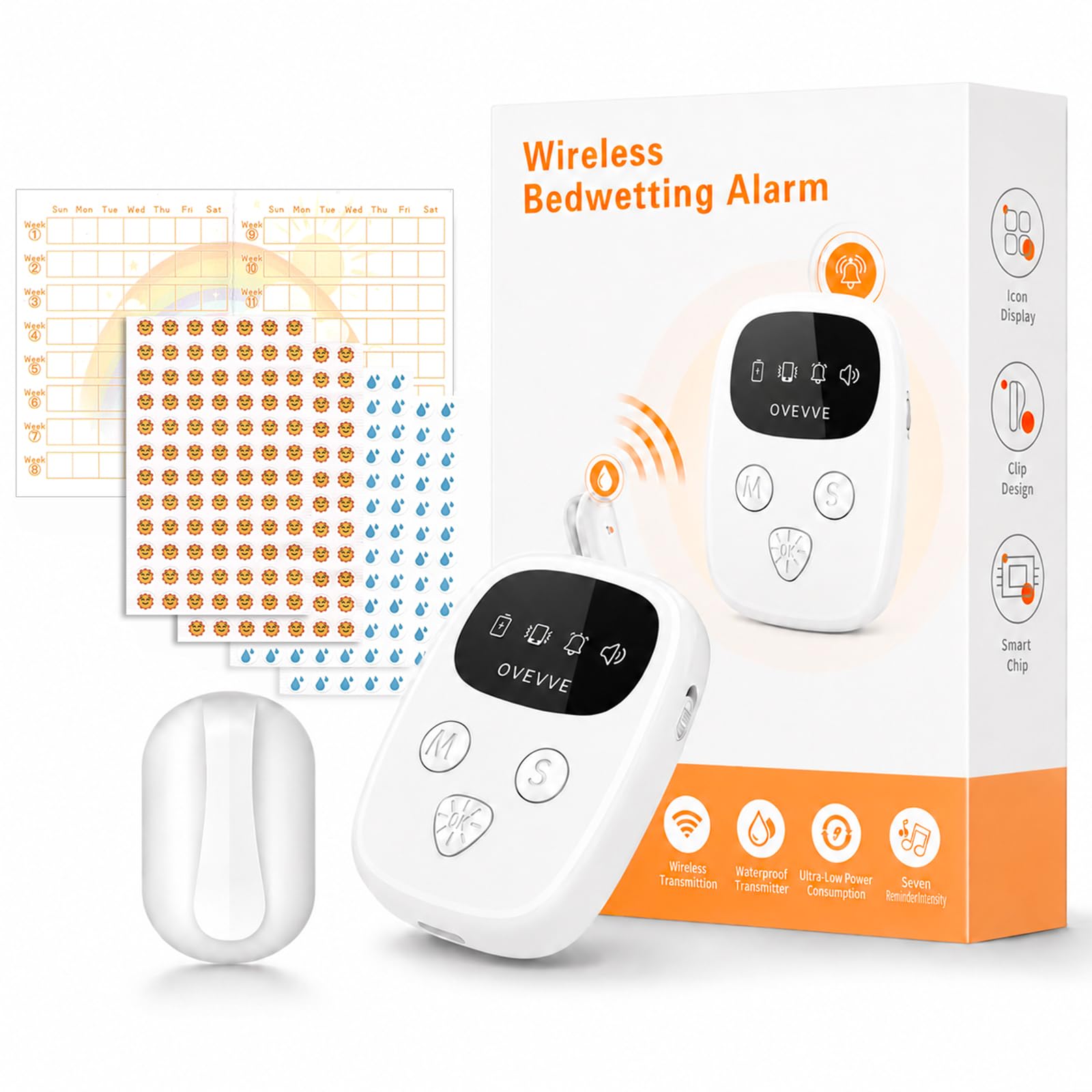
ovevve Wireless Bedwetting Alarm
Key Features
- Alerts: 7 melodies, 3 modes
- Extras: Progress card and stickers
- Sensor: Wireless, waterproof
- Charging: USB-C, 5V
- Price: Premium
Two design details set this one apart: the transmitter that clips inside the underwear is fully waterproof, and the receiver recharges over USB-C from any 5-volt phone adapter. Those are the two weak points of clip-on alarms — a sensor that gets soaked every time it works, and a receiver that dies at bedtime.
Waterproofing is the detail that matters most in practice. The sensor is going to get wet, and being sealed against it means a wet night doesn’t leave you wondering whether the thing will still work in the morning. The receiver is compact and tops up from a charger you already own, so the nightly routine is clip, switch on, plug in. Seven melodies and three modes, including vibration, cover the same ground as the DRYEASY alarms, and a progress card and stickers are in the box.
What you’re paying for is the newest design in the group. The alarms it’s priced against have years of results behind them, and that history is worth something when you’re signing up for weeks of broken sleep. Take this one if a sealed sensor and a receiver you charge rather than feed batteries are worth the difference to you; take the corded DRYEASY if you want the surest bet.
Pros
- Fully waterproof sensor
- USB-C rechargeable receiver
- Seven melodies and three modes
- Progress card and stickers included
Cons
- Priciest clip-on alarm here
- Receiver charges instead of taking spare batteries
A good buy for camp bags and shared rooms: the sensor is sealed against the wetting it’s built to detect, and the receiver charges from any phone adapter. It’s the priciest clip-on here.
How We Chose and Tested Bedwetting Alarms
We started with every alarm a family can buy without a prescription, then narrowed to 12 that covered the real spread: clips that go in underwear, pads that go under the sheet, and sensors that never touch the child at all, in both wired and wireless versions. Anything that needed a proprietary pad every month, or an app to work at all, came off the list. Each unit went into a home with a child between 5 and 10 who wets the bed most nights, and stayed for six months of ordinary bedtimes, sleepovers, and the occasional stomach bug.
The first night was a setup test. We timed how long one adult needed to attach the sensor in a dim room, then had a half-asleep adult try to re-clip it after a 2 a.m. wake-up to see whether it could be done by feel. We measured loudness at the pillow and from the next room with the door shut, and noted whether it woke the siblings; two alarms were loud enough that families asked us to turn them down. Then we tracked wake-up time, counted every false alarm, and logged each night a sensor slipped or a unit shut itself off early.
Heat and comfort got their own check. Kids run warm in summer, so we watched for sensors that triggered on sweat or left marks by morning, and asked families whether the child still agreed to wear it in week three. Units got dropped, tugged in sleep, and twice sent through the wash. At the end of six months we set each alarm’s price against the number of dry nights it produced, since reliability beats any feature list.
How to Choose a Bedwetting Alarm
An enuresis alarm only works if your child will wear it and you will hear it, so start with the sensor and where the sound lands rather than with the feature list.
Start With the Sensor: Clip or Pad
Two designs cover this category. A clip-on sensor fastens inside the underwear and fires on the first drops, which is the earliest warning you can get and the version that best teaches a child to respond. A bed pad sits under the sheet and senses moisture across a wider area, with nothing attached to the body. Pads suit a child who won’t tolerate a clip; clips suit a child who needs the alarm tied to the exact moment it happens. Choose on tolerance first and everything else second.
Decide Where the Alarm Should Sound
An alarm clipped to pajamas rings at the child’s ear; a wireless receiver sits on your nightstand. For the first weeks the adult is usually doing the waking, so a bedside receiver earns its place — the DRYEASY Plus is rated to reach 30 meters, enough for a room across the hall. The cost is a second device to keep track of, and it has to live within earshot every single night.
Match the Sound to Your Sleeper
Six tones that rotate at random beat a single favorite chime, because a child who hears the same sound nightly learns to sleep through it. Look for several volume steps with a top end around 85 dB — what both DRYEASY alarms list — so you can start loud and dial back as your child begins waking on their own. A vibration setting, alone or alongside sound, is what makes a shared bedroom workable.
Practice the Clip Before Bedtime
The clamp is the least glamorous part of a clip-on alarm and the most likely to cause a standoff at bedtime. Practice in daylight: fasten the sensor where the first drops will land, then let your child put it on themselves a couple of times before the first real night. Power is the other nightly chore — most clip-on alarms here run on AAA batteries, so keep spares in the house; the ovevve receiver charges from a 5-volt USB adapter instead.
Give the Training Something to Measure
Charts, stickers, and programs are not filler. A dry night a child can mark on a chart is a reward that arrives the next morning, long before the habit is finished, and the structured program bundled with TheraPee exists to keep a six-week process moving when enthusiasm dips. Keep the routine identical through the first wet night after a good stretch; stopping there throws away the progress the alarm has already bought.
Frequently Asked Questions
How long does a bedwetting alarm take to work?
Weeks, not days. Dry nights usually begin somewhere between the second week and the second month, and the training only holds if you keep using the alarm nightly until your child has a long dry stretch behind them. The first week is often the roughest: the alarm fires, everyone wakes, and the connection between the sound and a full bladder has not formed yet.
Can my child wear pull-ups with the alarm?
Not with a clip-on sensor. The sensor has to touch the underwear and meet the first drops of urine, and a pull-up wicks moisture away, so nothing triggers and the alarm stays silent all night. Put a waterproof pad under the sheet instead — the Wet-Stop3 kit includes one — so the wetness and the alarm keep arriving together, which is the whole mechanism.
At what age can a child start using one?
There is no switch that flips at a birthday. These systems are sold for children, and the Wet-Stop3 kit lists its range from child through teen to adult; what actually decides it is whether your child wants the dry nights enough to put up with the clip and the wake-ups. If a child who has been dry for months suddenly starts wetting again, or is older and distressed by it, check with your pediatrician before buying.
Can we take the alarm to a sleepover or on vacation?
Yes. The clip-on alarms are small and battery-powered, and the ovevve was designed with camp and travel in mind — sealed sensor, receiver charged from a phone adapter. Pack the sensor, the receiver, and spare batteries or a cable, and show the adult in charge how to switch it off. TheraPee’s pad and control unit travel too, but the program is online, so you need a connection to keep the sessions going.
Final Verdict
The DRYEASY alarm is the one we point most families to: the least expensive pick here, loud enough to carry down a hall, and backed by the longest record of dry mornings in this group. Spend more for a reason — the wireless DRYEASY Plus if the corded design is what your child fights, or TheraPee if a clip is out of the question and you want a program to follow.
