This post contains affiliate links. We may earn a small commission when you buy through our links — at no extra cost to you.
The first twenty minutes of a beach day are perfect. Then the bucket handle snaps, the shovel folds against a patch of packed sand, and someone’s watering can drifts out with the tide. Beach toys take more abuse than almost anything else in the garage, and the good ones survive it and still get played with.
We spent four months of weekends — one long summer, basically — running 18 beach sets and standalone toys through backyard sandbox afternoons, pool days, and a freshwater lake beach. Size mattered more than anything on the package: a bucket a toddler can’t lift when it’s full of wet sand gets dropped within minutes. Lid attachment is the quiet failure point, since a sifter lid that pops off in the beach bag means you arrive with a bag of sand, not toys.
Anything headed near the water also has to float or it’s gone for good. And durability is value measured over time: a big set that cracks by August is worth less than a small one that survives three summers. Each one below earned a second trip.




Best for Toddler First Beach
Hape Beach Basics
Key Features
- Pieces: 4
- Material: ABS plastic
- Set contents: Bucket, sifter, rake, shovel
- Recommended age: 18 months and up
- Price: Budget
The first sand set a toddler needs is not the biggest one. It is a bucket that survives being dragged, a shovel with no sharp edge, and a rake small enough to hold. Hape’s four-piece set gets that balance right: bucket, sifter, rake, and shovel, all with rounded corners and a smooth finish. We think it is the best first beach set here for an 18-month-old, precisely because there is nothing fussy to assemble and nothing small enough to lose in the sand.
The plastic is the sturdy kind, not the thin, flexing stuff that folds when a toddler pushes hard. That matters at the shoreline, where wet sand is heavier than it looks. The pieces are sized for a 1- or 2-year-old, not a 5-year-old, and that is the point: the bucket holds enough sand for a small castle, and the tools are light enough for a child to carry without dragging the whole set.
The set is deliberately small. A 5-year-old who wants a deep bucket and a long-handled shovel will find it limiting, but a toddler can manage every piece without help. That is the trade: fewer tools, fewer frustrations. For the first summer, this is the set we reach for.
Pros
- Rounded tools sized for small hands
- Sturdy plastic resists bending
- Simple four-piece set packs easily
Cons
- No carry bag included
We recommend this as the first sand set for an 18-month-old: four smooth, sturdy tools that fit small hands, with none of the extra pieces a toddler will ignore.
Best for Mixed-Age Family Kit
FUN LITTLE TOYS 19-Piece Sand Set
Key Features
- Storage: Mesh bag
- Piece count: 19
- Play features: Water wheel and watering can
- Recommended age: 3–13 years
- Price: Midrange
A beach bag can hold only so much, which is why the 19-piece set from FUN LITTLE TOYS makes sense for a family: one bucket, a water wheel, a watering can, molds, shovels, rakes, and a mesh bag to carry them. The water wheel is the piece that earns its space, because pouring sand or water through it turns a simple scoop into a cause-and-effect game.
We appreciate that the set spans several play patterns instead of repeating the same shovel in different colors. The mesh bag lets wet pieces drain instead of sitting in a puddle, and the bucket gives the set a center. This is the most complete kit here for mixed ages, with enough tools for two or three kids to dig at once without waiting for a turn.
The 3-and-up rating is the limit to respect; the small molds are not for a toddler who still mouths everything. For a family with mixed ages, the breadth is worth it; for one toddler, the smaller Hape set is easier. The water wheel and mesh bag are the two details that make this feel like a kit rather than a pile of plastic.
Pros
- 19 pieces cover digging, pouring, and molding
- Water wheel adds cause-and-effect play
- Mesh bag drains wet pieces
Cons
- Nineteen pieces to track and rinse
When one bag has to keep several kids busy, this 19-piece set covers digging, pouring, and molding; it is the most complete beach kit here.
Best for Pretend Sand Baking
Melissa & Doug Sand Baking Set
Key Features
- Theme: Sand baking
- Piece count: 7
- Set contents: Bowl, sifter lid, measuring cups, whisk, spoon
- Recommended age: 3+ years
- Price: Midrange
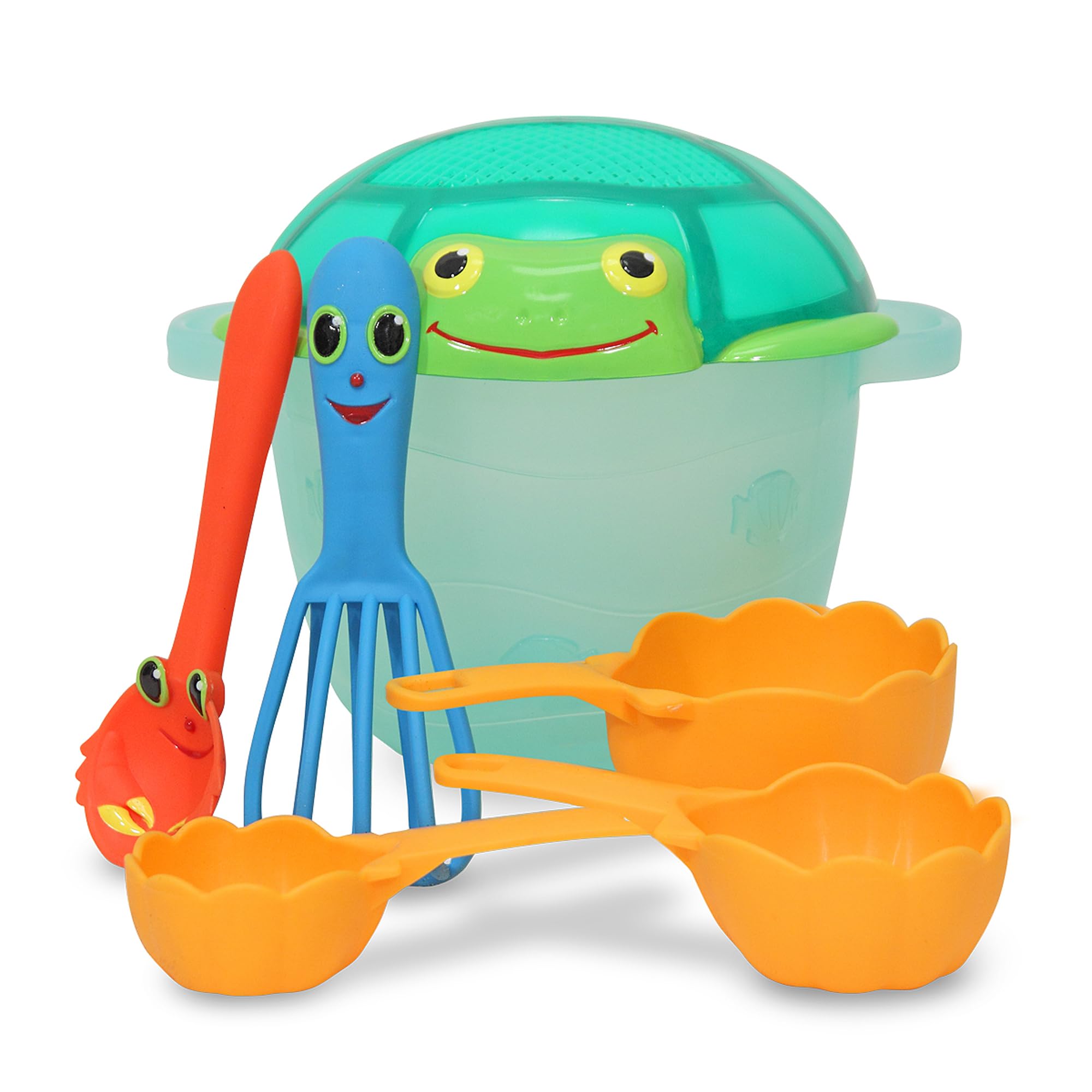
Most sand sets ask a child to dig. This one asks them to bake, and that is why it stands out: a mixing bowl, a turtle lid that sifts, shell-shaped measuring cups, an octopus whisk, and a crab spoon. The pieces are sturdy and sized for small hands, and the theme gives a child a story to play out rather than a pile of sand to move.
We like that every tool has a purpose. The measuring cups scoop, the whisk stirs dry sand, and the bowl holds a batch of pretend batter. The plastic is sturdy enough to last more than a single summer, and the set feels like a proper toy kitchen rather than a novelty. It is a better fit for a child who likes pretend play than for one who wants to move buckets of wet sand.
This is not a full beach kit. There is no plain bucket and spade here, and the pieces are built around one theme, so it works best alongside a basic digging set. For the right kid, though, it is the set that gets pulled out first.
Pros
- Themed pieces encourage pretend play
- Sturdy plastic for repeated trips
- Every tool has a clear job
Cons
- Turtle lid does not stay attached
This is the sand set for a 3-year-old who would rather bake than dig: sturdy pretend-play pieces with a clear job and enough variety for a whole afternoon.
Best for Toddler Truck Play
TOMY John Deere Sandbox Set
Key Features
- Toy size: 6 inches
- Vehicle count: 2
- Working parts: Dump bed and front loader
- Recommended age: 18 months–4 years
- Price: Budget
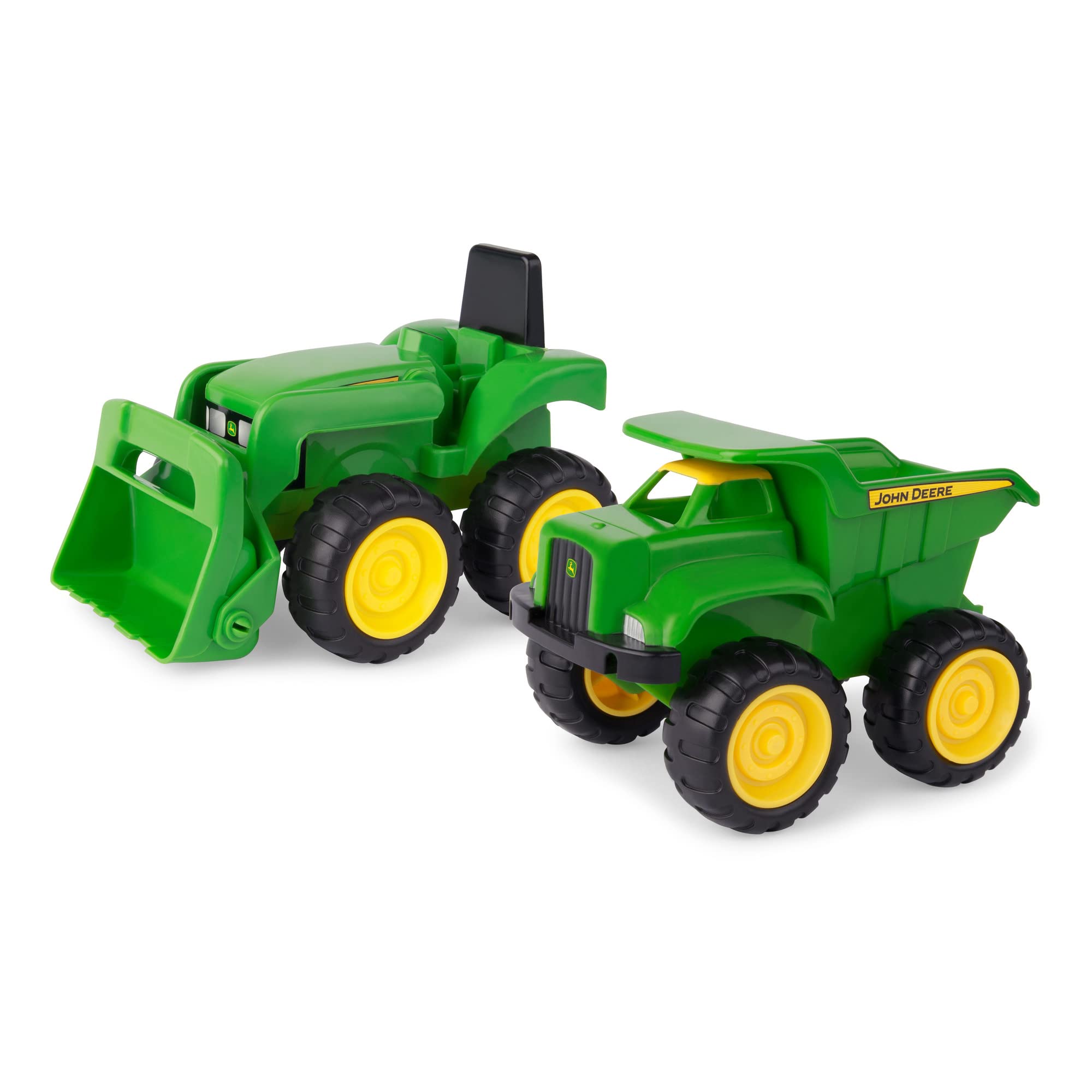
The green paint and John Deere styling are the first draw, but the working parts are what keep a toddler interested: the dump bed tips, the front loader moves, and both trucks roll freely from sand to sidewalk. We think this is the best sandbox vehicle set here for a truck-obsessed 2-year-old because there are no batteries and no switches, just two chunky trucks that reward pushing and scooping.
They are small trucks. A 2-year-old can carry one in each hand, and that is the scale that makes them useful at the beach; a 4-year-old who wants a big dump truck will be disappointed. The plastic is sturdy enough for sandbox duty, and the moving parts are simple enough that a child can work them without help.
The wheels are the part to check before each trip. A wheel that has worked loose is worth pressing back into place, and a truck with a missing wheel is not one to hand to a toddler. That is a small maintenance habit, not a reason to skip the set.
Pros
- Working loader and dump bed
- Toddler-sized for carrying
- No batteries required
Cons
- Decals and paint can chip
For a truck-obsessed toddler, this two-vehicle set earns its place with a working loader, a tipping dump bed, and wheels that roll from sand to sidewalk.
Best for Beach Catch
Nerf Vortex Aero Howler
Key Features
- Tail: 3-finned
- Diameter: 3.19 inches
- Material: Foam
- Recommended age: 6 years and up
- Price: Budget
The whistle is the first thing everyone notices. Air holes in the foam body make a roaring sound as the ball flies, so a throw is easy to track and easy to hear. The three-finned tail helps it spiral, and the molded grip gives smaller hands a place to hold.
The foam is soft enough that a missed catch does not end the game. It is light, easy to throw, and simple to catch, which makes it a good equalizer between a 6-year-old and an adult. There is no valve to leak or pump to remember, so it is ready whenever the beach bag is opened.
We think this is the throwing toy to bring when the group has mixed ages and the sand has room for a game of catch. It flies far enough to feel exciting without turning every throw into a sprint, and the whistle lets a kid find it after a bad bounce. It is not a sand tool, so it belongs on the dry side of the blanket, away from the bucket line.
Pros
- Flies far with a tight spiral
- Whistles loudly in flight
- Soft foam is easy to catch
Cons
- Tail fins can break with hard throws
This is the foam football we hand to a mixed-age beach group: it throws far, whistles on the way, and the soft foam makes catch easy for kids and adults.
Best for No-Mess Water Fights
Smirodi Reusable Water Balloons
Key Features
- Count: 12
- Material: Silicone
- Fill method: Magnetic, self-sealing
- Recommended age: 3–12 years
- Price: Midrange
The first change is the cleanup. Instead of a beach covered in torn latex, these silicone shells close with magnets, fill when you dunk them, and open on impact. The set comes with a mesh bag, and the pieces are soft enough for kids to handle.
A child can refill one without an adult tying knots. Dunk, close, throw; that loop is simple enough that the game keeps moving, and it is the reason a set of 12 can outlast a bucket of disposables. The mesh bag helps the set drain between uses and keeps the pieces together in a beach bag.
We think these are the better water-fight toy for a family that is tired of picking latex scraps out of the sand. The refill loop is quick enough that kids do not lose interest, and the silicone holds up to repeated rounds. They are a water-fight toy, not a dive toy; the magnets hold in the water, but the fun is in the throw and the pop.
Pros
- One-second magnetic fill
- Reusable and no latex cleanup
- Easy for kids to refill
Cons
- Needs a bucket or pool to fill
- Costs more upfront than disposables
For families tired of picking latex scraps out of the sand, these reusable balloons are the better water fight: they fill in a second, seal magnetically, and come back for another round.
Best for Group Water Battles
MAX LIQUIDATOR Water Blaster 6-Pack
Key Features
- Count: 6
- Range: 30 feet
- Floats: Yes
- Recommended age: 6–18 years
- Price: Midrange
At first glance they look like pool noodles with a handle, which is part of the appeal: the foam body is light, brightly colored, and easy to spot when it bobs in the water. Pull the handle back to load, push it forward to shoot. There are no batteries and no small tanks to refill one at a time.
The six-pack is the point. One child gets one, a cousin gets another, and the game starts without a trip to the store. The blasters shoot far enough for a proper chase, and because they float, a dropped one does not disappear under the surface. The bright colors also make them easy to spot when the pile of towels swallows everything else.
The blasters are at their best in the pool or the calm shallows, where a child can refill and fire without fighting a wave. The foam body stays afloat, and the pull-push action is simple enough for a 6-year-old to learn in one round. That is a simple pleasure: the game keeps moving instead of turning into a search.
We think this is the set to buy for a group at the pool or shoreline, where everyone can have one and no one has to wait for a turn. It is not a precision water gun, but for a pack of kids who want to chase and splash, the floating foam body and easy action are the right trade.
Pros
- Six blasters for group play
- Floats in pool or lake
- Shoots up to 30 feet
Cons
- Short length limits older kids
- Foam joints can separate
This six-pack is our pick for group water fights at the pool or shoreline: each blaster floats, shoots up to 30 feet, and is simple enough for younger kids to work.
Best for Wave Riding
Surfer Dudes Mini-Surfer

Key Features
- Power: Wave-powered
- Assembly: Snap-and-click
- Dimensions: 2 x 11 x 5 inches
- Recommended age: 6+ years
- Price: Midrange
The idea is simple and a little magical: toss the surfer into a breaking wave, and the weighted board rights itself and rides the white water back to shore. There are no batteries, no remote, and no winding. The set includes the figure, wing, skeg, fin key, and board, and it snaps together before the first throw.
On a surf beach, it gives a kid a reason to stand at the edge and watch the water instead of asking for the snack bag. The board is small enough to chase and bright enough to follow, and the ride back to shore is the payoff. It is the rare beach toy that makes the ocean itself the game.
It is rated 6 and up, and that feels right: a younger child can throw it, but reading the waves and chasing the board takes coordination. The set is small enough to live in a beach bag, which is the practical reason it comes with us.
We think this is the beach toy to bring when the ocean is doing the entertaining. It rewards a child who will chase it and a parent who is happy to stand at the shoreline. On the right day, it is the thing that gets the whole family watching the water.
Pros
- Self-righting wave ride
- No batteries or winding
- Small enough for a beach bag
Cons
- Needs breaking waves to work
- Board can come apart in surf
For an ocean beach with real waves, this self-righting surfer is the toy that draws a crowd and keeps kids chasing the shoreline.
How We Tested Beach Toys, in Sand and in Water
We started with the bestseller lists at the major retailers and the sets parents keep recommending in forum threads, then narrowed to toys that work in both sand and water and skipped anything battery-operated, fabric, or too bulky to fit in a beach bag. That left us with 18 sets and standalone toys across a wide range of sizes and prices. Testing ran four months, from late May through Labor Day, mostly on weekends.
The scene mattered as much as the toy. A backyard sandbox on weekday evenings caught the small stuff — whether a 2-year-old could carry a full bucket two-handed without tipping it, whether a 6-year-old could dig a real hole without the handle flexing. Saturdays at a freshwater lake beach handled the rest: we filled every bucket and turned it over to check the lid and handle, packed each set into a beach bag, drove it home, and opened the bag to see how much sand had escaped.
At the pool, we dropped every water toy in and left it for ten minutes, noting which stayed afloat, which tipped and filled, and which went straight to the bottom. Buckets got dropped full off a picnic table, shovels got stomped, and everything sat in sun and chlorine for a season so we could see what cracked. We noted whether molds released their shape or crumbled, counted how many pieces each set actually got used after the first week, and kept a rough tally of which toys held the kids’ attention past the half-hour mark.
How to Choose Beach Toys
The right beach toy is the one that earns its space in a wet, sandy bag and still works on the second trip.
Start With Age and the Mouthing Stage
A toy that suits a 6-year-old can be a hazard for an 18-month-old, so age is not a formality. For a child still putting things in their mouth, choose fewer, larger pieces with rounded edges and skip tiny molds, loose wheels, and magnetic parts. A four-piece toddler set is not a stripped-down version of a family kit; it is the correct tool for that stage. Once a child is past mouthing and can work a shovel with intent, a 19-piece set starts to make sense.
Match the Toy to Sand, Shallows, or Surf
Sand play and water play ask different things. Buckets, sifters, and molds need to release wet sand; water blasters and reusable balloons need to refill without an adult; wave toys need actual waves. A calm bay is not the place for a self-righting surfer, and a dry-sand castle kit will not keep a child busy in the surf. Pick one toy for each setting rather than expecting one set to do all three. We keep the sand tools near the blanket and the water toys at the shoreline.
Check the Parts That Fail First
On a beach toy, the failure usually starts at a joint: a lid that will not clip, a fin that snaps, a foam handle that pulls away, a decal that lifts. One-piece molded plastic is the safer bet for toddlers, while inflatables and foam games need a pre-trip check of valves, laces, and seams. We look for simple shapes with few moving parts, then accept that a water toy will eventually wear at the point where it flexes. Rinse and dry the toy after each trip so sand does not sit in the mechanism.
Pack for the Trip Home, Not Just the Beach
A toy that is hard to carry is a toy that stays in the car. A mesh bag lets wet pieces drain, a handle makes a bucket useful, and a piece count that matches the number of children prevents fights. For a toddler, four pieces in a small tote are easier than a 19-piece kit. For a mixed-age group, the bigger set earns its bulk because several kids can play at once. We prefer one set that gets used to three that stay zipped.
Frequently Asked Questions
How should I clean beach toys after a trip?
Rinse everything in fresh water, then shake out buckets, water wheels, and handles so sand does not dry inside the moving parts. Set the pieces in the sun until they are fully dry, and check for cracked plastic, loose wheels, or separated foam before the next outing. A mesh bag helps here because air can move through it.
Do beach toys work as flotation devices?
No. A foam football, inflatable ring, or water blaster is a toy, not a life-saving device. Use a properly fitted U.S. Coast Guard-approved life jacket for a child who needs one, and keep an adult within arm’s reach in or near the water.
How many beach toys should we bring?
Fewer than the trunk will hold. One digging set, one water toy, and one throwing game cover most beach days without turning the sand into a toy store. For a toddler, four well-made pieces are plenty; for a mixed-age group, the 19-piece set earns its space because several kids can play at once.
Final Verdict
The Hape Beach Basics set is the beach toy we recommend first for a baby or toddler: four sturdy, rounded tools that fit small hands and survive the way a 2-year-old actually plays. It will not cover a family of older kids, and it is not trying to.
If you need one bag for mixed ages, choose the FUN LITTLE TOYS 19-piece set; if the kids are old enough for a proper water fight, the reusable balloons are the upgrade that ends the latex cleanup.
