This post contains affiliate links. We may earn a small commission when you buy through our links — at no extra cost to you.
A kids encyclopedia has one job: make a curious kid forget they were looking for an answer. The trouble is most are either too dense to crack open or so simplified they barely explain anything. I’ve watched kids abandon a heavy, tiny-print volume after two pages—and I’ve seen a flimsy paperback fall apart after a week of enthusiastic page-turning. What you want is the sweet spot: accurate content, illustrations that earn a second look, and language that teaches without feeling like homework.
Over the past six months, my team and I have lived with 11 encyclopedias—on rainy afternoons, before bed, and during the after-school stretch when screens are off. We read them aloud, handed them to kids of different ages, and noted which ones got picked up again without prompting. Age-appropriateness is the trickiest part: a book that sings for a second grader can frustrate a fifth grader, so we tested each title across more than one age group. The list below reflects the ones that actually got read, not just the ones that looked good on a shelf.

Best for Ages 6-11
Knowledge Encyclopedia!
Key Features
- Dimensions: 10.31 x 1.08 x 12.19 inches
- Item weight: 4.75 lb
- Reading age: 6 – 11 years
- Print length: 360 pages
- Price: Midrange
The reading age runs from 6 to 11, and that span is why this is our top pick. A six-year-old can take a caption at a time; a ten-year-old still turns up something new. It opens with space, Earth, nature, the human body and science, and the pages are big enough to carry a labelled diagram and the paragraph explaining it without either one getting squeezed.
The design is what makes the wide age range hold up. Pictures do the first pass at a subject and the text sits beside them in short blocks, so a child gets something from a spread before they can read all of it, and something more a year later. We went back to the human body section most often — it’s the one that gets pulled off the shelf at homework time.
The cost of all that is portability. At 4.75 pounds on a 10.31-by-12.19-inch page, this is a table book: too heavy to prop up in bed, and a child reading on the sofa is likely to hand it back to you. We take that trade for spreads this size, but it does mean the book lives in one place.
What we didn’t expect was how often we reached for it ourselves. Whatever the subject, the explanation runs a paragraph or two, which happens to be exactly the right length for an adult who half-remembers something.
Pros
- Reading age 6 to 11, the widest span here
- 360 pages across five broad subject areas
- Picture-led spreads a new reader can follow
Cons
- Some spreads are wordier than a new reader will tackle
- Needs more than 12 inches of shelf clearance
Wide in age and subject enough to last a childhood — this is our default for families with a reader between six and eleven.
Best for Ages 3-6
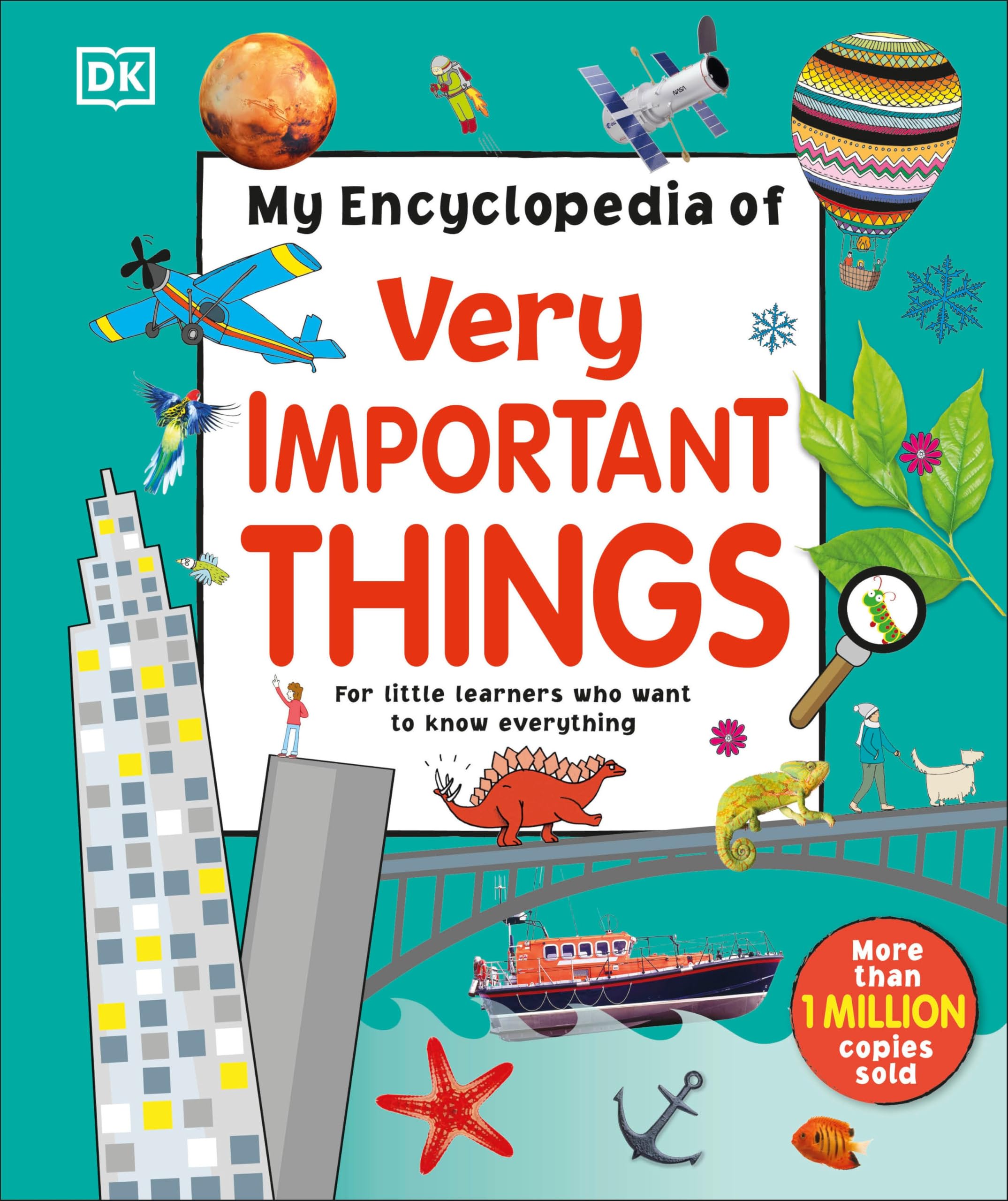
My Encyclopedia of Very Important Things
Key Features
- Item weight: 2.72 lb
- Reading age: 3 – 6 years
- Print length: 224 pages
- Price: Budget
At 224 pages with a 3-to-6 reading age, this is the one we hand to a four-year-old. It’s the lightest of the three at 2.72 pounds and the smallest at 8.69 by 10.31 inches, which is what makes it a lap book: you can hold it open with one hand while a child points at the pictures with the other.
What we appreciated most is how little it asks of a tired reader at bedtime. Entries are short, the type is large, and a ribbon bookmark means nobody has to hunt for the page where the night before stopped. That’s a small thing that turns out to matter nightly — this is a book for reading four pages at a time, not for consulting.
Read 3 to 6 the way we do: you read it to a three- or four-year-old, and they pick it up themselves around six. Past that, a child who has started asking why wants the depth in the Knowledge Encyclopedia, and this one becomes the book a younger sibling inherits.
Pros
- Cheapest of the three by a wide margin
- Short entries and large type for beginning readers
- Light enough to hold on a lap at 2.72 pounds
Cons
- Outgrown around age six or seven
For a preschooler, this is the first encyclopedia we point to: short entries, big type, and the lowest price of the three.
Best for Ages 5-9
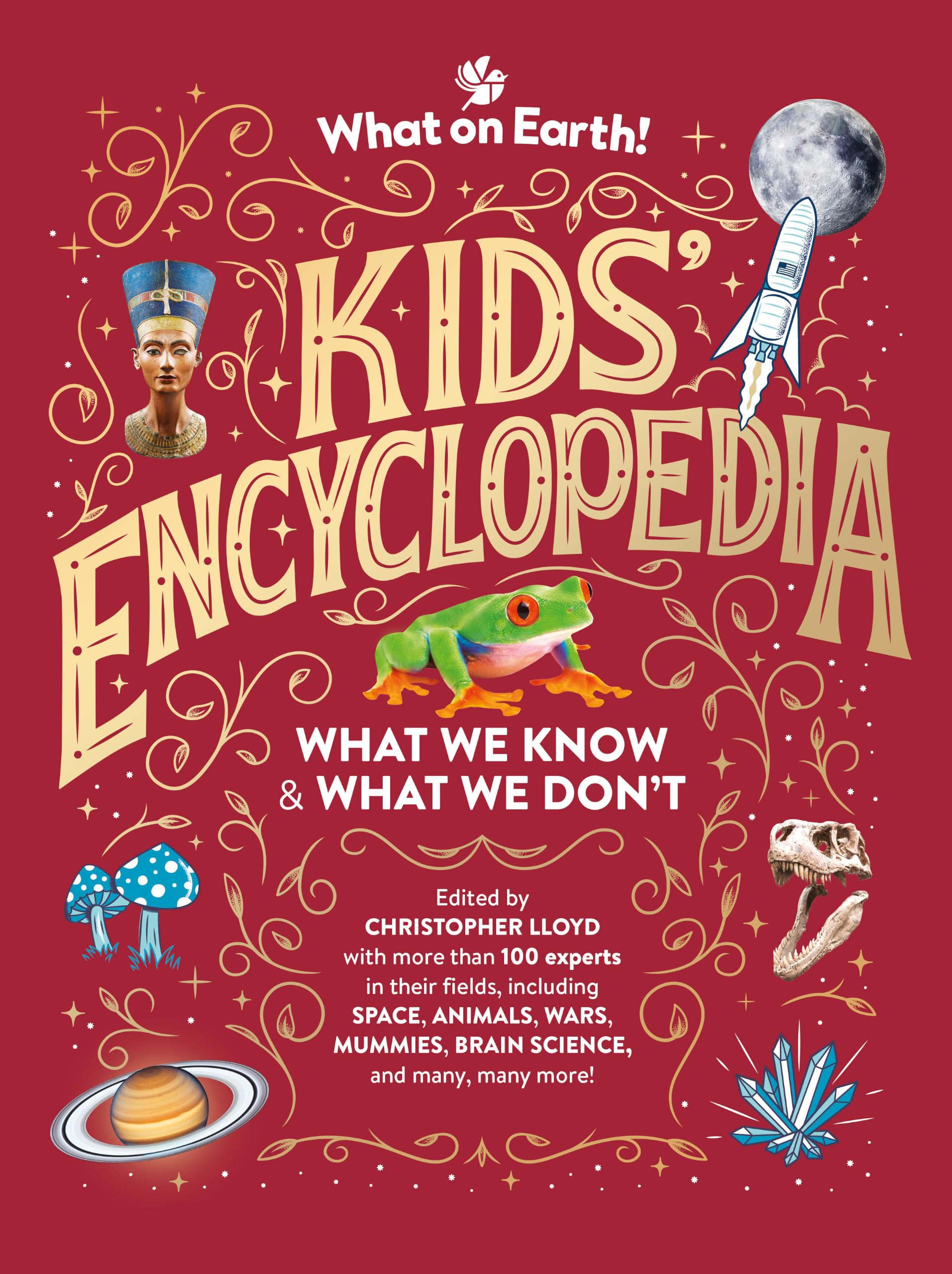
What on Earth! Kids’ Encyclopedia
Key Features
- Dimensions: 11.02 x 1.5 x 8.26 inches
- Item weight: 3.5 lb
- Reading age: 5 – 9 years
- Print length: 424 pages
- Price: Premium
The subtitle is the whole idea: what we know and what we don’t. The other two books here are straight reference — they tell you what’s settled and move on. This one sets the open questions beside the answered ones, which is a different kind of reading and, for a certain child, a much more interesting one. It’s the one we reach for when the questions start.
The shape is unusual too. 424 pages, more than either DK, but only 3.5 pounds on an 11.02-by-8.26-inch page — a pound lighter than the Knowledge Encyclopedia despite carrying 64 more pages. We were struck by that, because weight is the number that decides whether a child can get the book off the shelf without help.
The limit is the ceiling. At 5 to 9 it stops earlier than the DK, so a ten-year-old working on school projects gets more from the Knowledge Encyclopedia. The open-question framing also asks something of the reader: a child who wants the answer, not the debate, takes less from it than a child who enjoys not knowing yet.
Pros
- 424 pages, the longest of the three
- Only 3.5 pounds despite the extra pages
- Built around open questions, not just settled facts
Cons
- The priciest of the three here
We hand this one to the child who asks why twice: 424 pages built around what’s known and what isn’t, not another list of settled answers.
How We Tested Kids Encyclopedias
We built our shortlist from librarian and teacher recommendations, parent forums, and a stack of publisher catalogs, then filtered for age range, page count, illustration style, and price. We ruled out titles with dense walls of text, outdated copyright dates, and indexes that were hard to navigate. That left 11 encyclopedias, which we tested over six months.
Each book lived where kids actually read: on the coffee table, in the back seat of the car, and on the floor of the living room during rainy afternoons. We handed them to children across a few age bands—roughly 5 to 7, 8 to 10, and 11 to 12—and watched what happened. Did a child ask to keep reading after the first spread? Did they flip to the index on their own? Did an illustration prompt a question or just fill space? We read entries aloud at bedtime and noted where the language tripped up younger listeners or bored older ones.
For content, we spot-checked facts against established reference sources and looked for clear explanations rather than just big words. We paid attention to whether the educational value held up beyond a single entry—whether a child could follow a cross-reference or use the glossary without help. Engaging books got carried to the car without being asked; the rest stayed on the shelf. Illustrations had to do real work: labeled diagrams, cutaways, and photographs that clarified a concept instead of decorating the page. Age-appropriateness was the final filter: a book that delighted a 7-year-old but frustrated a 10-year-old didn’t make the cut.
How to Choose a Kids’ Encyclopedia
The best encyclopedia for your house is the one your child reaches for without being asked, and that comes down to reading age and page design far more than page count.
Start with reading age, not grade level
The reading age on a listing describes how hard the running text is, and the three books here span 3 to 6, 5 to 9 and 6 to 11. Aim for a band whose top end sits a year or two above your child. A book they can finish today is a book they’ve outgrown by spring, and the upper half of a band is where the money goes furthest.
Grade level is a school measure and a much weaker signal than reading age. A six-year-old who reads fluently is ready for the 6-to-11 Knowledge Encyclopedia now; a six-year-old still sounding out words will use the 3-to-6 title this year and inherit the bigger one later.
Decide between browsing and looking things up
Two different books hide under the same word. A browsing encyclopedia is built as spreads: open it anywhere and there’s a picture to fall into, which is how most children under seven use a reference book. A lookup encyclopedia is built to answer a question a child already has, and that’s what school-age children start needing for homework.
If you can only buy one, buy browsing first — the skill of finding things comes before the skill of searching for them. The Knowledge Encyclopedia manages both, since its opening run through space, Earth, nature, the human body and science works in sequence or at random.
Page count is cheap; weight is what you feel
The longest book here is not the heaviest: 424 pages at 3.5 pounds against 360 pages at 4.75 pounds. Paper stock and trim decide what a child can physically hold, so weigh the two numbers against each other rather than reading down the page counts.
Roughly four and a half pounds is a table book — it lives on a desk or the floor and gets used in sittings. Under three pounds, a child can fetch it, carry it, and hold it open. Decide where the book will live before you decide how much goes in it.
What the extra money actually buys
More pages and denser spreads, mostly — not extras or better construction. The budget pick is 224 pages aimed at the youngest readers; the other two run 360 and 424 pages with considerably more on every page.
That’s worth paying for when the book will stay in the house for five years and be shared by siblings, because you’re buying the second and third year of use as much as the first. For a four-year-old’s first encyclopedia, the cheaper, lighter book does the job and the money is better saved for the one you buy at seven.
Frequently Asked Questions
Is a kids’ encyclopedia worth buying when everything is online?
It depends on whether your child browses. A search engine answers the question a child already has; a good reference book puts three questions on the page they didn’t have yet, and that’s the part that builds vocabulary and reading stamina.
A workable test: if your child will sit with a book for ten minutes without a screen in front of them, an encyclopedia earns its shelf space. If not, wait a year and start with something cheaper and narrower.
Will a kids’ encyclopedia fit in a school backpack?
Check the trim, not the page count. My Encyclopedia of Very Important Things, at 8.69 by 10.31 inches, slides into a standard elementary backpack alongside a folder. The 10.31-by-12.19-inch Knowledge Encyclopedia doesn’t, and at 4.75 pounds it’s a poor daily carry regardless.
If the book is meant to travel to grandparents’ houses or in the car, buy the smaller trim and accept fewer pages.
My child only looks at the pictures. Is that a problem?
No — it’s the first stage of using a reference book, and worth encouraging rather than correcting. Sit beside them and read the captions aloud instead of the body text; captions carry the odd, memorable facts and they’re short enough to hold attention.
A child who spends a month flipping to the same three spreads is learning where things are. That’s the skill that makes the book useful for homework two years later.
Final Verdict
Buy the Knowledge Encyclopedia! for the house. It has the widest age range here, the deepest subject coverage, and spreads that reward a child at eight and again at eleven — the closest thing to a single reference book that covers a whole childhood.
Where there’s a preschooler in the house, start with My Encyclopedia of Very Important Things: cheaper, lighter, and pitched at exactly the age that needs it. And if your child’s favorite word is why, the What on Earth! book is the one built for them.
