This post contains affiliate links. We may earn a small commission when you buy through our links — at no extra cost to you.
Many science kits look thrilling on the box — erupting volcanoes, glowing crystals, hidden gems — but at the kitchen table they can fall flat. Seeds don’t sprout, geodes reveal dull interiors, or essential pieces are missing. The moment a child’s excitement turns to disappointment is the moment all that marketing falls short.
That doesn’t mean hands-on science is a gamble you shouldn’t take. It means the smart move is to choose kits where the core experience — whether it’s snapping circuits, digging for real specimens, or raising butterflies — has a track record of delivering. The selections here prioritize clear instructions, durable materials, and realistic outcomes, so you spend less time troubleshooting and more time watching a kid light up.
From electronics labs that grow with your child’s skills to earth science kits that actually produce crystals worth displaying, this guide matches the right kit to your young scientist’s interests and your tolerance for mess and waits.




Best for Electronics Beginners
Snap Circuits Jr. SC-100
Key Features
- Experiments: 100+ electronics projects
- Ages & Adult Help: 8+, 5+ with adult help
- Component Quality: 29 snap-together components
- Instructions & Depth: Picture-based project manual
- Longevity & Expandability: Expandable with other Snap Circuits
- Price: Mid-Range
The full-color picture manual is the reason even pre-readers succeed: each project uses sequential images to show exactly where to snap each part, and the connections themselves lock with a satisfying click that rarely slips apart. The 29 components span switches, a speaker, a motor, and a light bulb, letting a child build a working fan, a siren, or a light-sensitive alarm without fuss. Projects progress from dead-simple to clever, and the circuit stays connected while they move it around — no flimsy breadboards or loose wires that abandon a child mid-experiment.
This kit fits a 5-year-old with a parent nearby, an 8-year-old flying solo, and a gift-giver hunting a screen-free activity that actually teaches. It’s also designed to grow: all pieces are compatible with larger Snap Circuits sets, so a kid who outgrows the 100 projects can move up without starting over. The tradeoffs are small: the cardboard box won’t survive energetic daily use, and you’ll need 4 AA batteries that aren’t included. For a child who’s already deep into electronics, the SC-300 with its 300 projects and AM radio makes better sense, but for a first encounter, this kit’s bother-free design is what you’re paying for.
Pros
- Teaches real circuitry concepts like series and parallel with every project
- Components snap together securely and hold through repeated builds
- Keeps kids ages 5–12 engaged for hours, screen-free
Cons
- The included cardboard storage box can tear under heavy use
For a frustration-free first electronics set that teaches without screens, the SC-100 delivers — just budget a plastic bin for storage.
Best for Advanced Electronics
Snap Circuits Classic SC-300
Key Features
- Experiments: 300+ electronics projects
- Ages & Adult Help: 8+, some 6+ with help
- Component Quality: 60+ snap modules
- Instructions & Depth: Two full-color manuals
- Longevity & Expandability: Fully expandable ecosystem
- Price: Premium
Where the top pick’s 100 projects and picture-based manual are perfect for first-time builders, the SC-300 triples the project count and introduces complex concepts like AC signal propagation and logic gates. Durable snap modules and full-color illustrated manuals keep builds frustration-free, even when circuits get intricate.
This set hits its stride for kids 8-14 who’ve outgrown simpler electronics and are ready for a sustained exploration, and it’s a solid backbone for homeschool STEM or a family growing a Snap Circuits collection. The higher price point makes it a harder sell for a first-timer whose interest is untested; for those children, the entry-level kit offers a wiser starting point.
Pros
- 300-project span grows with a child’s skills, from simple switches to AM radio and alarm systems
- No-solder snap modules maintain consistent contact across hundreds of builds without tools
- Well-illustrated manuals keep complex assemblies accessible for upper elementary and middle-school learners
Cons
The SC-300 rewards a child’s existing curiosity with a deep, reusable lab that stays relevant into middle school — a long-term investment, not a one-weekend toy.
Best for Rock and Gem Fans
NG Mega Gemstone Dig Kit
Key Features
- Experiments: Geology excavation, 15 gems
- Ages & Adult Help: 8+, younger with adult help
- Component Quality: Dig brick, plastic tools, gems
- Instructions & Depth: 16-page learning guide
- Longevity & Expandability: Single-use dig
- Price: Mid-Range
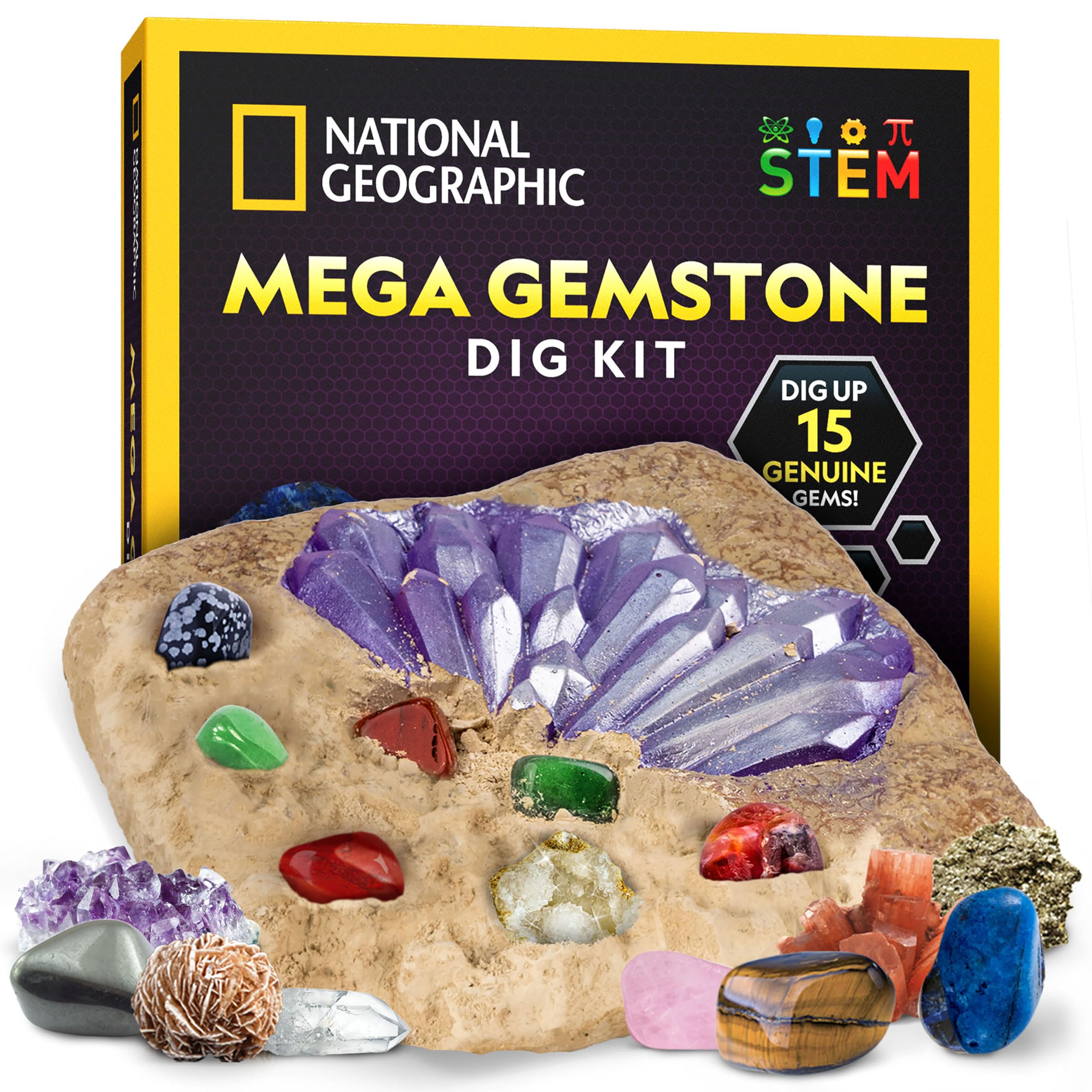
The National Geographic Mega Gemstone Dig Kit delivers a focused excavation experience — a single large dig brick hiding 15 real gemstones like amethyst, tiger’s eye, and pyrite. A 16-page learning booklet turns each find into a mini geology lesson, and the digging process itself is engaging enough that it doesn’t need extra experiments to hold attention.
This suits rock-obsessed kids who enjoy methodical chipping away, not those seeking a variety of science experiments. Expect some dust, small specimens (some no bigger than a pea), and flimsy plastic tools; a small metal hammer and adult helper make the dig smoother.
Pros
- Digging process is highly engaging, turning geology into a treasure hunt.
- Full-color booklet helps kids identify each gem, linking tactile play to real science.
- Makes a standout gift for rock collectors and dinosaur-dig fans alike.
Cons
- Some gemstone specimens may be surprisingly small, occasionally no bigger than a pea.
- The plastic excavation tools are flimsy; a metal hammer and flathead screwdriver from the toolbox work far better.
For a single-focused excavation that teaches gemology without screen time, this kit delivers a satisfying afternoon of dusty discovery — as long as expectations about specimen size are set.
Best for Multi-Science Explorers
NG Earth Science Kit
Key Features
- Experiments: 100+ across earth science
- Ages & Adult Help: 8+, younger with help
- Component Quality: Crystal kit, plaster, 2 dig bricks
- Instructions & Depth: Full-color guide
- Longevity & Expandability: Many single-use, multi-session
- Price: Mid-Range
Kids can sample geology, chemistry, and meteorology through over 100 activities that include a plaster volcano, crystal growing kit, tornado tubes, and two dig bricks. The range keeps things fresh across weeks, and the volcano and crystal projects deliver satisfying final builds that feel worth the effort. Drying times for the volcano mold and crystal growth can stretch across days — this works well for families who plan experiments around weekends and are comfortable with a slower pace. A few activities may not match the box’s dramatic photos, but the kit’s breadth means there’s always another experiment to try.
Pros
- Spans geology, chemistry, and weather with activities that stay fresh across dozens of sessions.
- Volcano and crystal projects yield dramatic final results that feel like a real lab.
- Core materials for volcano, dig kits, and crystals are included — no last-minute shopping.
Cons
- Volcano mold and crystal growth can take days of drying time, which may test a child’s patience.
- A few experiments may not produce the dramatic effect shown on the box.
This kit suits families who want a varied earth-science sampler to spread across weekends, where the drying times align with a relaxed pace and the occasional dud doesn’t overshadow the variety.
Best for Nature-Loving Families
Butterfly Garden Kit
Key Features
- Experiments: Live metamorphosis project
- Ages & Adult Help: 4+ with adult supervision
- Component Quality: Mesh habitat, caterpillar voucher
- Instructions & Depth: STEM journal, 3-week plan
- Longevity & Expandability: Reusable habitat, reorder caterpillars
- Price: Mid-Range
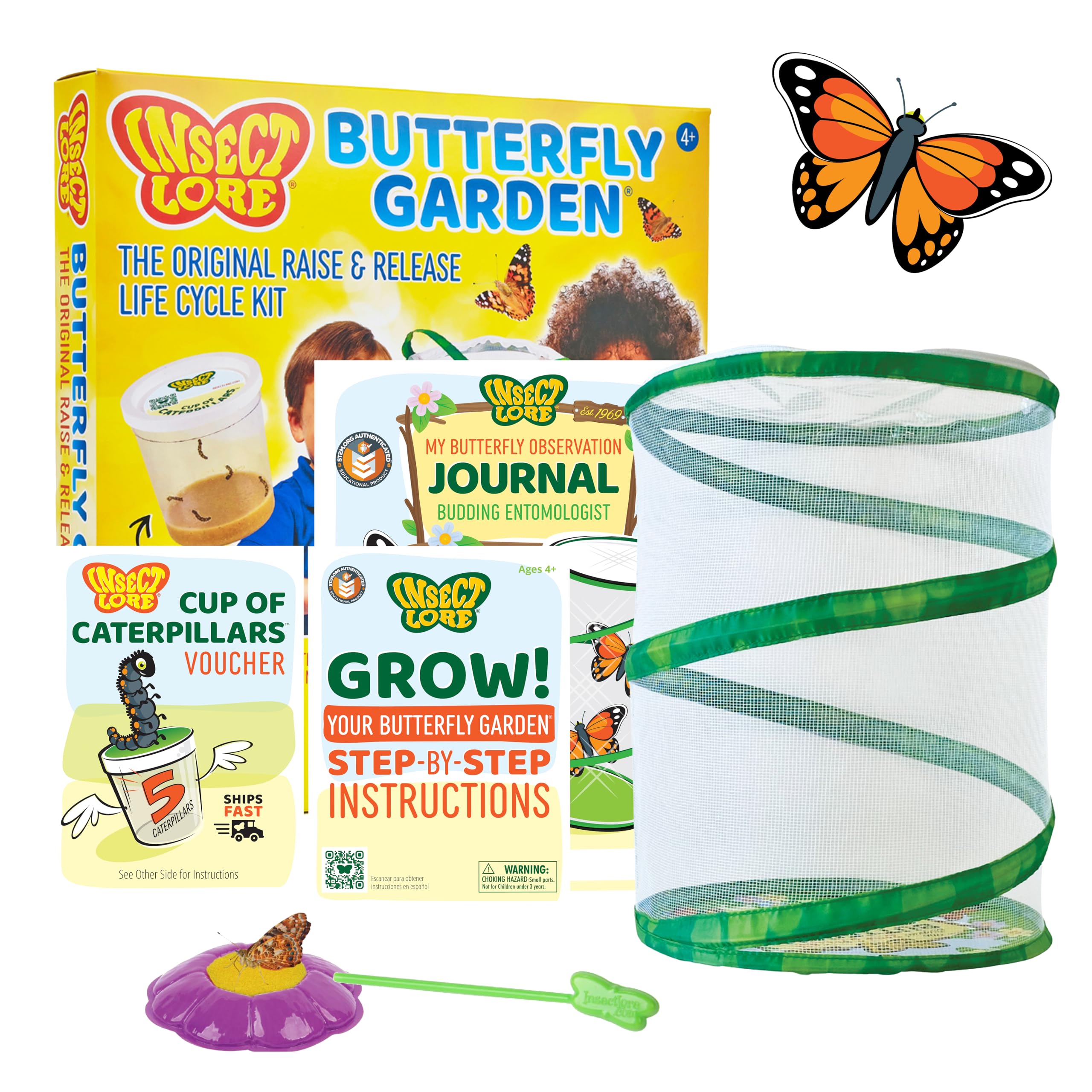
The mesh habitat and STEM journal guide children through watching caterpillars grow into butterflies over three weeks, a hands-on life cycle lesson no diagram can match. Daily observation builds excitement, and the release ceremony is genuinely memorable. It’s a biology experience that stands apart from static science kits.
This project suits patient families who value a nature connection and can plan ahead. The kit does not include live specimens; a voucher requires online redemption, an $8.95 shipping fee, and seasonal timing. For classrooms or homeschoolers, it’s a vivid multi-week unit. Those wanting an all-in-one, instant activity will find the added cost and wait a barrier.
Pros
- Watching caterpillars transform into butterflies up close is unforgettable and magical.
- STEM journal encourages observation, drawing, and note-taking—real science skills.
- Daily check-ins and the final release make the project fun and memorable.
Cons
- Some caterpillars may not survive to butterfly; occasional loss can be disappointing.
The butterfly kit rewards planning and patience with a hands-on life cycle experience no textbook can replicate.
Best for Budget Variety Seekers
UNGLINGA 70-Exp Kit
Key Features
- Experiments: 70 lab experiments
- Ages & Adult Help: 8+, 4+ with help
- Component Quality: Lab coat, goggles, chemicals
- Instructions & Depth: Illustrated manual, some errors
- Longevity & Expandability: Consumable, many activities
- Price: Mid-Range
The UNGLINGA kit packs 70 experiments — from a baking-soda volcano to fruit circuits — with a lab coat, goggles, and name tag that turn any kitchen table into a research lab, all at a price that’s easy on the wallet.
Thrifty families with young scientists (6–9) who adore dressing up and role-playing will appreciate the immersive pretend-play value. The instruction booklet can be confusing with translation quirks; adult troubleshooting is often part of the equation, making this best for kids who have a grown-up ready to help.
Pros
- Impressive variety at a budget-friendly price
- Kids absolutely love the lab coat and pretend play aspect
- Good introductory science kit that sparks curiosity
Cons
- Some experiments produce lackluster results or fail to deliver the expected reaction.
- The instruction booklet contains translation errors and vague steps that can frustrate kids working solo.
If you’re after maximum experiment count, dress-up fun, and can accept a quirky instruction guide, this kit delivers hours of discovery — just plan to join in as lab assistant.
Best for Crafty Gardeners
Grow ‘N Glow Terrarium

Key Features
- Experiments: Plant-growing craft
- Ages & Adult Help: 6+
- Component Quality: Jar, soil, seeds, stickers
- Instructions & Depth: Easy picture instructions
- Longevity & Expandability: Reusable jar, seeds extra
- Price: Budget
This kit combines an artsy gardening project with basic plant care lessons, letting kids design a glow-in-the-dark mini terrarium. The included seeds can be stubborn, and a barren jar may result if they don’t sprout. Buying an extra packet of chia or wheatgrass seeds sidesteps that risk, turning it into a reliable, hands-on biology lesson.
Pros
- Kids love decorating their personal mini garden with resin figures and glow sand, then watching sprouts emerge.
- Simple assembly means children 6+ can do most steps independently, making it a low-friction afternoon project.
Cons
- The included seeds can fail to germinate; an extra packet of chia or wheatgrass seeds may be needed to see sprouts.
For families willing to supplement with a packet of chia or wheatgrass seeds, this kit offers a delightful crafting-and-growing experience at a wallet-friendly price.
How to Choose
A science kit’s claim of "100+ experiments" means nothing if you don’t check what’s actually inside — the real value lies in the quality of the core activity, not the quantity of variations.
Experiment Count: Marketing vs. Reality
Many kits inflate the number by counting tiny variations. A box that boasts 100 experiments may deliver ten genuinely different activities — like crystal growing and a volcano — with each step or measurement variation labeled as a separate project. Focus on how many unique, satisfying experiments require a fresh setup, not just a tweak of the same reaction.
Age Range & Adult Involvement
The suggested age is a guideline, not a barrier. Picture-based manuals let non-readers as young as 5 assemble circuits with minimal help, while text-heavy chemistry sets may demand a supervising adult even for 10-year-olds. The real question is whether the child can wait through multi-day drying or crystal-growing phases — patience is a bigger factor than fine motor skills in many kits.
What’s Actually in the Box
Open-box surprises frustrate: some kits tout a complete experience but ship without batteries, caterpillars, or a crucial chemical. Live-specimen kits in particular require a separate voucher redemption and an extra shipping fee, so the advertised price isn’t the total cost. Verify that the core materials for the headline experiments are included, not just instructions and a promise.
Instructions That Make or Break the Experience
Poorly translated or vague instructions can turn an exciting project into a guessing game. Look for manuals that use full-color photos of each step and explain the science in plain language. Kits like Snap Circuits eliminate reading entirely with picture-based diagrams, while earth science guides should clearly state drying times and expected outcomes to avoid surprises mid-experiment.
Longevity: One Weekend or Ongoing Learning?
Some kits are consumable, offering a single afternoon of fun. Others integrate into a larger ecosystem — Snap Circuits modules can be reused and expanded with add-on packs, and a butterfly habitat can host new broods each spring. If you want a kit that grows with your child, choose one with a clear upgrade path or reusable core components.
FAQ
Why didn’t my crystal growing kit work even though I followed the instructions exactly?
Crystal growing is sensitive to temperature, water purity, and seed rock placement. Even with perfect instructions, small variations can cause weak growth or no results. For best chances, use distilled water and keep the temperature steady; if it still fails, many brands will send a replacement powder.
Do all butterfly garden kits come with caterpillars, or do you have to order them separately?
Most live butterfly kits, including the Insect Lore Butterfly Garden, ship the mesh habitat and a voucher certificate. You must later redeem the voucher online and pay an extra shipping fee (typically around $9) to receive the caterpillars when the weather is suitable. The caterpillars are never in the box at purchase due to perishability, so plan for the wait and extra cost.
How do I know if a gemstone dig kit will have actual crystals inside or just plain rocks?
There’s no guarantee, but reputable brands like National Geographic have higher odds of hollow geodes and identifiable stones. To improve the experience, use a real hammer and chisel instead of the included plastic tools, and know that natural geodes sometimes have small or imperfect crystals — that’s part of the real-world dig.
Are Snap Circuits kits worth the extra cost compared to cheap science experiment boxes?
Yes, if your child is interested in electronics. Snap Circuits’ snap-together components are durable and reusable, and the project manual builds understanding of circuits rather than just demonstrating chemical reactions. Cheap experiment boxes often rely on consumable materials and can produce hit-or-miss results, while Snap Circuits can expand with add-on sets for years.