This post contains affiliate links. We may earn a small commission when you buy through our links — at no extra cost to you.
Training wheels teach a kid to pedal a bike that can’t lean; the day they come off, leaning becomes a brand-new lesson. A balance bike flips the order — kids scoot, glide, and learn to catch themselves with their feet, then add pedals to a skill they already own. The trouble is these little bikes aren’t interchangeable. A couple of pounds, an inch of seat height, or a frame that flexes under a determined 3-year-old can turn a daily rider into garage clutter — and a bike that gets outgrown in one season is never good value, whatever it cost.
I’ve been through this with my own kids and leaned on my sister’s crew too, and over the past eight months our team assembled and handed off 12 balance bikes to riders between 18 months and 5 years. They got ridden on driveways and sidewalk laps, up a grassy park hill, and dropped on all three. The ones that earned a spot by the back door were light enough for a toddler to pick up alone and sturdy enough to shrug off a spill. Here’s what held up.


Best for Long-Term Learning
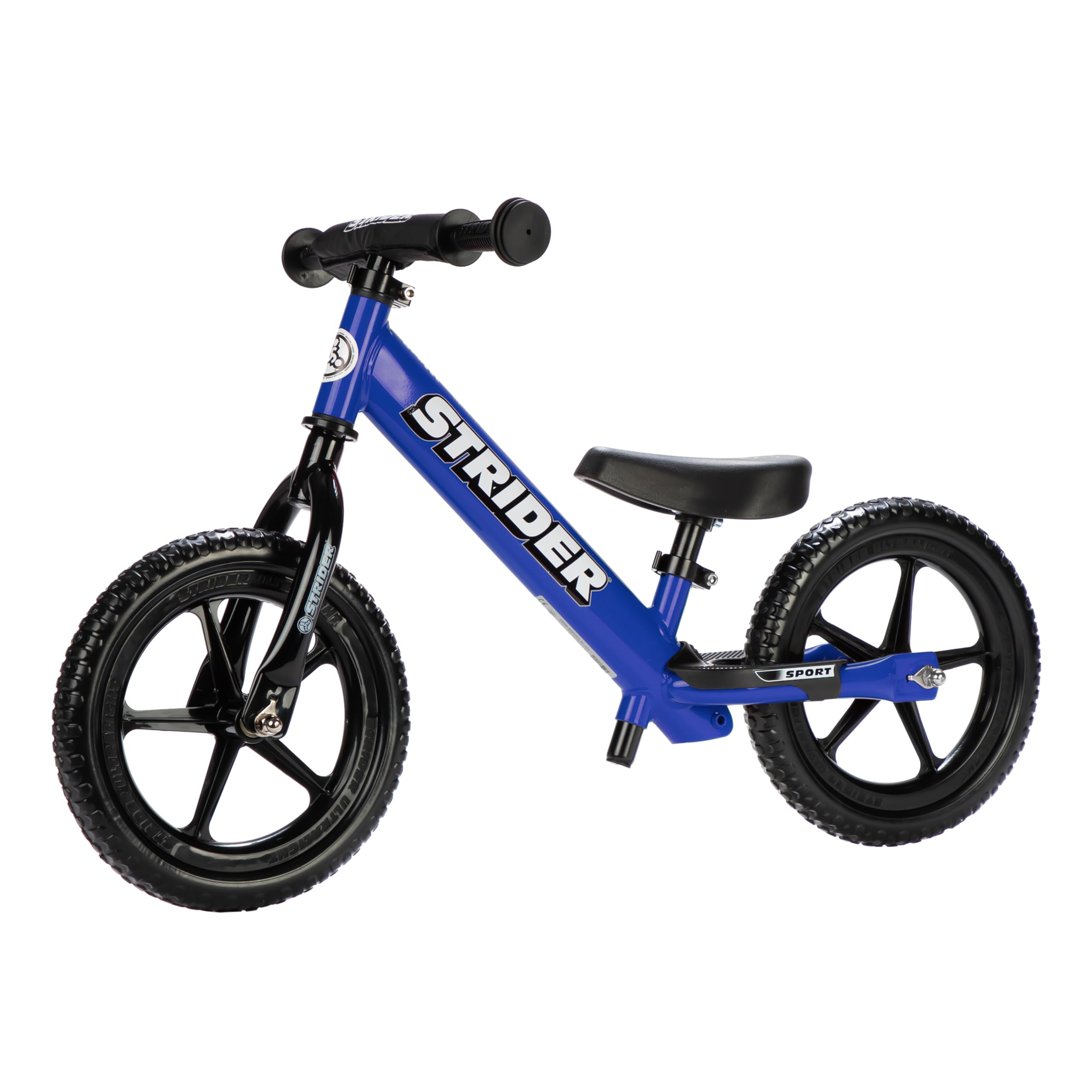
Strider 12 Sport
Key Features
- Age range: 1–4 years
- Bike weight: 6.7 lb
- Rider limit: 60 lb
- Seat height: 11–17 in.
- Price: Premium
The first thing we noticed about the Strider 12 Sport is how little bike there is to lift: 6.7 pounds, light enough to carry under one arm while holding a toddler’s hand. That matters because a balance bike gets carried as often as it gets ridden—up stairs, across a parking lot, back from the park when legs give out. The 12-inch foam tires never need air, and the seat slides from 11 to 17 inches, so the same bike fits a newly walking 1-year-old and a confident 4-year-old.
We think that range is what makes the Sport the strongest long-term choice here. It is the one pick we can see buying once and keeping through several growth spurts, rather than replacing a four-wheel starter after a year. The frame feels planted when a child pushes hard, and the low step-over leaves room to swing a leg off without catching a foot. We also appreciate the two-year warranty, which is longer than most of this group.
A 1-year-old who is still unsteady on their feet will do better with a four-wheel bike for a season. The Sport’s longer seat range and extra year of fit are the reason we still recommend it for a family that wants one bike rather than two.
Pros
- Light 6.7-pound frame is easy to carry
- Seat grows from 11 to 17 inches
- 12-inch foam tires never need air
- Two-year limited warranty
Cons
- Premium price for a first bike
Our pick for the family that wants one balance bike to last from first strides to preschool, the 12 Sport earns it with a light frame and a seat that grows to 17 inches.
Best for First Birthday
SEREED Baby Balance Bike
Key Features
- Wheels: 4
- Age range: 12–24 months
- Bike weight: 3.5 lb
- Rider limit: 55 lb
- Price: Budget
For a child still finding their feet, four wheels make more sense than two, and the SEREED UD30 is the four-wheel bike we reach for first. The 3.5-pound aluminum frame is light enough for a 1-year-old to push and for us to carry by the handle, and the 6.7-inch wheels sit inside a fully enclosed body so there is no spoke or chain to catch a foot. We like that the steering is limited; it keeps a sudden turn from becoming a tip-over.
The seat is low and the step-through shape lets a toddler straddle it without help. The 55-pound rider limit is generous for the age, and the non-slip handlebar and soft seat are small details that matter when a child is learning to push, stop, and climb off. The 6.7-inch wheels are small enough to stay out of the way and large enough to roll over a doorway sill.
The frame feels solid, the assembly is simple, and the enclosed wheels make it a low-stress first bike. We keep it as our first-birthday pick because it does that one job well.
Pros
- Very light 3.5-pound frame
- Enclosed four-wheel design
- Assembly is simple and low-stress
Cons
- Short 12–24-month fit
For a 1-year-old who is still finding their feet, we choose the SEREED UD30: four enclosed wheels, a 3.5-pound frame, and a low seat make the first ride less wobbly.
Best for Budget 2-Wheel
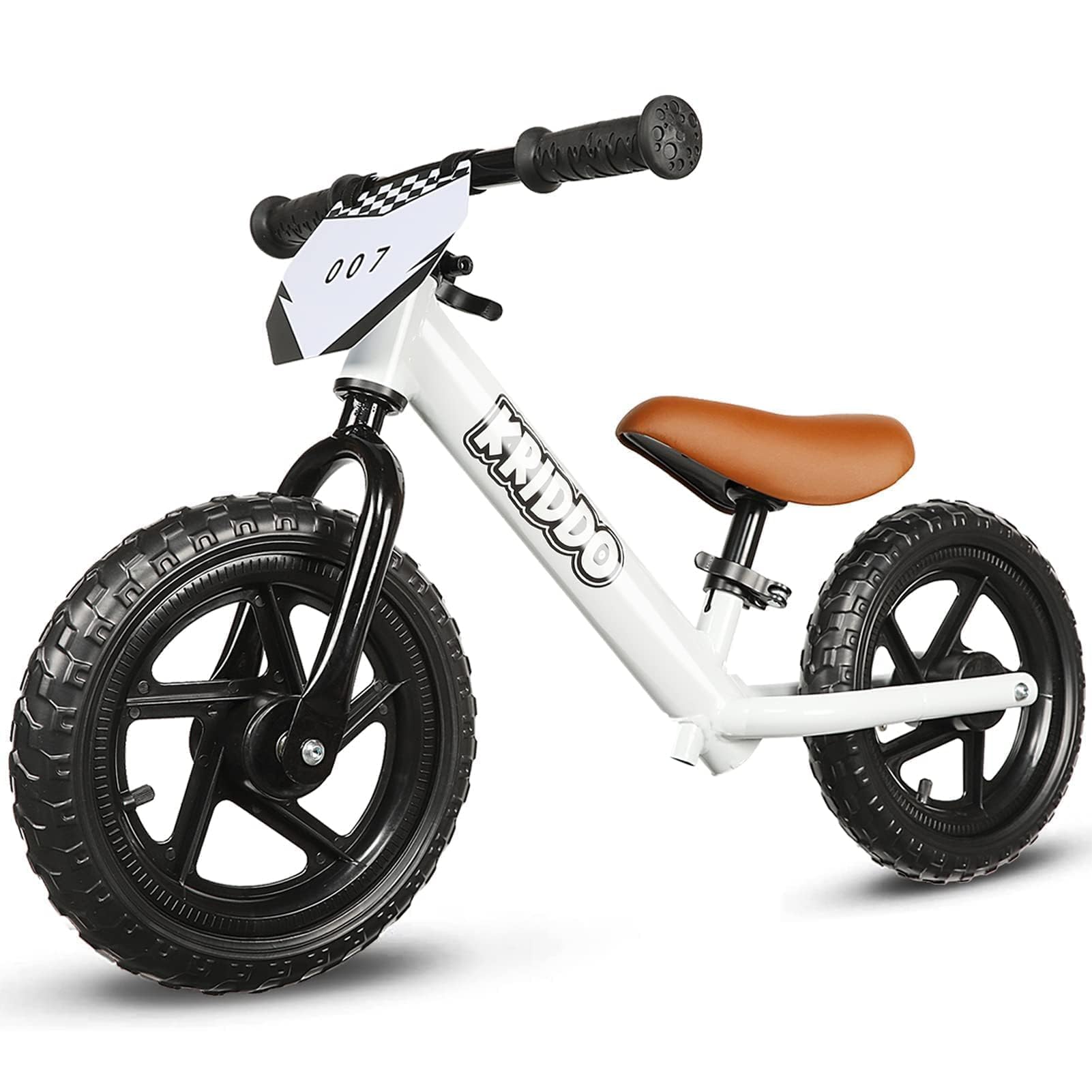
KRIDDO Toddler Balance Bike
Key Features
- Tires: 12 in. puncture-resistant
- Age range: 18 months–5 years
- Bike weight: 6.6 lb
- Rider limit: 110 lb
- Price: Budget
A 110-pound weight limit on a toddler bike sounds like overkill until you watch a preschooler launch it off a curb. The KRIDDO’s wide carbon-steel frame is built for that kind of abuse, and the 12-inch puncture-resistant tires roll over sidewalk seams and short grass without the constant hiss of air loss. The seat and handlebars adjust without tools, so the bike can grow from a tall 2-year-old to a 5-year-old.
We appreciate the customize plate more than we expected. It gives a child a sense of ownership—name, stickers, a drawing—and it is the first thing a child shows a visiting grandparent. The 6.6-pound weight is manageable for a parent to carry, though a small 2-year-old will need help lifting it onto a curb. The seat post can slide down over time, so check the clamp before a ride.
We think this is the value pick for a family that wants a two-wheel bike without the Strider premium. The wide age range and high weight limit mean it can survive hand-me-down duty, and the customizable plate gives it a personality the plain frames lack. We still point a very small 2-year-old toward a four-wheel starter first.
Pros
- Wide 18-month to 5-year fit
- Generous 110-pound rider limit
- Puncture-resistant 12-inch tires roll easily
- Customizable name plate adds personality
Cons
We reach for the KRIDDO when a family wants a two-wheeler that can take a beating without the Strider premium; the wide age range and 110-pound limit are the reasons.
Best for Confidence Building
Yvolution Y Velo Junior
Key Features
- Wheels: Dual rear, converts to single
- Age range: 18 months–3 years
- Bike weight: 7.7 lb
- Rider limit: 44 lb
- Price: Midrange
The Y Velo Junior is the only pick here that starts with a double-width rear wheel and lets you switch to a single wheel once a child is ready. That is a clever way to buy confidence: the three-point stance feels stable for an 18-month-old, and the narrower rear wheel gives a 3-year-old a more natural glide. The 9-inch wheels roll over uneven pavement better than the tiny wheels on most four-wheel starters.
We think the transition is the reason to choose it. A child can practice with the wider rear wheel for a few weeks, then move to the single wheel without losing the bike they already know. The planted feel comes from a sturdy frame that stands up on its own, which we appreciated when loading it into the car.
For a cautious rider who needs stability first, the Y Velo Junior does a job the standard two-wheelers here cannot. A child can start on the wide rear wheel and move to the single wheel without relearning the bike. That makes it a strong first two-wheeler for a hesitant toddler.
Pros
- Dual rear wheel converts to single
- Sturdy frame stands up on its own
- 9-inch wheels handle uneven pavement
Cons
- Heavy 7.7-pound frame for toddlers
- 44-pound limit caps older riders
The Y Velo Junior is the one we hand to a cautious toddler: start on the dual rear wheel, switch to a single wheel, and skip the leap to a strange new bike.
Best for Simple 2-Wheel
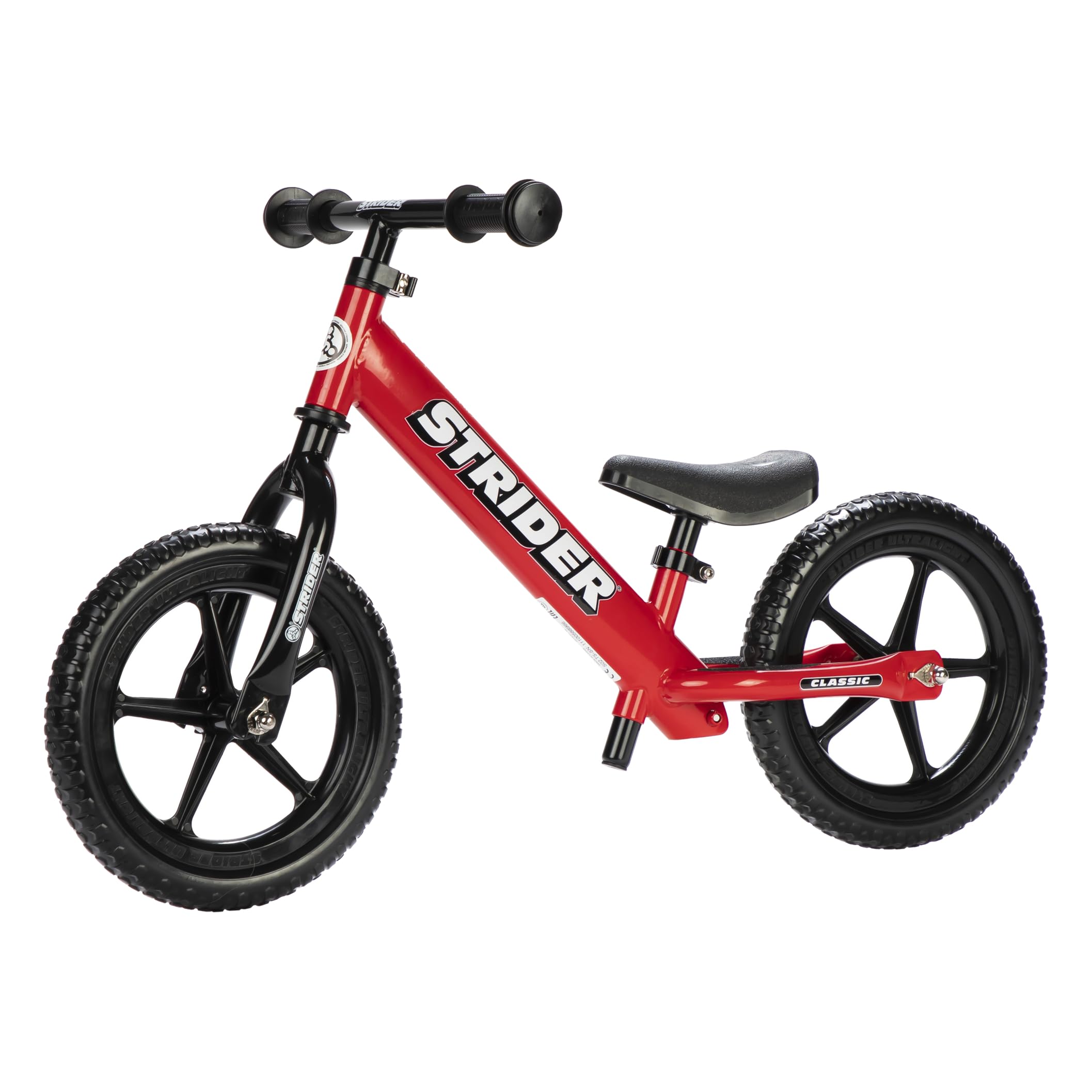
Strider 12 Classic
Key Features
- Age range: 1–3 years
- Bike weight: 6.5 lb
- Rider limit: 60 lb
- Seat height: 11–16 in.
- Price: Midrange
If the Sport feels like more bike than your family needs, the Classic strips it back without making it feel cheap. We think it is the right Strider for a 1- or 2-year-old who will spend a year or two on a balance bike and then move on. It shares the same 12-inch foam tires and steel frame as the Sport, but the Classic is the smaller, simpler model. At 6.5 pounds, it is a touch lighter.
The built-in footrest is a nice detail for kids who like to coast with their feet up, and the flat-free tires mean the bike can sit in the garage for weeks without a flat. The steering feels direct and the bike is easy to walk beside when a child wants a hand. The simpler setup is the point: fewer parts to adjust, fewer things to lose.
The Classic is also the easier Strider to hand down because there is less to adjust and fewer parts to lose. It is the one we choose for a family that wants a simple, light two-wheeler and does not need the Sport’s extras.
Pros
- Same foam tires as the Sport
- Light 6.5-pound frame
- Built-in footrest for coasting
- Lower price than the Sport
Cons
- Seat range tops out at 16 inches
We like the Strider 12 Classic for 1- to 3-year-olds who do not need the Sport’s extras; it keeps the foam tires and light frame and asks less of the family budget.
Best for Indoor Riding
Retrospec Cricket

Key Features
- Assembly: 95% assembled
- Age range: 12–24 months
- Bike weight: 4 lb
- Rider limit: 44 lb
- Price: Budget
The Cricket is the one we reach for when the bike has to live indoors. The 4-pound plastic body is light enough to move from living room to hallway, and the non-slip wheels are quiet and leave no marks on wood floors. It arrives 95 percent assembled, so setup is mostly handlebars and a bolt.
The low seat and four-wheel stance suit a 12- to 24-month-old, and the 44-pound limit is generous for that window. We like the soft handlebars and the steering limit, which keeps a sudden turn from turning into a fall. The Cricket is also one of the few four-wheel bikes here that looks deliberately designed rather than like a miniature quad.
Our reservation is durability. Check the hub caps before each ride and press them firmly into place; that is the one maintenance step we do not skip. Otherwise, the Cricket is a simple, quiet first bike that does not ask much of a small apartment.
Pros
- Quiet wheels protect indoor floors
- Light 4-pound body
- Arrives 95 percent assembled
- Steering limit adds stability
Cons
- Short seat height for taller toddlers
Apartment families should look at the Cricket first: we value its quiet wheels and 4-pound body, and we accept the short fit as the trade-off for a bike that lives indoors.
Best for Playful Toddlers
YGJT Tiger Balance Bike

Key Features
- Age range: 10–36 months
- Wheel size: 12 in.
- Bike weight: 5.2 lb
- Rider limit: 50 lb
- Price: Budget
The tiger’s mouth opens and closes as the bike rolls, which sounds like a gimmick until you see a hesitant toddler giggle and push forward. The YGJT Tiger is a four-wheel bike for 10 to 36 months, with a carbon-steel frame, a 50-pound rider limit, and 12-inch wheels that roll more easily over pavement than the tiny wheels on most first-birthday bikes.
We like that the playful shape does not come at the expense of the basics. The seat is low, the handlebar is wide, and the fully enclosed wheels leave nothing for a foot to catch. Assembly takes minutes and the bike is light enough at 5.2 pounds to toss in the car.
The longer age range is the practical reason to choose this over a 12–24-month starter. A 2-year-old can still use it, and the 50-pound limit gives it more room than the SEREED or the Cricket. The tiger styling is not for every family, but the bike itself is stable and easy to steer.
What sold us is the way the design encourages a nervous rider to move. The motion is gentle, the seat is stable, and the bike does not feel like a toy that will be outgrown by the next birthday. If you want a first bike with personality and a longer runway, this is the one we point to.
Pros
- Moving tiger mouth engages hesitant riders
- Longer 10–36-month fit than most starters
- 50-pound rider limit adds growing room
Cons
- 5.2-pound frame is heavier than the lightest picks
The YGJT Tiger is our choice for a hesitant rider who needs a nudge; the moving mouth and longer 10–36-month fit make it more than a novelty.
Best for Light-Up Motivation
WETIFY Balance Bike

Key Features
- Frame: Carbon steel
- Age range: 10–36 months
- Wheel size: 6.8 in.
- Bike weight: 4.6 lb
- Price: Budget
The light-up rear wheels are the feature that earns this one a second look. They glow as the bike rolls, without batteries, and the effect is bright enough to make a reluctant toddler want to push just to see the colors move. The WETIFY is a four-wheel bike for 10 to 36 months, with a carbon-steel frame, a 6.8-inch wheel, and a soft PU seat.
We appreciate that the lights are not the whole story. The bike is 4.6 pounds, light enough to carry by the handle, and the enclosed wheels and 135-degree steering limit keep a sudden turn from becoming a tip-over. Assembly is a three-minute job with no tools, and the handlebar and seat are sized for a small rider.
The 10–36-month range is longer than the SEREED’s, and the frame is stable enough for a child who pushes hard. The handlebar is easy for a small hand to grip, and the enclosed wheels roll quietly on pavement. We also like that the lights need no batteries, so there is nothing to replace when the novelty wears off.
What we like most is the motivation. A child who is hesitant to sit on a plain balance bike will often climb onto this one to make the wheels light up. That makes it a useful first bike for a toddler who needs a little entertainment, not just a stable seat.
Pros
- Light-up wheels need no batteries
- Light 4.6-pound frame
- Enclosed wheels and steering limit
Cons
- Size runs small for some older toddlers
We point parents of reluctant toddlers to the WETIFY, where the light-up rear wheels do the persuading and the 4.6-pound frame keeps the bike easy to handle.
How We Tested 12 Balance Bikes With Real Riders
We started with about 30 balance bikes and narrowed the list using specs a parent can actually check: seat-height range, claimed weight, frame material, tire type, brake or no brake, and what comes in the box for the price. That left 12 — wood, steel, and aluminum, 10- and 12-inch wheels, some with hand brakes and some without — each ridden by a family with a kid between 18 months and 5 years over eight months.
Assembly was timed with one adult, one hex key, and a stopwatch, from opening the box to a kid rolling away, and we noted whether the included tools actually fit and whether the instructions matched the hardware that arrived. We also measured true minimum and maximum seat height with a tape instead of trusting the listing, then set each bike so the rider could plant both feet flat.
On the driveway, sidewalk laps, and a gently sloped park path, we watched for the moment a kid stopped walking the bike and started gliding, and how long it took to get there. Twitchy steering, a handlebar that blocked the turn, or a bike that felt tippy in a corner showed up fast — and so did a low center of gravity, which made even a cautious 2-year-old brave enough to push off.
Durability got tested the way kids test it: dropped, dragged, left in the yard overnight, ridden off curbs, and we checked for loose bolts, cracked frames, worn tires, and grips that survived being scraped. For enjoyment, we logged which bikes kids climbed on without being asked. Value came down to what the price actually bought — real rubber tires, a brake a small hand could squeeze, a seat post with room to grow.
How to Choose a Balance Bike
The right balance bike is the one your child can straddle with both feet flat today, not the one with the longest age label.
Fit the child, not the age label
A balance bike works only when the child can sit on the seat with both feet flat on the ground and a slight bend in the knees. Age labels are a starting point, not a measurement. The Strider 12 Sport runs from 11 to 17 inches and the Classic from 11 to 16, which is why the same brand can fit a 1-year-old and a 4-year-old differently. Measure inseam, then check the seat height. If the child is on tiptoes, the bike is too tall.
A lower seat also makes it easier to climb on and off without help. We prioritize a usable low setting over a long top-end range, because a bike that is too tall at the start gets ignored.
Four wheels or two?
Four-wheel bikes are for the 12-to-24-month window, when a child is walking, straddling, and learning to push. They are stable and hard to tip, but they do not teach the same gliding balance as a two-wheeler. The SEREED UD30 is the purest example here; the Y Velo Junior bridges the gap with a dual rear wheel that converts to a single wheel. A standard two-wheeler such as the Strider 12 Sport makes sense once the child can walk confidently and lift both feet. The trap is buying a four-wheeler for a 3-year-old who is ready to glide.
Weight and carryability
Bike weight matters for two people: the child pushing it and the adult carrying it home. The lightest four-wheel picks here are around 3.5 to 4.6 pounds, while the two-wheelers run 6.5 to 7.7 pounds. A lighter bike is easier for a small toddler to manage, but a heavier frame can feel more planted and stand up on its own. We do not sacrifice fit for a few pounds. If you frequently carry the bike up stairs, the SEREED or Cricket is easier; if you want a stable two-wheeler, the Strider’s 6.7 pounds is still manageable.
Tires, terrain, and upkeep
Foam and EVA tires never go flat, which is why they show up on most first bikes. Twelve-inch wheels roll over sidewalk seams and short grass more easily than the 6-to-9-inch wheels on four-wheel starters. For indoor use, look for quiet, non-marking wheels; the Retrospec Cricket is built for that. For pavement and park paths, a larger foam tire such as the Strider’s is the lower-maintenance choice. Check the hub caps, axle fasteners, and seat clamp before each ride, especially on bikes that live outdoors.
Growth, adjustability, and hand-me-downs
A seat and handlebar that adjust without tools make a bike easier to keep in service as a child grows. The KRIDDO’s 18-month-to-5-year range and 110-pound limit make it the hand-me-down pick here, while the Strider 12 Sport covers 1 to 4 years with a two-year warranty. Do not chase the longest range if the lowest seat is still too high. A bike that fits today gets ridden; a bike bought for a future growth spurt often sits in the garage. Check the seat post and clamp for slipping before you pass it on.
Frequently Asked Questions
Can a 1-year-old use a balance bike?
Yes, if it is a four-wheel starter sized for a 12- to 24-month-old and the seat lets both feet reach the floor. At that age, most children walk the bike rather than glide it, and that is the point. Start indoors or on a flat path, keep sessions short, and move to a two-wheeler when your child lifts both feet to coast.
Do balance bikes need brakes?
Most toddler balance bikes do not have a brake; the rider stops by putting both feet down. That works at walking and gliding speeds on flat, traffic-free ground. If your routes include hills or a sloping driveway, choose a model with a hand brake or stay on flatter surfaces until the child is older. Grippy shoes help more than a brake at this age.
Can a balance bike replace training wheels?
For many children, yes. A balance bike teaches steering and balancing first, and the pedals come later without training wheels. The catch is that the child needs time to walk the bike, then glide, then lift both feet. When you move to a pedal bike, start with the seat low and the pedals removed for a few sessions so the transition feels familiar.
Final Verdict
The Strider 12 Sport is our pick for most families because it is light, adjustable from 11 to 17 inches, and built to last from first strides to preschool. If you are buying for a 1-year-old who is still unsteady, start with the SEREED UD30 and move to the Strider when they are ready to glide. The Y Velo Junior is the better first two-wheeler for a cautious toddler who needs the dual rear wheel.
