This post contains affiliate links. We may earn a small commission when you buy through our links — at no extra cost to you.
A telescope that shakes every time a kid breathes on it is a quick way to kill their interest in the night sky. The best kids telescopes aren’t the ones with the biggest magnification number on the box—they’re the ones a 7-year-old can set up, aim, and actually see through before bedtime. That means a clear look at the moon’s craters or Saturn’s rings, without an adult hovering to steady the tripod. It’s what turns a telescope from a dusty gift into a nightly ritual.
Over the past eight months, my team and I have put 12 kids telescopes through after-dinner sessions, camping weekends, and a few very cold driveway stakeouts. The spec that matters most is aperture, not magnification; a 70mm scope with a steady mount will show more than a 300x sticker on a shaky tripod. We ranked these on how quickly kids could get to a first look, how clear that look was, and whether the whole thing still felt solid after months of being dragged outside. The picks below are the ones that survived.


Best for First Family Scope
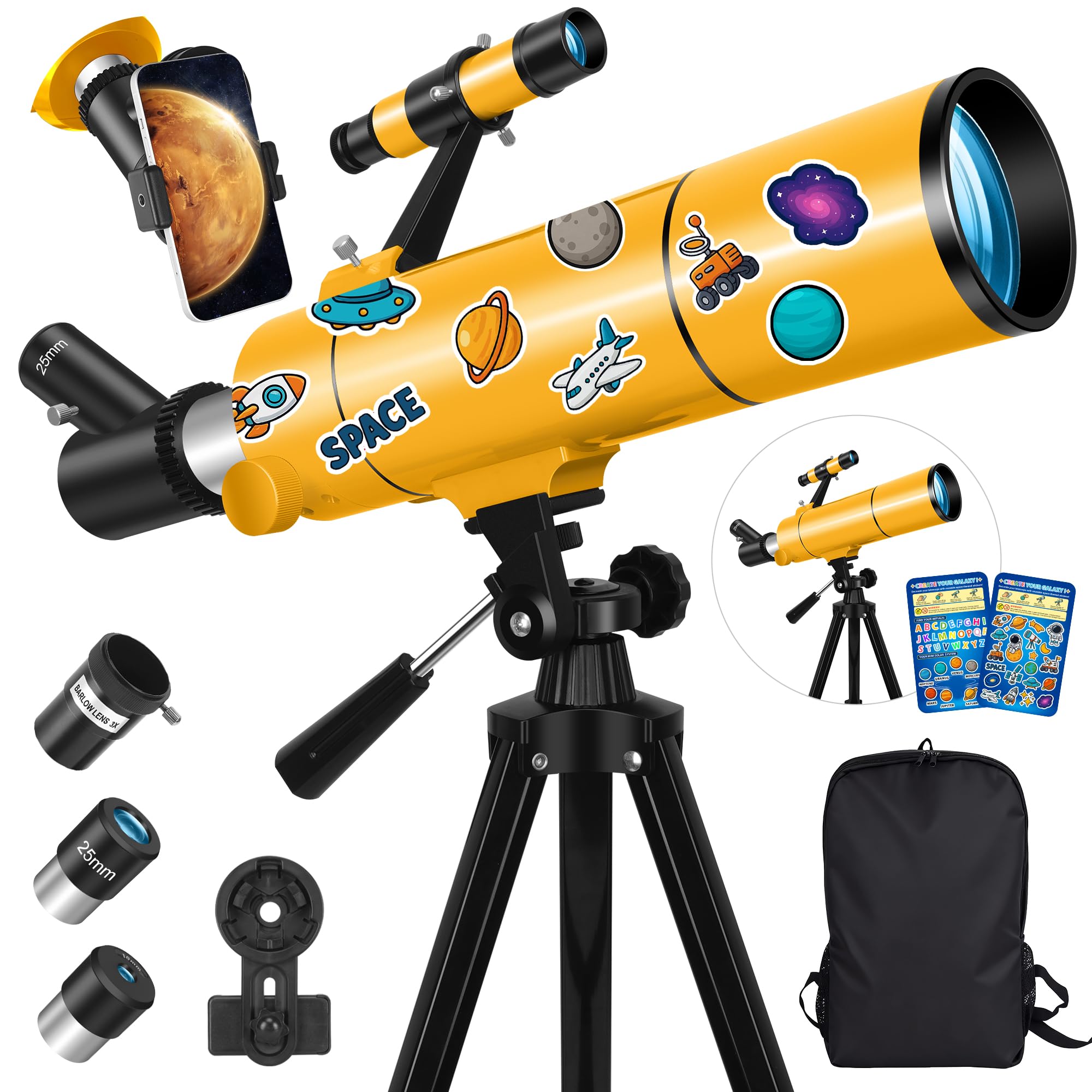
Gskyer 70mm Refractor
Key Features
- Weight: 5.7 lb
- Aperture: 70mm
- Included: Carry bag, phone adapter, wireless remote
- Focal length: 400mm (f/5.7)
- Price: Midrange
The view is where this one earns its keep. A 70mm refractor with a 400mm focal length is enough to turn the Moon into a place with craters and a terminator you can trace with a finger, and enough to show Jupiter as a disc with its four brightest moons strung out in a line beside it. That is the moment a child starts asking questions instead of humoring you, and it is why we keep coming back to this size of scope for beginners.
Assembly is deliberately plain: a couple of bolts, a finder to align, and you are outside. The kit goes further than most at this level, with a carry bag, a phone adapter and a wireless remote. The adapter is the part we rate highest — a photo of the Moon is something a kid can show a grandparent, and the remote means the shot does not shake when they tap the shutter.
The compromises sit at the high-power end. Screw in the 3x Barlow with the shorter eyepiece and the image dims, softens and becomes fussy to focus, while the light aluminum tripod turns every touch into a wobble. At the low and medium powers where a beginner spends nearly all their time, neither is a problem. There is also no moon filter in the box, and a full Moon through this scope is bright enough to make you squint.
For most families this is the telescope to buy: light enough at 5.7 pounds to carry out in one hand, simple enough that a child can run the focuser, and bright enough that the Moon looks like the Moon. The buyer we send elsewhere is the parent of a planet-obsessed kid, where the Koolpte’s 80mm aperture shows more on Jupiter, or the family whose stargazing happens away from home, where the Celestron packs smaller.
Pros
- Real lunar detail from a 70mm lens
- Bag, phone adapter and remote included
- Quick, tool-light first assembly
- Light enough to move in one hand
Cons
- Dim, fussy image with the Barlow at high power
- No moon filter in the kit
We recommend it without much hedging: it is the easiest of these to live with, bright enough on the Moon to hold a child’s attention, and sold as a complete kit rather than a tube you will spend another season accessorizing.
Best for Planet Spotting
Koolpte 80mm Refractor
Key Features
- Aperture: 80mm
- Included: Carry bag, phone adapter, wireless remote
- Eyepieces: 25mm and 10mm
- Focal length: 600mm (f/6.7)
- Price: Premium
The step from 70mm to 80mm of aperture is the difference between a planet being a bright dot and being a disc. The Koolpte’s 80mm objective gathers noticeably more light, and its 600mm focal length gets 24x and 60x out of the two supplied eyepieces before the 3x Barlow triples either one. We think that combination is what keeps a scope in use past the first month: Jupiter and its moons are genuinely exciting through 80mm, and that is the view that sends a kid running to fetch a parent.
Setup asks nothing of you. No tools, no collimation, no alignment ritual, and the whole thing packs into the included carry bag with the phone adapter and wireless remote. The eyepieces are easy for a child to swap, the mount moves by hand in two directions, and nothing about the first evening requires an adult who knows astronomy.
It is the most expensive of the 80mm refractors in this group, and that is the whole case against it. The CELTICBIRD adds a moon filter for less, and the MEEZAA gives you the same aperture for less again. What the extra buys is a 600mm focal length matched only by the CELTICBIRD here, plus the widest magnification spread of the three. Buy it when the interest is already real.
Pros
- 80mm aperture shows planets as discs
- 24x to 180x from the supplied optics
- No-tool assembly with bag and remote
- Lifetime maintenance from the maker
Cons
- Priciest 80mm refractor in this group
Buy this one if the child in your life has already asked what Saturn looks like: the 80mm aperture and 600mm focal length answer the question, and the kit needs nothing added on day one.
Best for Younger Kids
MEEZAA 80mm Refractor
Key Features
- Aperture: 80mm
- Focal length: 500mm
- Magnification: 20X–150X
- Tripod height: 16.92–44.48 inches
- Price: Budget
The specification that matters most on the MEEZAA is not optical. Its aluminum tripod adjusts down to 16.92 inches, low enough for a six- or seven-year-old to sit on a step and look straight into the eyepiece. That sounds like a small thing until you have watched a child stand on tiptoe, lean in, and knock the tube off target for the fourth time.
The optics hold up their end too. Eighty millimetres of aperture and a 500mm focal length give the same light grasp as the pricier 80mm scopes here, with 20x to 150x available across the 25mm and 10mm eyepieces and the 3x Barlow. We rate it the value pick of the group: a waterproof backpack, a finder, a phone adapter and even a sheet of stickers, for less than our top pick. The stickers are a genuinely smart inclusion — a kid who decorates the tube owns the telescope.
Where it lands relative to that top pick is straightforward. The Gskyer is the more complete first kit and the one to hand families who want to be told what to buy. The MEEZAA gives you more aperture and a tripod a small child can actually sit at, for less money, which makes it the better buy whenever reach is the deciding factor.
Pros
- Tripod drops to 16.92 inches for small kids
- 80mm aperture for a budget price
- Waterproof backpack and phone adapter included
Cons
- Dim, hard-to-focus image at its 150x maximum
The pick for younger kids: 80mm of aperture, a tripod that drops low enough for a child to sit at the eyepiece, and the lowest price of any 80mm scope here.
Best for Camping and Travel
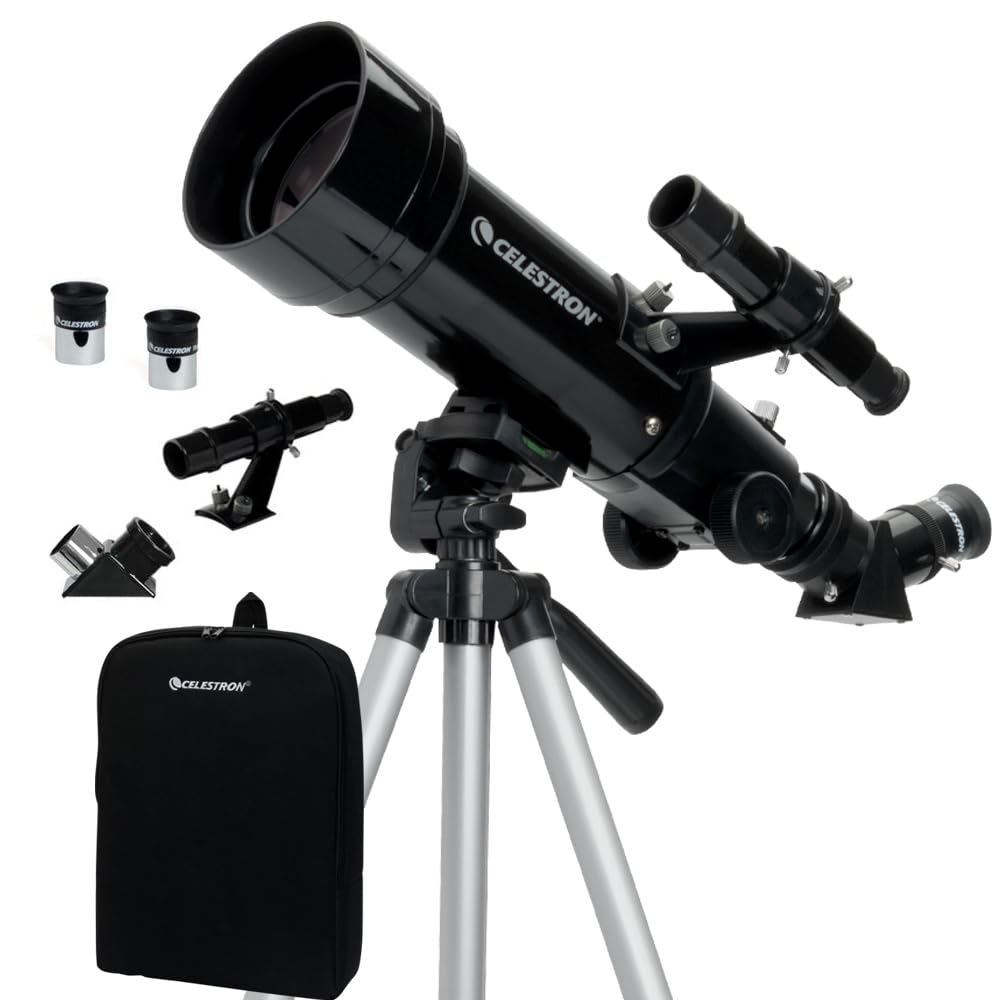
Celestron Travel Scope 70
Key Features
- Weight: 4.2 lb
- Aperture: 70mm
- Eyepieces: 20mm and 10mm
- Focal length: 400mm
- Price: Midrange
Four point two pounds, a 17-inch tube and a padded backpack: the Travel Scope is the one in this group you can genuinely take somewhere. That matters more than it sounds. A telescope that lives in a closet gets used a handful of times, while one that fits in the trunk next to the camping gear gets used every clear weekend.
The kit is thoughtful for a beginner. The 20mm and 10mm eyepieces give 20x and 40x, and the 45-degree erect-image diagonal means the view arrives the right way up, so the same scope works on birds, boats and distant hills during the day. Setup needs no tools, and the bundled Starry Night software gives a child something to explore on cloudy nights.
The tripod is where Celestron saved the money, and it is the one thing to know before you order. It is a light camera-style mount, and at 40x a finger on the focuser sends a shiver through the image. On grass, with the legs kept short, it is manageable — but a child who grabs the tube to point it will lose the target every time. Packability is why it is here; the mount is what you accept in exchange for 4.2 pounds.
Pros
- Packs into a backpack at 4.2 pounds
- Erect-image diagonal for daytime viewing
- No-tool setup in seconds
Cons
- Tripod shivers whenever you touch the focuser
Choose it when the telescope’s life will be in a car or a backpack — it packs smaller and lighter than anything else here, as long as you can live with a shaky mount.
Best for Moon Viewing
CELTICBIRD 80mm Refractor

Key Features
- Weight: 5.8 lb
- Aperture: 80mm
- Eyepieces: 20mm and 9mm
- Focal length: 600mm
- Price: Midrange
A moon filter is the accessory most beginner kits leave out, and it is the one that gets used on the very first night. A full Moon through an 80mm scope is uncomfortably bright: you squint, your eye waters, and the detail you bought the scope for washes out. The CELTICBIRD includes the filter, and that small inclusion tells you somebody at the company actually looked through their own product.
The rest of the package is sensible. Eighty millimetres of aperture, a 600mm focal length, 20mm and 9mm Kellner eyepieces that give 30x and 66x, a phone adapter, an adjustable aluminum tripod and a backpack that swallows the lot. At 5.8 pounds it is a two-hand carry for a child, but the tube is short enough that getting it out to the yard is not an expedition.
That makes it a lunar specialist, and a good one. If your child’s interest is the Moon — its craters, its terminator, the way the shadows shift through the month — this is the most complete kit here for the money. If they are already asking about Saturn, put the budget toward the Koolpte instead, because the extra power matters more than the filter at that point.
Pros
- Moon filter included for lunar glare
- 600mm focal length for close lunar views
- Three-year service commitment
Cons
- No Barlow, so 66x is the ceiling
For a child whose interest is the Moon rather than the planets, this kit does more on the first night than anything else here, moon filter included.
Best for Lowest Cost
ECOOPRO 70mm Refractor

Key Features
- Weight: 3.09 lb
- Aperture: 70mm
- Eyepieces: K25mm and K10mm
- Focal length: 360mm
- Price: Budget
The ECOOPRO is the cheapest way into a real refractor here, and it is a real one: 70mm of aperture, a 360mm focal length, two Kellner eyepieces, a 5×24 finder and a phone adapter. It goes together without tools, and at 1.4 kilograms it is light enough that a child can carry it out alone.
Where the savings show up is the mount. The tripod is light and the adjustment is touchy, so the view drifts while you are focusing and shifts again when a small hand grabs the tube. That is survivable for the Moon at low power and frustrating for anything smaller. Which makes it a specific buy rather than a general recommendation: a first scope for a child who has not asked for one, where the cost of finding out whether the interest is real stays low. Expect to want a better mount before you want a better telescope.
Pros
- Cheapest genuine refractor in this group
- Tool-free setup and a phone adapter
- Light enough for a child to carry
Cons
- Tripod drifts and wobbles while focusing
It earns a place as a low-cost way to find out whether a child actually likes stargazing, and it asks you to accept a flimsy mount in exchange.
Best for Ages 5 to 6
LeapFrog Magic Adventures

Key Features
- Zoom: Up to 110x
- Screen: 2.4 in
- Age range: 5 years and up
- Batteries: 4 AA
- Price: Midrange
There is no eyepiece on the LeapFrog. You look at a 2.4-inch screen showing what the digital sensor sees, with up to 110x zoom. Optically that is a compromise and we will not pretend otherwise — but it solves the problem that ends most five-year-olds’ astronomy sessions in ten minutes, which is the business of lining one eye up with a tiny hole in the dark.
What it does, it does well. A child points it at the Moon and sees the Moon, immediately, on a screen they already know how to look at. The 100-plus NASA videos and images give them something to do on cloudy nights, the spacecraft game is the reason a lot of them come back to it, and the tripod detaches so the whole thing can sit on a picnic table. Budget for AA batteries, because the included set is for demonstration only.
We think of it as a space-enthusiasm machine with a telescope attached, and that is a fair description of what you are buying. Past the Moon there is very little to see, and the screen is hard to read in daylight. For a five- or six-year-old it is the right first step and a genuinely delightful one; for an eight-year-old who wants to find Saturn, buy a refractor instead — the MEEZAA does more for less.
Pros
- Screen makes the Moon instantly visible
- 100-plus NASA videos and images included
- Detachable tripod sits on a table
Cons
- Not an eyepiece view of the sky
- Little to see beyond the Moon
The right first telescope for a five- or six-year-old who cannot yet manage an eyepiece, and the wrong one for anyone older.
How We Chose the Best Telescopes for Kids
We started by pulling together every kids telescope we could find from established optics brands and toy companies, then cut anything with a plastic eyepiece, a tripod that wobbled on the showroom floor, or a magnification claim that seemed aimed at grandparents rather than kids. That left 12 scopes, which we tested over eight months.
We handed each scope to kids ages 6 to 10 with the instruction booklet and a timer. We watched whether they could assemble it, focus it, and find the moon without an adult stepping in—and noted where they got stuck, like a finder scope that was misaligned out of the box or a tripod knob too stiff for small hands.
On clear nights, we looked at the moon, Jupiter, Saturn, and whatever bright star was handy, plus a bird feeder across the yard during the day. We bumped the tripod gently to see how long the image took to settle, and we tracked how much detail held up at higher magnifications. We also packed each scope into the car for a weekend camping trip and checked the joints, lens caps, and focuser afterward.
At the end, we compared what came in the box—eyepieces, finder, carrying case—against what a family actually needs to get started, and we noted which ones felt like a real gift rather than a toy that would be abandoned by the second week. After eight months, we checked for loose screws, scratched lenses, and mounts that had developed a wobble.
How to Choose a Kids Telescope
The telescope that gets used is the one that is easy to aim, steady enough to focus, and pointed at something worth seeing — everything else on the box is decoration.
Aperture First, Magnification Second
The figure that decides what your child can see is the aperture, the diameter of the front lens. A 70mm scope gathers enough light to show lunar craters and Jupiter’s four big moons; 80mm adds brightness and lets you push the power a little further before the image falls apart. Magnification on its own tells you almost nothing, and the biggest numbers are usually the emptiest: 450x through an 80mm lens on an ordinary night is a blurry mess.
Our advice is to shop for 70mm or 80mm and a focal length between 400mm and 600mm, and to treat anything advertising much beyond 150x as a warning rather than a feature. A short tube with a long eyepiece beats a long number on the carton.
The Mount, the Height and the Carry Bag
An altazimuth mount, the simple up-down and left-right kind on every pick here, is the right choice for a beginner; an equatorial mount is a puzzle a child does not need yet. What separates a usable one from a frustrating one is rigidity. Light aluminum tripods pass every touch straight into the eyepiece, so the view swims exactly when you are trying to focus.
Two figures tell you most of it. The tripod’s lowest height decides whether a small child can sit at the eyepiece, and the packed weight decides whether the scope ever leaves the house. Four to six pounds is a one-hand carry for an adult and a two-hand carry for an older child, and a bag with room for the tripod is worth more than an extra eyepiece.
Eyepieces, Finders and the Rest of the Kit
Two eyepieces and a 3x Barlow is the standard package, and it covers more ground than a beginner needs. The long eyepiece, 20mm to 25mm, is the one that gets used: wide, bright and easy to aim. The short one gives more power and a dimmer, narrower view. A Barlow multiplies whatever you already have, which is handy for the Moon and close to useless on anything faint.
The finder matters more than either. Without one that is aligned, a child is hunting the sky by guesswork, so take five minutes under a streetlight to line it up before dark. We rate a phone adapter above a Barlow: a photograph of the Moon is something a kid can show someone, and that is what keeps a hobby alive.
What They Will Actually See
Set expectations before the first clear night, because they are the difference between wonder and disappointment. The Moon is spectacular and easy. Jupiter shows as a bright disc with up to four moons in a line, and Saturn is a small oval whose rings you can just make out on a steady night. Mars is an orange dot and most galaxies are grey smudges that city light erases.
A 70mm or 80mm refractor is a Moon-and-planets instrument, and a wonderful one. Tell a child that before they look, and the first night lands as a discovery instead of a letdown.
Frequently Asked Questions
What else do we need for the first night?
A red-light flashlight so you can read without wrecking your night vision, warm clothes, and a free sky app or printed star chart to point you at the Moon. Look up the Moon’s phase for the evening: a half Moon shows far more crater shadow than a full one.
If you bought the LeapFrog, add a pack of AA batteries. The set in the box is for demonstration and will not last an evening.
Can a kids telescope be used during the day?
Yes, and it is the best way to practise. Aim at a distant tree or a bird and you learn the finder and the focuser while everything is easy to see. Pick a model with an erect-image diagonal, like the Celestron, or the daytime view arrives upside down.
Never point any telescope at or near the Sun, and keep the lens cap on between looks.
How old does a child need to be to use one alone?
Around seven or eight, most kids can aim at the Moon with a finder and focus it themselves. Younger than that, plan to do the aiming while they do the looking.
Height matters as much as age. Check that the tripod drops low enough for them to reach the eyepiece without climbing; the MEEZAA goes down to 16.92 inches, which suits a seated six-year-old.
Final Verdict
Weigh the decision on the mount and the first night’s view, and the Gskyer is still the telescope we point most families toward: it shows the Moon properly, it sets up without a fight, and nothing in the box needs replacing before the first clear weekend.
Buy the Koolpte instead if the child has already started asking about planets and you want the aperture to answer them. And if the child is five, skip both and get the LeapFrog — a screen they can use beats an eyepiece they cannot.