This post contains affiliate links. We may earn a small commission when you buy through our links — at no extra cost to you.
A convertible car seat has to earn its keep twice — first as a rear-facing seat for an infant, then as a forward-facing one for a preschooler with opinions about the cup holder. That long run is the appeal, and also the anxiety. The install has to lock down solid with a seat belt or LATCH, the harness has to snug a wiggly kid without pinching, the padding has to survive two years of crackers and slammed doors, and the price has to make sense for something you’ll use every single day for six years.
Over the past eight months I’ve installed 10 convertible car seats in a compact back seat, a minivan, and a borrowed pickup, usually with a toddler supervising from the driveway. The surprise: a seat that clicks in effortlessly in one car can fight you for twenty minutes in another, so vehicle fit matters as much as the seat itself. The ones worth your money are below.


Best for Extended Rear-Facing
Graco Extend2Fit 2-in-1
Key Features
- Rear-facing: 4-50 lb
- Seat weight: 19 lb
- Extra legroom: Up to 5 in
- Forward-facing: 26.5-65 lb
- Price: Midrange
Fifty pounds is the number that decides this seat. The Extend2Fit keeps a child rear-facing to 50 pounds and 49 inches, further than anything else in this guide, and the panel behind their feet pulls out through four positions for up to 5 inches of extra legroom. That second part matters more than it sounds: the usual reason a toddler gets turned around early is that their knees are up near their ears, not that they have hit a limit.
So this is the seat we point most families to first. Rear-facing is where a convertible does the most work, and this one does it longer than the SlimFit or the Grow and Go for the same money as the Graco beside it. The no-rethread harness is the other thing we keep coming back to: lift the headrest and the straps travel with it, so a growth spurt is a two-second adjustment instead of an afternoon with the manual.
The harness adjuster is the part that irritates. The pull strap wants a firm, deliberate tug rather than a quick one, and the webbing twists if you let it bunch at the shoulder. Smooth the straps flat before you pull and it takes up slack cleanly, and that habit covers most of the complaint — worth knowing before you commit if you have weak grip or arthritis in your hands.
Installation is the quiet strength. Lower anchors or the seatbelt, and the seat settles without the wrestling match a couple of these require. At 19 pounds it is a two-handed lift between cars, fine for a permanent spot in one vehicle and less fun if it moves twice a week.
Pros
- Rear-faces to 50 pounds, the longest reach here
- Five inches of extra legroom for rear-facing toddlers
- Headrest and harness adjust together, no rethreading
Cons
- No booster stage after the 65-pound harness
We recommend the Extend2Fit to most families because it buys the most rear-facing time of anything here, and the legroom panel is what actually keeps a toddler facing backward.
Best for Three Across
Graco SlimFit 3-in-1
Key Features
- Booster: 40-100 lb
- Rear-facing: 5-40 lb
- Seat weight: 19.5 lb
- Forward-facing: 22-65 lb
- Price: Midrange
The SlimFit costs the same as our top pick and adds a stage: it starts at 5 pounds rear-facing, runs to 65 pounds forward-facing, then becomes a belt-positioning booster rated to 100 pounds. That last step is why we hand it to families who want to stop shopping, and the shape is why we hand it to families with three children in the second row.
The three-across reputation comes from shape rather than footprint. The cup holders rotate out of the way, the sides sit low, and the base is compact enough to sit beside two other seats without a fight. It works in a lot of mid-size SUVs and gets tight in smaller crossovers, so measure the second row before you count on it.
Those low sides earn their keep every morning. A heavy toddler goes in over the edge instead of up and over a wall of plastic, which is the difference between a calm drop-off and a wrestling match at the curb. The headrest and harness rise together, so nobody is rethreading straps in a parking lot.
The real trade against the Extend2Fit is time spent backward. This seat’s rear-facing limit is 40 pounds against 50 on the top pick, and a heavy toddler reaches it sooner than feels comfortable, well before the booster stage is anywhere in sight. Buy it for the years at the end, not for the longest possible stretch facing the rear window.
Pros
- Three stages ending in a 100-pound booster
- Fits three across in many mid-size back seats
- Low sides make loading a toddler easier
Cons
- Body is wider than the slim name implies
If you need three seats across a second row or want one seat to carry a child from newborn to booster, the SlimFit is the one we point you to.
Best for Budget Travel Seat
Safety 1st Grow and Go
Key Features
- Booster: 40-100 lb
- Rear-facing: 5-40 lb
- Seat weight: 13.2 lb
- Forward-facing: 30-65 lb
- Price: Budget
The Grow and Go weighs 13.2 pounds, and that number is most of the argument. A seat that lives in a closet and comes out for weekends — the grandparent car, the second vehicle, the one that goes to the sitter — gets moved constantly, and shaving several pounds off the lift pays off more often than any feature here. It also sits at the budget end of this guide alongside the Cover Me.
Installation splits by direction. Forward-facing, it goes in quickly with the lower anchors or the seatbelt. Rear-facing is the version that takes patience: the belt path and recline angle are less forgiving than the Gracos, and the first attempt in a hurry is the one that goes wrong. Do that first install in daylight with the manual open, and check the angle again after the seat has been in and out a few times.
Padding is where it punches above its price. The cushioning is genuinely soft, softer than seats costing considerably more, and the pad unclips and goes in the machine without pulling the harness out. The cup holders are dishwasher-safe, which sounds trivial until the first cup of milk comes back. The QuickFit headrest raises the harness with it, so growing room is a one-handed job.
Depth is the measurement to check before you order: at 24 inches front to back it takes more room than either Graco, so behind a driver who sits well back, try the fit with the seat reclined for rear-facing.
Pros
- Lightest seat in this guide at 13.2 pounds
- Three stages to a 100-pound booster at a budget price
- Soft padding and a machine-washable pad
Cons
- Harness adjuster sticks and needs several pulls
For a tight budget or a seat that gets carried between cars, the Grow and Go covers three stages in the lightest body here.
Best for Sunny Back Seats
Baby Trend Cover Me
Key Features
- Canopy: UPF 50+, adjustable
- Rear-facing: 4-40 lb
- Seat weight: 18 lb
- Forward-facing: 30-100 lb
- Price: Budget
A canopy on a car seat sounds like a gimmick until you drive west into a low winter sun with a toddler screaming behind you. The Cover Me’s shade is built into the shell, adjusts for height and angle, carries UPF 50+, and is simple enough that a child old enough to reach can nudge it themselves. Nothing else in this guide has one, and that alone earns it a place.
Under the canopy sits a sensible 4-in-1: rear-facing from 4 pounds to 40, then a forward-facing harness and a booster rated to 100 pounds, for less than either Graco. Between the two budget seats here, this is the one we take when sun is the daily problem, and its 18.25-inch body is narrow enough to sit beside another seat without a fight.
The trade is height. The canopy structure makes this the tallest shell in the guide at 30.5 inches, which can crowd the view out of a low rear window and leaves less room under a sloping roofline. In a minivan or a mid-size SUV it disappears into the cabin; in a small hatchback, put it behind the passenger seat rather than behind yourself.
Pros
- Built-in UPF 50+ canopy, unique in this guide
- Four stages from 4 pounds to a 100-pound rating
- Narrow 18.25-inch body for tight back seats
Cons
- Straps twist and need smoothing before tightening
Buy the Cover Me if sun in the back seat is a daily problem; the canopy is the whole reason, and its budget price keeps the compromise small.
Best for Newborn Comfort
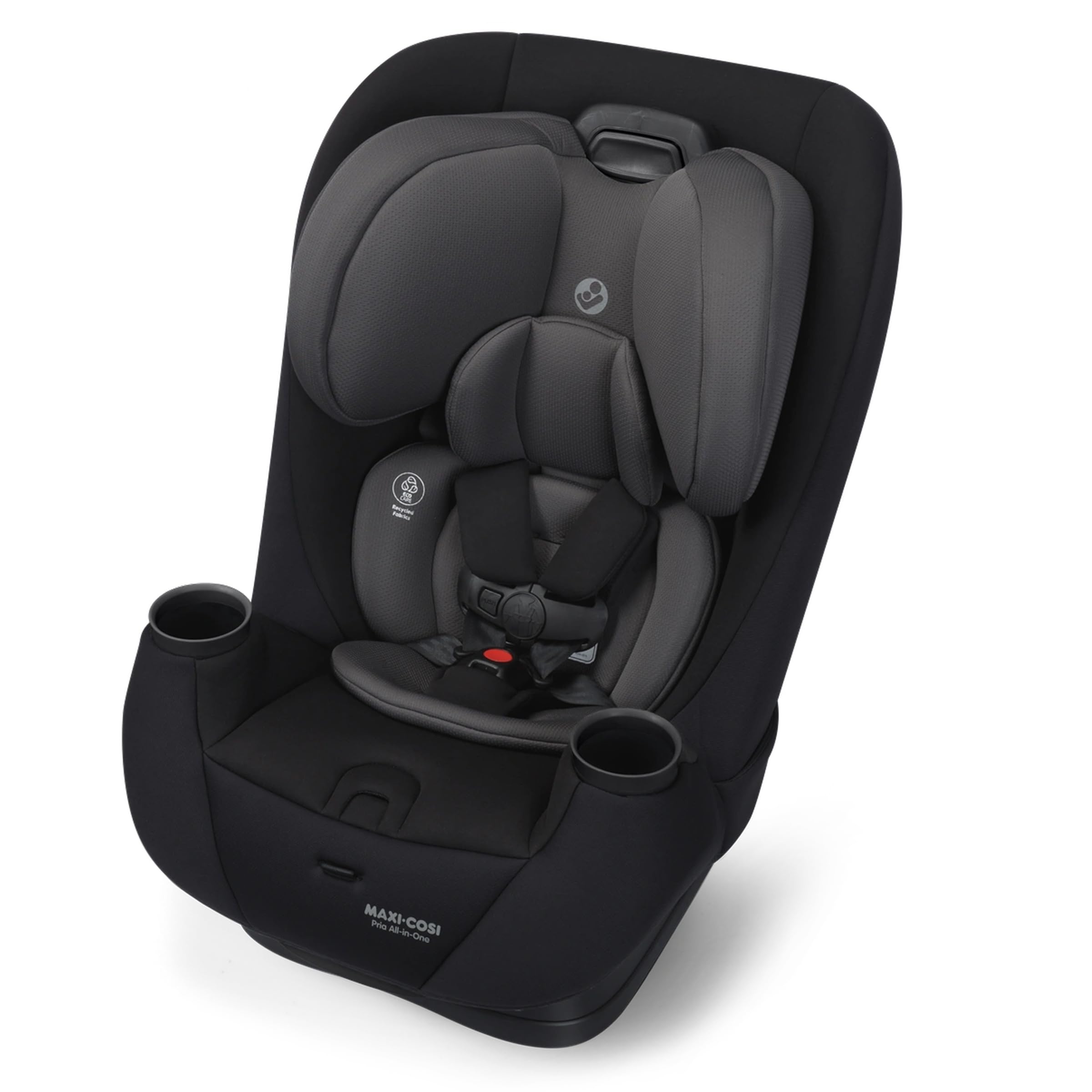
Maxi-Cosi Pria
Key Features
- Booster: 40-100 lb
- Rear-facing: 5-40 lb
- Seat weight: 16.5 lb
- Forward-facing: 30-65 lb
- Price: Midrange
The Pria is the seat you notice with your hands. The padding is thick, the fabric is soft enough that a baby settles into it, and the removable infant pillows mean a small newborn is supported instead of swimming in a seat built for a four-year-old. If you have a baby who sleeps in the car, this is the one here that makes it easiest.
It is a 3-in-1: rear-facing from 5 to 40 pounds, a forward-facing harness to 65, then a belt-positioning booster to 100, with a one-hand headrest that raises the harness with it. At 16.5 pounds it is lighter than either Graco, and the three-position recline makes a comfortable rear-facing angle easier to find in a car with sloped seats.
Where it falls behind is the long game. Forty pounds rear-facing and 65 forward means a big preschooler outgrows it before the cheaper Gracos do, and the fabric is the first thing to look tired. The harness can also work loose enough that checking tension every time you buckle stops being optional. None of that changes our view of it as the most comfortable seat here for a baby: the Pria is a comfort purchase, and the first two years are what you are paying for.
Pros
- Plush padding and soft fabric for newborns
- One-hand headrest raises the harness with it
- Lighter than either Graco at 16.5 pounds
Cons
- Deep shell takes front-seat legroom
The Pria is the pick when plush padding and soft fabric matter more than long-term reach; newborns and car nappers do especially well in it.
How We Tested the Best Convertible Car Seats
We started with roughly 30 convertible car seats and cut the list using height and weight limits, the number of harness and recline positions, vehicle fit notes from owner reviews, and price spread, then bought 10 of them ourselves and lived with each for eight months. Every seat went into at least two vehicles, because a seat that locks down easily in one back seat can be a wrestling match in another.
Installation got the most attention. We timed how long a solo install took with the seat belt and again with LATCH, pushed hard at the belt path to see whether the shell budged, checked the recline indicator on sloped back seats, then left each seat installed for a week and re-checked tightness. With a real child buckled in, we did the pinch test at the collarbone to see how easily the harness straps snugged down and whether the chest clip stayed level instead of riding up.
Over the months we moved harness heights and crotch-buckle positions through the full growth range, converted each seat from rear- to forward-facing, and noted which adjustments could be done one-handed with a kid already in the seat. Comfort revealed itself on two-hour drives and nap-heavy afternoons; fit came down to small things, like whether the buckle dug into a thigh or the headrest pushed a sleeping head forward.
Durability and value came last. We washed covers the way each manual specified and noted which ones pilled or shrank, vacuumed crumbs out of every crevice, and re-checked the install after months of daily school runs. Value judgments came down to what a seat gave us beyond the basics, not the sticker price.
How to Choose a Convertible Car Seat
The most useful comparison you can make is how long each seat rear-faces, because everything else is a comfort or convenience decision layered on top of that one.
Start with the rear-facing limits
The mode count on the box — 2-in-1, 3-in-1, 4-in-1 — tells you how a seat ends its life, not how long your child rides backward, and backward is the stage that does the most work. Compare the rear-facing weight and height limits instead. In this group they run from 40 to 50 pounds, and the Extend2Fit’s 50 pounds plus its legroom panel is a real advantage for a heavy or tall toddler. Check the height limit as well: plenty of children top out of the shell before they hit the weight.
Installation is the safety feature
A correctly installed seat with a snug harness beats a more expensive seat installed badly. Lower anchors and the seatbelt are both legitimate; the seatbelt path is what you will use in the middle seating position, since many vehicles put no anchors there. Whichever you use, the seat should not move more than an inch side to side at the belt path, and the top tether goes on whenever the seat faces forward. If a seat fights your car every single time, that is the purchase to reconsider, not something to live with.
Try the harness adjuster before you commit
Every seat here takes up slack with a front pull strap, and that strap is where the biggest daily annoyance lives. Some adjusters glide; others want an unhurried two-handed pull, and twisted webbing is the usual reason a strap refuses to tighten. Look for a no-rethread headrest, which raises the harness height along with the headrest in one motion. If you have arthritis or a weak grip, buckle and tighten the exact seat you are considering before you buy it rather than after.
Width, depth, and seat weight
A convertible seat has to fit the car, not just the child. Width decides three across — the bodies in this guide run from 18.25 to 22.2 inches — while depth decides whether the front passenger keeps their legroom. Weight matters most if the seat moves between vehicles: the spread here is 13.2 to 19.5 pounds, which is the difference between carrying it out one-handed and planning the day around the swap.
Decide whether you will really use the booster
All-in-one seats sell the idea of one purchase covering a childhood, but booster mode only pays off if this is still the seat in your car when your child is six or seven. If a second vehicle, a grandparent, or a hand-me-down takes over first, a seat with a longer rear-facing limit spends your money where it counts. The Extend2Fit is that trade. The SlimFit is the opposite bet: three stages to 100 pounds at the same price.
Frequently Asked Questions
Can you use a convertible car seat for a newborn?
Yes, provided the seat’s rear-facing minimum is at or below your baby’s weight — the seats here start at 4 or 5 pounds — and the harness sits at or below the shoulders with the infant padding in place. Leave that padding in until your baby outgrows it rather than pulling it early. If your baby arrived small or early, check the harness on its smallest setting before you leave the hospital.
Can I take a convertible car seat on a plane?
Only if the seat carries the FAA-approved label, which is what the cabin crew will look for. These are 13 to 20 pounds and 18 to 22 inches wide, though, and several will not sit comfortably in an economy seat, so a convertible is usually better left in the car. For a single trip, a lightweight travel seat or an infant carrier is the easier answer.
How do I clean a car seat?
Unclip the seat pad without pulling the harness out — the Grow and Go’s cushion comes off that way — and wash it to the care label, which on some pads allows the dryer. Harness straps should be spot-cleaned with mild soap and water and never submerged or machine washed. Cup holders like the Grow and Go’s are dishwasher-safe, and a quick vacuum of the buckle and belt path keeps grit from making the buckle stiff.
Final Verdict
Most families should buy the Graco Extend2Fit. It rear-faces to 50 pounds and 49 inches, gives a toddler five extra inches of legroom to make that time bearable, and costs the same as the seats here that stop at 40. The harness adjuster is fussier than it should be, and it will not be the last seat you buy — but it is the one that keeps a child facing backward longest, which is the job.
If three seats have to fit across a second row, or you want the booster stage at the end, take the SlimFit instead. If the seat travels between cars and the budget is fixed, the Grow and Go’s 13.2 pounds is the deciding argument.
