This post contains affiliate links. We may earn a small commission when you buy through our links — at no extra cost to you.
A baby’s first utensil is not a small adult spoon. The handle has to be short enough that a fist wrapped around it still reaches the mouth, the head has to be soft enough to bite down on, and the whole thing has to survive being flung onto the floor forty times a day. Get those three things wrong and mealtime becomes a wrestling match with a very small, very opinionated opponent. The right spoon or fork instead lets a six- or seven-month-old actually feed themselves, which is the entire point of baby-led weaning.
My team and I have spent the past four months putting 16 utensils through that gauntlet, and the differences show up fast. The ones that work share a handle a baby can hold without white-knuckling it and a head shallow enough that food stays on the way up. Cleaning matters more than most parents expect, too: anything with a deep scoop or a two-piece design ends up with sweet potato in a seam you can’t reach. What follows is what survived breakfast, lunch, dinner, and the drop test.


Best for First Self-Feeding
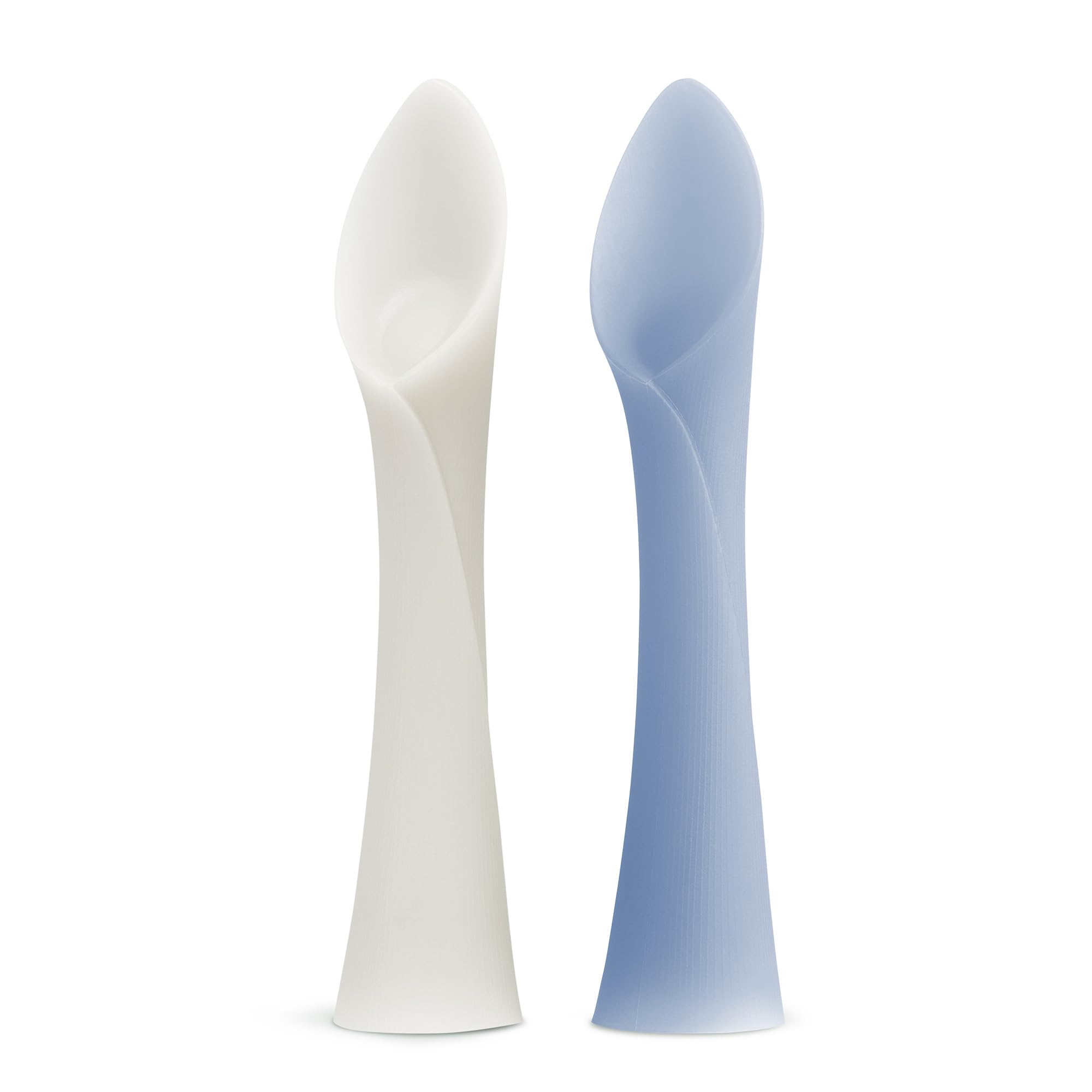
Olababy Silicone Training Spoon
Key Features
- Pieces: 2 training spoons
- Material: 100% food-grade silicone
- Heat safe: Up to 428F/ 220C
- Recommended age: 6 to 18 months
- Price: Premium
A seven-month-old holds a spoon in a fist, not a pencil grip, and the Olababy spoon is built around that. The handle is short and thick enough to disappear into the palm, and the business end is a thin silicone leaf rather than a bowl. The leaf flexes, so it does not need aiming: a baby can drag it through yogurt at any angle and still come up with food on it. That flex is the whole trick, and it is why this one beats every other spoon here at the very first meal.
It also stands up. The base is flat enough that the spoon stays upright on the tray when it gets dropped, so the tip is not lying in a puddle of purée — and mid-meal, a spoon gets put down a dozen times. The silicone is soft enough for a gumming baby to chew between bites and thick enough not to collapse in the process. Dishwasher, microwave and freezer safe, heat safe to 428F/ 220C, and ours have come out of the wash in the same shape they went in.
There is no fork in the box, so this is a spoon-only answer until your baby starts wanting to spear things; the Bumkins pair or the PandaEar metal set covers that stage. What we keep coming back to is how long this stays useful — a dipper at six months, a scooper at twelve, and a teether in between.
Pros
- Flexible tip scoops at any angle
- Stands upright between bites
- Soft enough to chew between bites
- Dishwasher, microwave and freezer safe
Cons
- Just two spoons per pack
- Premium price for a two-spoon set
For most babies starting solids, this is the spoon we recommend: soft, easy to hold in a fist, and shaped so a baby can actually get food into their mouth.
Best for Earliest Eaters
NumNum Pre-Spoon
Key Features
- Care: Dishwasher safe
- Head: Flat dipper, no wrong way up
- Pieces: 6 pre-spoons
- Recommended age: 6 to 18 months
- Price: Premium
The NumNum Pre-Spoon answers a question most first spoons ignore: what if the baby cannot scoop? A six- or seven-month-old does not have the wrist rotation to shovel food out of a bowl, so the head here is flat — a textured paddle you dip rather than scoop. There is no wrong way up, which means a baby can wave it around and still arrive at their mouth with something on it.
In our testing it earned its place for a few months and then gave it up. Once a baby works out that a bowl holds more than a paddle, the flat head becomes the thing they have outgrown, and the spoon that gets picked up again is a scooped one. That is not a fault, just a short window — treat this as the bridge between fingers and a real spoon.
Texture is the other limit. The flat head holds thick yogurt and porridge well, but a watery first purée slides straight off, so it is a thick-texture tool. The six-pack, which looks excessive at first, turned out to be about right: these live in the diaper bag and the dishwasher in equal measure. And it doubles as a teether, which is how a good number of babies use it before they use it for food.
Pros
- No wrong way up for early eaters
- Doubles as a teether
- Six in the pack, so one is always clean
Cons
- Grooved head takes more rinsing
- Premium price for a spoon outgrown in months
Buy this if your baby is six to nine months old and cannot scoop yet — the flat head lets them dip and lift, and it doubles as a teether.
Best for Dipping Stage
Bumkins Chewtensils
Key Features
- Care: Dishwasher safe, boilable
- Pieces: 1 spoon and 1 fork
- Material: Platinum-cured silicone
- Recommended age: 6 months and up
- Price: Midrange
The Bumkins pair is built around one small piece of silicone: a wide collar between the handle and the bowl that stops the spoon sliding too far into a baby’s mouth. It sounds fussy until you watch a six-month-old ram a spoon at the back of their throat, and then it is the reason this pair gets picked up. The spoon head has bumps on the back, and both pieces are soft enough that a baby who is not eating yet still gets something out of holding one.
Where it fits is the dipping stage, roughly six to ten months, when a baby drags a loaded spoon through purée and misses half the time. The silicone has enough give that a baby mashing it against the tray still ends up with food on it, and both pieces go through the dishwasher or a pot of boiling water without complaint.
The grey is the least babyish color in this group and the one that hides carrot and tomato best — worth thinking about, because silicone takes on color over time. Buy it as a first pair and expect to add a metal set when your toddler starts wanting to spear things at the table.
Pros
- Collar limits how far the spoon goes in
- Both pieces soft enough to chew
- Dishwasher and boil safe
Cons
- Fork tines too soft to spear
- Two pieces is a short set
The best first spoon-and-fork pair we tested: the collar stops over-insertion, and the soft silicone is as useful for chewing as for eating.
Best for Confident Toddlers
Munchkin Raise Fork and Spoon
Key Features
- Care: Top-rack dishwasher only
- Material: BPA-free
- Recommended age: 12 months and up
- Standout feature: Rest keeps tips off the table
- Price: Budget
Each piece in the Munchkin set has a small curved foot on the handle that stands it off the table when it is put down, so the tip never lands in a puddle of applesauce. It is a tiny design decision that saves a wipe at every single meal, and it is the reason we keep a set in the drawer.
These are bigger utensils than the silicone first spoons: a fuller bowl, fork tines that actually catch a piece of pasta, and a thick handle that suits a toddler’s grip. The listed starting age is twelve months, and that reads right — a younger baby gets too much food on the spoon at once and finds the fork more tool than they need.
What we like best is that they feel like real cutlery scaled down rather than a toy version, and toddlers notice the difference: a two-year-old eating with these looks like a small person eating, not a baby playing. The fork is the standout of the two, which is not a given in this category.
Pros
- Rest base keeps tips off the table
- Fork that actually picks up food
- Multi-pack leaves spares for the wash
Cons
- Top-rack dishwasher only
- Plastic can stain and wear over time
Once your toddler has the motion down, this is the set we hand over — real-feeling cutlery with a rest that keeps the tip off the tray.
Best for Moving to Metal
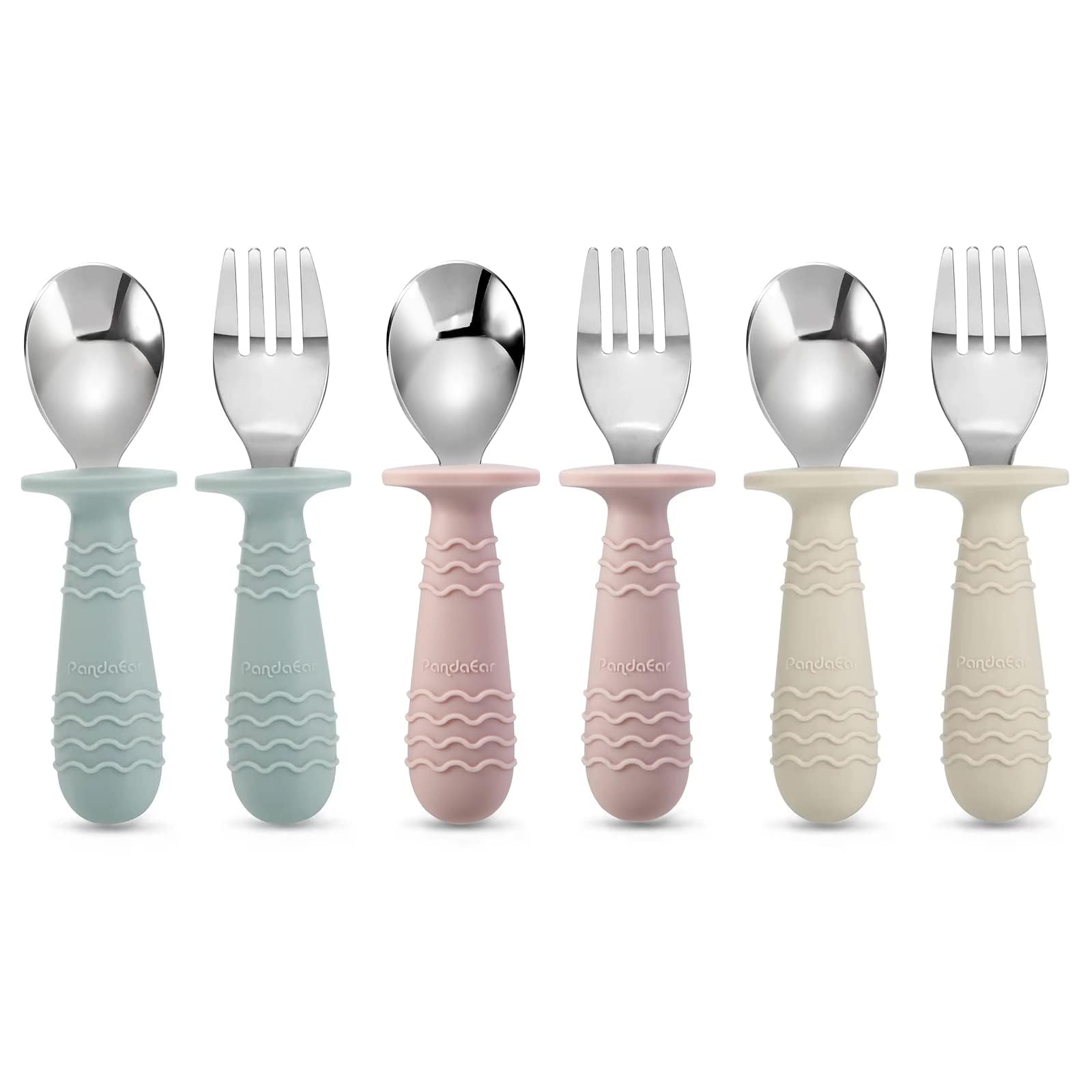
PandaEar Stainless Steel Utensils
Key Features
- Care: Dishwasher safe
- Pieces: 6, spoons and forks
- Material: Stainless steel with silicone
- Edge design: Rounded spoons and tines
- Price: Budget
Six pieces of stainless steel with silicone handles, for less than a two-pack of the specialist spoons in this group — the PandaEar set is the least expensive way here to put real cutlery in a toddler’s hand.
The steel is what makes them useful. A metal spoon scoops a proper bite, and a metal fork spears a piece of pear, which soft tines simply will not do. The edges and tines are rounded, and the silicone collar between handle and head keeps the business end from going too deep, so the safety here is in the shape rather than in softness.
They are light in the hand, the silicone grip holds up to a wet fist, and the dishwasher does the rest. The colors — pink, blue and white — are the loudest in this group, which either suits your kitchen or does not.
What settles it for us is the stage rather than the price. Once a baby is eating more than purée and wants to do what everyone else at the table is doing, metal teaches the motion faster: a toddler who sees a fork actually pick something up keeps trying, where bending tines are a lesson in frustration.
Pros
- Metal spoons and forks that actually work
- Silicone collar guards against over-insertion
- Dishwasher safe and cheap for six pieces
Cons
- Needs closer supervision than silicone
The cheapest route here to real cutlery: stainless steel that spears and scoops, wrapped in silicone so a toddler can hold it safely.
Best for Parent-Led Feeding
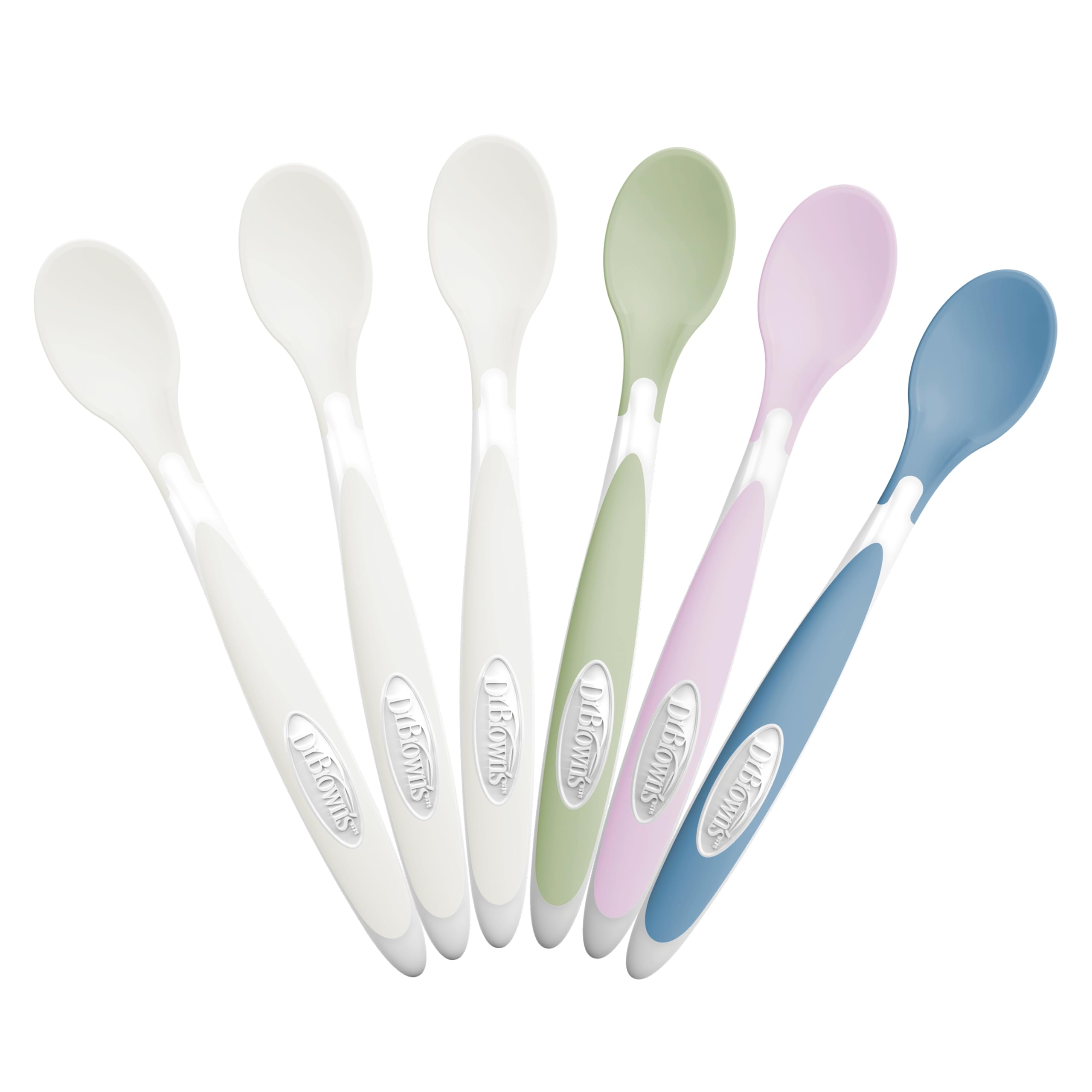
Dr. Brown’s Soft-Tip Spoons
Key Features
- Care: Dishwasher and sterilizer safe
- Scoop: Flexible and shallow
- Pieces: 6 spoons
- Recommended age: 4 months and up
- Price: Budget
The handle on these is longer than anything else here, and that is the point: it reaches the bottom of a jar without your knuckles going in, and it gives you the reach to follow a baby who lunges at the spoon.
The scoop is flexible and shallow — closer to a spatula than a spoon — so it scrapes the last of a purée out of a container and wipes clean against a lip. Soft tips are the other half of that: gentle on a teething gum, quiet against a bowl, and forgiving when a baby grabs the spoon and yanks.
We treat this as the parent’s spoon, not the baby’s. A four-month-old is not holding anything, and by the time a baby is grabbing for the spoon, the long handle becomes leverage they do not need — the spoons that work in a baby’s own hand are shorter and fatter. As the second spoon in a two-spoon feed, though, this set does the job better than anything else in this group, and six in the pack means there is always a clean one.
Pros
- Long handle reaches into jars
- Flexible shallow scoop like a spatula
- Six spoons for a budget outlay
Cons
- Raised base tips over easily
Buy this set for the adult doing the feeding: the long handle reaches into jars and the soft, shallow scoop wipes clean against a baby’s lip.
Best for Budget Starter Set
NETANY Silicone Baby Spoons

Key Features
- Care: Dishwasher safe, boil-proof
- Handle: Bendable, holds its shape
- Pieces: 6 spoons
- Material: 100% food-grade silicone
- Price: Budget
The handle bends and stays where you put it. That reads like a gimmick until you watch a baby try to bring a straight spoon to their mouth from the side; bending the neck toward them meets the hand where it actually is. Set it shallow for a baby just starting, straighten it out as they get the idea.
Of the all-silicone spoons in this group, this is the one we reach for when the angle matters more than the bowl. The tip is soft enough that a teething baby will chew it between bites, and the head is shallow, so a baby gets a sensible amount rather than a mouthful.
Cleaning is the quiet win: the smooth surface rinses off under the tap, and the muted grey does not look like nursery plastic. The pack of six matters more than it sounds — spoons end up in the diaper bag, the dishwasher and under the high chair in roughly equal numbers.
Pros
- Bendable handle holds a set angle
- Soft tip doubles as a teether
- Six spoons in the pack
Cons
- Long handle is a stretch for early self-feeders
A bendable, budget-friendly silicone spoon that lets you set the angle your baby needs — a useful second set more than a first one.
Best for Small Mouths
ezpz Tiny Spoon

Key Features
- Bowl: Narrow, with sensory bumps
- Pieces: 2 spoons
- Material: Food-grade silicone
- Recommended age: 6 months and up
- Price: Premium
The ezpz Tiny Spoon is the most prescriptive spoon here. The bowl is narrow and shallow on purpose, so a baby gets a small, manageable bite rather than a mouthful, and the neck has a slight arc that makes dipping and scooping work from more than one angle.
The bumps on the bowl are the talking point. They are there to give a baby’s tongue and lips something to feel, which the maker links to awareness around gagging. We are careful with that: sensory feedback is real, but how much it changes any one baby’s gagging is not something a spoon can promise. What we can say is that the bumps do not get in the way of the food, and the narrow shape makes a small bite easy to load.
Both spoons in the pack are the same, in food-grade silicone, dishwasher safe, and light enough for a baby to wave around. It was designed with a pediatric feeding specialist, and that shows in the proportions more than in any single feature.
Whether it earns its place comes down to appetite. For a baby who stuffs both fists in and gags on the result, a narrow bowl is a practical answer, and it is the reason this one stays in the roundup.
Pros
- Narrow bowl limits each bite
- Sensory bumps on the bowl
- Designed with a pediatric feeding specialist
Cons
- Slimmer handle is harder for a fist grip
- Costs more per spoon than anything else here
The pick for a baby who takes huge bites: the narrow bowl limits each mouthful, and the sensory bumps give a new eater something to feel.
How We Tested 16 First Utensils
We started by gathering every first-utensil set we could find that claimed to be dishwasher-safe and made from food-grade silicone, stainless steel, or bamboo, then weeded out anything with a detachable part, a head wider than a baby’s mouth, or a handle long enough to be a gagging risk. From that list we bought 16 utensils, including pre-loaded dipper spoons and a few forks with rounded tines, and used them for four months with babies between 6 and 11 months old. They went through three meals a day in a high chair, a diaper bag on weekend trips, and more drops onto tile than I care to count.
At each meal we handed the utensil to the baby rather than to the parent and watched what happened. We noted whether a wet, fist-wrapped grip held or the spoon spun sideways, whether the handle was short enough to reach the mouth without tipping, and how much of a loaded scoop of yogurt was still there on arrival. With the forks, we checked whether the tines actually speared a piece of banana or just shoved it around the tray. Anything that let a baby get too far into their mouth, or left a mark on the gums after a good chew, came off the list.
Cleaning separated the field more than anything else. After each meal we hand-washed half the utensils and ran the other half through the top rack, then looked for food trapped in seams, silicone that had picked up a stain or a soapy smell, and tips that had gone tacky or chewed. We also set each one down on the tray to see whether it rolled off onto the floor or stayed put, and did the math on cost per utensil, since an inexpensive set that survives three months beats a fancier one that stains in a week.
How to Choose Baby-Led Weaning Utensils
The spoon that works at seven months is not the one that works at eighteen, so the first decision is about the grip your baby has right now, not the age printed on the pack.
Start with the grip, not the age
Before about nine months, most babies hold a utensil in a whole-fist grip, and a slim handle rolls straight out of it. What works is short, thick and slightly textured — the Olababy and the ezpz are both built around a handle a closed fist can keep hold of. Once the thumb and forefinger start working together, usually somewhere between nine and twelve months, slimmer handles and longer reach begin to make sense.
A quick test: hand your baby a stick of steamed carrot and watch how they pick it up. A fist means a thick handle for now.
Scoop or dip: the head shape decides a lot
Rotating a wrist to scoop is a skill that arrives late, which is why so many first spoons are flat. A dipper like the NumNum lets a baby drag and lift before they can shovel; a flexible leaf like the Olababy’s does the same job from a different angle. The trap is a deep, generous-looking bowl, which holds more than a young baby can manage and keeps the last of the food out of reach in the corners.
Under nine months, choose shallow or flat over deep. After that, a fuller bowl starts earning its place.
Silicone, metal, or the compromise
Silicone is the right material for the first year: soft on gums, chewable, and quiet when it hits the floor. It cannot spear anything, though, which is why metal sets exist. The middle ground — stainless steel with a silicone handle and a collar — gives you a tool that picks food up and still cannot go too far into the mouth, and it is the version we hand over once a toddler wants to eat like everyone else.
Be sceptical of soft plastic. Tips marketed as gentle vary a lot, and some are rigid enough to matter against a gum.
The fork is where most sets fall short
A silicone fork is a practice tool, not a fork. Its tines bend against anything firm, so a baby learns the motion without the payoff. That is fine for the dipping stage and frustrating from about fifteen months, when a toddler wants to spear a piece of banana and eat it.
Buy the soft fork with the soft spoon, then move to metal once pinching starts. If a set’s fork is the reason you are buying it, check that the tines are metal.
Buy for the wash cycle, not the drawer
You will be washing these constantly, so buy more than you think you need — three to six is realistic once one lives in the diaper bag. Silicone also takes on color and scent: tomato, carrot and turmeric will tint a pale spoon permanently, so pick a color that hides it or accept the patina.
Every set here goes in the dishwasher; the Munchkin is top-rack only, so check before you load it with the plates.
Frequently Asked Questions
When can my baby start using a spoon?
Around six months, once your baby can sit with support, hold their head steady and has stopped pushing food back out with their tongue. Start by pre-loading the spoon and handing it over rather than steering it in — the first few weeks are about grabbing and mouthing more than eating. A short-handled silicone spoon is the safest thing to hand over at that stage.
Can I just use a regular teaspoon?
For loading and feeding, a small teaspoon works fine. For a baby’s own hand it does not: the handle is too long, which gives a wobbly arm more leverage than it can control, and the bowl is deeper than a first bite should be. If you are not buying anything yet, keep the teaspoon for loading and let your baby hold a soft-tipped spoon.
Do these spoons work for purées, or only for baby-led weaning?
Both. The two methods overlap more than the labels suggest: most babies doing baby-led weaning also get loaded spoons of yogurt or porridge, and most spoon-fed babies grab for the spoon by eight or nine months. Flat and shallow heads handle purée and soft lumps; only very thin, watery purée slides off a flat dipper, so thicken it or use a bowl-shaped spoon for that.
How do I stop my baby throwing the spoon on the floor?
You do not, entirely — dropping things is how a baby learns what happens next. What helps is giving two spoons: one to hold and one to drop, with a third pre-loaded and waiting. Keep your reaction flat and hand the next one over. Sets of six earn their keep here; a two-pack means you are on the floor between every mouthful.
Final Verdict
The Olababy spoon is the one we recommend first. It is soft, it stands on the tray between bites, and its flexible tip keeps working from the first bowl of purée to the day a toddler insists on doing it alone.
If your baby is six or seven months and cannot scoop yet, start with the NumNum pre-spoon instead. If a fork needs to be in the box from day one, open the Bumkins pair. Move to the PandaEar stainless set when spearing food becomes the goal.