This post contains affiliate links. We may earn a small commission when you buy through our links — at no extra cost to you.
The first time a baby works out that the plate lifts up, dinner turns into a game with no winner. I’ve watched a bowl of peas become a projectile in a restaurant, and I’ve mopped yogurt off a kitchen floor more than once. A plate that actually stays put changes the mood of the whole meal: your toddler can practice scooping with both hands free, and you’re not pinning the dish to the tray while trying to eat your own food.
We’ve spent the past four months testing 14 baby suction plates through breakfast, lunch, and dinner, on highchair trays, glass tables, and one very textured wooden dining table. Here’s the thing I wish someone had told me sooner: suction is a partnership between the plate and the surface, and no base holds firm on a scratched tray or a grainy finish. The picks below are the ones that clung to the surfaces real families actually eat on.
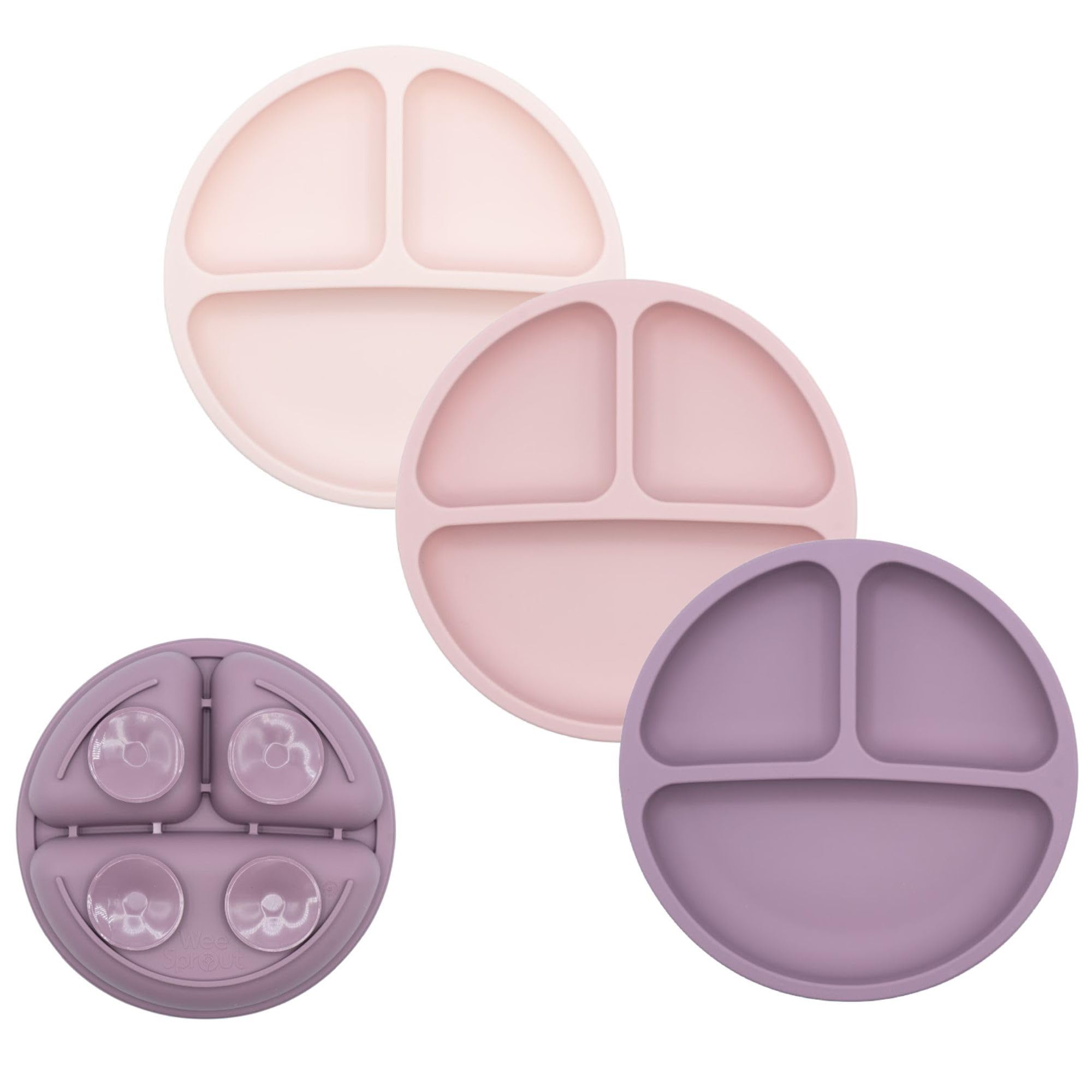


Best for Everyday Toddler Meals
WeeSprout Suction Plates
Key Features
- Material: Food-grade silicone
- Dimensions: 8.4"L x 8.4"W x 2.4"Th
- Suction points: 4
- Divided sections: 3
- Price: Midrange
A suction plate fails in one very specific way — a toddler hooks a finger under the rim and levers. The WeeSprout plate is built around that move, with four separate suction points spread across the base instead of one broad cup, so breaking a single seal doesn’t release the other three at once. In testing it was the plate that took longest to work loose, and on a clean, smooth tray it held through the shoving and grabbing that flipped most of the others. That’s why it’s the one we recommend first.
The rest of the design is sensible rather than clever, which is what you want in a plate. Three sections are deep enough that rice and yoghurt stay in their own corners while a one-year-old scoops, the silicone is soft enough that a bumped mouth doesn’t end the meal, and all three plates go through the dishwasher. The 8.4-inch footprint is the thing to measure: it sits inside a standard highchair tray with room around it, but it overhangs a compact one, and an overhanging plate is a lever with a handle on it.
What settled it above the single-plate picks is the arithmetic of everyday life — one in use, one in the wash, one in the bag for a restaurant or a grandparent’s kitchen. Choose this when you want the whole shelf sorted in one purchase; take the ChériKid when you want one plate that a very determined toddler still can’t shift.
Pros
- Four suction points resist rim-lifting
- Three deep sections keep foods apart
- Three dishwasher-safe plates in one pack
- Holds up to daily toddler handling
Cons
- Wide base overhangs compact highchair trays
Our top pick: the four-point base held through the grabbing and rim-lifting that defeated most plates here, and the three-plate pack keeps a clean one in the cupboard.
Best for Determined Plate-Throwers
ChériKid Suction Plate
Key Features
- Material: Food-grade silicone
- Dimensions: 7.75"L x 7.75"W x 1.3"Th
- Suction cups: 4 extra-wide
- Divided sections: 3
- Price: Premium
The ChériKid is the most expensive single plate in this guide, and what you’re paying for is the widest suction cups in the group. Four broad cups sit under a 7.75-inch plate, and the surrounding silicone is thick enough that the base doesn’t flex when small hands pull at it. That combination gave the firmest grip of any single plate we tried — it was the last one still on the tray at the end of a session that had already claimed two others.
Whether that’s worth the money depends entirely on your child. If yours has learned the rim-lift and treats dinnerware as a launch pad, the extra hold is the difference between a meal and a floor clean-up, and this is the plate we hand those families first. If your baby mostly pats at the food and hasn’t discovered leverage yet, the WeeSprout set gives you three plates for less and enough grip for the stage they’re at.
It’s a single plate, so a household with two children, or one that runs the dishwasher every other day, will be buying a second. The matte finish looks better than most of the shiny silicone here, and the 1.3-inch walls are generous for a plate this size. One practical detail: the wide cup can leave a temporary ring on a matte tabletop, which wipes away but is worth knowing if the table is a good one. Nothing in this category is truly toddler-proof, either — a determined two-year-old eventually finds the edge on any plate.
Pros
- Strongest single-plate hold in this set
- Thick, non-flexing base resists levering
- Deep 1.3-inch walls for scooping
- Matte finish that looks good on a table
Cons
- Sold as a single plate, not a set
The firmest single plate we tried, and worth the premium if your toddler has already worked out how to lever a plate off the tray.
Best for Small Highchair Trays
Bumkins Silicone Grip Dish
Key Features
- Material: Platinum-cured silicone
- Heat safe: Oven, microwave and freezer safe
- Dimensions: 8"L x 7"W x 1"Th
- Divided sections: 3
- Price: Budget
Eight inches by seven, with three wells an inch deep: the Bumkins Grip Dish is the smallest plate in this guide, and for a lot of highchairs that’s the entire argument. Compact trays, shallow-lipped budget chairs and travel seats that leave almost no room all punish a plate that overhangs, and this one sits inside the boundary instead of on top of it.
The depth is what we kept coming back to. An inch of well means a one-year-old can chase a spoonful of yoghurt around without pushing it over the wall, and the sections are wide enough for a proper portion of pasta rather than a token pile. Bumkins uses platinum-cured silicone, the plate is oven-safe as well as microwave-safe, and ours has been through the dishwasher after every meal without going chalky or losing its shape.
The catch is the surface. The Grip Dish is at its best on glass, marble or a bare table, where it held hard enough that we had to slide a thumbnail under the edge to free it, and it is noticeably less committed to textured plastic highchair trays. If your tray is matte, wet the base and press from the centre, or use the plate on the table the chair pulls up to. It’s an easy first plate to try before you commit to a three-pack.
Pros
- Smallest footprint in this guide
- Inch-deep wells hold loose and wet foods
- Oven, microwave and freezer safe
- Durable platinum-cured silicone
Cons
- One plate per purchase, no multipack
Compact, deep and easy to try first — the plate we point to when a highchair tray is too small for everything else here.
Best for Silicone-Free Feeding
PandaEar Stainless Plates
Key Features
- Material: Stainless steel, silicone base
- Dimensions: 8.1"L x 8.1"W x 2"Th
- Suction cups: 4
- Divided sections: 3
- Price: Midrange
A steel plate sitting inside a removable silicone sleeve is a different answer to the same problem. The PandaEar set gives you three of them, each a three-section stainless dish with a silicone jacket whose four cups do the sticking. What appealed to us immediately was the eating surface: no silicone under the food, no soft edge to chew, nothing for tomato sauce to dye.
Stainless earns its place over a few months of use. It doesn’t hold flavours, so a fish pie leaves nothing behind for tomorrow’s porridge; it wipes clean in one pass; and it can’t be chewed into a ragged edge the way a silicone rim can. The whole thing goes in the dishwasher, sleeve included, which is more than we can say for some of the silicone plates here that we’ve taken to hand-washing to keep them tasting neutral.
The trade-off is that the steel is held by the sleeve rather than fused to it. Lift the plate straight up by its rim and it can come away while the silicone stays stuck to the tray, which is the one thing to watch with a toddler who has worked out that the middle lifts. Press the plate firmly back into the sleeve before each meal and check that the rim is seated all the way round.
We keep these for families moving away from silicone altogether, whether because of flavour, staining or a preference to avoid plastic-adjacent surfaces. They’re heavier and louder in a bag than a soft plate, and there’s no microwave step with steel, so warm food separately and tip it across. For meals eaten at a table, though, the steel surface is the nicest thing to eat off in this guide.
Pros
- Stainless surface takes on no flavours or stains
- Detachable silicone sleeve goes through the dishwasher
- Strong four-cup suction base
- Three plates in the pack
Cons
- Steel insert can lift out of the sleeve
- Not microwave safe
For anyone who wants food off silicone entirely, these steel plates clean better and taste of nothing — as long as you press the insert home each time.
Best for Budget Backup Plates
Eascrozn Silicone Plates
Key Features
- Material: Food-grade silicone
- Dimensions: 7.5"L x 7.5"W x 1.1"Th
- Suction cups: 4
- Plates per pack: 3
- Price: Budget
Three plates, three sections each, four suction cups a plate: the Eascrozn set is the cheapest way here to put a suction plate at every meal of the day. The plates are 7.5 inches across, moulded from food-grade silicone, and they stack in a cupboard without much fuss — which matters more than it sounds when three of anything is competing for drawer space.
We expected the budget set to be the one that let us down, and it wasn’t. The cups are shallower than the ChériKid’s, so a strong toddler can still get a fingernail under an edge and pop it, but the plate sits flat and stays put through ordinary pushing and scooping — the sort of thing that happens at most meals rather than at the meals where someone is testing you. At the budget end, that’s a fair trade, and this is the set we reach for when the good plates are all in the dishwasher.
Durability has held up through repeated dishwasher cycles with no warping and no chalkiness, and the colours are muted enough to look fine on a table. A practical point about shallow cups: press each one down individually rather than shoving the plate from above, and they hold noticeably better on a table than on a textured tray. Our reservation is depth of grip, not quality — if your toddler has already beaten a silicone plate, start with the premium plate and keep these as the spares.
Pros
- Three divided plates at the budget end
- Stays put through everyday pushing and scooping
- Dishwasher and microwave safe
- Sections sized for real portions
Cons
- Shallow cups give way to a strong grip
A budget three-pack that does the everyday job: shallow cups, honest grip, and enough plates to stop hand-washing between meals.
Best for First Cutlery
Eascrozn Plate & Utensil Set

Key Features
- Cleaning: Dishwasher safe
- Material: Silicone plates, stainless utensils
- Set contents: 2 plates, 2 forks, 2 spoons
- Suction cups: 4 per plate
- Price: Budget
Somewhere around the first birthday a toddler stops wanting to be fed and starts wanting to stab at a pea. The Eascrozn set is aimed at exactly that stage: two divided silicone plates with four suction cups each, plus two forks and two spoons with thick silicone handles and 18/8 stainless tips.
The plates belong to the same design family as the three-pack above — smaller footprint, three sections, dishwasher safe — and the cutlery is the interesting part. The tines are rounded, there are no sharp edges anywhere, and a protective collar sits between handle and tip so a small hand doesn’t slide down onto the food end. They’re sized for a beginner, which is right for a one-year-old and too small for a three-year-old who has already got the hang of it.
Our verdict is that this makes sense as an add-on rather than a first purchase. If you already own plates you like and your toddler is starting to grab at your fork, the two plates and four pieces of cutlery carry you through the transition without adding another stack of dishes. If you’re starting from nothing, buy a three-pack of plates and add cutlery separately: you’ll get more plates and a better choice of forks for the same outlay.
Pros
- Beginner-friendly forks and spoons included
- Plates hold well for their size
- Easy to clean and dishwasher safe
Cons
- Cutlery suits beginners, not older toddlers
- Smaller plates and only two of them
A sensible buy when your toddler is reaching for cutlery, though the plates are small and the forks won’t suit them past two.
Best for Table-Side Looks
mushie Suction Plate

Key Features
- Material: Food-grade silicone
- Dimensions: 7.25"L x 7.25"W x 0.87"Th
- Plates per pack: 1
- Price: Premium
The mushie plate is the one guests comment on. Soft matte silicone, a muted Cambridge Blue, a clean round profile — it looks like it belongs on the table rather than in a bottom drawer, and that is genuinely part of why people choose it over the practical-looking plates here. It is also the plate in this guide that lifts most easily: one shallow base under a 7.25-inch dish, and a determined eight-month-old can break the seal by pulling at the rim.
So our recommendation is narrow and honest. If your child is past the plate-throwing stage, or eats at a table where the plate is mostly a serving dish and the food goes straight onto the tray, the mushie does its job and looks better doing it than anything else here. If you’re in the thick of a toddler testing every boundary including the dinnerware, this isn’t the plate to hand them — take the ChériKid or the WeeSprout instead. The matte surface wipes clean with a rinse, and the round well is generous enough for a full portion without crowding.
Pros
- The best-looking finish in this set
- Wipes clean with a quick rinse
- Wide 7.25-inch eating surface
Cons
- Suction lifts easily under a determined pull
- Sold one plate at a time
The best-looking plate we tested and the easiest for a baby to lift — buy it for the table, not for grip.
How We Chose and Tested 14 Baby Suction Plates
We started by reading through customer reviews for dozens of plates and filtering for the basics: food-grade silicone or BPA-free plastic, a base wide enough to form a real seal, and a shape that would still be useful once a baby moved past purees. From there we bought 14 plates across price points, from cheap two-packs to splurges, and put them into daily rotation in four households for four months.
Each plate’s first job was to stick. We pressed it down on six surfaces — a smooth plastic highchair tray, a glass tabletop, polished granite, a laminate counter, a wooden dining table, and a silicone placemat — and noted how much pressure it took, whether the release tab pulled the seal tight or left a corner lifting, and how long the plate held once a determined 10-month-old started prying at the rim. After every meal we checked the tab again, looking for one an adult thumbnail could pop easily but a toddler finger could not.
Cleaning got its own pass. Every plate went through at least 30 dishwasher cycles and was hand-washed after tomato sauce and curry, then smelled to see whether it had picked up soap or last night’s dinner — the source of most taste complaints, and several silicone plates did. We wiped the table after each meal to check for a sticky ring or a base that dragged up lint and crumbs, and we logged which plates were still sealing properly by week twelve. Functionality came down to small things: compartments too shallow for a spoon, rims too high for a first-time scooper, a lid that didn’t survive the diaper bag.
How to Choose a Baby Suction Plate
The most useful thing we can tell you is that suction is a property of the surface as much as the plate — the same dish that locks onto a bare table can slide off a matte tray.
Your tray decides more than the plate does
A suction cup works by pushing air out and letting pressure hold the seal. Any texture, matte grain or flex in the surface lets air creep back in, which is why so many plates grip a glass table like glue and fail on the tray they were bought for. Run a fingernail across your tray: if it catches on a pattern, expect trouble.
The fix is usually technique rather than a different plate. Wipe the tray and the base dry, press the plate down from the centre outwards so both surfaces meet evenly, and give it a small twist. If you’re still fighting it, use the plate on the table the chair pulls up to instead — that’s where most of these are at their best.
One wide cup or four small ones
A single broad base gives the strongest total seal, but it is all-or-nothing: get a finger under one edge and the whole plate releases. Four smaller cups break that into separate seals, so lifting a corner doesn’t free the rest. The WeeSprout and ChériKid plates are built this way, and it’s why they survive the rim-lift that frees a single-base plate such as the Bumkins or the mushie.
The trade-off is cleaning. More cups mean more grooves for purée to dry into, and the water that hides under them after a wash needs to drain before the plate goes back on the tray. Four cups are worth that extra rinse if your toddler grabs at the edge; they buy nothing if your child mostly pushes food around.
Silicone or stainless steel
Silicone is quiet, soft against gums, unbreakable and safe in the microwave, which is why nearly everything here is made of it. Its weakness is that the surface absorbs a little of whatever it lives with. Dishwasher detergent is the usual culprit — if food starts tasting of soap, hand-wash with a fragrance-free detergent and rinse thoroughly, or move to steel.
Stainless steel has none of that problem: nothing soaks in, nothing stains, and the plate comes out of the dishwasher tasting of nothing. It is heavier, noisier, not microwave safe, and usually wrapped in a silicone sleeve that can lift away from the steel. Choose steel for the eating surface, not for the suction, and press the insert home before every meal.
Measure the plate against the flat part of the tray
Plates here run from about seven and a quarter inches across to eight and a half, and a couple of inches makes the difference between a plate that sits inside the tray and one that hangs over the lip. An overhanging edge is a handle, and a handle is what a toddler reaches for. Measure the flat area, not the tray’s outer rim, and leave an inch of clearance all round where you can.
Depth matters as much as width. A well around an inch deep gives a one-year-old something to chase a spoonful against; a shallow plate lets yoghurt slide straight off the edge. If your child is still mostly eating with their hands, width for portions matters more than depth for scooping.
Frequently Asked Questions
At what age can a baby use a suction plate?
From around six months, once your baby can sit upright with support and has started on solids. Before that there’s little to hold on the tray anyway.
The plate earns its keep between roughly nine and fifteen months, when a baby works out that dishes can be pushed, dragged and flipped. Put one plate down, watch whether they go for the rim rather than the food, and that tells you how much suction you actually need to pay for.
Do I need a divided plate or a single compartment?
Divided, if your child minds their food touching or you like offering three things at once — three sections also give you a natural portion guide for a new eater.
A single well is faster to fill, easier to wipe, and better for a large portion of one thing, such as a pile of pasta. There’s no rule that you need both; most families end up using the divided plate for meals and the plain one for snacks.
How many suction plates do I actually need?
Two is the practical minimum: one on the tray, one in the wash. A third is worth having if plates travel to grandparents or restaurants, because a plate left behind shouldn’t cost you the next meal.
That’s the argument for a three-pack over a single premium plate. If you do buy one good plate, buy it knowing you’ll hand-wash it between meals or buy a second within a month.
Final Verdict
Start with the WeeSprout set if you want the decision made for you. The four-point base is the most reliable hold in this guide, the three sections suit real meals rather than a token snack, and having three means a clean plate is always within reach.
If your toddler has already beaten a plate, go to the ChériKid instead — it’s the firmest single plate we tested and worth the premium for that household. And if the smell of silicone in the dishwasher has ever put you off a meal, the PandaEar stainless set sidesteps the problem entirely.
