This post contains affiliate links. We may earn a small commission when you buy through our links — at no extra cost to you.
The first time I tried to fold a stroller one-handed while holding a boarding pass and a squirming toddler, I understood why so many parents just gate-check the thing and hope for the best. A good travel stroller fixes more than folding. It collapses small enough for an overhead bin or a rental-car trunk, rolls over cobblestones without rattling your kid awake, feels solid and stable enough to hang a diaper bag on the handle, and still looks presentable after a gate-check. Get that right, and the whole trip gets easier.
Over the past eight months, my team and I have tested 12 foldable strollers on flights and city sidewalks. We folded and unfolded each one dozens of times and found that some fold in one motion and self-stand while others need two hands, a foot, and a prayer. The smallest fold isn’t always the one that survives a gate-check, and the sturdiest may not fit in an overhead bin. Value matters, and a few cheaper models beat pricier ones; the picks below are the ones we’d take.



Best for All-Round Travel
Mamazing Ultra Air
Key Features
- Fold: One-hand
- Weight: 11.6 lb
- Folded Size: 22 × 19.3 × 11 in
- Weight Limit: 50 lb
- Price: Premium
Folded, the Ultra Air becomes a 22-inch-tall package about the size of a weekend bag — small enough to drop behind a car seat or into a footwell, and it fits an overhead bin on a full-size jet, though at that height it’s worth checking your airline’s carry-on limit before you count on it. Unfolded, the carbon-fiber frame weighs 11.6 pounds, which is the number that decides how you feel at the end of a long terminal.
Light enough to lift with one hand and roomy enough for a four-year-old is the combination that puts it first here. The seat is rated to 50 pounds and 39.4 inches, so it keeps working well past the age when most travel strollers get handed down. The fold is a true one-hander: a pull on the handle, a shove on the frame, and it’s flat enough to shoulder while you collect a bag.
The rest of the spec sheet is more stroller than most travel models bother with. The seat reclines for naps, the canopy is UPF 50 and covers a sleeping face, and a bumper bar, travel bag, and 22-pound under-seat basket come with it. That basket takes a diaper bag and a jacket, and the push stays light as long as you don’t load it to the claim.
Durability is the caveat. The strap on the included travel bag is the flimsiest piece of the kit, so don’t hang a loaded stroller from it, and the seat fabric is light rather than plush. If the smallest possible folded package matters more than seat comfort, the gb Pockit Air does that better.
Pros
- 11.6 lb with a true one-hand fold
- 50 lb, 39.4 in seat outlasts toddlerhood
- Recline, UPF 50 canopy, bumper bar, travel bag
- 22 lb basket swallows a diaper bag
Cons
- Travel bag strap is the weak point
- Taller folded package than the smallest picks
The one we recommend first: 11.6 pounds, a genuine one-hand fold, and a seat rated to 50 pounds that outlasts the toddler years.
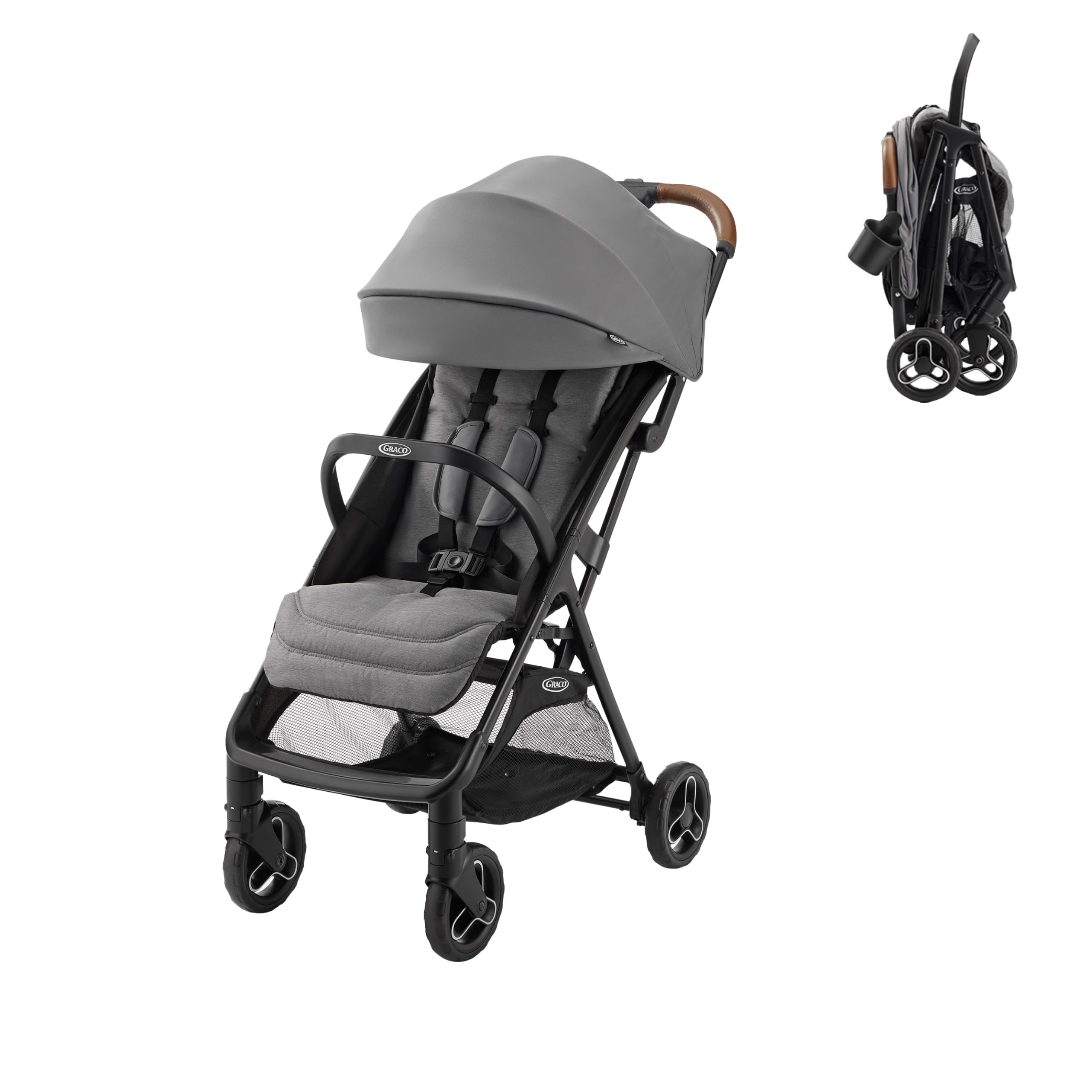
Best for Car Seat Transfers
Graco Ready2Jet
Key Features
- Fold: One-hand, automatic
- Weight: 13.2 lb
- Car Seat: Graco SnugRide
- Weight Limit: 50 lb
- Price: Premium
Graco’s travel stroller weighs 13.2 pounds, a pound and a half more than our top pick, and that extra weight buys an automatic fold and a package that stands up on its own.
The fold is the best trick here. Hit the trigger and the frame collapses itself; stand it in a restaurant doorway and it waits upright while you sort out a diaper bag. We opened and closed it one-handed without bracing it against a knee, which is the test that matters when your other arm has a baby in it.
Graco SnugRide infant seats click onto the frame, which turns it into a travel system for the airport run, and all-wheel suspension plus a multi-position recline make it more comfortable over a long day than its weight class suggests. The removable belly bar doubles as a carry handle, the harness converts between three and five points, and the calf support adjusts as a child grows.
Two things to know before you buy. The basket is small — a diaper bag and little else — and an infant seat can take a couple of tries before it clicks, so lift the seat to check the latch rather than trusting the sound. Once your child is out of a bucket seat, the Mamazing is the lighter stroller and the better default.
Pros
- Automatic one-hand fold that self-stands
- Takes Graco SnugRide infant seats
- All-wheel suspension and multi-position recline
- Belly bar doubles as a carry handle
Cons
- Basket is small for a day’s gear
- Infant seat can take a couple of tries to click
Our pick if an infant car seat has to dock: the automatic fold and self-standing package make airport days easier.
Best for Overhead-Bin Travel
gb Pockit Air
Key Features
- Weight: 10.4 lb
- Harness: 3-point
- Folded Size: 11.8 × 7 × 13.8 in
- Weight Limit: 48 lb
- Price: Premium
Folding the Pockit Air takes two moves and a firm hand: lift the handles, squeeze, and shove. What lands at your feet is a package 11.8 by 7 by 13.8 inches, the smallest folded footprint in this group, and the one here that behaves like a carry-on instead of luggage. That single fact is why we still recommend it to anyone flying an airline that actually enforces its cabin limits.
Everything else is trimmed to get there. The seat is a fabric sling with a three-point harness rather than a padded five-point, the canopy is short enough that low sun gets in, and the plastic frame flexes and rattles under a bigger toddler in a way a heavier stroller’s won’t. It also needs a decisive push to lock open, and half-folded it can feel like it’s fighting you, so practice once at home rather than in a gate queue. At 10.4 pounds with a 48-pound limit and a two-year warranty, it makes sense as the airport-and-rental-car stroller that lives in a bag, not as your only stroller.
Pros
- Smallest folded package in this group
- 10.4 lb with a 48 lb seat limit
- Two-year manufacturer warranty
Cons
- Three-point harness rather than five
- Short canopy leaves low sun in
We keep coming back to it for the fold: the smallest package here, small enough to treat like a carry-on.
Best for Value Travel
Mompush Jeto
Key Features
- Weight: 10.1 lb
- Carry Strap: Integrated
- Folded Size: 20.5 × 17.3 × 7.1 in
- Weight Limit: 40 lb
- Price: Midrange
The Jeto is the budget pick of the small-fold group, and it doesn’t feel like one: a 10.1-pound aluminum frame, a fold that ends with the package standing on its own, and an integrated strap that goes over a shoulder while your other arm has the baby.
We rate it as the best value here for travel that doesn’t involve a car seat. The fold is a one-hander, the package measures 20.5 by 17.3 by 7.1 inches, and the 5.3-inch rear wheels with suspension roll over sidewalk cracks and terminal tile far better than the hard little wheels on cheap umbrella strollers. Our reservation is the seat rating: 40 pounds is on the low side of this group, so a tall four-year-old will outgrow it before the frame gives out.
The basket holds 4.4 pounds, which is a jacket and a snack bag rather than a day’s gear, and the folded package is small without being cabin-guaranteed. For a second stroller, or a first one for a child past the newborn stage, none of that gets in the way of a good buy.
Pros
- 10.1 lb with a self-standing fold
- Integrated carry strap
- Suspension wheels and a five-point harness
Cons
- 40 lb seat limit
- 4.4 lb basket is small
We think it’s the value pick of the group: a 10.1-pound frame, a self-standing fold, and the essentials done properly.
Best for Short Budget Trips
Dream On Me Aero
Key Features
- Weight: 7.2 lb
- Harness: 3-point
- Folded Size: 40.6 × 7.7 in
- Weight Limit: 33 lb
- Price: Budget
The first thing to know about the Aero is the handle height. It sits low; if you’re much over about five foot six you’ll notice yourself hunching, and shorter parents and grandparents will find it just fine. Set that aside and 7.2 pounds is the headline — the lightest stroller here, light enough to carry up a flight of stairs with a toddler on your hip.
The fold is one-handed with a latch on the right side that keeps it closed, the brakes work on both rear wheels, the canopy comes off when you don’t want it, and the rubber tires are a step up from hard plastic. The seat is rated to 33 pounds, roughly a three-year-old, and the folded shape is a long umbrella rather than a square, so it goes in a footwell or a closet rather than an overhead bin. As the stroller that lives in the car for errands and short trips, that’s an easy trade.
Pros
- 7.2 lb, the lightest stroller here
- One-hand fold with a closing latch
- Dual rear-wheel brakes
Cons
- Low handle height
- 33 lb seat limit
Buy it for the weight and the short trips, as long as the handle height suits whoever pushes it.
Best for Home and Travel
Jeep Altitude
Key Features
- Weight: 16.6 lb
- Suspension: Four-wheel
- Folded Size: 12.5 × 19 × 29 in
- Weight Limit: 50 lb
- Price: Midrange
This is the pick for the family that wants one stroller instead of two: something that lives by the front door and still folds into a trunk for a weekend away.
At 16.6 pounds it isn’t a carry-on stroller, and the weight buys a real seat. Four-wheel suspension, a multi-position recline, an adjustable footrest that grows with a child, and an extendable canopy with a peek-a-boo window. The one-hand fold leaves a package 12.5 by 19 by 29 inches — trunk-sized rather than bin-sized — and the seat is rated to 50 pounds, with Greenguard Gold certification for the fabrics and foam.
Among these, it’s the best everyday ride: the suspension takes curb cuts and park paths that rattle the lightweights, and the recline is enough for a nap on a long afternoon. What you accept is the lift — 16.6 pounds over your head on a jet bridge is a chore — plus one stability quirk: a child who stands and leans over the back can tip it, so keep the child seated and the heavy gear low in the basket.
Pros
- Four-wheel suspension and a real recline
- 50 lb seat rating
- Greenguard Gold certified
Cons
- 16.6 lb to lift into a trunk
The one-stroller answer for families who need a daily ride that still travels, as long as it lives in the trunk.
Best for Theme Park Days
Dream On Me Coast Rider

Key Features
- Modes: Stroller, ride-on, scooter
- Weight: 12.8 lb
- Folded Size: 24.41 × 16.14 × 10.63 in
- Weight Limit: 45 lb
- Price: Midrange
The Coast Rider is the one here that changes shape: a full stroller that converts to a ride-on and then to a scooter, which is the difference between pushing a bored four-year-old through a theme park and being towed along by one who is enjoying herself.
In stroller mode it’s a structured, upright seat with a five-point harness, rated from six months to 45 pounds at 12.8 pounds of stroller. It folds to 24.41 by 16.14 by 10.63 inches, steers easily with one hand through crowds, and sits high enough that a toddler can see where she’s going rather than staring at knees.
We rate it as the best of this group for a park day with a preschooler, and it comes with a caveat: the fold is the weakest part. It takes two hands and a deliberate sequence, and it can stick when the frame is loaded, so learn it in the driveway before you’re doing it in a queue with a melting-down child.
Confirm what’s in the box before you count on the scooter mode, since the conversion is the reason to choose this over a plain umbrella stroller. For a baby, or for a parent who wants a one-second fold at the gate, another pick here serves you better.
Pros
- Converts between stroller, ride-on, and scooter
- 45 lb limit for older toddlers
- Steers one-handed through crowds
Cons
- Fold takes two hands and can stick
We like it for older toddlers at theme parks, where the ride-on and scooter modes earn their keep.
Best for Naps on the Go
Mompush Lithe V2

Key Features
- Weight: 17.4 lb
- Recline: 3 positions, near-flat
- Folded Size: 21.26 × 11.2 × 26.9 in
- Weight Limit: 40 lb
- Price: Premium
The Lithe V2 treats the seat as the point. The recline runs through three positions to nearly flat, the footrest adjusts, the canopy is big enough to shade a sleeping face, and the snack tray lifts off for washing.
That makes it the best stroller here for naps and long days — the near-flat seat is the difference between a toddler who sleeps through lunch and one who doesn’t. It’s also 17.4 pounds, the heaviest in this group, and you feel it lifting the stroller into a trunk or up a porch step.
The fold is one-handed on paper and mostly in practice; the mechanism wants a firm, deliberate motion and can fight you when you’re rushed. Folded, it measures 21.26 by 11.2 by 26.9 inches, and a travel bag and rain cover come in the box, which is a fuller kit than the lightweights include.
The seat stops at 40 pounds, on the low side for a stroller this substantial, and the frame is wide enough that it takes up real trunk space. For road trips, where the stroller stays in the car and comes out for a whole day, both are the right trade.
Pros
- Three-position near-flat recline
- Removable snack tray and cup holder
- Travel bag and rain cover included
Cons
- 17.4 lb, the heaviest here
- Fold can stick when rushed
We point nap-and-snack families here: the near-flat recline and snack tray are worth the extra weight.
How We Chose and Tested Travel Strollers
We started by pulling every foldable stroller marketed for travel that we could find, then narrowed the list by folded dimensions, weight, price, and whether it accepted an infant car seat with an adapter. That left 12 strollers, which we tested over eight months. We didn’t just unfold them in a living room: we took them through airport security, folded and lifted them into overhead bins, wrestled them into rental-car trunks, and pushed them over cobblestones, subway grates, and sidewalk cracks.
Foldability was timed, not eyeballed. We folded and unfolded each stroller one-handed, sometimes with a toddler on a hip, and counted the steps and seconds. We noted whether it self-stood once folded, whether the fold locked, and whether it fit in the overhead bin without a fight. For ease of use, we buckled and unbuckled the harness, flipped the brake with one foot, and adjusted the recline while holding a squirming kid; we also clicked in infant car seats with each model’s adapters and checked for wobble.
After eight months, we checked every wheel, joint, and seam for wobble, fraying, and scuffs; some strollers looked beat up after one trip, while others cleaned up well. We pushed each one over curbs and around tight store aisles, hung a loaded diaper bag on the handle to see if it tipped, and had testers from 5-foot-2 to 6-foot-4 push them to judge handle length and kick space. We compared what each stroller offered for the money, and we factored in appearance—how the fabric and frame held up to gate-check grime.
How to Choose a Travel Stroller
The fold gets all the attention, but weight and folded size decide whether a stroller is a help or a chore once you’re actually traveling.
Weight Is What You Carry
The strollers here run from 7.2 to 17.4 pounds, and that spread is the difference between lifting a stroller onto a security belt with one hand and needing both. Count the moments you’ll carry it rather than push it: up stairs, onto a bus, over a jet bridge, in and out of a trunk. Under about 12 pounds is comfortable one-handed for most parents; past 16, you’ll feel it on the second day of a trip. If your travel is mostly drives and short walks, a heavier stroller is a fair trade for a better seat.
Folded Size: Cabin or Trunk?
Compact is the most overused word in stroller listings, and it usually means the trunk of a car, not an overhead bin. Compare the folded dimensions against your airline’s carry-on limit before you plan to bring it aboard: the gb Pockit Air folds to 11.8 by 7 by 13.8 inches, while the Jeep Altitude’s 12.5 by 19 by 29-inch package is a trunk stroller. If you’ll gate-check anyway, folded size matters less than how the package carries — a strap or a belly bar is worth more than two saved inches.
A Fold You Can Do One-Handed
You will fold this stroller while holding a child, a bag, or a boarding pass, usually in a queue. Look for two things beyond the fold itself: whether it latches closed, and whether it stands up on its own once folded. A self-standing package can be parked beside a cafe table instead of laid on the floor. Practice the sequence at home — the strollers that disappoint are the ones whose fold needs a shove in exactly the right place, which is hard to find under pressure.
Seat Limits and How Long It Lasts
Weight limits here run from 33 to 50 pounds, and that number matters more than the age range on the box. A 33-pound limit is often reached around a child’s third birthday; 50 pounds keeps a stroller useful into the preschool years. Check the height limit too, since tall toddlers run out of legroom and canopy before they run out of pounds. If you want one stroller to cover several years, pay for the higher limit rather than the lighter frame.
Wheels, Harness, and the Parts That Wear
Small wheels are fine on terminal tile and mall floors and miserable on cobblestones; if your trips include old cities, look at wheel size and suspension. On the harness, a five-point gives you more to buckle but holds a wriggling child more securely than a three-point. The parts that fail first are the ones you handle most — wheel assemblies, brakes, and bag straps — so check the warranty before you buy and give the frame a firm shake before you commit.
Frequently Asked Questions
Can I take a foldable stroller through airport security and onto the plane?
Yes to security: a folded stroller goes through the X-ray like any bag, so keep it folded until you’re past the checkpoint. Boarding is the airline’s call, not the stroller’s. Most carriers let you gate-check free and hand it back at the jet bridge, and a few allow a small folded stroller in the cabin. Check your carrier’s carry-on dimensions and pack a travel bag so the frame survives the hold.
How do I clean a travel stroller?
Wipe the frame and wheels with a damp cloth and spot-clean the fabric with mild soap and cold water — most of these seats don’t come off the frame, so machine washing is off the table. Let everything dry completely before you fold it, because a damp canopy stored folded is how mildew starts. After a beach trip, rinse the wheels and frame to get salt and sand out of the joints.
Do I still need a second stroller at home?
Only if the travel stroller is genuinely a compromise. A 7-pound umbrella like the Dream On Me Aero is a second stroller by design: fine for errands and short trips, thin on support for a long day out. A 50-pound-rated stroller with suspension, like the Jeep Altitude, can be the only one you own. Count how often you lift the stroller rather than push it — that is what decides it.
Can I use a travel stroller from birth?
Most of these start at six months, when a baby can sit supported. For a newborn you need either a stroller with a near-flat recline, like the Mompush Lithe V2, or one that takes an infant car seat — the Graco Ready2Jet docks Graco SnugRide models. Check the stated age range and the recline positions before you buy, and don’t count on a padded insert to make an upright seat suitable for a newborn.
Final Verdict
For most families the Mamazing Ultra Air is the travel stroller to buy: 11.6 pounds, a real one-hand fold, and a 50-pound seat that outlasts the toddler years. Change one requirement and the answer changes with it — if an infant car seat has to dock, take the Graco Ready2Jet; if the folded package has to pass as cabin luggage, the gb Pockit Air is the smaller one. Those three cover most trips, and the rest of the list covers the ones they don’t.
