This post contains affiliate links. We may earn a small commission when you buy through our links — at no extra cost to you.
The first time I zipped a friend’s elderly terrier into a stroller, she stood rigid for two blocks and then fell asleep sitting up. That’s the lesson with pet strollers: the animal casts the deciding vote. A low basket with plenty of mesh can read as a cozy den to a confident cat and as a trap to a nervous dog, and no amount of suspension tuning fixes a pet who simply refuses to get in.
Over the past eight months, my team and I have assembled, folded, pushed, and loaded 14 of them, from budget umbrella frames to sturdier three-wheelers. Two things surprised me. Assembly is usually ten minutes of fumbling with wheel caps rather than an afternoon project, and the sturdiness you’re paying for lives in the frame joints, not the fabric. What a good stroller actually fixes is simple: your pet still comes to the farmers market, the vet, and the long evening walk even when their legs have quit. The picks below are sorted by which animal and which kind of outing they suit.



Best for Everyday All-Rounder
Bicystar Dog Stroller with Detachable Carrier
Key Features
- Carrier: Detachable, 7.5 pounds
- Cabin size: 26"L x 14.2"W x 9.4"H
- Weight limit: 50 lb
- Stroller weight: 20 lb
- Price: Premium
The cabin is the whole argument. Unclip it and you are carrying a 7.5-pound basket with your dog still inside — through a shop door, up the vet’s steps, along a line — while the frame waits in the car. That one trick covers the errands where a full stroller is unwelcome, and it is why this one holds the top spot.
As a walking stroller it is also the most composed of the group. Four rubber tires with 10-inch rears and spring suspension at each corner keep it flat over cracked sidewalk and tree roots, and it stands where you park it. On a long mixed-surface walk, this is the one we take.
The tax is weight. Twenty pounds and a 34.6-inch fold mean two hands and an empty trunk, and a daily hatchback lift gets old by the second week. The cabin is also shallow at 9.4 inches, so a tall dog rides lying down with its chin near the mesh rather than standing to look out — good for a relaxed passenger, less so for a nosy one.
At 20 inches wide it takes more of a sidewalk than the Gen7Pets here, and the single cup holder is a shallow well that a tall bottle tips out of on a corner. What keeps it in front is that nothing else in this group does two jobs — pram on the pavement, carrier in the car — without you owning both.
Pros
- Detachable carrier doubles as a carry-in basket
- Rubber tires and suspension give the smoothest push here
- 50-pound rating with room for two small pets
- Folds with the cabin on or off the frame
Cons
- 20 pounds to lift, with a long folded frame
- Shallow 9.4-inch cabin limits standing room
Buy this one if you want a single stroller for walks, errands and car trips; the detachable cabin is worth the extra bulk and the extra money.
Best for Small Dogs, Travel
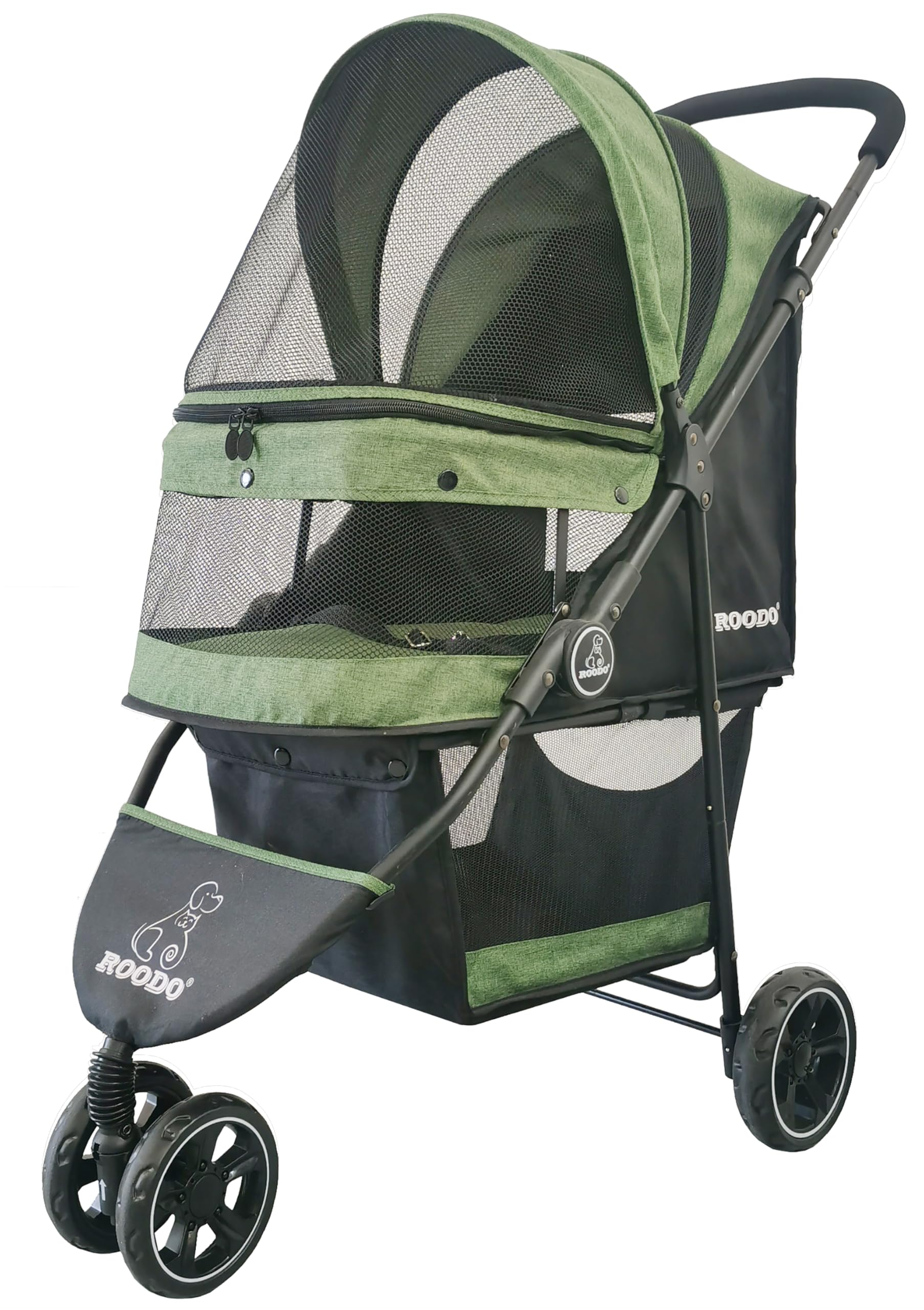
ROODO 3 Wheel Pet Stroller
Key Features
- Harness: 2-point
- Folded size: 18.5 x 6.5 x 33 in
- Weight limit: 30 lb
- Stroller weight: 11 lb
- Price: Midrange
Five kilos is the number that matters. That is light enough to swing into a trunk one-handed while the other hand closes the hatch, and light enough to carry up apartment stairs at the end of a walk. Plenty of strollers fold small; far fewer are this easy to pick up while folded.
You still get a 30-pound cabin, mesh on every side, a two-point harness and quick-release wheels that come off and go back on without tools — the feature we used most, because a frameless stack slides under a bed or into a narrow closet. It is roomier inside than the rating suggests: two cats, or one small dog sprawled sideways, is realistic.
Against the Bicystar it gives up composure. The frame flexes a little over rough ground, the fold needs a firm shove before it latches flat, and the 5.5-inch front wheel stumbles in gravel where the bigger wheels here roll through. On pavement, store floors and park paths none of that shows, and at this weight it is the one that ends up in the car rather than the hall.
Pros
- About 11 pounds, so one-handed lifting
- Quick-release wheels come off without tools
- 30-pound cabin with mesh on all sides
- Folds to 18.5 by 6.5 by 33 inches
Cons
- Fold needs a firm shove to latch flat
- Small front wheel catches in gravel
For a small dog or a cat, this is the stroller to buy if you want something you can lift, fold and store without thinking about it.
Best for Big Dogs
Zoosky Dog Stroller for Medium and Large Dogs
Key Features
- Folded size: 41.5 x 25 x 10 in
- Rear wheels: 8.9 inches
- Weight limit: 66 lb
- Stroller weight: 24.4 lb
- Price: Premium
Sixty-six pounds is a different problem from thirty. The Zoosky is built around the weight: a reinforced steel frame, 8.9-inch rear wheels with spring suspension up front, and a cabin deep enough that a 30-pound dog can lie flat without touching both ends. For a dog in the 30-to-60 range, this is the one we point to.
Two details stood out in use. The canopy opens from both sides and rolls away without eating into the cabin, and the handle adjusts, so a tall pusher is not hunched over for an hour. Neither sounds like much until you have pushed a fixed-handle stroller through a park.
The cost is footprint: 25 inches wide, 41.5 inches long when folded, and 11 kg to lift into anything higher than a tailgate. What earns the space back is the zippered mesh door on the side, which lets a dog walk in rather than be lifted — the detail that decides it for arthritic and post-surgery dogs.
Pros
- 66-pound rating for medium and large dogs
- 8.9-inch rear wheels with front suspension
- Side mesh door for dogs that cannot jump
- Adjustable handle and dual-opening canopy
Cons
- 25 inches wide and long when folded
- 11 kg is a two-handed lift
Buy it when your dog is too big for the usual stroller and still wants the walk; a small dog will rattle around in it.
Best for Small Pets, City
Gen7Pets Regal Plus Dog Stroller
Key Features
- Harness: 5-point with tether
- Frame width: 17 inches
- Weight limit: 25 lb
- Stroller weight: 11.5 lb
- Price: Midrange
Seventeen inches across is the figure to hold onto. That is narrow enough to take down a store aisle without clipping shelving, and narrow enough to pass a trash bin on a sidewalk without turning sideways.
The rest of the design aims at the same buyer. It weighs 11.5 pounds, folds to 36 by 17 by 10 inches, and its canopy folds under its own hood instead of bunching into the pet’s headroom — the detail we appreciated most on bright days, because the cabin keeps full height with the shade up. It is also the only pick here with a five-point harness and a safety tether.
The 25-pound limit is the honest part of the deal. A nine-pound Maltese has room to spare, a Frenchie just under the limit fits, and a 30-pound dog does not belong here. For a cat or a small pair in an apartment, the narrow frame and the flat fold are worth more than the capacity you give up.
Pros
- 17-inch frame fits narrow aisles
- Five-point harness with a safety tether
- Canopy folds under its hood, keeping headroom
- Folds flat to 36 by 17 by 10 inches
Cons
- 25-pound limit rules out medium dogs
The one to buy for a cat or a small dog in a city, where doorways, aisles and hallways are the real constraint.
Best for Two Dogs
ojcme Dog Stroller for Large and Medium Dogs
Key Features
- Cabin length: 30 inches
- Weight limit: 132 lb
- Handle height: 27 to 41 inches
- Stroller weight: 23.4 lb
- Price: Premium
A hundred and thirty-two pounds is not a misprint, and it tells you who this is for: two medium dogs, three small ones, or one giant breed that has stopped doing stairs. The cabin runs 30 inches long with 12-inch sidewalls, deep enough that a dog can turn around rather than just lie down.
The build is the heaviest-duty of the picks here — a reinforced steel frame under 600D oxford rated as scratch and chew resistant — and the handle adjusts from 27 to 41 inches, the widest range in the group. That last figure matters more than it sounds: it is the difference between one stroller two people can share and one that only suits the taller of them.
The limitations are the ones size brings. Folded it is 41.5 by 25 by 10 inches at 10.61 kg, so it lives in a garage rather than a closet, and the plastic wheels bog down in deep sand. This is a pavement, park-path and hardware-store stroller, not a beach one.
For a two-dog household it is the roomiest thing here that still folds, and it is the pick that makes a second dog possible rather than a second stroller. With one small dog you are buying cabin you will never fill.
Pros
- 132-pound rating and a 30-inch cabin
- Handle adjusts from 27 to 41 inches
- Scratch-resistant 600D oxford over steel
- Folds flat for its size
Cons
- 10.61 kg with a long folded footprint
- Plastic wheels sink in deep sand
The pick for two dogs or one very large one; the 132-pound rating and 30-inch cabin are the whole point of it.
Best for First Stroller
ZENY Foldable Pet Stroller
Key Features
- Wheels: 4 with swivel front
- Folded size: 11.8 x 8 x 35 in
- Weight limit: 33 lb
- Stroller weight: 13 lb
- Price: Budget
This is the least expensive stroller here by a wide margin, and it is the one we point to when someone wants to find out whether their dog will tolerate a stroller at all. The specification does not read cheap: a 33-pound rating, a 13-pound frame, four wheels with a 360-degree swivel front, two cup holders, a center tray and a basket big enough for a shopping run.
What you give up shows in the front wheels, which can shimmy and occasionally stay turned sideways until you straighten them by hand, and in a frame that feels busier over pavement joints than the ROODO’s. For flat sidewalks, a store and a small dog who rides ten minutes at a time, it does the job — and if strolling becomes a habit, you will know what to look for in the second one.
Pros
- Least expensive of the picks here
- 33-pound rating on a 13-pound frame
- Big under-basket and two cup holders
- Folds to 11.8 by 8 by 35 inches
Cons
- Front wheels can shimmy and stick
- Frame feels busy over rough pavement
Buy it to find out whether your dog likes a stroller before you spend real money on the one you actually want.
Best for Open-Air Rides
Carlson Pet Products Stroller

Key Features
- Canopy: Umbrella and mesh
- Folded size: 37 x 18 x 7 in
- Front wheel: 7.87 inches
- Weight limit: 30 lb
- Price: Midrange
The canopy is the first thing you notice: an umbrella over a mesh screen instead of the zipped fabric hood the rest of these use. On a warm day it lets air through the top and keeps the sun off without sealing the cabin, and a dog who likes to watch the world gets a much better view than a fabric roof allows.
There is more room inside than the 30-pound rating suggests, and the fold is the flattest here at 37 by 18 by 7 inches — thin enough to slide behind a door. Four wheels, a 7.87-inch front, and reflective trim along the frame for low light.
Two things to know. The cabin is narrow and sits high, so it leans when weight shifts to one side; load the under-basket evenly and keep the dog centred and it settles. The front zip also needs a deliberate pull to seat fully, so check it before you set off, particularly with a cat.
As a stroller for a calm small dog who rides with the top open, it makes sense, and as a second stroller for someone who already owns a closed cabin it earns its shelf space. For a dog that stands and scans the whole walk, the fixed cabins here give it more to look through.
Pros
- Umbrella and mesh canopy for open-air rides
- Flattest fold here at 37 by 18 by 7 inches
- Reflective trim for low light
- Large 7.87-inch front wheel
Cons
- Can lean if weight shifts to one side
- Front zip needs a deliberate pull
A good pick for a calm small dog who likes an open view, and for evening walks where the reflective trim earns its keep.
Best for Tight Budgets
MoNiBloom Pet Stroller

Key Features
- Harness: None included
- Folded size: 19 x 32 x 12 in
- Weight limit: 33 lb
- Stroller weight: 11 lb
- Price: Budget
Sixteen-inch rear wheels on a budget stroller are unusual, and they are the best thing about this one — they roll over curbs and broken pavement that stop the small-wheeled cheap picks. Add a hooded peek window, two cup holders, an under-basket and a 33-pound rating on an 11-pound frame, and the specification reads above its position in this group.
Where it lets you down is the single front wheel. It can work loose, and the mount is the part to check before every walk; keep the load well inside the 33-pound rating and take curbs at an angle rather than square on. That caveat is why it is not our budget pick.
The other gap is containment: the cabin comes with no harness or tether, so bring your own leash clip or thread a lead through the frame. With a dog who stands up mid-walk, that is the difference between a passenger and a jump.
Pros
- 16-inch rear wheels clear curbs
- 11 pounds with a 33-pound rating
- Two cup holders and a hooded peek window
- Folds thin enough to stand against a wall
Cons
- Front wheel can work loose
- No harness or tether in the cabin
A light, big-wheeled budget stroller with a front wheel to watch; add your own tether before the first walk.
How We Tested 14 Pet Strollers
To build the shortlist, I went through owner reviews and spec sheets for more than 40 strollers, then narrowed by weight capacity, basket dimensions, whether replacement wheels and canopies could be ordered, and price. We bought 14 ourselves and used them for eight months, so nothing went back to a brand after a single week.
Assembly came first. I timed each stroller from box open to first roll using only the tools in the box, counted the steps, and noted where the instructions lost me. Foldability got its own test: collapsing each one with a single hand while holding a leash, timing it, and checking whether the folded frame stood upright on its own. Then I lifted every folded stroller into the back of a hatchback and carried it up a flight of stairs.
On the street, we pushed loaded strollers over cracked sidewalk, gravel, curb cuts, and the cramped aisles of a Saturday farmers market, often one-handed with a coffee in the other. Each basket carried 10 pounds of cat litter plus whichever pet volunteered, and we watched for frame flex at the joints, wheels that wandered, and brakes that slipped on a slope.
Pet preference doesn’t score well on a clipboard, so we noted entry height, how much mesh each pet could see through, and how quickly they lay down versus tried to climb out. After eight months we rechecked zippers, seams, tires, and brake cables, then weighed what each stroller cost against how it was holding up.
How to Choose a Pet Stroller
Your pet’s weight and body length decide which stroller works, and how you lift and store it decides whether you keep using it.
The weight rating and the cabin behind it
Listings lead with a weight rating because it is one number, but cabin length and height decide whether your dog can actually lie down. A 50-pound rating attached to a cabin 9.4 inches tall means a tall dog rides prone with its chin on the floor; a 30-inch cabin is generous for a 30-pound dog and tight for a 45-pound one.
Measure your dog from chest to rump, add two inches, and compare that with the cabin rather than the rating. The Bicystar is a good example: its 26-inch cabin suits pets up to roughly 23 inches of body length, which is a far more useful figure than its 50-pound ceiling.
Wheel count and wheel size
Three-wheeled joggers turn faster and track better on pavement; four wheels stand steadier when parked and feel less tippy on a sloped curb. Size matters more than the count. Rear wheels across this group run from 6.5 to 16 inches, and that is where a stroller stops being useful: a 5.5-inch front wheel catches in gravel, while a 10-inch rear rolls over it. Rubber tires ride softer than the plastic and EVA wheels on the cheaper picks.
Treat all-terrain in a listing as a claim about the front wheel swivelling, not a promise about trails. If your walks are pavement and store floors, small wheels are fine; if they are not, look at the rear diameter first.
The lift, not the fold
Folded dimensions get all the attention, but weight decides whether the stroller goes in the car or stays in the hall. The lightest picks here are around 11 pounds and lift one-handed; the biggest run to 20 pounds and beyond, which is a two-handed hoist into a hatchback and a genuine chore up stairs.
Quick-release wheels, as on the ROODO, let a folded frame go flat under a bed or into a closet corner. If you live in a walk-up, weigh the stroller before you fall for its cabin.
Doors, zips and tethers
How your pet gets in decides how often you use it. A front zip means lifting the dog over the frame; a side or top opening lets a dog walk in, which matters for seniors and for anyone with a bad back. Look for a tether inside the cabin, because an unclipped dog can stand, shift its weight and lean on the zip.
The Gen7Pets is the only pick here with a five-point harness and a safety tether. The MoNiBloom has neither, so budget for your own clip before the first walk.
Car trips and the detachable carrier
A cabin that lifts off the frame is the most useful extra for errands: you carry seven or eight pounds of carrier instead of twenty pounds of stroller, and the frame stays in the trunk. That is the case for the Bicystar over the fixed-cabin picks here.
It is not a car seat. The detachable carriers in this group are described as carry conveniences, not tested child-seat equivalents, so the carrier rides on the seat beside you or in the footwell rather than being strapped in as one.
Frequently Asked Questions
How do I get a cat used to a pet stroller?
Let the stroller live in the room with the cat for a few days first, open, with a worn T-shirt or their own bedding inside. Then zip them in for two minutes of gentle pushing indoors before you go outside. Keep a harness on for the first few outdoor trips and start with short, quiet routes.
A cat that panics in a moving cabin usually settles once it can see out, so mesh on all four sides matters more than cabin size.
Can I take a pet stroller into stores and on public transport?
Policies vary by shop and by transit system, so call ahead for anything indoors. Outdoor malls, farmers markets and pet stores generally allow them; grocery and pharmacy chains usually do not, and will ask you to carry the pet instead. Local transit agencies mostly treat a pet stroller as a stroller, with peak-hour restrictions in some cities.
If being turned away would ruin the trip, buy a stroller with a detachable carrier and you always have a Plan B.
My dog can still walk. Is a stroller worth it?
For a healthy young dog, probably not. It earns its place in the other cases: a senior who can manage the first half of a walk but not the way home, hot summer pavement, a flat-faced breed that overheats, or a long day out where the dog would otherwise stay behind.
The practical test is whether you have ever cut a walk short because of the dog. If you have, you will use it more than you expect.
What sort of upkeep does a pet stroller need?
Less than you would think, but not nothing. Wipe the fabric with mild soap and water and let it air dry rather than machine-drying the cabin, and check the wheel mounts every few weeks — the push-on wheels on most of these are the first thing to work loose. A drop of lubricant on the swivel axle at the start of each season keeps the steering light.
Store it folded and dry. A damp cabin left zipped shut is how mildew starts.
Final Verdict
The Bicystar is the stroller we recommend to most people, because the detachable cabin turns one purchase into two: a pram for the pavement and a carrier for the car, the vet and the shop. It is also the smoothest thing here to push, which is the part you notice every single day.
If you want less to lift, the ROODO does the same walk at about half the weight and a fraction of the bulk, and if your dog is past 50 pounds, skip both and go to the Zoosky or the ojcme, where the cabin is actually built for the size.
