This post contains affiliate links. We may earn a small commission when you buy through our links — at no extra cost to you.
The first time you hand a baby a spoon, you expect a mess. What you don’t expect is the spoon making things harder—a tip that’s too firm on sore gums, a handle that slips out of a sticky fist, or a bowl that tips. A good baby spoon fixes those small frictions: soft enough for teething mouths, stable enough to rest without flipping, and easy for a baby to grip while learning to self-feed. The differences show up at breakfast, not on the packaging.
I’ve spent four months testing 16 baby spoons with my own toddler and a few parent testers, running them through oatmeal, purees, yogurt, and the dishwasher. The keepers share a grippy handle, a tip that’s gentle on gums, and a shape that doesn’t tip when a baby sets it down. Price wasn’t the deciding factor—several inexpensive sets held up well, while a couple of pricier ones lost points on balance and softness. The picks below are the ones we kept reaching for.




Best for First Purees
Munchkin Soft Tip Spoons
Key Features
- Bowl: Shallow
- Length: 9 in
- Material: BPA-free plastic
- Pack size: 12 spoons
- Price: Budget
A shallow bowl is the first thing we look for in a starter spoon, and the Munchkin set gets that right: the scoop holds a useful bite without asking a baby to clear a deep well. The soft plastic tip has enough give to be gentle on gums, and the handle is long enough to reach the bottom of a baby-food jar without dragging your knuckles through the puree. That combination is why this is the set we recommend first.
The dozen-spoon format is the practical part. You can keep a few in the diaper bag, a few in the dishwasher, and still have a clean one when the next meal arrives. The spoons are light and narrow enough for a small mouth, and the bright colors make them easy to spot in a drawer. It is a plain design, but plain is what you want when you are feeding a tired baby at the end of the day.
The plastic is the trade-off: it is not the silky silicone some parents prefer, but it keeps the spoons light in a small hand and easy to replace when one disappears. They are also simple to wash, which matters more than any feature on days when mealtime happens in three shifts. For straightforward first feedings, this is the one we keep coming back to.
Pros
- Shallow bowl keeps first bites manageable
- Soft tip is gentle on gums
- Long handle reaches jar bottoms
- Twelve spoons mean backups in every bag
Cons
- Can stain with orange purees
We recommend the Munchkin Soft Tip set as the easiest first-spoon purchase: a dozen shallow, soft-tipped spoons that make early feedings less fiddly.
Best for Baby-Led Weaning
Olababy Silicone Training Spoons
Key Features
- Age: 6–18 months
- Tip: Flexible leaf shape
- Material: 100% food-grade silicone
- Pack size: 2 spoons
- Price: Premium
A leaf-shaped tip sounds like a design flourish until you watch a baby try to use it. The flexible silicone edge meets food at an angle, so scooping does not depend on a perfect wrist turn, and the wide base stands upright on the tray between bites. That upright rest is a small thing that keeps the tip off the table and out of the mess.
We found the short, thick handle is the other half of the idea: it gives a small fist something to close around, and the silicone is soft enough to chew without feeling like a toy. The spoon works for purees and early self-feeding, and it is flexible enough to act like a mini spatula when a baby is chasing the last of a yogurt cup. This is the one we hand over when a baby wants to lead.
Two spoons are enough to start, especially since the upright base keeps one clean while the other is in the dishwasher. The silicone is dishwasher, microwave, and freezer safe, and it holds up to a teething baby. For baby-led weaning, that flexibility is the feature that matters.
Pros
- Flexible leaf tip scoops from any angle
- Short handle suits small hands
- Stands upright between bites
Cons
- Premium price for only two spoons
We recommend the Olababy training spoon for baby-led weaning, where the flexible tip lets a baby scoop without a perfect wrist turn.
Best for Jar Feeding
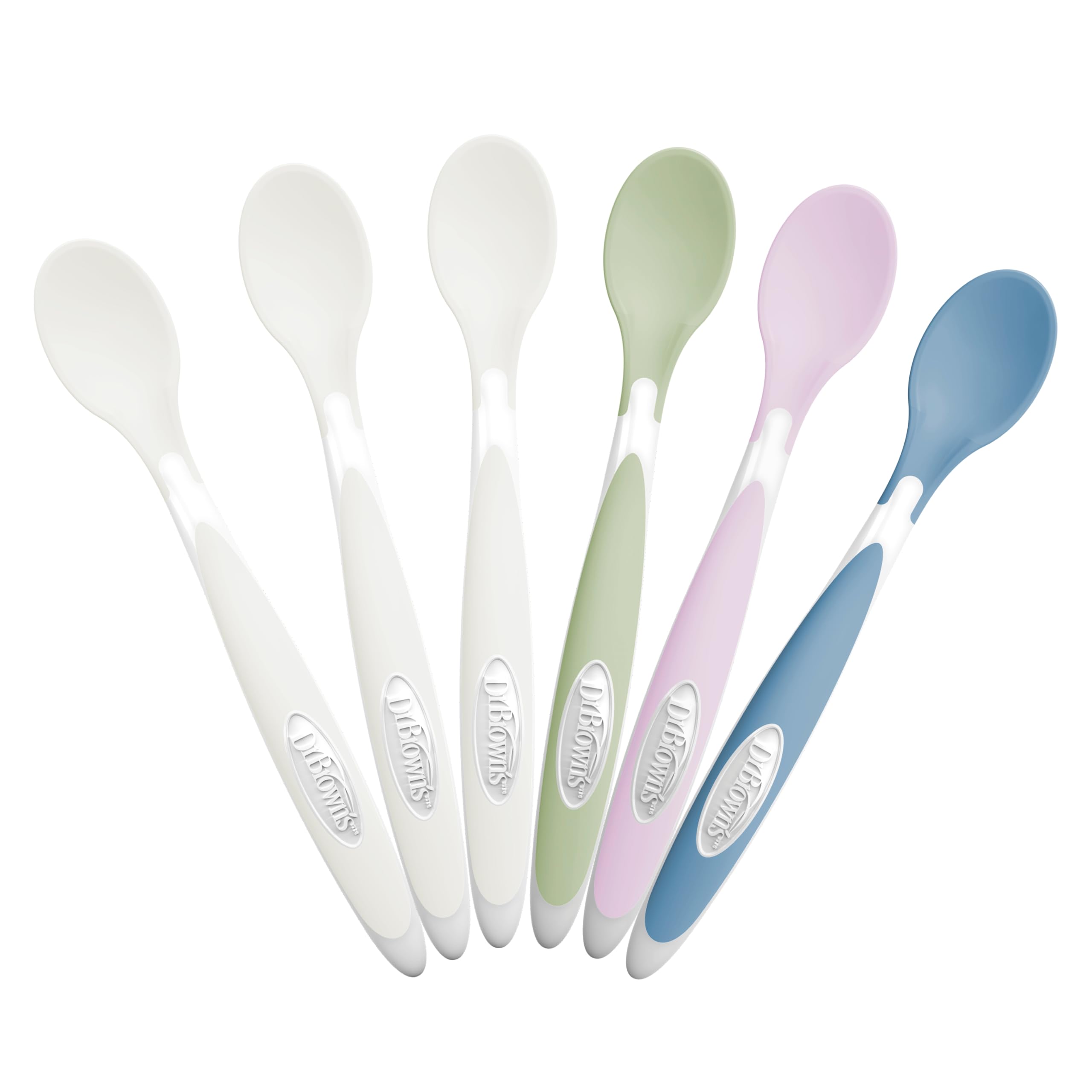
Dr. Brown’s Soft-Tip Spoons
Key Features
- Bowl: Flexible shallow scoop
- Care: Dishwasher and sterilizer safe
- Material: BPA-free plastic
- Pack size: 6 spoons
- Price: Budget
The Dr. Brown’s spoon is the one we reach for when there is a nearly empty jar: the long handle gets into the corners, and the flexible, shallow scoop bends enough to scrape the last of the puree out. It is the budget route in this group, but it does not feel like a compromise when you are feeding a baby who is more interested in the spoon than the food.
The soft tip is gentle on gums, and the six-pack means you can leave one in the diaper bag without mourning it if it disappears. The spoons are light and the handle is easy to grip, which matters when you are holding a jar in one hand and a baby in the other. They are dishwasher and sterilizer safe, too, which takes some of the dread out of cleanup.
The raised base is the one fussy detail. It is meant to rest on the table, but on a bowl with a pronounced rim the spoon can slide off and land in the food. That is a small annoyance rather than a reason to skip the set, especially at this price. For jar-feeding and backup duty, Dr. Brown’s earns its place.
Pros
- Long handle scrapes the bottom of jars
- Flexible shallow scoop is gentle and efficient
- Six-pack at a budget price
Cons
We recommend Dr. Brown’s for jar-feeding on a budget: the long handle and flexible scoop get the last of the puree without costing much.
Best for Early Self-Feeding
NumNum Pre-Spoons
Key Features
- Age: 6–18 months
- Design: Flat, no-wrong-way head
- Material: Silicone and nylon
- Pack size: 6 pre-spoons
- Price: Premium
The NumNum pre-spoon looks more like a tiny paddle than a spoon, which is the point. Its flat head has no wrong way up, so a baby can dip, drag, or scoop without first learning how a bowl works. The shape is also easy to chew, which makes it useful during the months when everything goes into the mouth anyway.
It is built for thick purees, yogurt, and other foods that cling; thin liquids slide off the flat head. The short, chunky handle gives small hands a good grip, and the six-pack means there is usually one clean when you need it. The flat head also doubles as a teether, which is why it tends to stay in the diaper bag beyond mealtime.
What we keep coming back to is the stage: this is a pre-spoon for 6 to 18 months, not a lifelong utensil. If your baby is already scooping well, a regular training spoon will last longer. If they are still grabbing the bowl and chewing the handle, the no-wrong-way shape gets them participating sooner.
Pros
- Flat head works from any angle
- Chunky handle is easy for small hands
- Doubles as a teether
Cons
- Textured surface can be hard to clean
- Premium price for a pre-spoon
We recommend the NumNum pre-spoon for the grabbing, chewing stage, when a no-wrong-way shape gets a baby feeding themselves sooner.
Best for Temperature Checks
Munchkin White Hot Spoons
Key Features
- Bowl: Tapered
- Heat cue: Turns white above 110°F
- Material: Silicone
- Pack size: 4 spoons
- Price: Budget
The White Hot spoons turn white at the tip when food is hotter than 110°F, which is the kind of cue that is easy to act on when you are juggling a hungry baby and a jar of sweet potato. The soft tip and tapered bowl are otherwise familiar: a small bite, a gentle edge, and a handle long enough to reach into the jar. The color change is the reason to choose these over a plain set, and it is a good one for first feedings.
We appreciate the cue because it is visual and immediate, but it is a prompt, not a thermometer: stir the food and test a drop on your wrist before feeding. The tip is soft against gums, and the shallow bowl keeps the bite small. Bright colors help hide the stains that come with orange purees, and the spoons are light enough to keep with the baby food. If temperature is the thing you worry about at the start of solids, these earn their place.
The tapered bowl is the quiet advantage: it fits a small mouth without a giant scoop, so you can feed at the baby’s pace. The handle is long enough for jar duty, and the soft tip stays gentle against gums. For the first weeks of solids, when you are still learning how warm your baby likes things, that combination is reassuring.
Pros
- Tips turn white above 110°F
- Soft tip is gentle on gums
- Long handle reaches jar bottoms
Cons
- Only four spoons in the pack
We recommend the White Hot spoons when you want a visual temperature cue at the start of solids, paired with a soft tip and a jar-reaching handle.
Best for Tiny Hands
ezpz Tiny Spoon
Key Features
- Bowl: Narrow with sensory bumps
- Handle: Short
- Material: 100% silicone
- Pack size: 2 spoons
- Price: Premium
The Tiny Spoon is short on purpose: the handle is sized for a baby’s fist, and the narrow bowl fits a small mouth without asking for a huge open-wide bite. The slight arc gives a baby a better angle for dipping and scooping, and the sensory bumps on the bowl give them something to feel with their lips and tongue.
It works for purees and baby-led weaning, which is a wider range than some training spoons manage. The silicone is soft enough for gums, and the narrow bowl keeps the scoop small. The short handle makes it easy for a baby to bring the spoon to their own mouth without a parent steering every bite. The design comes from a pediatric feeding specialist, and it shows in the small details.
What stands out is how deliberately it is sized. This is not a parent’s jar spoon; it is a self-feeding tool, and it is at its best when a baby wants to hold the utensil. If you are still doing most of the feeding from a deep jar, a longer handle will serve you better. For the hand-over stage, the Tiny Spoon is the one we reach for.
Pros
- Short handle fits a baby’s fist
- Narrow bowl with sensory bumps
- Works for purees and baby-led weaning
Cons
- Premium price for a two-spoon set
We recommend the ezpz Tiny Spoon for self-feeding babies: the short handle and narrow, textured bowl are built for small hands and mouths.
Best for Growing Appetites
Moonkie Silicone Spoons
Key Features
- Case: Travel case
- Sizes: Two bowl sizes
- Material: Food-grade silicone
- Pack size: 4 spoons
- Price: Midrange
Moonkie’s set comes with two bowl sizes, which is a small thing that turns out to matter. The smaller spoon is genuinely useful for first purees, and the larger one still works when a baby starts taking bigger bites. Instead of buying a new set at every stage, you get a little more runway from one purchase.
The silicone is soft and bendable, so the handle can be angled to suit a baby’s grip. That bend is useful when a baby is learning to scoop, and it also helps a parent feed from an awkward angle. The spoons are light, chewproof, and boil-proof, which makes them easy to live with.
The travel case is the other practical touch. It keeps the spoons out of the diaper bag grit, and it is small enough to toss in a tote. The latch can take a couple of tries to close, but it stays put once it is lined up. The spoons are dishwasher safe and easy to rinse between meals.
What we keep coming back to is the two-size range. A lot of sets are either too small for a hungry baby or too big for a first mouth; this one gives you both without making you buy twice. For the messy middle of starting solids, that is the detail that earns the space.
Pros
- Two bowl sizes grow with appetite
- Bendable handle can be angled
- Travel case keeps spoons clean
- Boil-proof and chewproof silicone
Cons
- Can stain with orange foods
We recommend the Moonkie set when you want one spoon to span first purees and bigger bites, with a case for the diaper bag.
Best for Simple Silicone
mushie Silicone Spoons

Key Features
- Bowl: Narrow
- Care: Not microwave, steam, or sterilizer safe
- Material: Silicone
- Pack size: 2 spoons
- Price: Premium
The mushie spoon is the one that looks like it belongs on the table, not in a drawer of baby gear. The muted colors and simple silhouette are the first draw, but the shape is practical too: a narrow bowl, a soft silicone edge, and a handle that is easy to hold.
The narrow bowl is the useful part for a small mouth. It keeps the bite modest, and the silicone is soft enough to be gentle on gums without feeling flimsy. The spoon is light in the hand, and the length gives a little more reach than the shortest training spoons.
Two spoons are enough for a single meal, but you will be washing them often. The silicone has a soft, matte feel that is pleasant to use, and it cleans up with a quick wash. It is not the set for a family that wants a dozen spoons in rotation.
What we appreciate most is that mushie did not over-design it: no deep scoop, no gimmick, just a narrow silicone spoon that feels good in the hand. If you want a set that can go from high chair to table without looking like baby gear, this is the one.
Pros
- Narrow tip fits small mouths
- Soft silicone is gentle on gums
- Simple shape is easy to clean
Cons
- Not microwave, steam, or sterilizer safe
- Premium price for two spoons
We recommend the mushie spoons for parents who want a simple, good-looking silicone spoon and can live with its careful cleaning rules.
How We Tested the Best Baby Spoons
We started by pulling together a shortlist from top-selling spoons and sets, then narrowed it by material safety, tip shape, handle length, age range, and price. We ruled out any spoon with a bowl too wide for a first-time eater or a handle too short for a parent to hold comfortably. That left 16 spoons, which we tested over four months with my own toddler and a group of parent testers whose babies were at different feeding stages.
Every spoon went through the same real-life routine: breakfast oatmeal, puréed vegetables, yogurt, and applesauce, plus the occasional mashed banana. We watched how each tip felt against sore gums, whether a wet hand could keep hold of the handle, and whether the spoon stayed put when a baby set it down on the high chair tray instead of flipping into the seat. We also sent spoons home with testers whose babies were just starting self-feeding and asked them to note how easily their child could scoop and bring the spoon to their mouth.
After each meal, spoons went into the dishwasher; we checked for tips that clouded, handles that loosened, and any change in softness after repeated cycles. We compared the cost of each set against what it actually delivered—a few budget spoons matched pricier ones scoop for scoop, while some expensive sets had handles that were too slick or bowls that were too deep. Stability got its own simple test: we set each spoon on a tray and nudged it, noting whether it tipped, rolled, or stayed put. The spoons that rose to the top were the ones that stayed soft, grippy, and balanced through months of daily use.
How to Choose Baby Spoons
The right spoon depends on who is holding it: a long handle for jar-feeding, a short grippy one for self-feeding, and a shallow bowl either way.
Start with the bowl and the tip
A shallow bowl is the difference between a manageable first bite and a mouthful that ends up on the bib. Look for a soft tip if your baby is just starting solids; plastic or silicone both work, but silicone gives more flexibility for baby-led weaning. The Munchkin Soft Tip’s shallow bowl is why it is our default for first purees, while the Olababy’s leaf-shaped tip is the more flexible choice for a baby who wants to scoop from an angle. If the bowl is deep and narrow, expect more food left behind and more scraping.
Match the handle to the hand
A long handle is for the parent: it reaches the bottom of a jar and keeps your knuckles out of the puree. A short, thick handle is for the baby: it gives a small fist something to close around and makes it easier to bring the spoon to their own mouth. Dr. Brown’s is the jar-feeding shape here; ezpz’s Tiny Spoon is the self-feeding shape. Buy for the stage you are in now, not the one you expect in three months, because babies change their grip quickly.
Pack size, travel, and cleanup
A larger set is not about having more spoons; it is about having a clean one when the dishwasher is full and the baby is hungry. A dozen spoons makes sense if you are feeding several times a day, while a two-pack is enough as a dedicated spoon you wash by hand. A travel case is worth having if spoons live in the diaper bag; Moonkie’s set includes one. Silicone and soft plastic can stain with orange, carrot, or squash purees, so choose a color you can live with and do not expect it to stay pristine.
Temperature cues and care limits
A heat-sensitive spoon can be a useful extra check at the start of solids: the Munchkin White Hot tips turn white when food is hotter than 110°F. Treat that as a prompt, not a thermometer, and still stir the food and test a drop on your wrist. Care limits matter too. Some silicone spoons are dishwasher safe, while others should not go in the microwave, steam sterilizer, or boiling water. Check the maker’s instructions for the exact set before you heat or sterilize it.
Frequently Asked Questions
Can I use a regular teaspoon for baby food?
A metal teaspoon has a deeper bowl and a hard edge, so it is easier to give too big a bite or clink against gums. A dedicated baby spoon’s shallow bowl and soft tip are worth it for the first few months. If you are caught without one, use the tip of a small spoon and load only a smear of food.
How often should I replace baby spoons?
Inspect the tip and handle before each use. Replace any spoon with tears, cracks, bite marks that trap food, or a change in flexibility, and follow the maker’s care limits. Staining alone is not a reason to retire a spoon; damage is.
Can I sterilize silicone baby spoons?
Only if the maker says so. Dr. Brown’s spoons are labeled dishwasher and sterilizer safe; mushie’s silicone spoons are not microwave, steam, or sterilizer safe. Check the care instructions for the exact set, and when in doubt, wash with warm soapy water and let it air-dry.
Final Verdict
For most families starting solids, the Munchkin Soft Tip 12-pack is the set we recommend: shallow, soft, and easy to keep clean, with enough spoons to leave one in every bag. It is not the fanciest spoon here, but it is the one that makes the first month of feeding less fraught.
If your baby is leading the feeding, the Olababy’s flexible tip is the better tool; if you are mostly scraping jars, Dr. Brown’s does that job for less. The mushie set is for a table that looks nice, provided you can follow its no-microwave, no-steam care rules.
