This post contains affiliate links. We may earn a small commission when you buy through our links — at no extra cost to you.
Somewhere between learning to sit up and taking those first steps, a baby figures out the deep satisfaction of putting one thing inside another — and the equally deep frustration of not being able to get it back out. That twenty-minute window while you’re trying to get dinner on the table is exactly what a shape sorter is built for: hands busy, brain working, no screen involved. The problem is that most of them overshoot in one direction or the other. They’re either so simple a baby cracks the code in an afternoon and never touches it again, or the holes are so tight and the angles so unforgiving that every piece bounces off and the whole thing ends in tears.
We put 16 shape sorters in front of real babies, from 6 to 24 months, over four months — on playroom floors, on high chair trays, in diaper bags, and on more than one car ride — and the split was almost never about how many shapes came in the box. It came down to whether the holes let a piece drop in on the second or third attempt, and whether the thing survived being sat on, chewed, and hurled off a coffee table. One piece of advice nobody gives first-time buyers: a sorter with four chunky shapes gets played with far longer than a twelve-piece set, because a baby can actually finish it. The picks below are the ones that held up to all of it.




Best for First Shape Sorter
Fisher-Price Baby’s First Blocks
Key Features
- Storage: Bucket with carry handle
- Shape sorter: Lid with shape holes
- Blocks included: 10 blocks
- Recommended age: 6 months and up
- Price: Budget
Six months is early for a puzzle, which is why the Fisher-Price set works as a first shape sorter. It is really a bucket of ten chunky blocks with a shape-sorting lid, so the first job is grabbing, dumping, and mouthing; matching comes later. We appreciated that the bucket holds everything and the handle makes it easy to move from room to room. The blocks are light enough for a baby to lift without help, and the shape holes are cut into the lid so there is a clear next step when they are ready.
The play pattern grows in stages. A younger baby can dump and fill, an older baby can stack, and a toddler can start posting shapes through the lid. We noticed the colors are bright without being overwhelming, and the blocks are simple enough that a child can focus on one skill at a time. There are no batteries, no songs, and no flashing lights, just the physical work of fitting and stacking. That quiet simplicity is why we keep it in the first-toy category rather than the electronic-toy category.
It is not a toy that will teach shape names on its own, and it will not hold a child’s attention forever. But as a first sorter, that is the point: it is inexpensive, self-contained, and easy to hand down. We recommend it for families who want a classic, no-frills start and a toy that can live in the living room without taking over.
Pros
- Starts at six months
- Ten chunky blocks store in the bucket
- Carry handle for take-along play
- No batteries or electronic noise
Cons
- Lid sits loosely rather than snapping
For most families, this is the first shape sorter we point to: it starts at six months, stores everything in one bucket, and keeps play simple.
Best for Pretend-Play Toddlers
LeapFrog Picnic Basket
Key Features
- Batteries: 3 AA batteries
- Play modes: 3 play modes
- Play pieces: 15 play pieces
- Recommended age: 6 months to 4 years
- Price: Midrange
The first thing you notice is the basket handle, the plates, and the picnic setup, but the shape sorter is what gives this toy its staying power. The food pieces drop through matching holes in the basket, and the toy recognizes each one, naming the shape and color aloud. That audio feedback is the hook, and it is why a toddler who ignores a wooden cube may come back to this one.
We liked the three modes because they let the toy change as the child does: music for cause-and-effect, shapes and colors for naming, and picnic time for pretend play. The pieces are chunky enough for small hands, and the basket holds everything when play is done. The songs and lights are not our favorite part of the toy, but they are optional; the shape matching works without them. We preferred the picnic-time mode because it turns matching into a little story.
This is a fuller pretend-play set than a simple sorter, with plates, cups, food, and a tablecloth, so it suits a toddler who is past the mouth-everything stage more than a young baby. For a child who already likes pretend food, it is a shape sorter that will get used beyond the matching stage. We recommend it for toddlers who want a story with their shapes, not for a family looking for the simplest possible first toy.
Pros
- Grows from matching to pretend play
- Names shapes and colors aloud
- All pieces store in the basket
- Three play modes
Cons
- Many pieces to keep track of
- Requires 3 AA batteries for sound
This is the one we choose when you want a shape sorter that doubles as a pretend-picnic toy and keeps a toddler busy with sounds, songs, and matching.
Best for Travel and Sensory
M&D Take-Along Shape Sorter
Key Features
- Design: Soft activity bag
- Carry handle: Carry handle
- Recommended age: 9 months to 3 years
- Textured blocks: 9 textured blocks
- Price: Midrange
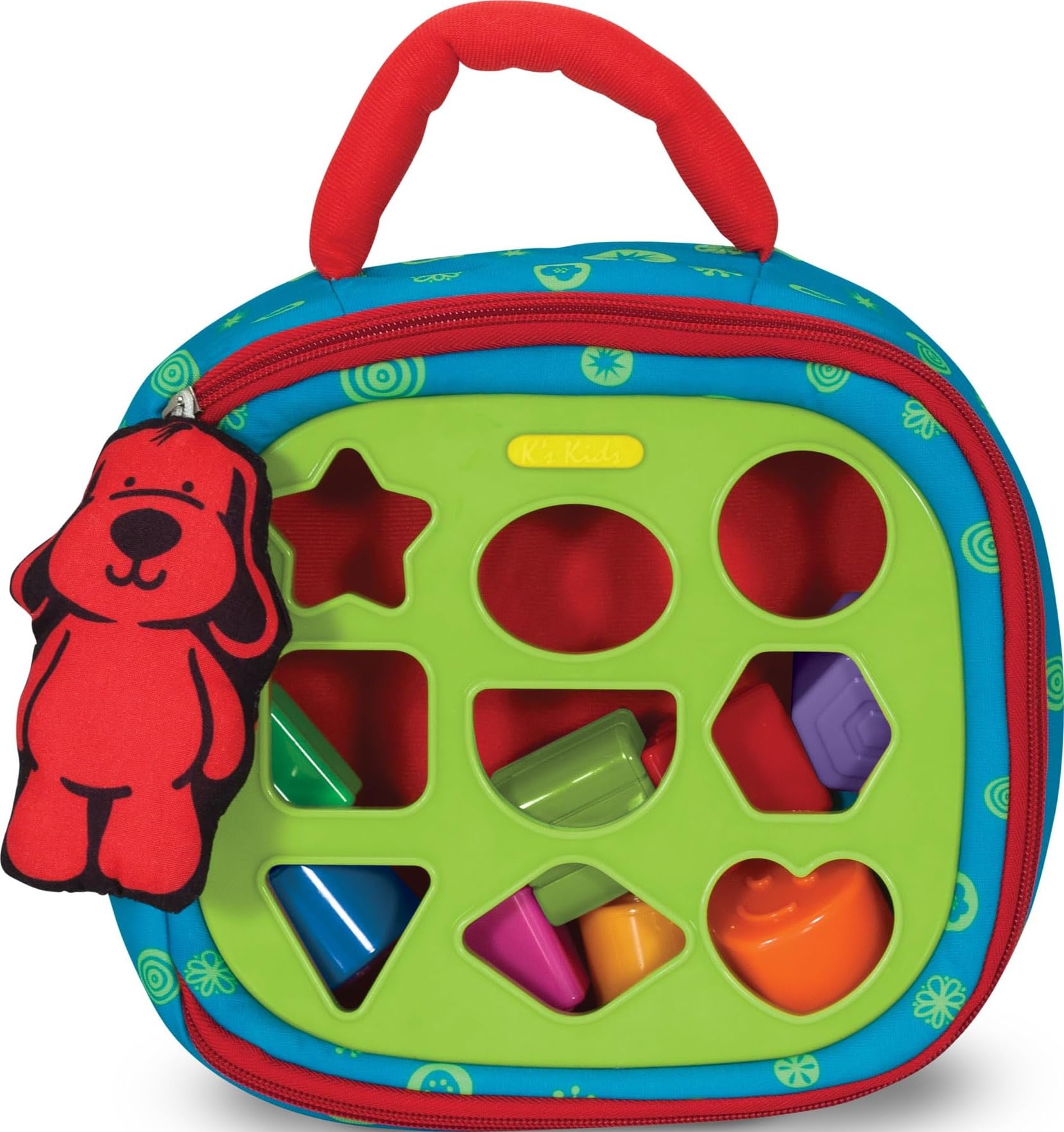
A shape sorter that can be carried like a purse is a different proposition from one that lives on the playroom floor, and that is exactly the appeal of the K’s Kids bag. The nine textured blocks go through matching holes in the soft bag, and the crinkly flaps hide pictures for peekaboo. We liked that it packs up into one piece for a diaper bag or a car trip, and the textures give a baby more to explore than smooth plastic alone.
The soft sides are the trade-off. They make the bag light and easy to carry, but they also mean the shape holes can shift and the bag can collapse when a baby pushes down. We got the best results on a lap or a flat surface, where the bag stays open enough to receive a block. The flaps and the handle are the details that make it feel like a toy rather than a travel container.
We recommend it for families who are often on the go and want a sorter that doubles as a sensory toy. It is not the most rigid option, and it will not replace a wooden cube at home, but it earns its place in the bag. The part we came back to is the crinkle: it gives a baby a reason to lift the flap even before they understand the matching.
Pros
- Packs into a carry bag
- Nine textured blocks
- Crinkle flaps for sensory play
- Suitable from nine months
Cons
- Zipper can be fiddly to close
For travel and small hands, this soft-sided sorter is the one we reach for: the textured blocks and crinkly flaps make it a toy, not just a matching exercise.
Best for Cause-And-Effect Play
VTech Sort & Discover Drum
Key Features
- Batteries: 2 AAA batteries
- Shape blocks: 5 shape blocks
- Recommended age: 6 to 36 months
- Learning content: Animals, shapes, numbers
- Price: Budget
The drum is the shape sorter for the baby who wants a reaction. Drop a block through the matching hole and the toy recognizes it, names the shape or animal, and flashes a light; tap the top and it plays drum sounds. That cause-and-effect loop is the reason to choose it over a quiet wooden sorter. We noticed the five blocks are chunky and easy to grab, and the top opens so the pieces can be dumped out and sorted again.
We liked that the shape recognition is not just decorative: the drum names the shape and color, which gives a toddler a reason to try the next one. The controls are simple enough that a child can tap and drop without help, and the top opens for dumping. The trade-off is that it is an electronic toy first and a sorter second; a baby who is sensitive to noise or lights may prefer a plainer set.
For a baby who needs a little fanfare to stay with a task, the drum earns its place. We recommend it as an engagement tool, not as the only sorter in the house. The shape blocks are simple, but the feedback is what makes the matching click.
Pros
- Rewards correct drops with lights and sound
- Names shapes, animals, and numbers
- Five chunky blocks
- Open top for dumping and resetting
Cons
- Requires 2 AAA batteries
If your baby needs cause-and-effect feedback to stay interested, this drum is the shape sorter we recommend, with lights and music that reward every correct drop.
Best for Truck-Loving Toddlers
M&D Shape-Sorting Dump Truck
Key Features
- Material: Wood
- Wooden figures: 2 wooden figures
- Blocks included: 9 blocks
- Recommended age: 2 years and up
- Price: Premium
A shape sorter that dumps its own blocks is a clever way to get a toddler to clean up. The wooden dump truck has nine shaped holes in the bed, nine blocks, and two little figures; a child matches the blocks, then tilts the bed to send them tumbling out the back. We liked that the sorting is not a separate activity from the truck play. The truck rolls, the figures ride, and the blocks become cargo.
The wooden construction feels solid, and the pieces are chunky enough for a two-year-old to handle. We noticed the back door opens and the bed tilts smoothly, which is the part that keeps a toddler repeating the cycle. The truck is not a complicated sorter; nine blocks and a handful of shapes means it is easy to reset.
We recommend it for a toddler who already loves vehicles and is ready for a sorter with a second act. It is not the first choice for a baby, but for a two-year-old it turns matching into loading and hauling. The two figures are a nice touch; they give the truck a driver and a passenger, so the play continues after the blocks are put away.
Pros
- Dual shape sorter and dump truck
- Tilting bed and opening back door
- Two wooden figures
- Solid wooden build
Cons
- Heavier and bulkier than a bucket
For truck-obsessed toddlers ready for a two-year-old sorter, this is the one: the dumping action and wooden figures make shape matching part of pretend play.
Best for Sensory Fine Motor
Fat Brain InnyBin

Key Features
- Material: Plastic
- Cube size: 5.5 inches per side
- Chunky blocks: 6 chunky blocks
- Recommended age: 10 months and up
- Price: Premium
This is not a matching sorter, and that is the point. The InnyBin is a cube strung with elastic bands; a baby pushes the six chunky blocks through the bands, pulls them back out, and discovers that the opening changes shape as they pull. We liked it for the immediate cause-and-effect: the resistance is right there, and a baby does not need to find the correct slot to get a result. The blocks have different textures, and the whole thing is small enough to hold on a lap.
The trade-off is that it does not teach shape matching in the way a classic sorter does. Any block can go through any gap, so a child learns fitting and pulling rather than matching a triangle to a triangle. We found the bands make it harder to retrieve pieces than to push them in, which is good for persistence but can be frustrating for a younger baby. That is the moment to help, not to hand them a different toy.
We recommend it as a fine-motor and sensory toy for a baby who is not ready for matching, or as a second sorter for a child who has already figured out the basics. It earns its place by being different, not by being comprehensive. The textured blocks are the part that gives it range; a baby can mouth them, stack them, or push them through the bands.
Pros
- Builds fine motor strength
- Six textured blocks
- Elastic bands create resistance
- Compact for lap play
Cons
- Hard plastic blocks are not ideal for teething
This is the pick for babies who learn through push, pull, and texture rather than matching; it builds fine motor strength without demanding a correct slot.
Best for Montessori Stacking
GOPO Montessori Shape Sorter
Key Features
- Material: Wood
- Shape bases: 5 shape bases
- Recommended age: 18 months to 4 years
- Stacking pieces: 20 stacking pieces
- Price: Budget
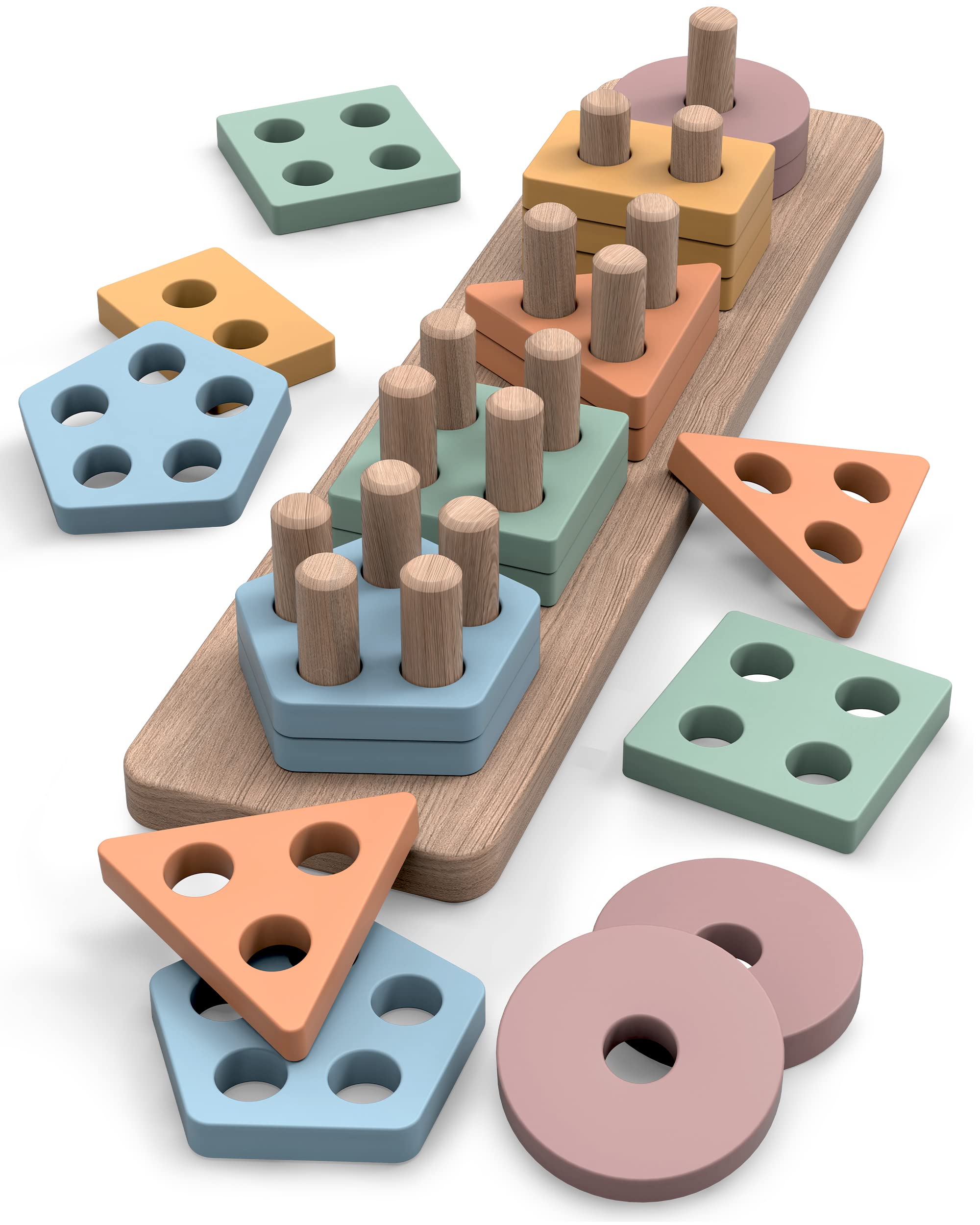
The first thing we noticed is that the shapes stack on pegs rather than drop through slots. That makes the GOPO set a different kind of shape sorter: five geometric bases hold twenty pieces, and a toddler sorts by shape, color, and the number of holes on each piece. It is a quiet, tabletop toy with a Montessori feel, and the pieces are painted in muted colors that look at home in a living room.
We liked the open-endedness. A younger toddler can stack the pieces on the pegs, an older one can sort by color, and a preschooler can count the holes. The chunky shapes are easy to grip, and the whole set stores on one board. The stacking pegs also demand more precision than a simple drop-through hole, which is good for fine motor but can be frustrating at first. We found that a child who is still in the dump-and-fill stage will need a little modeling before the pegs make sense.
We recommend it for a toddler who has moved past the dump-and-fill stage and is ready to sit and work through a puzzle. It is not the first sorter we hand a baby, but it is a satisfying next step. The self-contained board is the detail we appreciate most; it keeps the pieces together without a bucket or a bag.
Pros
- Five shape bases
- Twenty stacking pieces
- Supports color and counting
- Self-contained storage board
Cons
- Pieces are smaller than classic wooden blocks
This Montessori stacking sorter suits toddlers ready to count, sort by color, and work on pegs; it is calmer and more open-ended than an electronic toy.
Best for Bath and Beach
iPlay Stacking Cups
Key Features
- Material: ABS plastic
- Stacked height: 23 inches stacked
- Pieces included: 18 pieces
- Recommended age: 12 months to 6 years
- Price: Midrange
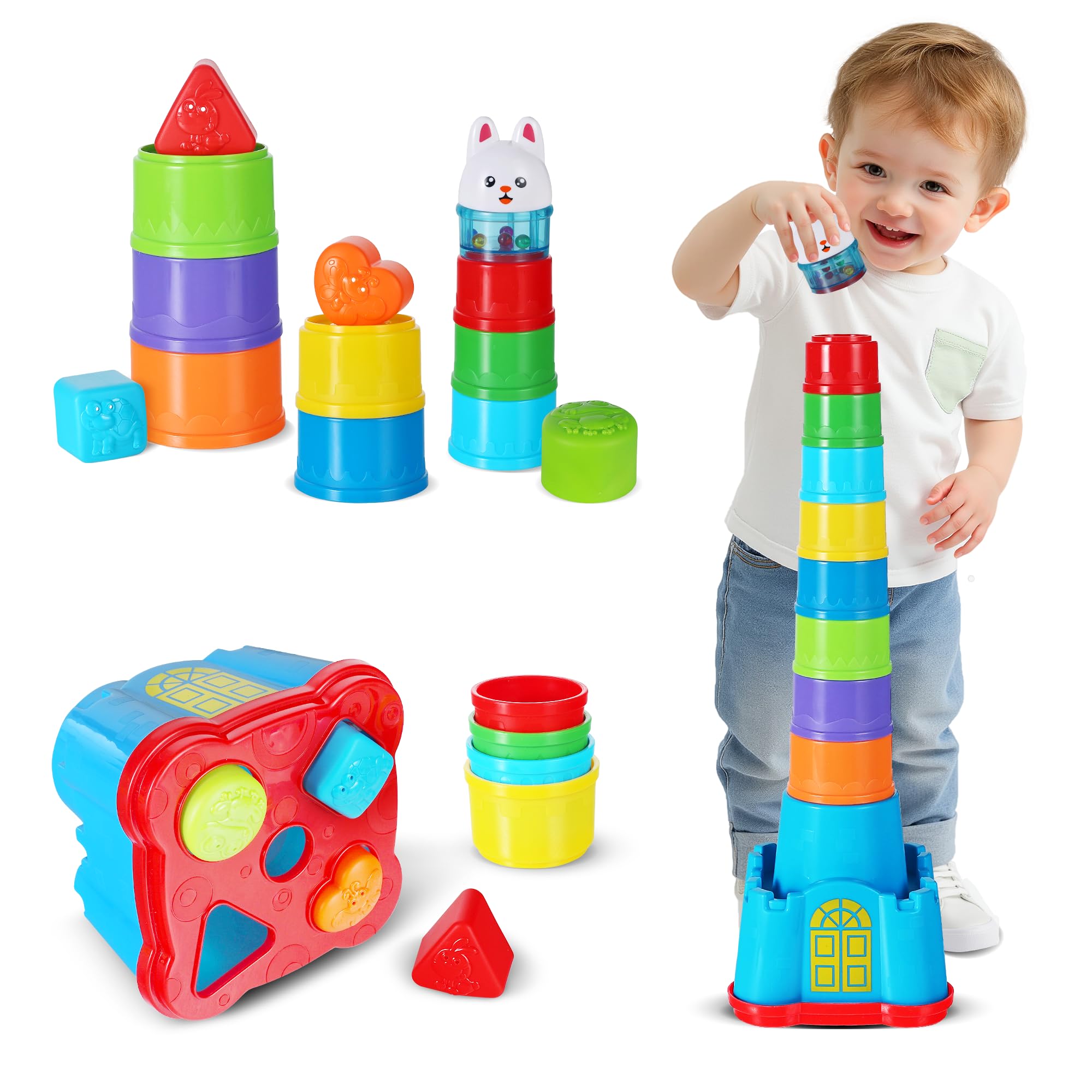
The 23-inch tower is the headline, but the shape sorter is what makes this set more than a stack of cups. The eighteen pieces nest and stack, the cups have numbers and pictures, and the base turns into a shape-sorting lid. We liked the range: a baby can bang cups together, a toddler can stack and knock them down, and an older child can sort the shapes or use the set in the bath.
The cups are light and easy to clean, and the whole set packs into itself when play is done. We found it works best as a bath or beach toy, where the plastic can get wet and the pieces can be rinsed. The plastic is light and easy to rinse, which makes it a natural choice for water play.
We recommend it for families who want one toy that covers stacking, nesting, and sorting without spending a lot of space. It is the one that will get used in more places. The base turning into a storage box is a clever finish, and it makes cleanup part of the play.
Pros
- Stacks to 23 inches
- 18 pieces nest and store
- Works in bath and beach
- Shape sorter included
Cons
- Shape-sorter base lifts off easily
This is the versatile, grow-with-me pick for bath, beach, and floor play, with stacking cups and a shape-sorting base in one set.
How We Tested the Best Shape Sorters
We started with every shape sorter we could find that was rated for roughly 6 to 24 months, then filtered by material, piece count, and closure design. Wooden boxes with sliding lids, plastic buckets with snap-on tops, and soft fabric pouches with zippered openings all stayed in the running. Anything with pieces small enough to be a choking concern, or a lid that required adult hands and adult patience to open, came off the list. That left 16.
Each one went home with a family and stayed in rotation for four months. We watched babies between 6 and 24 months approach the same toy cold, and noted whether they kept at it for a couple of minutes or lost interest and moved on. We handed over the correct piece and counted how many attempts it took before it dropped through, then tried the wrong piece to see how the toy handled a near-miss. We flipped each box over and pressed on the lid to see whether a toddler leaning on it could pop it open, and we checked whether the pieces were wide enough for a small, clumsy hand to grip and turn.
Durability got its own pass: each sorter was dropped from counter height, sat on, chewed, and shaken, then washed the way a parent would actually wash it. On the fabric pouches, we filled the bag with blocks and worked the zipper open and closed repeatedly to see whether it snagged or split. We also packed every option into a diaper bag to check the footprint and weighed it one-handed, since a sorter that’s awkward to carry rarely leaves the house. The ones that stayed in the rotation are the ones that never needed a rescue.
How to Choose a Shape Sorter for a Baby
The right sorter is the one your baby can use now, not the one with the most shapes on the box.
Match the sorter to the sitting-and-grasping stage
A shape sorter is not one skill; it is a sequence. A baby who is just sitting and grabbing needs chunky pieces, a stable base, and a way to dump everything out. A toddler who can deliberately post a shape is ready for matching holes and maybe a puzzle with pegs. We prioritize the stated age range and the size of the pieces over the number of shapes, because a sorter that is too advanced becomes a chew toy or a frustration. For under a year, fewer, larger pieces are easier to manage.
Choose the matching mechanism you actually want
Classic sorters ask a child to fit a shape through a corresponding hole. Stacking sorters use pegs and holes, and sensory bins use elastic bands or soft openings. They look similar in a listing, but they teach different things. Slot sorters are the clearest introduction to shape matching; peg sorters add counting and precision; elastic-band toys build grip and persistence without a correct answer. If shape matching is the goal, choose slots. If fine motor and sensory play matter more, a stacking or banded toy can be the better first step.
Check the lid, hinge, and storage before you buy
The lid is the part that decides whether a sorter works as a sorter or just a bucket. A lid that snaps or locks keeps the shape holes in place; a lid that sits loosely will come off when the bucket tips, which turns matching into dumping. That is not always a dealbreaker, since dump-and-fill is a legitimate stage, but you should know which toy you are buying. Look for a hinged lid, a secure sliding top, or a deep bucket that holds pieces without spilling. Storage matters too: a sorter with a bag or box is easier to live with than a pile of blocks.
Decide how much sound and light you want
Electronic sorters add cause-and-effect feedback: a light, a song, or a voice naming the shape. That can hold a baby’s attention long enough to practice matching, especially if they are not yet motivated by the puzzle alone. The cost is batteries, volume, and a toy that may be more stimulating than you want before bedtime. We suggest choosing electronic only if you want the feedback to be part of the play. A quiet wooden or plastic sorter lets a child focus on the fit, and it is easier to use in a car or a quiet room.
Plan for travel, cleanup, and the pieces you will lose
A sorter that stays home can be heavier and more elaborate. A sorter that goes in a diaper bag needs a handle, a closure, and pieces that stay contained. Soft bags are light and packable, but they can collapse during play and their zippers can be fussy. Wood and plastic wipe clean; fabric needs spot cleaning and air drying. No matter which you choose, count the pieces after play and keep the set in one place. Missing pieces are normal, and a sorter with a storage base is easier to keep complete.
Frequently Asked Questions
How many pieces should a shape sorter have for a baby?
For a baby under 18 months, five to ten chunky pieces is plenty. More pieces mean more to keep track of and more to mouth, and a young baby rarely uses the extra shapes. A set with 15 to 20 pieces is better for a toddler who already sorts and wants to count or stack. The storage matters as much as the count: choose a set that holds every piece.
Can a shape sorter help with speech and language?
It can give you something to talk about, which is the useful part. Name the shape, color, and action as your baby handles the pieces: yellow star, push it in, dump it out. The toy does not teach language on its own, and a baby does not need to say the words back. The back-and-forth is what counts. Follow your child’s lead and keep the naming short.
What should I check before buying a used shape sorter?
Inspect every piece for cracks, splinters, peeling paint, and loose pegs. Wooden sorters can chip, and a loose peg or small block is a choking risk. Check that the lid, hinge, or zipper still works and that no pieces are missing. If the set is damaged or you cannot confirm the age range, skip it; a baby toy is not the place to cut corners.
Can a shape sorter be used in the bath?
Only if the maker says it is safe for water. Plastic stacking cups like the iPlay set are the usual bath candidate; wooden sorters, fabric bags, and battery-powered toys should stay out of the tub. Even a waterproof plastic toy can trap water in small crevices, so shake it out and let it dry fully. If the set has a shape-sorter base that lifts off, check that it drains before storing.
Final Verdict
For most families, the Fisher-Price Baby’s First Blocks is the shape sorter we recommend first: it starts at six months, stores everything in one bucket, and meets a baby who is still learning to grab. If you want a toy that will still be in use at three, the LeapFrog Picnic Basket is the better choice; if travel is the priority, the M&D Take-Along bag earns its place.
