This post contains affiliate links. We may earn a small commission when you buy through our links — at no extra cost to you.
The trouble with baby sunscreen is that the safest formulas are often the least pleasant to use. Mineral blockers sit on top of the skin, which means broad-spectrum protection but also a ghostly cast, a thick consistency, and a wrestle at the park bench. Chemical filters spread more easily, but parents worry about irritation and ingredients—and rightfully so when the skin in question is six months old. What you’re really shopping for is a formula that protects without a fight, and that both of you can live with.
I’ve applied enough chalky lotions to a squirming toddler to know that the best baby sunscreen is the one you’ll actually reapply. Over the past five months, our team tested 14 formulas—sticks, lotions, and sprays—on our own kids during stroller commutes, backyard afternoons, and a few beach weekends. We paid attention to the things that make or break daily use: whether a formula leaves a white cast, how greasy it feels on the car seat, whether it smells like a pool toy, and how far a tube really goes. The shortlist below reflects that mix of protection and practicality.

Best for Everyday Body Coverage
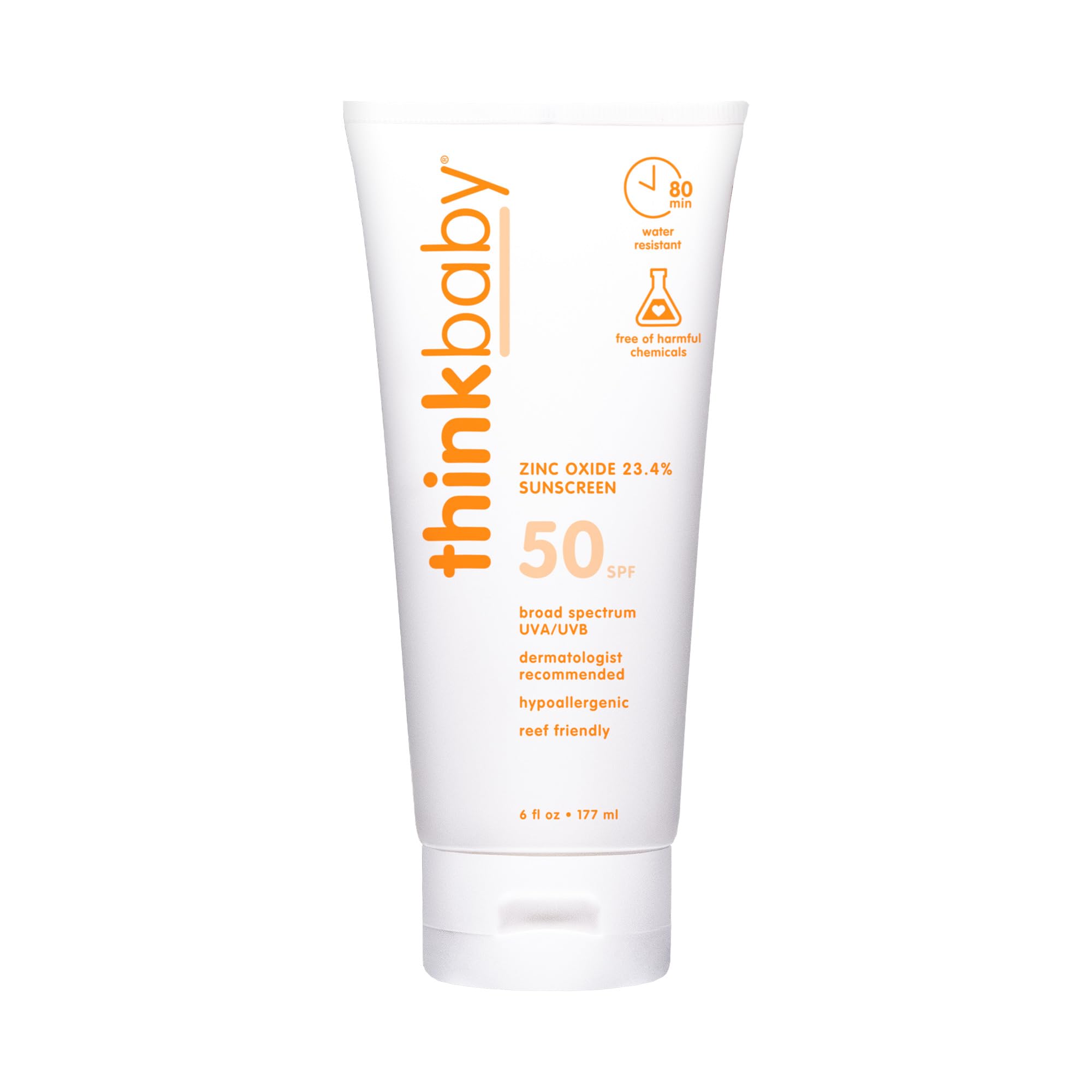
Thinkbaby SPF 50+
Key Features
- SPF: 50+
- Size: 6 oz
- Active formula: Mineral
- Water resistance: Highest FDA rating
- Price: Midrange
Six ounces is the first thing that makes Thinkbaby practical: this is a full-body lotion, not a tiny face stick, and a tube lasts through more than one beach-bag packing. The formula is mineral, broad-spectrum SPF 50+, and water-resistant enough for swimming and sweaty playground time. The six-ounce size is not so large that it feels like a commitment, but it is enough for a real beach day.
What earns it our top spot is the balance. We can cover arms, legs, and the back of a neck without stopping to pump or spray, and the lotion rubs in with less drag than many thick mineral creams. The lotion is thick enough to stay where you put it but not so stiff that it balls up. For a baby who will not sit still, that matters more than a fancy bottle.
The trade-off is finish. Apply too much at once and it leaves a pale cast, especially on deeper skin tones; warm a small amount between your palms and build it in thin layers. Otherwise it stays comfortable enough for daily use, and the tube is easy to squeeze one-handed.
We keep the tube by the back door and a stick in the diaper bag for faces; that division of labor is how it gets used rather than admired. The tube is the one that gets emptied first.
Pros
- Six ounces covers a full body
- Broad-spectrum SPF 50+ protection
- Water-resistant for swimming and sweat
- Mineral formula without parabens or phthalates
Cons
- Noticeable natural scent
We recommend Thinkbaby as the default baby sunscreen because its six-ounce mineral lotion covers a whole body and holds up through water play without a fussy application.
Best for Fragrance-Free Sensitive Skin
Blue Lizard Baby Lotion
Key Features
- SPF: 50
- Size: 5 fl oz
- Active: Zinc oxide
- Fragrance: Fragrance-free
- Price: Premium
The cap on Blue Lizard’s baby lotion turns color in strong sun, which is a useful nudge before the next swim. We choose this one when fragrance is the first thing we want to avoid: the five-ounce lotion is zinc-based, broad-spectrum SPF 50, and fragrance-free.
It is a body lotion first. The bottle is easy to pass between two adults, and the lotion spreads with less tug than a stick. Water resistance holds through a pool session, and the color-changing cap gives you a reason to reapply before your baby turns pink. It does not feel greasy once it settles.
A five-ounce bottle is enough for several full-body applications, but not so large that it feels wasteful in a diaper bag. We treat it as the sensitive-skin lotion and keep a stick for faces. The white cast is still there if you use the full amount, particularly on deeper skin tones; thin layers and a little patience help.
Pros
- Fragrance-free zinc formula
- Five-ounce bottle for body coverage
- UV-sensitive cap prompts reapplication
Cons
- Premium price for five ounces
For a fragrance-free mineral lotion that suits reactive skin, we choose Blue Lizard Baby; its five-ounce bottle and UV-sensitive cap make regular reapplication easier to remember.
Best for Budget Family Bottle
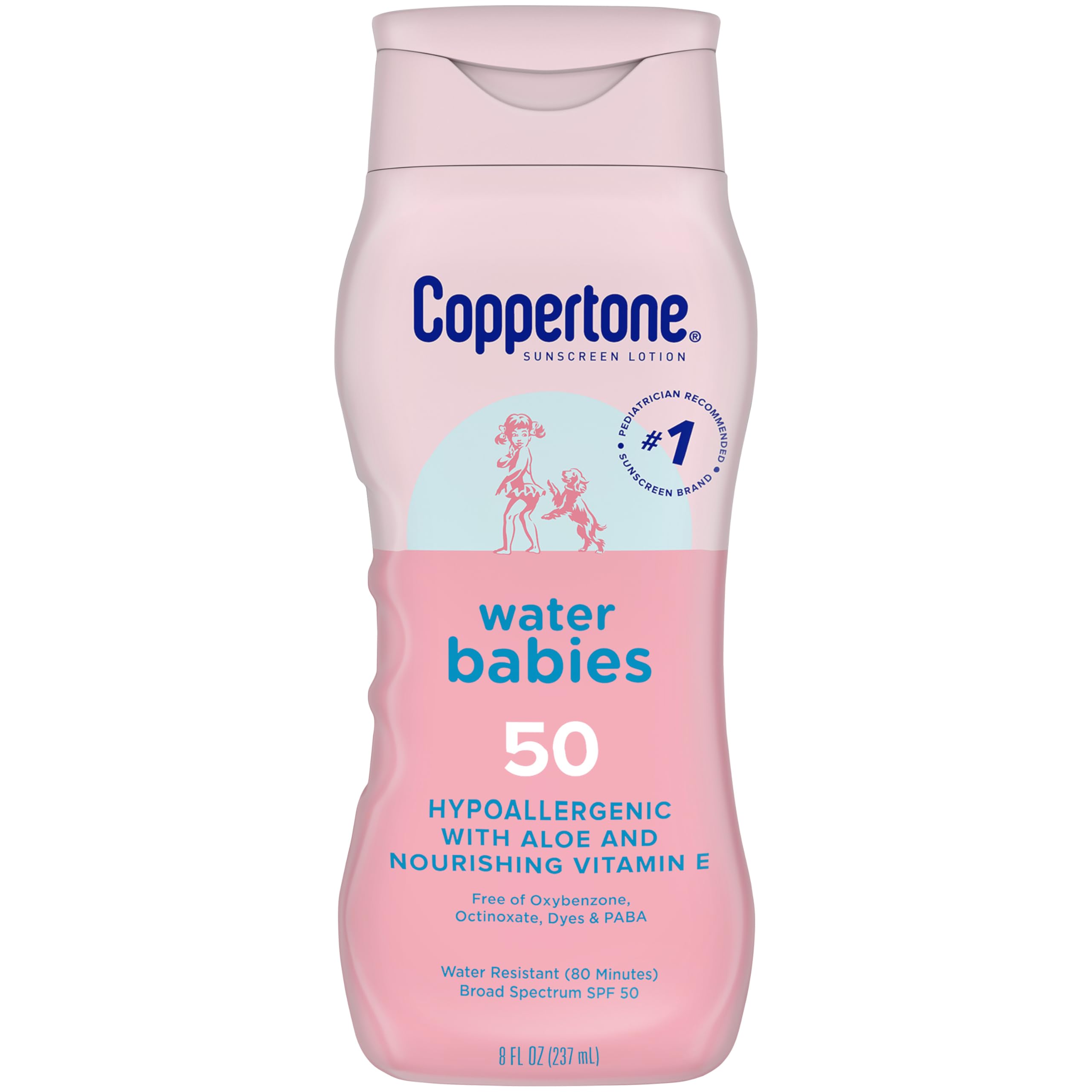
Coppertone WaterBabies Lotion
Key Features
- SPF: 50
- Size: 8 fl oz
- Minimum age: 3 months
- Water resistance: 80 minutes
- Price: Budget
The eight-ounce bottle is the family-size argument for Coppertone WaterBabies. It is a lotion, not a stick or spray, with broad-spectrum SPF 50 and water resistance for up to 80 minutes.
It spreads easily and soaks in quickly, which is what makes a big bottle useful on a squirming baby. The label lists a three-month minimum age and leaves out PABA, dyes, octinoxate, and oxybenzone. That makes it a practical everyday option for a family that goes through sunscreen fast.
We keep it as the budget option for body coverage. It is not the most elegant formula here, and it can leave a white cast on some skin tones, so rub it in before dressing. Otherwise the value is straightforward: a big bottle for the pool bag.
Pros
- Large eight-ounce bottle
- Broad-spectrum SPF 50
- Water-resistant for 80 minutes
Cons
- Strong baby-powder scent
Coppertone WaterBabies is the budget bottle we hand to families who need broad coverage for the whole body and do not mind a noticeable baby-powder scent.
Best for Eczema-Prone Babies
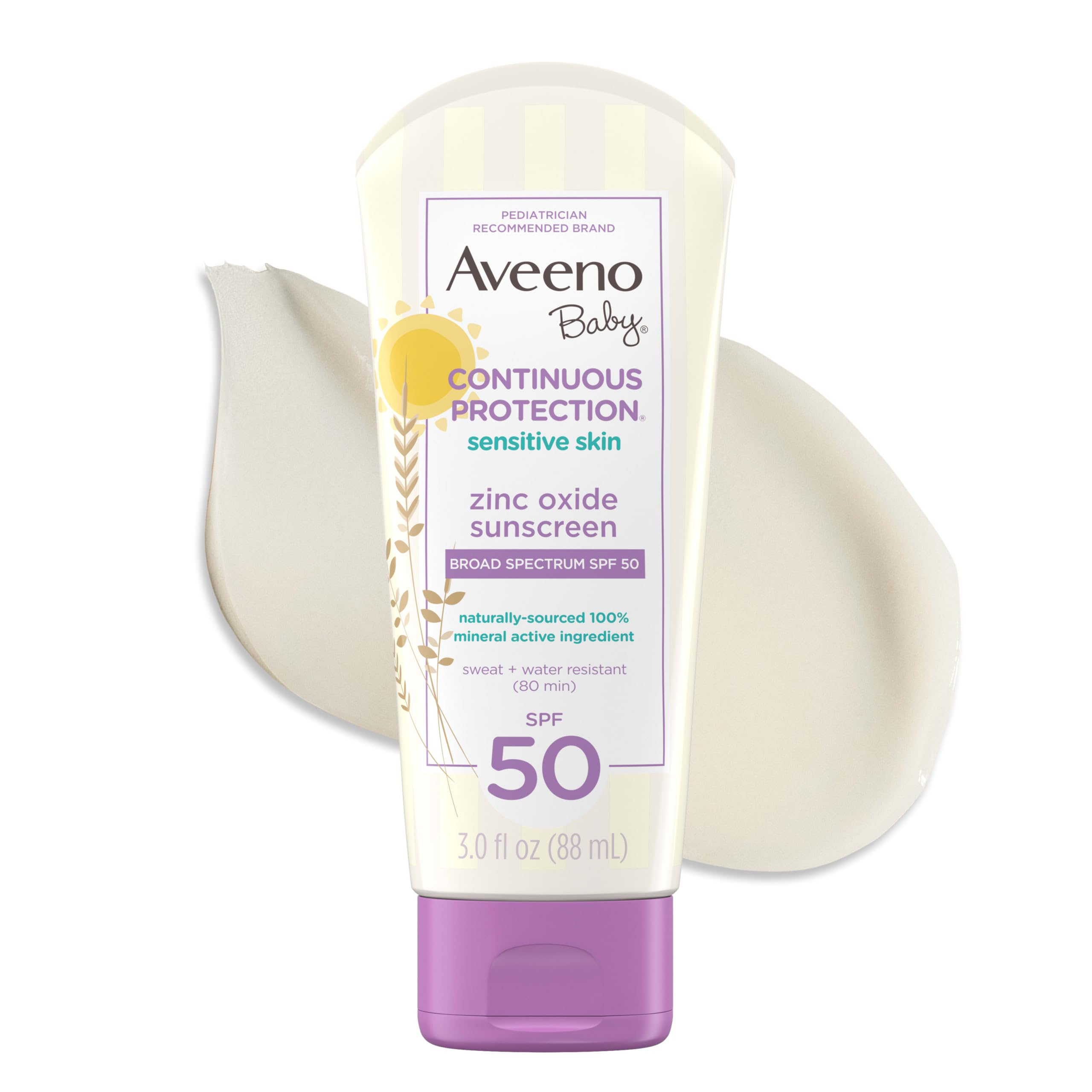
Aveeno Baby Mineral Lotion
Key Features
- SPF: 50
- Size: 3 fl oz
- Active: Zinc oxide
- Eczema seal: NEA Seal
- Price: Midrange
The National Eczema Association seal is the first thing we look for on Aveeno Baby Continuous Protection, and it is why this lotion stays in reach during flare-ups. The formula uses zinc oxide with skin-soothing oat, and it is fragrance-free and tear-free.
We reach for it when a baby’s skin is dry, reactive, or already irritated, because the lotion feels mild and the water resistance holds for up to 80 minutes. It is not the easiest formula to rub in: the cream is thick, so we dot it on and work in small circles rather than trying to spread a full pump at once.
The three-ounce tube is easy to keep in a diaper bag, and the seal gives parents a clear shortcut when the ingredient list is long. We use it on the body and keep a stick for faces.
Pros
- Zinc oxide and oat formula
- National Eczema Association seal
- Fragrance-free and tear-free
- Water-resistant for 80 minutes
Cons
- Leaves a visible white cast
We reach for Aveeno Baby when eczema-prone skin is the deciding factor: its zinc-and-oat lotion carries the National Eczema Association seal and stays water-resistant.
Best for Face Touch-Ups
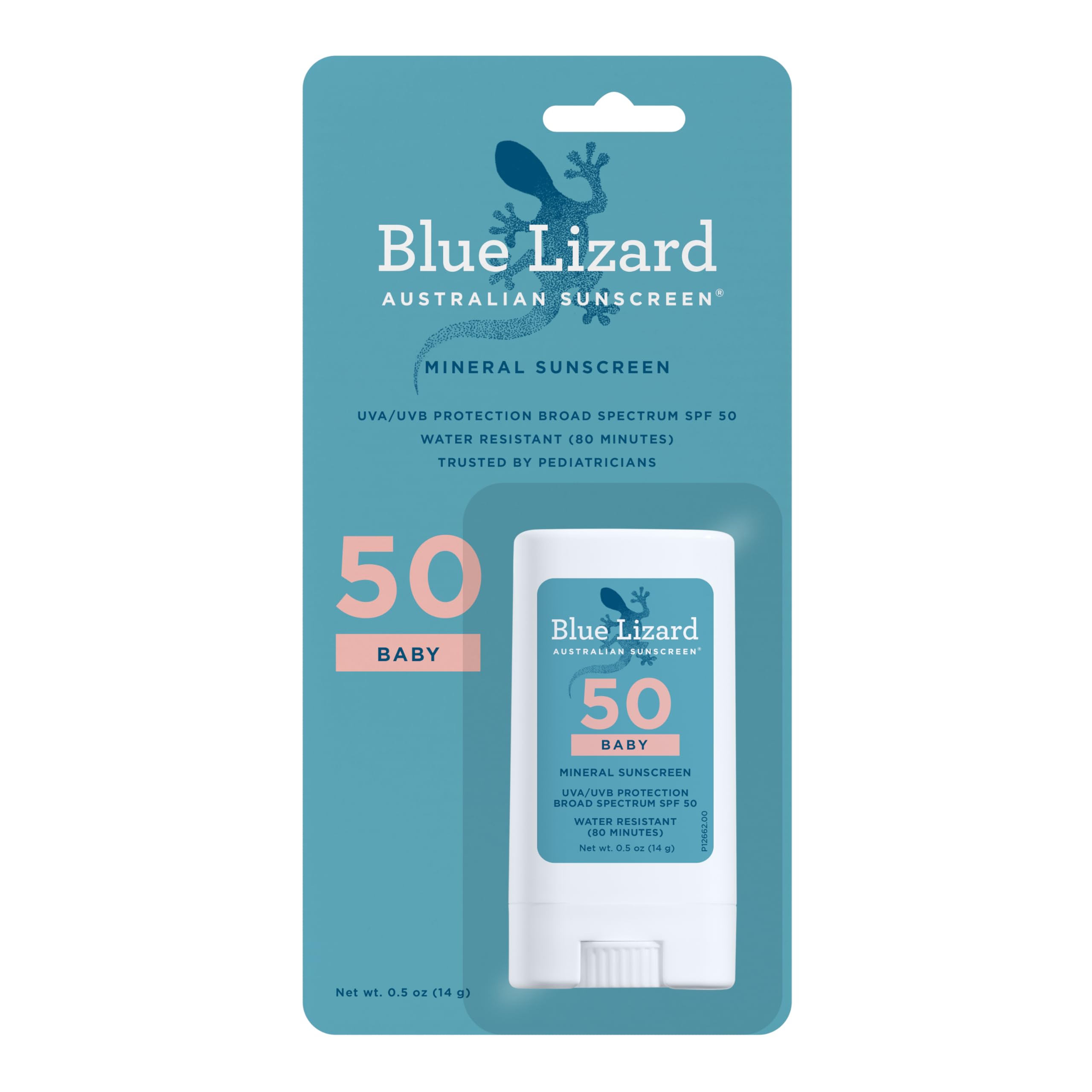
Blue Lizard Baby Stick
Key Features
- SPF: 50+
- Size: 0.5 oz
- Active: Zinc oxide
- Water resistance: 80 minutes
- Price: Budget
A stick is the format that gets used on a moving baby: one pass across each cheek, a dab on the nose, and you are done. Blue Lizard’s 0.5-ounce baby stick is zinc-only, broad-spectrum SPF 50+, fragrance-free, and water-resistant for up to 80 minutes.
We keep it for faces and touch-ups because it does not run into eyes or drip down a chin. The small size is the point: it disappears into a diaper bag pocket and is easy to hand to a grandparent. The zinc formula also means you are not chasing a spray cloud on a windy day, and it glides on smoothly enough for a quick pass.
It is not a body sunscreen; for a beach day, pair it with a lotion. That division is clear, and it is why the stick earns its place rather than replacing the tube. The stick lives in the stroller pocket, not the beach bag.
Pros
- Zinc-only SPF 50+ stick
- No-mess face application
- Fragrance-free and water-resistant
Cons
- Runs out quickly with daily use
- Can drag over dry skin
The Blue Lizard stick is the face-friendly pick we keep in the diaper bag for cheeks and noses, with zinc protection and no fragrance in a no-mess format.
Best for Minimal Ingredients
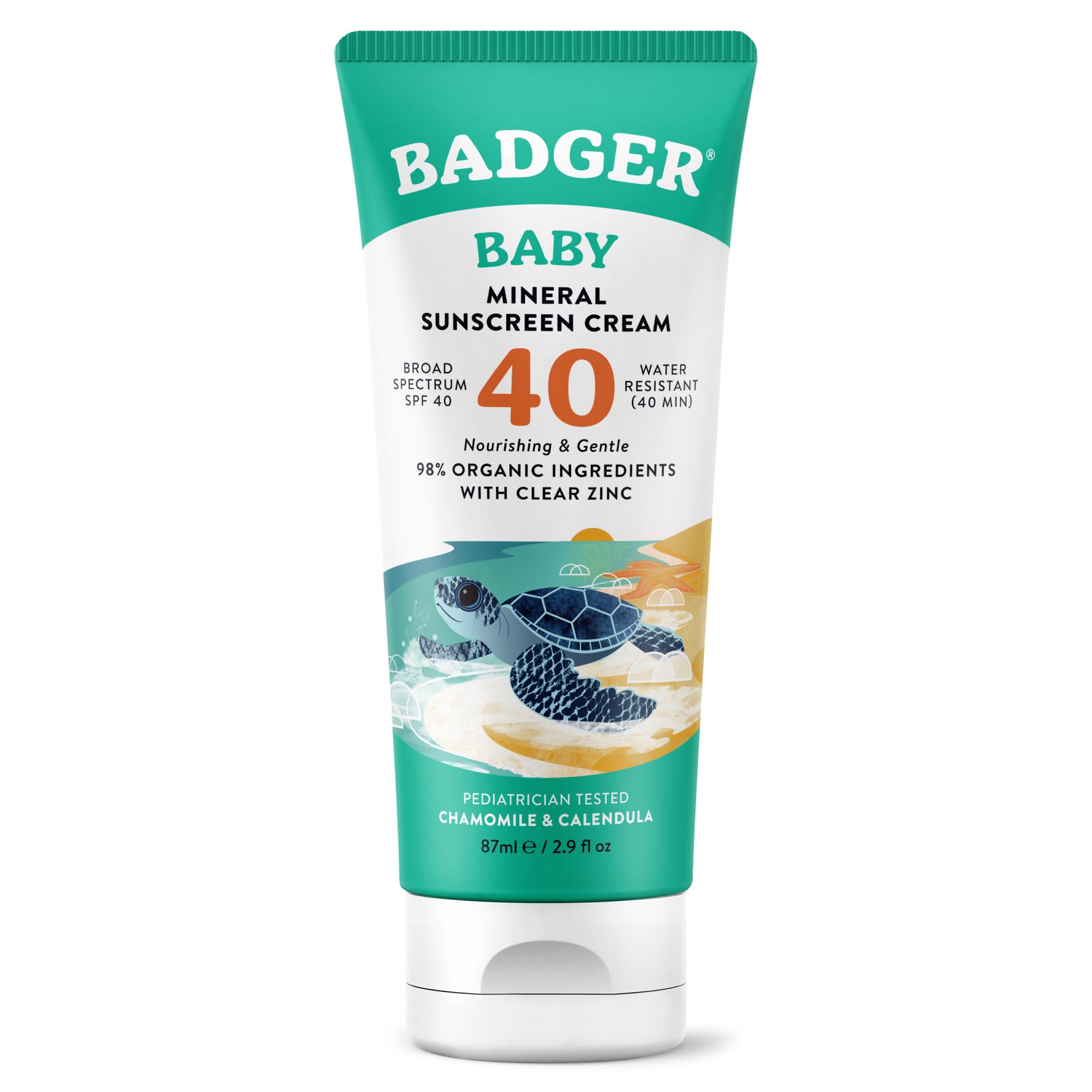
Badger Mineral Baby
Key Features
- SPF: 40
- Size: 2.9 fl oz
- Active: Non-nano zinc
- Water resistance: 40 minutes
- Price: Midrange
Seven ingredients is the shortest list here: Badger’s baby cream pairs non-nano zinc oxide with organic sunflower oil and chamomile. That short list is the appeal for a parent who reads every label.
It is broad-spectrum SPF 40, and the plant oils make it feel more like a balm than a lotion. The cream is thick, so a little goes further than you expect. It is also reef-safe and biodegradable, which matters if those claims are part of why you are shopping.
We recommend Badger for very sensitive skin and for families who want a simple, reef-safe formula, provided you can live with a thicker cream. Warm it between your palms and press it on in thin layers; this is not a sunscreen that disappears in one swipe.
The chamomile gives it a soft, pleasant scent that does not announce itself. That is a small thing, but it helps when you are already wrestling a baby into a hat.
Pros
- Seven-ingredient formula
- Non-nano zinc oxide
- Reef-safe and biodegradable
- Nourishing plant oils
Cons
- Only 40-minute water resistance
We recommend Badger for ingredient-conscious parents who want a short list and can accept a thicker cream with a forty-minute water-resistance window.
Best for Travel and Daycare
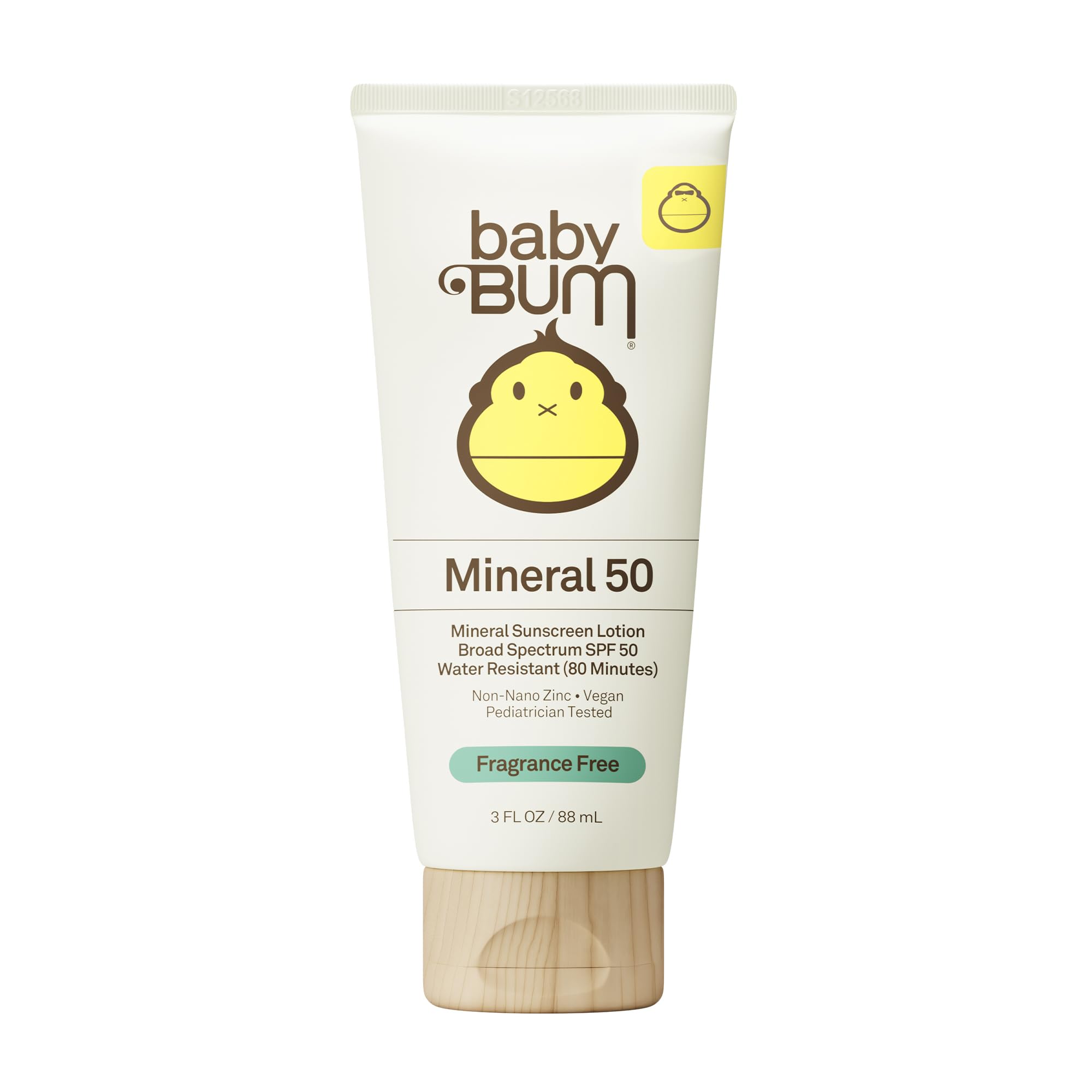
Baby Bum SPF 50
Key Features
- SPF: 50
- Size: 3 oz
- Active: Zinc oxide
- Fragrance: Fragrance-free
- Price: Midrange
Three ounces is a useful size for a diaper bag: Baby Bum’s travel lotion is small enough to keep in a purse but still gives you several full-body applications. It is a mineral zinc formula with broad-spectrum SPF 50 and fragrance-free.
The lotion includes coconut oil, shea butter, and cocoa butter, so it feels more moisturizing than a bare mineral paste. It is water-resistant for up to 80 minutes and spreads easily enough for a quick application before daycare.
A patch test is wise if your baby has very reactive skin; some babies still flare. Otherwise it is a comfortable everyday lotion that does not announce itself.
We recommend Baby Bum as the travel-friendly fragrance-free pick, with that patch test as the one caveat. The three-ounce tube is the one we restock for daycare because it is easy to toss in a bag and hard to leave behind.
Pros
- Three-ounce travel size
- Fragrance-free mineral SPF 50
- Water-resistant for 80 minutes
Cons
- White residue if under-rubbed
Baby Bum is our travel-friendly fragrance-free lotion for families who want a three-ounce tube that fits a purse and still offers mineral SPF 50 protection.
Best for Lightweight Daily Use
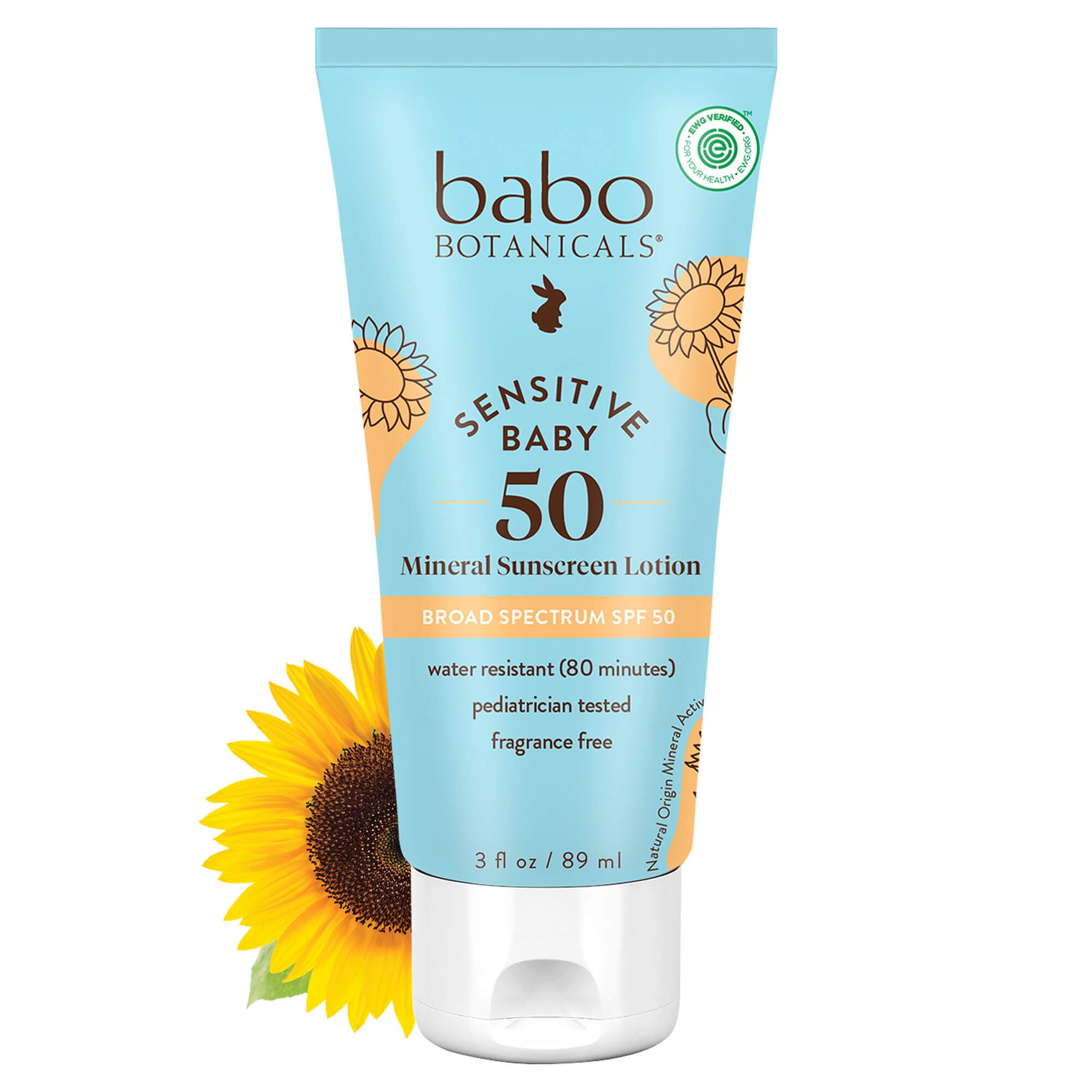
Babo Botanicals Baby
Key Features
- SPF: 50
- Active: Zinc oxide
- Fragrance: Fragrance-free
- Certification: EWG Verified
- Price: Premium
Babo Botanicals Sensitive Baby is the lightest lotion in this group, and that is the first thing we notice. It is zinc-based, broad-spectrum SPF 50, fragrance-free, and EWG Verified, with a texture that spreads more like a moisturizer than a paste.
It works best as a daily lotion for a baby who tolerates sunscreen without much fuss. It is water-resistant, and it leaves less drag than the thick mineral creams here. The finish is still mineral, so a pale tint can show if you apply it heavily. It absorbs quickly enough to dress a baby without a long wait.
The catch is skin compatibility: some babies with very reactive skin still rash, so patch-test before a full application. We do not hand it to a baby mid-flare without that test.
We like Babo for clean-ingredient shoppers who want a lighter daily lotion, and it is the one we reach for on daycare mornings when speed matters. The texture is the reward.
Pros
- Lightweight, fast-absorbing lotion
- EWG Verified formula
- Fragrance-free and water-resistant
Cons
- Premium price
We like Babo Botanicals for clean-ingredient shoppers who want a lighter mineral lotion; patch-test first if your baby’s skin is highly reactive.
How We Tested Baby Sunscreens
To build our shortlist, we started with 40 baby sunscreens from drugstores, big-box stores, and specialty retailers, then filtered for broad-spectrum SPF 30 or higher, water resistance, and formulas explicitly labeled for infants or sensitive skin. We eliminated anything with a strong added fragrance or a price per ounce that felt hard to justify for daily use. That left 14 formulas—mineral lotions, chemical lotions, sticks, and sprays—which we tested for five months.
Testing happened where sunscreen actually gets used: on the morning stroller walk, at the park during peak sun, at the splash pad, and on two beach weekends. Parents on our team applied each formula to their own babies and toddlers, following the label’s reapplication schedule. We noted how long it took to rub in and whether it dragged or glided; we took photos in direct daylight to check for white cast; and we watched for greasiness by seeing whether sand stuck to slick legs or whether residue transferred to car seat straps. After two hours in the sun, we checked shoulders, noses, and cheeks for any pinkness.
For skin compatibility and ingredients, we reviewed each label for active filters and common irritants, and parents reported any redness, stinging, or bumps after use. We also smelled each formula straight from the tube and again on skin after 20 minutes, because a scent that seems mild at application can turn cloying in a warm car. To judge value, we tracked how many full-body applications we got from each container before it ran out—not just the sticker price. Formulas that protected well but left a chalky mess or required a wrestling match got marked down, no matter how good the SPF looked on paper.
How to Choose a Baby Sunscreen
Start with the format and the label, then worry about the finish: the right baby sunscreen is the one you can apply completely and reapply on schedule.
Mineral formulas and sensitive skin
The mineral options here name zinc oxide, which sits on the skin rather than disappearing into it. That is why they can feel thick and look pale, and why they are often the first choice for a baby with reactive skin. Fragrance-free matters more than the word mineral on its own: Blue Lizard Baby and Aveeno Baby both skip added fragrance, while Coppertone WaterBabies has a noticeable baby-powder scent.
Patch-test any new sunscreen on a small area before a full-body application, especially if your baby has eczema or has reacted to a lotion before. A mild formula is not a guarantee for every child.
Lotion or stick: match the format to the body part
A lotion is the efficient choice for arms, legs, and the back of the neck; a stick is the tool that actually gets used on a moving face. Thinkbaby’s six-ounce lotion is built for body coverage, while the Blue Lizard stick is small enough for cheeks, noses, and diaper-bag touch-ups.
The trap is buying only a stick. A half-ounce stick runs out quickly if you try to cover a whole body, and a full-body lotion is clumsy around the eyes. Most families do best with one lotion and one stick.
Water resistance and the reapplication clock
Water resistance is a timer, not a permanent shield. Most picks here list 80 minutes, while Badger lists 40; after that, or after toweling off and heavy sweating, reapply. SPF 50 is common in this set, but SPF 40 with careful reapplication is still a reasonable choice for a short outing.
If you are going to be in and out of the water all afternoon, choose an 80-minute formula and keep it visible. A bottle that disappears into the bottom of the bag does not help anyone.
Fragrance, white cast, and the finish you will live with
Fragrance-free does not mean odorless, and scented does not automatically mean irritating. It does mean you should read the label for your own household: a strong scent is hard to ignore on a baby, while a fragrance-free lotion is the simpler starting point for sensitive skin.
White cast is a cosmetic trade-off, not a safety failure. Mineral formulas can look pale on deeper skin tones, especially when applied heavily. Warm the product between your palms, apply in thin layers, and accept that a little ghosting may be the price of a mineral formula.
Size and cost per use
A body lotion and a face stick are not priced the same way. The large Coppertone bottle is the budget choice for volume, while the Blue Lizard lotion costs more for five ounces and the Babo lotion sits at the premium end. Sticks look inexpensive until you realize how fast a half-ounce disappears with daily face use.
Buy for how you will actually apply it: one six-ounce lotion for the body, one stick for the face, and a smaller travel tube only if it will live in a diaper bag.
Frequently Asked Questions
Can I use adult sunscreen on my baby?
Use a product labeled for babies and check the minimum age. In this set, Coppertone WaterBabies lists three months, while Thinkbaby and Baby Bum list six months. Adult formulas may carry fragrances or filters you do not want on a baby’s skin, and they do not solve the age question.
How do I apply sunscreen to a baby’s face without a fight?
Use a stick on the brow bone, nose, and cheeks, and keep it out of the eye crease. Apply before you leave the house, when there is less squirming, and give the baby a toy or snack. A tear-free lotion like Aveeno can work around the eyes, but a stick gives you more control.
What should I do if my baby gets a rash after sunscreen?
Stop using that product, wash the area with mild soap and water, and note the ingredient list. A patch test on the inner arm or behind the ear for 24 hours can help you tell whether the reaction is from the sunscreen. If the rash is spreading, blistering, or comes with swelling, call your pediatrician.
Final Verdict
For most families, Thinkbaby is the one we point to first: a six-ounce mineral lotion with SPF 50+, broad-spectrum coverage, and water resistance that holds through a beach afternoon. If your baby’s skin reacts to scents or you want a fragrance-free lotion, Blue Lizard Baby is the better fit.
For faces and diaper-bag touch-ups, the Blue Lizard stick is the one we reach for. The deciding question is simple: buy the lotion for the body, then add the stick for the parts that will not sit still.
