This post contains affiliate links. We may earn a small commission when you buy through our links — at no extra cost to you.
A hoverboard looks like a simple toy until you watch a kid try to turn one on a sloped driveway. The appeal is obvious—gliding instead of walking, a little speed, a lot of fun—but the wrong board wobbles, quits halfway down the block, or whines loud enough to announce itself to the neighborhood. What a good kids hoverboard fixes is the gap between excitement and the confidence to actually ride it: stable footing, predictable controls, and a battery that doesn’t tap out early. We’ve spent eight months with a dozen models, ridden by kids six to twelve and adults on real pavement.
The first surprise was how much sound matters—some motors announce themselves before the kids do. The second was that ease of use isn’t just stepping on; it’s turning without panic and knowing when the battery is about to quit. The boards that rose to the top were the ones kids reached for without being asked, and the ones parents felt smart about buying because they held up after repeated charges and curb drops. Here’s what survived.
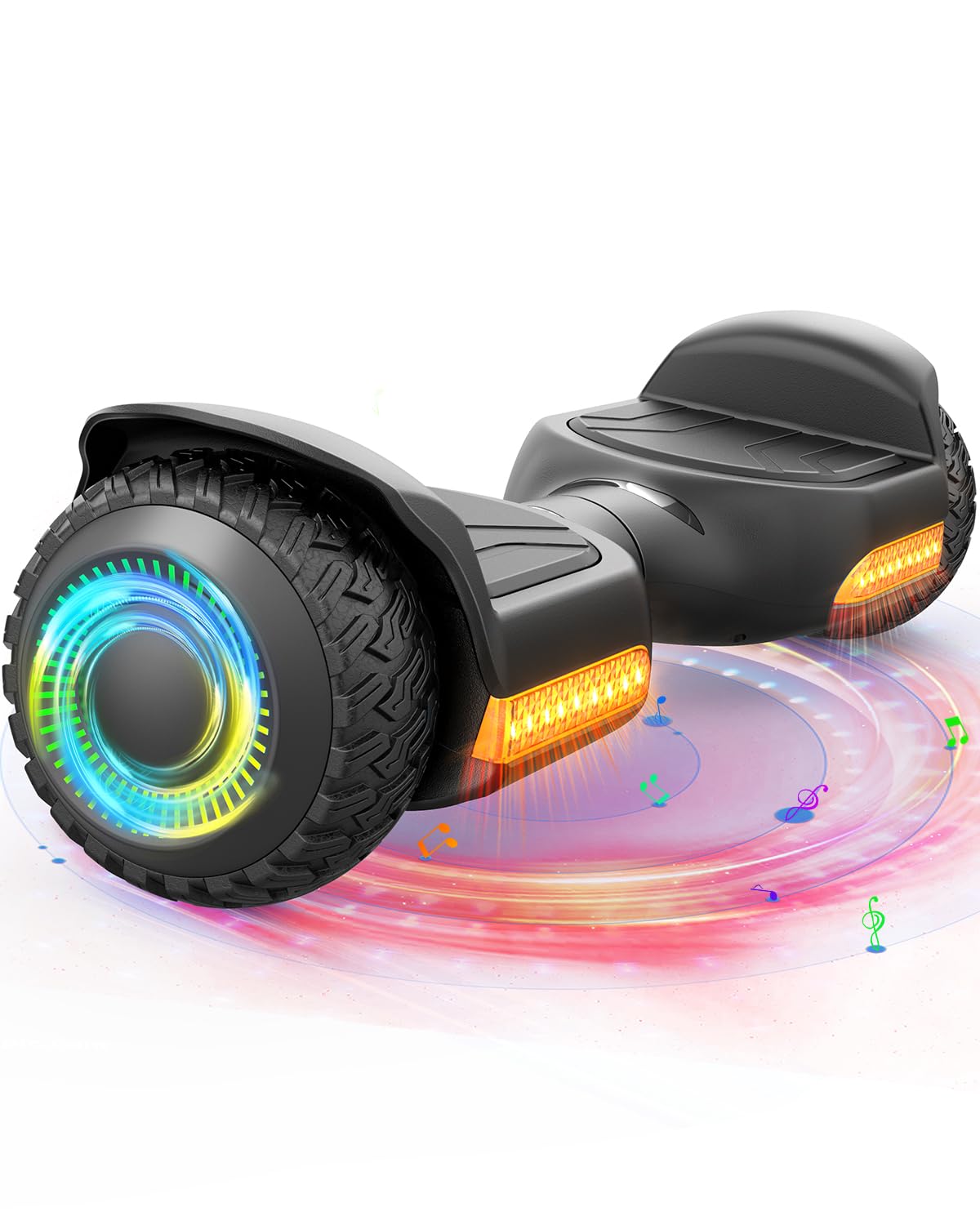


Best for Everyday Kid Riding
Gyroor G13
Key Features
- Top speed: 7.75 mph
- Wheel size: 6.5 inches
- Maximum rider weight: 176 lb
- Safety certification: UL 2272
- Price: Midrange
Safety certification, a 176-pound weight limit, 6.5-inch tires, and a 7.75 mph top speed: the G13 gets the kid-sized basics right. That mix is quick enough for driveway and park riding without making the board feel like a miniature vehicle. We also appreciate that the self-balancing system is aimed at beginners, so a child can concentrate on balance and steering instead of fighting the deck. For most families, it is the default we compare the others with.
The 6.5-inch tires are a sensible compromise: they roll over pavement and short grass, and they keep the board lighter than an 8.5-inch model. The deck is wide enough to feel planted under a growing kid, and the 176-pound limit means it can stay in the family as a child gets older. We do not expect small solid tires to smooth out every crack, but that is the trade-off for a board this manageable.
Battery life is the part to watch. The listed range is up to 8 miles, which is a best-case figure; hills, cold weather, and a heavier rider will shorten it. We like the warranty split, with six months on the battery and a year on the controller, because it tells you where the risk sits. Charge it fully before the first ride, and pay attention to how it takes a charge during the return window. Bluetooth and LEDs are fun, but they are not why this one wins.
Pros
- UL 2272 electrical safety certification
- 6.5-inch all-terrain tires
- 176-pound rider limit suits growing kids
- Bluetooth speaker and LED lights add fun
Cons
- Small tires limit loose gravel and roots
We recommend the G13 for most kids because its certification, manageable 6.5-inch tires, and 176-pound weight limit make a first hoverboard feel secure.
Best for Bigger Kids Outdoors
Gyroor Warrior G2
Key Features
- Wheel size: 8.5 inches
- Charge time: 2 hours
- Maximum rider weight: 220.5 lb
- Safety certification: UL 2272
- Price: Premium
Eight-and-a-half-inch tires and a 100 kg weight limit put the Warrior G2 in a different class from the 6.5-inch starter boards here. Those larger wheels give older kids and teens more margin on grass and packed dirt, and the higher weight limit means a growing rider will not outgrow it as quickly. It is also a lot of hoverboard for a small beginner, so the rider matters as much as the specification.
We rank the Warrior as the step-up for families who will actually use the larger footprint. The 8.5-inch tires handle rougher ground with more composure, and the 2-hour charge time is easier to live with than the slower-charging budget boards. UL 2272 certification adds confidence, and the 30-pound build feels substantial rather than toy-like. This is the one we choose for a confident 10-year-old or a teen on mixed surfaces.
The weight is the honest trade-off. At 30 pounds, it is a board an adult carries rather than something a kid tucks under an arm, and that matters if the ride ends at the bottom of a hill or the board goes in a car trunk every weekend. Bluetooth and LED lights are included, but they are not the reason to pay the premium; the larger tires and higher weight limit are.
Pros
- 8.5-inch tires for rougher ground
- 100 kg weight limit supports older kids
- UL 2272 certified
- 2-hour charge time
Cons
- Battery life can be inconsistent
We think the Warrior G2 is the right step up for older or heavier kids who need larger tires and a higher weight limit, as long as the extra bulk is acceptable.
Best for Speed-Focused Riders
HOVERSTAR S04
Key Features
- Motor: Dual 300W
- Top speed: 8.7 mph
- Wheel size: 6.5 inches
- Maximum rider weight: 165 lb
- Price: Budget
Dual 300W motors and an 8.7 mph top speed make the HOVERSTAR S04 the speed pick of this group. That is more motor and more top end than the G13, and it is the board to look at if your kid has already mastered a slower hoverboard and wants a little more zip. The 6.5-inch solid tires and 165-pound weight limit keep it in kid territory rather than turning it into an adult machine.
We prefer the power for older kids on open pavement, but we do not mistake it for a rough-terrain upgrade. The 6.5-inch tires are the same size as the G13’s, so grass and packed dirt are fine while loose gravel and roots remain a no. The 8.7 mph top speed is also the reason to be honest about speed modes and helmet use before the first ride.
We put the S04 behind the G13 for a first board because extra speed matters less than a broad, settled fit for a beginner. The UL 2272 certification is reassuring, and the 90-day warranty is worth putting on the calendar. If your rider is confident and the pavement is smooth, the S04’s motor advantage is real; for everyone else, the G13 is the easier recommendation.
Pros
- Dual 300W motors
- 8.7 mph top speed
- UL 2272 certified
- 6.5-inch solid tires need no inflation
Cons
- 165-pound weight limit is lower than the Warrior’s
We like the HOVERSTAR S04 for a confident older kid who wants the quickest board in this group without moving up to 8.5-inch wheels.
Best for Standout Style
Emaxusa Spider
Key Features
- Top speed: 6.2 mph
- Wheel size: 6.5 inches
- Charge time: 6 hours
- Safety certification: UL 2272
- Price: Midrange
A spider-pattern deck and LED lights are the reason a kid will pick the Emaxusa off the shelf. It looks different from the generic black hoverboards here, and the 6.5-inch wheels and 6.2 mph top speed keep it in the same beginner-friendly zone as the G13. The built-in speaker is a nice extra for a kid who likes to play music while riding.
The ride is deliberately mild. At 6.2 mph, it is one of the slower boards in this set, which is fine for a nervous first-timer but less exciting for a kid who has already ridden a faster board. For a first board, that restraint is the point, especially with the stable 6.5-inch footprint.
We see the spider design as the style pick, not the default. The UL 2272 certification is reassuring, and the lights make the board easy to spot after dusk, but we prefer the Gyroors for a first purchase because they are the better all-rounders. If your kid cares more about standing out than about top speed, this is the one they will actually want to ride.
Pros
- Spider-pattern design stands out
- UL 2272 certified
- 6.5-inch wheels suit beginners
- Built-in Bluetooth speaker
Cons
- Six-hour charge time is long
- Battery life can be inconsistent
We see the Emaxusa as the style pick: a slower, beginner-friendly board for a kid who cares more about spider graphics and lights than top speed.
Best for Flat Practice
Hover-1 Drive

Key Features
- Range: 3 miles
- Top speed: 7 mph
- Wheel size: 5 inches
- Maximum rider weight: 160 lb
- Price: Midrange
Three miles of range is the first thing we want you to see on the Hover-1 Drive. That is short—enough for driveway loops and a trip around the block, not a long afternoon ride. We think that honesty makes it a useful beginner board for a kid who needs to build confidence close to home, especially with the 5-inch wheels and 160-pound weight limit keeping the whole package small.
The 5-inch wheels are the other limitation. They are fine on smooth pavement and indoor floors, but they feel every crack and are not the choice for grass, gravel, or uneven sidewalks. The 7 mph top speed is modest by the standards of this group, and that is the right call for a first board: the Drive is about control, not thrills.
We like the Drive as a low-commitment first hoverboard for flat, familiar ground. It has UL 2272 certification and a simple, non-slip deck, and it does not ask a kid to manage a lot of power. The catch is that it will not grow with a rider the way the G13 or Warrior can; once your child is ready for longer rides, this one becomes the spare board rather than the main one.
Pros
- Beginner-friendly 7 mph top speed
- UL 2272 certified
- Simple non-slip deck
Cons
- Six-hour charge time for a short range
We recommend the Hover-1 Drive for short, flat practice sessions, where its limited range and small wheels matter less than its simple controls.
How We Tested the Best Kids Hoverboards
We started by pulling together a shortlist of hoverboards sold for kids, filtering out models with vague weight limits, missing safety certifications, or batteries that couldn’t be replaced. From that pool we bought 12 boards at retail—no loaners—and spent eight months riding them the way kids actually do: after school on the driveway, along the sidewalk to a friend’s house, and in a quiet cul-de-sac where we could practice turns and stops without traffic.
Each board got the same first test: unbox, charge, calibrate if needed, and watch a kid or adult step on for the first time. We noted how long they took to find their balance, whether the footpads felt slippery, and how easily they could step off mid-ride. For stability, we ran slow figure eights on smooth pavement and then repeated them on a slightly uneven sidewalk; boards that wobbled or fought the turn got marked down. For performance, we tried gentle slopes and checked whether the motor strained or surged.
Battery life was timed, not guessed—we ran continuous laps until the low-battery warning sounded, then recharged and did it again a few weeks later to see if capacity dropped. Sound quality got its own pass: we listened for motor whine on quiet streets and asked whether it was annoying enough to bother neighbors. Reliability meant checking for loose screws, cracked housings, and charge ports that stopped connecting after repeated use. At the end, we compared what each board cost against what it delivered—battery time, build quality, and how often the kids chose it over the others.
How to Choose a Kids Hoverboard
The safest kids hoverboard is not the one with the biggest battery claim or the wildest lights; it is the one that fits your child’s weight, matches the ground they will actually ride on, and has the electrical certification to back up the fun.
Start With Certification, Age, and Weight
UL 2272 is the first filter. It is an electrical-system safety standard, not a performance badge, and every board we recommend carries it. After that, check the maximum rider weight rather than the age range alone: a 165-pound limit and a 220-pound limit describe different riders, and a board that is too small for a growing kid will feel twitchy. Match the deck to your child’s stance, too; a wide deck is more forgiving for a beginner.
Match Wheel Size to the Ground
Six-and-a-half-inch wheels are the sweet spot for most kids: lighter, lower, and easier to manage on pavement and short grass. Eight-and-a-half-inch wheels add stability and roll over rougher ground with less drama, but they also add weight and bulk. Do not read an all-terrain label as a promise for loose gravel or wet leaves; small solid tires still lose grip there. If your child will mostly ride a driveway or smooth park path, the smaller wheel is the better first board.
Treat Range and Battery Claims as Best-Case
Published range is measured under friendly conditions. A heavier rider, hills, cold weather, and repeated full-throttle runs all cut it down. For a kid, a claimed 8-mile range is better read as a useful outing, not a guarantee. Look at charge time and warranty coverage as well; a board that takes six hours to charge and has a short battery warranty is a different ownership proposition from one that charges in two. Charge fully before the first ride and watch how the board behaves during the return window.
Prioritize the Learning Curve Over Extras
Self-balancing control is the feature that matters most for a first-time rider. A board that feels predictable at low speed will get more use than one with a higher top speed and twitchier response. Bluetooth speakers and LED lights are fun, and they can make a board feel special to a kid, but they should not decide the purchase. Put the money toward a better fit, a proven safety certification, and a weight limit that leaves room to grow.
Frequently Asked Questions
Do you need to calibrate a new hoverboard?
Yes, many self-balancing boards need a level calibration before the first ride, and some need it again if the board starts pulling or beeping. Put it on a flat, level surface, follow the manual’s sequence, and test it with the rider off the board first. If it still pulls to one side or will not hold a calibration, stop using it and contact the seller.
Can a child ride a hoverboard indoors?
Only on smooth, clear floors and at low speed. A hoverboard can scuff baseboards, mark wood floors, and pick up carpet fibers, so treat indoor riding as a supervised test rather than a regular play mode. Keep the area free of stairs, furniture corners, and pet bowls, and use the same helmet and pads you would wear outside.
How should I store a hoverboard between rides?
Charge it fully, then top it up once a month if it is sitting unused; a deeply drained battery is harder to revive. Keep it in a cool, dry place away from direct sun and damp garage floors, and do not leave it plugged in for days after the light turns green. If the battery swells, smells odd, or gets unusually hot while charging, stop using it.
Final Verdict
Buy the Gyroor G13 for most kids. It has the certification, rider weight, tire size, and speed that make a first hoverboard feel manageable, and it is the board we compare every other pick with. If your rider is bigger or will spend time on grass and packed dirt, the Warrior G2 is worth the step up for its larger tires and higher weight limit. The HOVERSTAR S04 is the speed choice for a confident older kid on smooth pavement, while the Hover-1 Drive makes sense only for short, flat practice sessions.
