This post contains affiliate links. We may earn a small commission when you buy through our links — at no extra cost to you.
The hardest part of kids’ allergy season isn’t the pollen count—it’s getting a squirmy, miserable kid to take something that actually helps without a battle. A good kids’ allergy medicine calms the sneezing, itchy eyes, and sniffles without turning your child into a zombie or sparking a stomachache. I’ve learned that a cheerful label means nothing if the taste makes them clamp their mouth shut or the spray stings.
Over one full spring allergy season, my team and I tested 12 kids’ allergy medicines with families living through the same pollen cloud—school mornings, soccer Saturdays, bedtime. We tracked how quickly symptoms eased and how long relief lasted, plus how each kid tolerated the formula, whether the spray or oral dose was easy to use, and whether the per-dose cost felt fair. We gave extra credit to dye-free and sugar-free options that fit allergy-friendly households, because quality should show up in the label as well as the bottle. The picks below are the ones that balanced effectiveness with a dose your kid won’t fight.


Best for Daily Allergy Relief
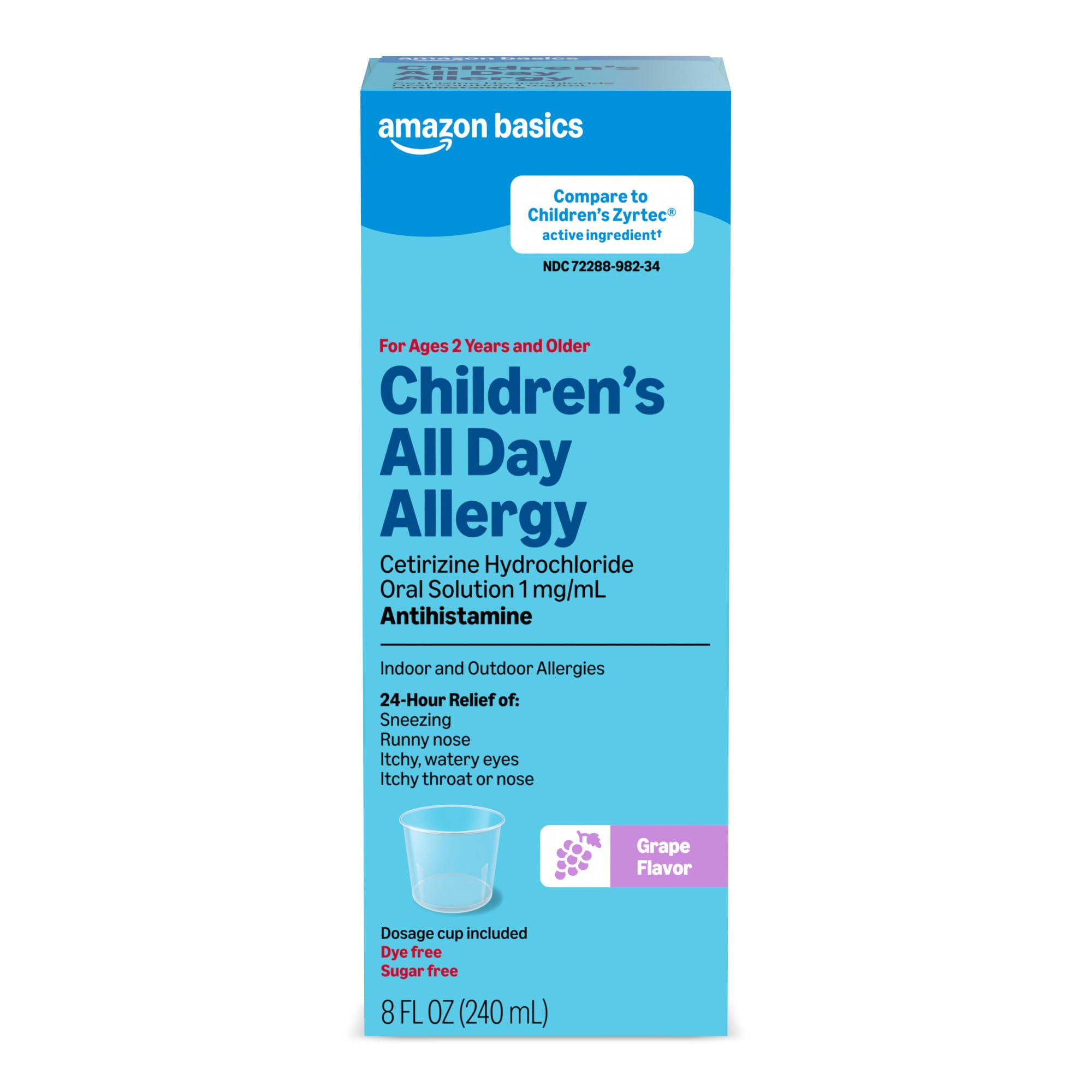
Amazon Basics Children’s Cetirizine
Key Features
- Form: Grape liquid, 8 fl oz
- Labeled age: 2 years and older
- Dosing interval: 24 hours
- Active ingredient: Cetirizine HCl 5 mg/5 mL
- Price: Budget
The case for this bottle starts with the label: cetirizine hydrochloride 5 mg/5 mL, the same active ingredient and strength as Children’s Zyrtec, in the same 8-ounce size, for less. That combination is why we make it the default for most kids 2 and up. You get a once-daily 24-hour antihistamine without paying for the brand name.
The practical details are right for a household in allergy season. The grape syrup is dye-free and sugar-free, and the 8-ounce bottle is large enough that you are not back at the store every week. One dose covers the day on the label, which is the real convenience for school mornings and daycare bags. The flavor is kid-friendly, but no grape syrup wins with every child.
We keep coming back to this one because the value is not a smaller bottle or a weaker formula. It is the same strength as the brand-name cetirizine, with a lower cost per bottle. If your pediatrician specifically recommends the brand-name product, that is a different conversation; otherwise, this is the cetirizine we reach for first.
Pros
- Same cetirizine strength as brand-name syrup
- One 24-hour dose for ages 2 and up
- Dye-free, sugar-free grape in an 8-ounce bottle
- Lower cost per bottle than the brand-name equivalent
Cons
- Not a fit for kids who refuse liquid
We make this the default for most kids 2 and up: same cetirizine strength as the brand-name syrup, one daily dose, dye-free grape, and a lower cost per bottle.
Best for Brand-Name Cetirizine
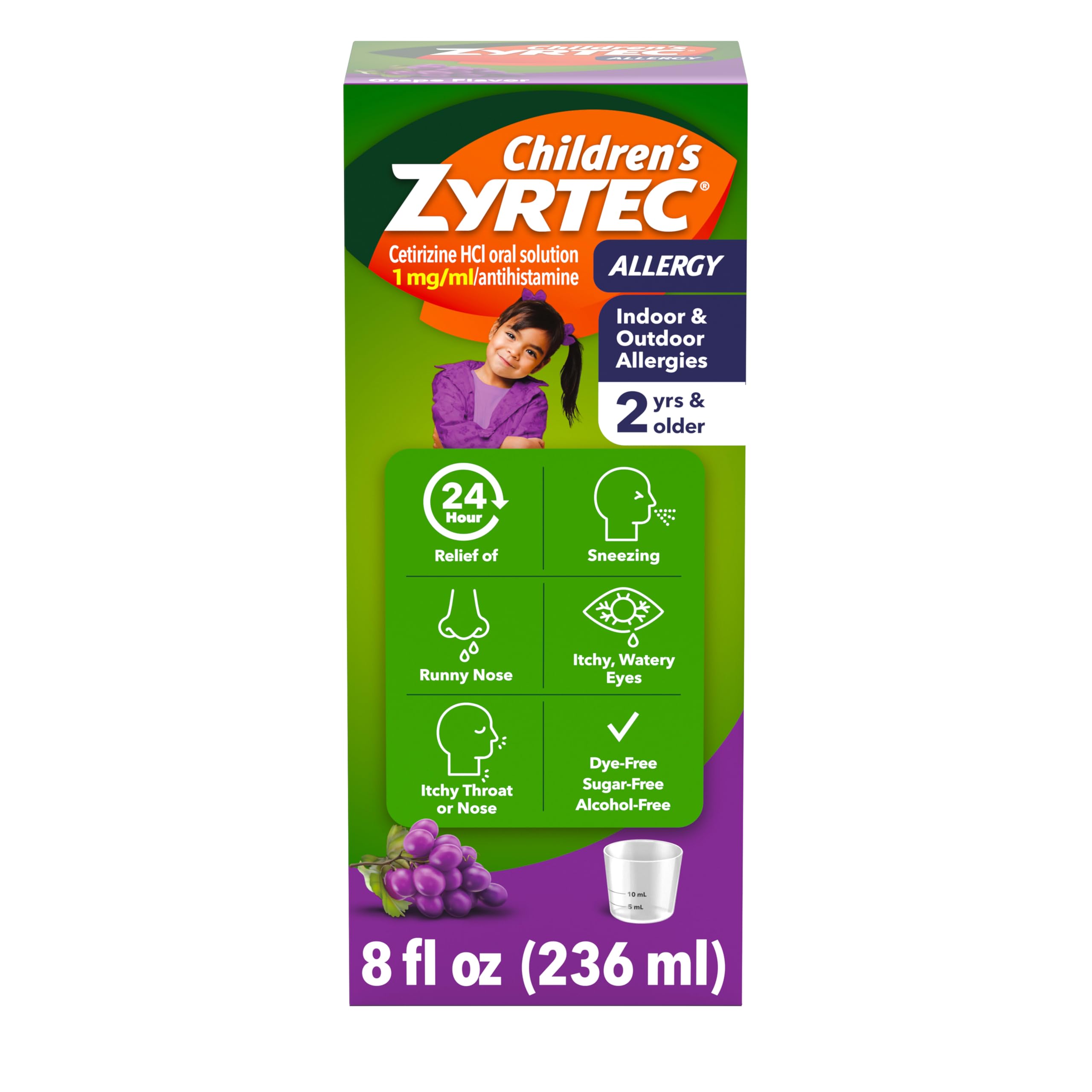
Children’s Zyrtec Syrup
Key Features
- Form: Grape liquid, 8 fl oz
- Labeled age: 2 years and older
- Dosing interval: 24 hours
- Active ingredient: Cetirizine HCl 5 mg/5 mL
- Price: Premium
Children’s Zyrtec is the brand-name version of the same cetirizine formula: 5 mg/5 mL, 8 ounces, ages 2 and up, one dose for 24 hours. If you already know your child does well with cetirizine, this is the label you will recognize. We see it as the brand-name option.
The grape syrup is easy to keep in a medicine cabinet, and the 8-ounce bottle matches our top pick ounce for ounce. The difference is the label, not a different strength or a different active ingredient. The taste gets a warm reception in most houses, though it is still a liquid, so a child in a no-liquid phase will fight it just as hard as any syrup.
We recommend it when brand familiarity is worth something to you, or when a clinician has specifically pointed you to Children’s Zyrtec. Otherwise, the generic cetirizine above does the same labeled job.
Pros
- Brand-name cetirizine at 5 mg/5 mL
- 24-hour dosing for ages 2 and up
- 8-ounce grape syrup
Cons
- Costs more than generic cetirizine
A familiar brand-name cetirizine syrup for kids 2 and up; we recommend it when brand comfort matters more than saving on the generic.
Best for Daytime Non-Drowsy Relief
Children’s Claritin Liquid
Key Features
- Drowsiness: Non-drowsy
- Labeled age: 2 years and older
- Dosing interval: 24 hours
- Active ingredient: Loratadine 5 mg/5 mL
- Price: Midrange
Claritin’s children’s liquid is the loratadine counterpoint to the cetirizine picks. The label is explicit about non-drowsy 24-hour relief, which is exactly what we want for a school day, and the 5 mg/5 mL dose is for ages 2 and up. If drowsiness is the concern, this is the first swap we consider.
The 8-ounce bottle is dye-free, sugar-free, and alcohol-free, and the grape flavor is more tart than sugary. That matters when a child has to take it daily through spring or fall. It handles sneezing, runny nose, and itchy eyes.
Check the expiration date when the bottle arrives, especially if you are buying a backup for the school year. We like this as the daytime loratadine pick, and we keep a bottle around for the child who does not tolerate cetirizine.
Pros
- Non-drowsy 24-hour loratadine
- Ages 2 and up
- Dye-free, sugar-free, alcohol-free
- 8-ounce bottle
Cons
- Does not relieve nasal congestion
We choose this when a child needs daytime relief without the drowsiness question: a once-daily loratadine syrup for ages 2 and up.
Best for Nasal Congestion
Flonase Children’s Sensimist
Key Features
- Form: Nasal spray, 60 sprays
- Drowsiness: Non-drowsy
- Dosing interval: 24 hours
- Congestion relief: Yes
- Price: Midrange
Most kids’ allergy medicines are aimed at sneezing, runny nose, and itchy eyes. Congestion is the symptom they leave behind. Flonase Children’s Sensimist is the pick for that gap: a 24-hour non-drowsy nasal spray that relieves nasal congestion, which a single-ingredient oral antihistamine does not.
The Sensimist version is the one we prefer for children because the mist is fine and scentless, and the side-squeeze design is easier to aim than a standard pump. Start with one spray and a calm countdown, not a wrestling match.
The 60-spray bottle is the practical detail to check against the label’s dose, and the label lists year-round use. Check the minimum age on the box before the first dose. The sprayer can be finicky; prime it and test the mist into the air before you aim it at a child. We reach for this when congestion is the main complaint, not as a replacement for an oral antihistamine.
Pros
- Relieves nasal congestion
- Fine, scentless mist
- 24-hour non-drowsy relief
- 60 sprays per bottle
Cons
- Not for a child who refuses nasal sprays
Our pick when congestion is the main complaint: a gentle, scentless children’s nasal spray that adds relief an oral antihistamine does not.
Best for No-Liquid Dosing
Children’s Claritin Chewables
Key Features
- Form: Grape chewable, 40 tablets
- Labeled age: 2 years and older
- Dosing interval: 24 hours
- Active ingredient: Loratadine 5 mg
- Price: Premium
A chewable is the answer to the daily spoonful battle. Children’s Claritin Chewables put 5 mg of loratadine in a grape tablet for ages 2 and up, with the same 24-hour non-drowsy label as the liquid. We like this format for school-age kids who can chew and swallow without a drink.
The 40-tablet bottle is a long supply, and the grape flavor is the kind kids describe as candy rather than medicine. That is the point: a child who takes it without a fuss is a child who gets consistent relief. The tablet is dye-free, and it removes the measuring cup from the morning routine.
Check the label for the exact age and dose; the 5 mg tablet is not a one-size dose for every age. The 40-tablet bottle is the practical part for a daily routine. For a child who takes chewables, this is the easiest switch from syrup.
Pros
- No liquid measuring
- Same loratadine as Claritin liquid
- Grape flavor kids accept
- 40-tablet supply
Cons
- Requires a child who can chew
For the child who refuses a spoonful, this is the easiest switch: a grape loratadine chewable for ages 2 and up with 24-hour non-drowsy relief.
Best for 12-Hour Coverage
Children’s Allegra Liquid

Key Features
- Form: Berry liquid, 8 fl oz
- Drowsiness: Non-drowsy
- Dosing interval: 12 hours
- Active ingredient: Fexofenadine
- Price: Midrange
Allegra is the odd one out here because it is a 12-hour dose, not a 24-hour one. That is not automatically a downgrade. If your child’s day splits into morning and bedtime doses, or if you want a shorter-acting non-drowsy option, the fexofenadine liquid is a reasonable alternate route.
The label lists a one-hour onset and a non-drowsy formula, which is the reason to choose it over a sedating antihistamine. The berry flavor and 8-ounce bottle are practical, and it covers indoor and outdoor allergens.
The 12-hour schedule is the trade-off: a second dose is easy to forget. If your day already has a morning and bedtime routine, it fits neatly. If not, a once-daily syrup is easier to manage.
We recommend it when the 12-hour window suits your family and you want fexofenadine specifically. Otherwise, the 24-hour cetirizine and loratadine picks cover more of the day with one dose.
Pros
- Non-drowsy fexofenadine
- 12-hour dosing
- One-hour onset listed
- Berry liquid, 8 ounces
Cons
- Cap can be hard to open
A good fit when you want a non-drowsy 12-hour liquid rather than a 24-hour one; just be ready for a stubborn cap.
Best for Flavor Variety
Children’s Xyzal Liquid

Key Features
- Form: Bubble gum liquid, 5 fl oz
- Onset: 45 minutes
- Dietary: Sugar-free, dye-free, alcohol-free
- Dosing interval: 24 hours
- Price: Budget
Xyzal’s children’s liquid is the bubble-gum option in a shelf full of grape and berry. That sounds cosmetic until you have a child who refuses every purple spoonful. The 5-ounce bottle is smaller than the 8-ounce syrups here, so it is a trial size as much as a daily supply.
The label promises 24-hour relief and a 45-minute onset, and the formula is dye-free, sugar-free, and alcohol-free. We like it as a flavor change for a child who has turned down the usual grape syrups. It is still an oral antihistamine, so it handles the same daytime symptoms rather than congestion.
Watch the first dose, and check the label for the minimum age. If your child does fine, the once-daily schedule and bubble-gum taste are a useful alternative.
Pros
- 24-hour relief
- 45-minute onset listed
- Bubble gum flavor
- Dye-free, sugar-free, alcohol-free
Cons
- Some children become grumpy or nauseous
A useful flavor change for a child who turns down grape or berry, with once-daily coverage and a dye-free formula; watch for mood or stomach upset.
How We Tested Kids’ Allergy Medicines
We started by pulling together the kids’ allergy medicines that parents actually ask about—oral liquids, chewables, and nasal sprays—then narrowed the list by age range, active ingredients, dye-free and sugar-free options, and clear dosing instructions. Over one full spring allergy season, 12 products went home with families whose kids were already sneezing, eye-rubbing, and waking up congested. The testing happened where medicine actually gets given: in the school-morning rush, in the car on the way to practice, at bedtime, and on sleepovers at Grandma’s house.
Each family kept a short symptom log for a week per product, noting sneezing, itchy eyes, congestion, and sleep disruption, then rated how quickly relief showed up and how long it lasted. We also watched the administration itself: whether the child swallowed a liquid without gagging, chewed a tablet without complaint, or flinched at a spray; whether the dose went down on the first try; and whether anyone reported stomach upset, drowsiness, or a lingering aftertaste. Dosing tools got a workout, too—we checked whether syringes and cups were easy to read, whether caps sealed in a backpack, and whether the label made age and weight dosing obvious at 7 a.m.
Taste and value were judged in plain terms: did the child take it again without a fight, and did the bottle deliver enough useful doses to justify the per-dose cost? We read ingredient panels to confirm allergy-friendly claims like dye-free, sugar-free, and common-allergen-free, and we separated those from vague front-label promises. Sprays got extra scrutiny for stinging, drip, and cooperation—a spray only works if a kid will let you near their nose twice a day. The products that rose to the top were the ones that eased symptoms, sat well enough to tolerate, and made a stressful routine a little less difficult.
How to Choose a Children’s Allergy Medicine
The first decision is not the brand; it is the active ingredient, the form your child will actually take, and whether congestion is part of the problem.
Start With the Active Ingredient
Most children’s allergy syrups here use cetirizine, loratadine, or fexofenadine. Cetirizine and loratadine are once-daily 24-hour options; fexofenadine is the 12-hour choice in this group. The drowsiness wording matters more than the brand: loratadine and fexofenadine are sold as non-drowsy, while cetirizine can still make some children sleepy even though it is not the old sedating antihistamine.
For school days, we start with a non-drowsy label. For a child who reacts badly to one ingredient, ask the pediatrician before switching rather than stacking medicines.
Match the Form to the Child
Liquid is the default for toddlers and for any child who cannot chew. An 8-ounce bottle is the practical size for daily use; a 5-ounce bottle is better for a trial. Chewables remove the measuring cup, but only for a child who can chew well.
A nasal spray is a different skill: it works only if your child will tolerate the mist. If mornings are already a battle, choose the form your child takes without a fight, not the one with the best label.
Decide Whether Congestion Is the Problem
Oral antihistamines are good at sneezing, runny nose, and itchy eyes. They do not do much for a blocked nose. If congestion is the main complaint, a children’s nasal spray such as Flonase Sensimist adds relief that an oral antihistamine does not.
The trade-off is cooperation: a spray takes a calm child and a practiced hand. Do not add a decongestant to an antihistamine without asking a pharmacist or pediatrician, and check the spray label’s age and daily-use limit before starting.
Read the Age, Dose, and Supply
Age limits are product-specific: some oral liquids start at 2, some tablets at 6. Use the dosing device that comes with the medicine, not a kitchen spoon, and follow the label’s dose for your child’s age or weight. A larger bottle is a better value only if you will use it before the expiration date.
For daily nasal-spray use beyond the label’s stated period, check with the child’s doctor. If your child is under 2, or has another health condition, ask the pediatrician before giving any OTC allergy medicine.
Frequently Asked Questions
Can I give my child adult allergy medicine?
No, not without a clinician’s direction. Adult tablets and liquids are dosed for adults, and splitting a tablet does not make the dose child-safe. Use a children’s product with a labeled age or weight dose, and ask a pharmacist if your child is between sizes or takes other medicines.
If you only have an adult product on hand, call the pediatrician or poison control rather than guessing.
How fast does children’s allergy medicine work?
It depends on the product. Allegra Children’s lists a one-hour onset; Xyzal Children’s lists 45 minutes. Cetirizine and loratadine are labeled for 24-hour coverage, but that does not mean instant relief.
Give the dose as directed and do not redose early because the first hour feels slow. If your child is struggling to breathe or has swelling, seek urgent care rather than waiting on an allergy medicine.
Is Benadryl okay for kids’ allergies?
Diphenhydramine, the active ingredient in Children’s Benadryl, is a sedating antihistamine. It can make children sleepy, which is why it is not our default for daytime seasonal allergies.
Ask your pediatrician before using it, especially for regular allergy control, and never combine it with another sedating medicine. For a one-off itchy reaction, follow the label’s age and dose exactly.
Final Verdict
For most families, we start with Amazon Basics Children’s Cetirizine. It gives the same active ingredient and strength as the brand-name syrup, a once-daily dose for kids 2 and up, and a dye-free grape flavor in an 8-ounce bottle, at a lower cost per bottle.
If your child needs a non-drowsy daytime option, Claritin liquid is the swap we make. If congestion is the main symptom, Flonase Sensimist covers what an oral antihistamine leaves behind. Check the label age and ask your pediatrician before combining medicines.
