This post contains affiliate links. We may earn a small commission when you buy through our links — at no extra cost to you.
There’s a particular Saturday that begins with a new art set and an hour of quiet, then ends with a snapped crayon and a colored pencil shedding its core inside the sharpener. I’ve watched that arc at my kitchen table more times than I can count, and it’s rarely the kid’s fault. A kit can look generous on the box and still be thin on pigment, stingy on storage, or full of pieces that quit in a week. The right one keeps a kid drawing instead of hunting for a cap.
That’s the standard my team held 16 sets to over four months — crayon tins, marker packs, colored pencils, and big mixed kits. We gave them to preschoolers, grade-schoolers, and a few adults who couldn’t resist. The ones everyone reached for again laid down dark color on the first pass, had pieces thick enough for small hands, and came in cases that made cleanup possible. Every pick below is one I’d hand to a niece or a neighbor’s kid without a second thought.


Best for All-In-One Starter Kit
Crayola Inspiration Art Case
Key Features
- Case: Space-themed carry case
- Age Range: Ages 5-8
- Piece Count: 140 pieces
- What’s Inside: 64 crayons, 40 markers, 20 pencils, 15 sheets
- Price: Midrange
An art case earns its place when it makes the after-school mess smaller, and this 140-piece Crayola kit is the best all-in-one set here for exactly that reason. Open it and the crayons, washable markers, short colored pencils, and paper all have a home; close it and the table is clear. What we appreciate is that the case does the organizing for you, because loose crayon boxes and marker tubs are what turn a five-minute drawing into a twenty-minute cleanup.
Piece count alone does not make a kit useful; the mix does. Sixty-four crayons, forty washable markers, twenty short colored pencils, and fifteen sheets cover coloring, drawing, and a first try at lettering without committing to a single medium. For a birthday or a first school-year art bin, that breadth is the point: a kid can move from crayon outline to marker fill to pencil detail in one sitting. The space-themed case has compartments, locking latches, and a handle, so it moves from kitchen to car without spilling its contents.
The paper supply is the first thing to run out. Fifteen sheets disappear quickly with a kid who draws daily, and the short pencils are a starter length rather than a full-size set. We pair the case with a separate paper pad and treat the included sheets as a bonus, not the main drawing surface. That is a small correction for a kit that otherwise gets the first-art-supply job right.
Pros
- Four media in one organized case
- Compartments speed up cleanup
- Carry handle makes it easy to move
- Strong gift for a first art kit
Cons
- At 3.3 pounds, it’s better for home than a backpack
We recommend the Crayola Inspiration Art Case as the best all-in-one kit here: it covers four media and the case makes cleanup part of the gift.
Best for Budget Coloring
Crayola Colored Pencils 36ct
Key Features
- Barrel: Round wood
- Age Range: 3+
- Non-Toxic: Yes
- Pencil Count: 36
- Price: Budget
Thirty-six colors is the sweet spot for a kid who has moved past the eight-crayon box but is not ready for a tin of artist pencils. Crayola’s set covers the primaries, the odd pastels, and enough skin tones to keep a family drawing from looking like aliens. The round wood barrels feel familiar in small hands, and the 3+ age rating makes them an easy first pencil set.
We keep this box in the same cupboard as the paper and markers because it is the set we reach for when a coloring book needs more than crayon texture. The leads lay down color smoothly, and the 36-count gives a kid room to experiment without turning every page into a hunt for the one green that is not broken. The light shades need a couple of passes before they show up, so this is not the set for a kid who wants one-stroke saturation.
None of that makes them artist-grade pencils, and we do not expect them to blend like a soft wax pencil. What they do is give a young colorist a wide, familiar palette at a price that makes sense for a supply that will be sharpened down to a stub. We keep a second box in the gift closet for birthday parties, because a 36-count colored pencil set is one of the few art gifts that almost always gets used.
Pros
- 36 shades at a budget price
- Smooth color for coloring books
- Fits small hands and ages 3+
Cons
- Tips can break during sharpening
We recommend this 36-color set as the best budget colored pencils here; it gives a young colorist room to experiment without a precious-art-supply price.
Best for Toddler Modeling
Play-Doh 36-Pack
Key Features
- Age Range: 2+
- Can Count: 36 cans
- Non-Toxic: Yes
- Net Weight: 6.75 lb
- Price: Midrange
Six pounds of Play-Doh sounds like a storage problem until the first rainy afternoon, when the 36-can case turns into the rare art supply that a two-year-old and a seven-year-old can share. The 3-ounce cans are small enough for a child to hold and big enough for a serious snake, and the color range is wide enough that a kid can make a purple dinosaur without negotiating for the one purple can.
We reach for this pack when we want one activity that covers a playdate, a classroom prize box, and a party favor table without buying three separate things. The compound is soft out of the can and labeled non-toxic for ages 2 and up, and the colors mix without turning every creation into a brown blob. It is also the one supply here that needs no paper, brushes, or sharpener, which makes it the easiest first art purchase for a toddler.
Play-Doh is not a keep-forever supply. The compound dries out when a lid is left off, and the colors eventually mix into a muddy set that no longer matches the label. That is normal for modeling compound, not a defect, and it is why the 36-pack works: you get enough cans to sacrifice a few to the learning curve and still have a full rainbow for the next project.
Pros
- 36 cans cover playdates and classrooms
- Non-toxic and labeled 2+
- Easy to split into party favors
Cons
- 3-ounce cans are smaller than full-size tubs
We recommend the 36-pack as the best modeling compound here for toddlers and shared play; the color range turns a single can into a whole afternoon.
Best for Mixed-Media Drawing
Melissa & Doug Drawing Paper
Key Features
- Pad Size: 9 x 12 inches
- Works With: Crayons, markers, pencils, paint
- Sheet Count: 150 sheets
- Paper Weight: 30 lb
- Price: Budget
Three 9 x 12 pads, 50 sheets each, and a 30-pound bond weight: that is the whole pitch for this Melissa & Doug paper pack. The pages are big enough for a full drawing, and the pads tear out one sheet at a time, so a kid can work on a project without dragging the whole stack to the table.
We keep this three-pack with the markers and paints because it handles more mediums than the average kids’ drawing pad. Markers do not bleed through to the next page, crayon texture sits on the surface instead of shredding it, and a light watercolor wash holds up better than it does on copy paper. The 150 sheets last through a lot of after-school drawing, and that matters more than any single feature here—running out of paper is what stops an art session cold.
The tear-out edge is the one place to temper expectations. A few pages can come away raggedly if a kid pulls instead of lifting the sheet, and the 9 x 12 size is better for a table than a toddler’s lap. Those are small compromises for a pad that otherwise does the unglamorous work of keeping the rest of the art supplies usable.
Pros
- 150 sheets across three pads
- Heavyweight paper resists marker bleed
- Handles crayons, markers, pencils, and paint
- Big 9 x 12 pages for full drawings
Cons
We recommend this three-pack as the best paper here for mixed-media kids: 150 big sheets that stand up to markers, paint, and repeated drawing sessions.
Best for Scented Coloring
Mr. Sketch Scented Markers
Key Features
- Ink: Water-based
- Tip: Chisel
- Age Range: 3+
- Marker Count: 22
- Price: Budget
Open a Mr. Sketch marker and the room knows: the scents are the reason kids reach for these before any other marker in the drawer. The 22-count set covers the usual colors plus a few odd ones, and the chisel tip is the practical surprise—it lays down a thick band for filling in a poster and turns for a thinner line when a kid wants to outline.
The ink is bold and water-based, and the large cylinder is easy for small hands to grip. These are not fine-detail markers; the chisel tip is built for broad strokes, poster lettering, and coloring book fills. The scents are strong enough to be the main event, which is either the point or a reason to pass. We found the unusual ones fun and the sweet ones a little much, and the reaction from kids is usually the same: they want to smell every color before they start drawing.
We recommend them for classroom and poster projects rather than everyday coloring. The scents invite a lot of sniffing, and the chisel tip makes a poster look deliberate rather than scribbled. For a rainy-day project or a kid who needs a reason to sit down and color, the novelty does real work.
Pros
- Scented colors make coloring playful
- Chisel tip draws thick and thin lines
- Bold ink for posters and coloring
Cons
- Not washable; can stain clothing
- Markers can dry out if caps are left off
We recommend these scented markers for supervised coloring and classroom fun; the chisel tip and bold ink make them more than a novelty.
Best for Older-Kid Painting
Caliart Acrylic Paint Set
Key Features
- Brushes: 12 brushes
- Bottle Size: 2 fl oz each
- Color Count: 36 colors
- Non-Toxic Standard: ASTM-D4236
- Price: Midrange
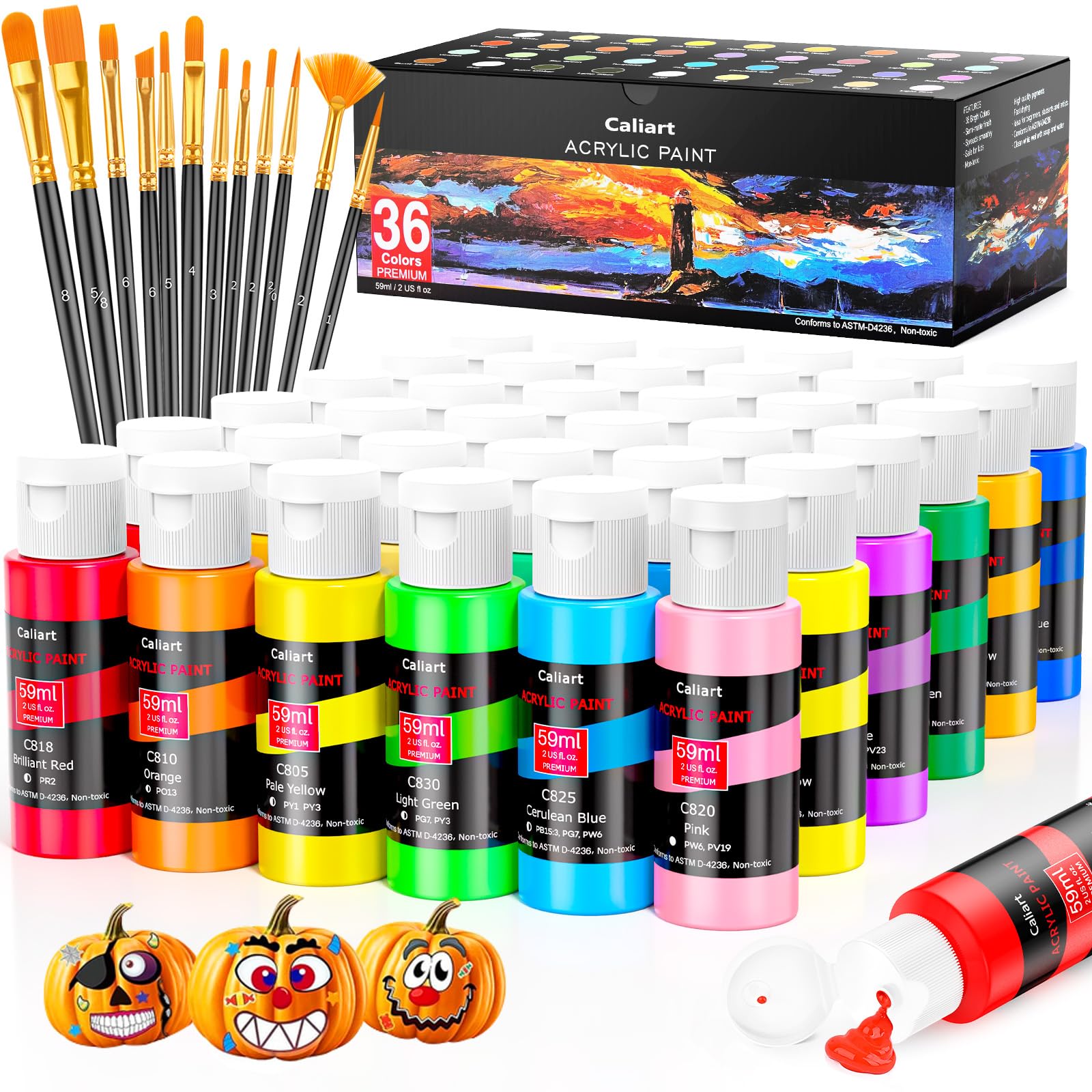
Thirty-six 2-ounce bottles and a dozen brushes make this the most complete paint set here for a kid who has graduated from washable poster paint. The colors are creamy and opaque enough to cover a canvas, a wooden birdhouse, or a rock in one coat, and the set includes metallic gold and silver that are usually sold separately.
The paint is the reason to buy. It blends easily, dries quickly, and holds up on canvas, wood, plastic, fabric, rock, clay, and metal, which makes it a better choice for a kid who wants to paint beyond paper than a tiny tube set with a limited palette. Acrylics are not the forgiving choice—they set fast, stain fabric, and need brushes rinsed before the paint hardens—but that same quick-drying quality is why a project can go from wet to display in an afternoon. We keep this set for older kids and teens, or for a younger kid who paints at a covered table with an adult nearby.
The 36-color range is broad enough for mixing skin tones and landscapes, and the 2-ounce bottles are big enough to survive more than one project. This is not a toddler paint set, and it is not the one to hand a child who still paints with fingers and elbows. For an older kid who wants real coverage and a reason to treat art as a project, it is the paint set we reach for after the washable stuff.
Pros
- 36 opaque colors, including metallics
- Works on canvas, wood, rock, and more
- Non-toxic ASTM-D4236 formula
Cons
- Brushes may be missing from the box
We recommend this acrylic set for older kids and teens who want real coverage on canvas, wood, or rock; the paint is the reason to buy.
How We Tested Every Set at the Kitchen Table
I started with research, not crayons: comparing what each box promised against what buyers said actually arrived, and filtering out sets with padded piece counts, flimsy cases, or contents that didn’t match the photo. That left 16 sets, tested over four months. They went to the kitchen table on rainy Sundays, into backpacks for after-school, into the back seat on a long drive, and to a birthday party where a seven-year-old started drawing before the cake was cut.
Before a single mark was made, we counted every piece against the contents list, then counted again after a month to see what had gone missing and whether the case still held it all. We sharpened each colored pencil four times in a row and noted which ones cracked, shed their cores, or ground down unevenly. Wrappers came off the crayons so we could feel for cracks, and a four-year-old held each one to judge whether it was thick enough for small hands or thin enough to snap under normal pressure.
Color got its own round: we layered and blended to see whether a palette gave us distinguishable shades or twenty versions of the same blue, and whether pigment went down dark on the first pass. Markers sat uncapped for twenty minutes, because that happens, and we wrote down which ones came back. Every tin and case got knocked off the counter onto a wood floor, and a five-year-old packed one away to see if the storage worked for the person actually using it. Four months in, the sets still in rotation are the ones with pieces that held up and a case that closed.
How to Choose Kids Art Supplies
The right kids art supplies are the ones your child can use without a parent hovering—so start with age and cleanup, then decide how many mediums you actually want on the table.
Match the Age Rating Before the Piece Count
A 140-piece kit is not automatically better than a 36-count pencil set if the pieces are too advanced for the child. Play-Doh is labeled 2+, most Crayola markers and pencils start at 3+, and the Inspiration Art Case is pitched at ages 5 to 8. We treat those labels as the first filter, not the last: a younger child needs supplies that open easily, mark without much pressure, and survive being dropped. For a toddler, one medium that gets used beats five that need supervision.
Non-toxic labeling matters more than a long feature list. Check the package for an age range and a non-toxic claim, and keep small caps and brush tips away from children who still mouth things. If a set is marketed for teens or adults, don’t hand it to a preschooler without checking the label and planning supervision.
Choose by Medium, Then by Quantity
Art supplies are not one purchase. A child who colors every day needs a good pencil or marker set and a steady paper supply; a child who is just starting out may do better with one all-in-one case. The 140-piece Crayola kit makes sense when you want variety in a single box, while the 36 colored pencils and the Melissa & Doug paper pads are better for a kid who already knows what they reach for. Buy the medium first, then the quantity.
A big count is only useful if the extras match the way your child works. Thirty-six colored pencils are enough for a young colorist; a 140-piece case is for the kid who moves between crayons, markers, and pencils in one sitting.
Washability Is a Buying Decision
For toddlers and preschoolers, washable markers are not a luxury; they are the difference between a quick rinse and a ruined shirt. Crayola’s washable markers are formulated to come off skin and most children’s clothing, and that matters more than an extra ten colors. Mr. Sketch markers are the exception in this group: the scents are fun, but the ink is not washable, so they belong at a covered table with an adult nearby.
Acrylic paint is a different cleanup conversation. It sets quickly and can stain fabric, so cover the table and keep a rinse cup for brushes. If you want a low-stress first paint set, start with washable poster paint; save the acrylics for a kid who can work within a boundary.
Storage and Portability Change How Often Supplies Get Used
A case with compartments does more than look tidy. The Crayola Inspiration Art Case keeps crayons, markers, pencils, and paper together, so a kid can start drawing without emptying three boxes onto the floor. That is the real convenience: fewer lost caps and a faster cleanup. If the supplies live on a shelf, a simple bin works; if they travel to grandparents or a restaurant, a handle and a latch matter.
Paper pads are the other half of the storage problem. Three 9 x 12 pads stack flat and tear out one sheet at a time, which keeps the rest of the pad clean. We prefer that to a loose stack of copy paper, which wrinkles, slides, and disappears under the couch.
Plan for Consumables and Replenishment
Every art supply in this group runs out. Markers dry out, colored pencils break, paper disappears, and Play-Doh cans get left open. The useful question is not whether a set will last forever but whether the refill is easy to find and affordable. Crayola pencils and markers are easy to replace, and a 150-sheet paper pack buys you time between reorders.
For Play-Doh, the 3-ounce cans are easy to divide into party favors or classroom bins, but a heavy sculptor will go through several in one session. Buy the big pack when you want variety, and keep a few spare cans for the day the lids don’t get snapped back on.
Frequently Asked Questions
How do I sharpen colored pencils without breaking the tips?
Use a metal sharpener with a fresh blade and turn the pencil slowly, letting the sharpener do the work. Cheap plastic sharpeners wobble and take off too much wood, which is where a lot of broken tips start. If a tip snaps inside the sharpener, clear it before the next pencil; a clogged blade will crack the next point too.
How do I get Play-Doh out of carpet?
Let the blob dry completely, then loosen it with a dull knife or spoon and vacuum up the crumbs. Don’t rub it while it’s wet—that pushes the compound into the fibers. For a colored smear, dab with cool water and a little mild dish soap, then blot dry; test any cleaner on a hidden patch first.
What’s the best way to store finished kids’ artwork?
Keep a large portfolio or a flat document box for the pieces you want to save, and date each one on the back. For bulky or glitter-covered projects, take a photo and recycle the original after the child loses interest. A simple file by year makes it easier to thin the stack without feeling like you’re throwing away the memory.
Final Verdict
For most families, the Crayola Inspiration Art Case is the easiest yes: it covers four media, keeps them together, and makes cleanup part of the gift. If your child already has a favorite medium, skip the kit and buy the Crayola 36 colored pencils for coloring or the Melissa & Doug paper pads for drawing and painting. For a toddler, Play-Doh is the better first purchase; add washable markers once the child is past mouthing caps.
