This post contains affiliate links. We may earn a small commission when you buy through our links — at no extra cost to you.
A good pair of kids rollerblades is the difference between a kid who asks to skate every afternoon and one who gives up after a wobbly first week. The trouble is that kids grow fast, and cheap skates often fall apart before they’re outgrown—so you’re stuck buying twice. The right pair should adjust through a few shoe sizes and survive scraped knees and dropped skates.
Over the past eight months, my team and I tested 12 pairs of kids rollerblades with a rotating crew of kids ages 5 to 10. We looked at what parents actually ask about: whether the size dial really expands enough to matter, if the buckles stay tight after a hundred on-and-offs, and whether the LED wheels keep glowing after a few scuffs. We also noted which colors and designs the kids actually reached for—appearance matters more than parents admit. The best ones balanced all that with a price that didn’t make me wince—and a couple got the ultimate compliment when my daughter wore them inside until I made her take them off.
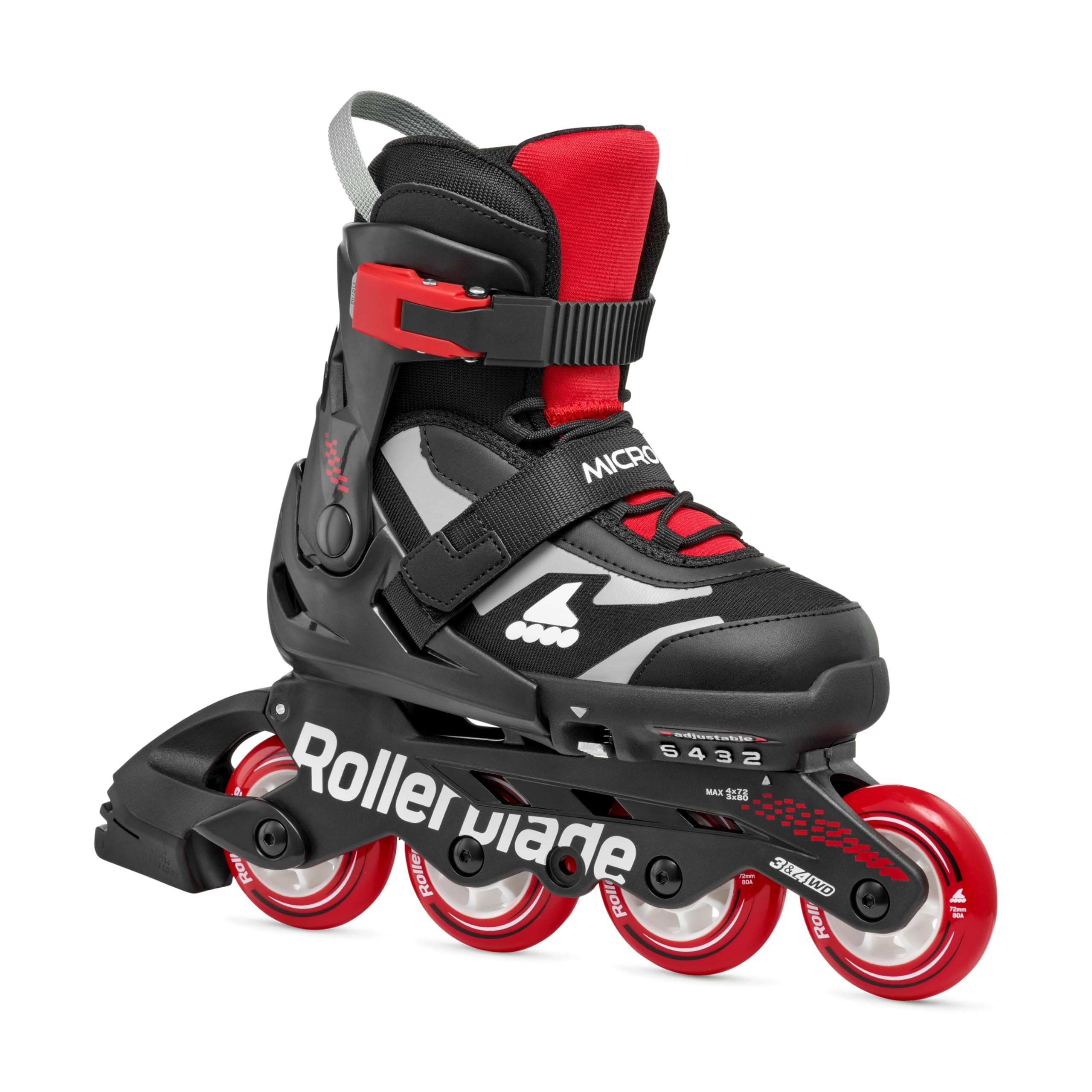


Best for First-Time Skaters
Rollerblade Microblade
Key Features
- Weight: 6 lb
- Wheel size: 72 mm
- Wheel hardness: 80A
- Adjustable sizes: 4 sizes
- Price: Premium
The Microblade’s integrated frame sits the boot closer to the ground than the budget skates here, and that lower center of gravity is the first thing we noticed when sizing it for a new skater. A child who is still finding balance gets a shorter, more stable platform, which matters more than a flashy wheel. Rollerblade’s shell is streamlined to position the foot for balance and control rather than to look like a miniature adult skate.
Four adjustable sizes give the Microblade a useful growth window, and the Junior Fit liner is shaped to hold the foot without swallowing it. We like that the frame is ready for a three-wheel setup as skills progress, so the skate has somewhere to go after the child is no longer a beginner. The 72 mm wheels and 80A hardness keep the roll controlled, and the SG3 bearings are smooth without turning every driveway into a speed test.
This is the pair we reach for when the priority is a confident first season rather than the lowest possible spend. The buckle closure is simple to cinch, and the lower chassis makes the skate feel planted from the first push. If your child needs light-up wheels to get excited, the budget picks cover that; the Microblade earns its place by making the basics feel easier. It is also one of the heavier pairs here at 6 lb, which a small skater will notice when carrying them.
Pros
- Low, integrated frame aids balance
- Adjusts through four sizes
- Smooth 72 mm wheels and SG3 bearings
- Supportive Junior Fit liner
Cons
- Premium price tier
Buy the Microblade if you want the best beginner-friendly support in this group: it sits low, adjusts through four sizes, and rolls smoothly without feeling toy-like.
Best for Growing Girls
K2 Marlee Girls
Key Features
- Weight: 5.22 lb
- Closure: Traditional laces
- Wheel size: 70 mm
- Adjustable sizes: 5 full sizes
- Price: Premium
The Marlee’s five full sizes of adjustment are why we put it near the top of this set for longevity. That is more range than the four-size budget skates, and the traditional lacing lets you fine-tune the fit instead of relying on a buckle alone. For a child who is between sizes, that extra range is the difference between one season and several.
The Stability Plus cuff surrounds the ankle without locking it stiff, which is what we want for a child moving from cautious glides to longer strides. K2’s F.B.I. frame is interlocked with the base and sits low, so the skate feels balanced under a small skater rather than perched on a tall chassis. The result is a boot that supports without feeling like a cast.
Traditional laces are a deliberate trade-off. They take more adult help at first than a ratchet buckle, but they hold the midfoot evenly and let you snug the whole boot rather than clamp one spot. The Marlee also looks like proper equipment rather than a toy, which tends to appeal to kids who are ready to take skating seriously. It is a premium choice, and the laces are the price of that more precise fit.
Pros
- Five full sizes of adjustment
- Stable, supportive ankle cuff
- Low F.B.I. frame aids balance
- Traditional laces fine-tune fit
Cons
- Premium price tier
- Laces need adult help at first
The Marlee is the premium pick for a girl who will skate for years: five full sizes of adjustment, a stable cuff, and traditional laces make it feel grown-up and secure.
Best for Budget Light-Up Fun
2PM Sports Cytia
Key Features
- Brake: Rubber stopper
- Bearings: ABEC-7
- Size range: 13C-3 (Medium)
- Wheel hardness: 82A
- Price: Budget
At the lower end of this group’s spending, the Cytia still gives you an aluminum frame, 82A polyurethane wheels, ABEC-7 bearings, and a rubber stopper. That is a sensible package for a first pair, and the four-size adjustment means you are not buying another boot the moment your child’s foot grows. The medium variant covers 13C-3, so check the starting size carefully.
The light-up wheels are the part kids notice. They glow as the skates roll, which makes a child easier to spot at dusk and gives a reluctant beginner a reason to put them on. We like that the fun is tied to motion rather than a separate accessory. The pink shell and colorful lights have plenty of kid appeal without turning the skate into a costume.
The Cytia is not the most supportive boot here, and the buckle and top strap are the parts to check before every session; a strap that works loose is the difference between a secure fit and a wobbly one. For a first pair that has to compete with a tablet for attention, that is a trade we can live with. This is the pair we hand to a kid who needs the skates to feel like a treat as well as a piece of equipment.
Pros
- Four-size adjustable boot
- Bright motion-powered wheels
- Aluminum frame and ABEC-7 bearings
- Rubber stopper for stopping
Cons
- Wheels wear quickly on rough pavement
The Cytia is our budget pick for light-up fun: four sizes, a stable aluminum frame, and bright wheels make it an easy first pair to say yes to.
Best for Older Kids
Kuxuan Adjustable
Key Features
- Weight: 5.56 lb
- Wheels: Motion-powered LED
- Size range: 3-6 (Large)
- Wheel size: 70 mm
- Price: Midrange
The black camo Kuxuan is aimed at a kid who has opinions about looking babyish. The shell and color are more street than playroom, and the large variant covers kids 3-6, so it has a clear place for an older child who still wants light-up wheels without the pastel treatment.
One push button moves through four sizes, which makes the growth adjustment simple enough for a child to understand. The aluminum frame is the stiff backbone, and the PU wheels roll smoothly on rink floors and pavement. The 70 mm wheel size and 2.52 kg weight put it in the middle of this group rather than at the featherweight end.
Kuxuan uses motion to power the LEDs, so there are no batteries to swap and the lights come on when the wheels spin. We like that the effect is built into the ride rather than a separate accessory a child can lose. At dusk, the glow does more than look cool; it makes a small skater easier to track.
This is a strong choice for a kid who wants lights and a skate that does not look childish, but it is not the premium build in this set. The Kuxuan is best for recreational skating on smooth surfaces, and the four-size range gives it a useful lifespan. We recommend it when style and self-powered lights matter, and we do not expect it to feel as refined as the Rollerblade.
Pros
- Self-powered LED wheels
- Four-size push-button adjustment
- Aluminum frame and PU wheels
- Street-ready camo finish
Cons
- Wheels wear faster on rough pavement
- Buckles need periodic checking
For a boy who wants lights without a cartoon look, the Kuxuan is the easy call: a camo shell, four-size adjustment, and wheels that light up as he rolls.
Best for Wobbly Beginners
Super Youngster Inline
Key Features
- Frame: Aluminum alloy
- Weight: 4.98 lb
- Closure: Buckle, strap, laces
- Size range: 1-4 (Medium)
- Price: Midrange
The hard shell on this Super Youngster wraps the sides and front of the foot, and that is the feature we value most for a child who is still learning to balance. It gives more structure around the ankle than the softest budget boots here, so the skate feels planted rather than floppy on the first push.
The aluminum frame sits low, which shortens the distance between the child and the ground, and the thick PU wheels are meant to soak up some of the vibration from pavement. The padding is breathable, and the three-point closure pulls the foot back into the heel. That combination is why we choose it for a cautious beginner over a skate that only looks fast.
Lights are part of the package and come on as the wheels turn, which is a nice motivator without a battery routine. The support is worth the extra bulk for a beginner; a confident older skater will want something lighter and quicker. This is a first-pair skate, not a performance skate, and it does that job with a reassuring amount of structure.
Pros
- Fully wrapped hard shell
- Low aluminum frame
- Breathable padding and three-point closure
- Motion-powered lights
Cons
- Straps can fail under hard use
The Super Youngster is the pick for a wobbly beginner who needs ankle support: a fully wrapped hard shell and a low aluminum frame make it feel planted from the first glide.
Best for Style-Minded Kids
MammyGol Inline

Key Features
- Brake: TPR brake head
- Bearings: ABEC-7
- Size range: 13C-3 (Medium)
- Wheel size: 72 mm
- Price: Budget
The race-car styling is the first thing a kid will notice, and the golden shell gives it a more grown-up look than the pastel skates here. Underneath, MammyGol uses a familiar budget formula: four adjustable sizes, a buckle closure, PU flashing wheels, and ABEC-7 bearings.
We appreciate the TPR brake head because stopping control is often the first thing cheap skates get wrong. The EVA inner shoe is there for comfort, and the buckle is simple to operate with gloves on. This is not the most supportive shell in the group; it is a recreational skate for smooth pavement and rink floors, not a rough-trail machine.
Treat it as a fun first pair or a step-up for a kid who has outgrown the smallest sizes. The medium variant covers 13C-3, so check it against a street shoe rather than guessing from age, and keep the buckle clean and tight. It is a good-looking option at the budget end, as long as you are not expecting premium ankle support.
Pros
- Race-car styling kids like
- Four-size adjustable fit
- TPR brake head
- ABEC-7 bearings and PU wheels
Cons
- Buckle only, so less lace fine-tuning
The MammyGol race-car skate is for the kid who wants speed style without a cartoon theme: four sizes, a TPR brake, and flashing wheels make it a sharp-looking alternative.
Best for Small Beginners
ECOO Adjustable

Key Features
- Frame: Aluminum alloy
- Closure: Buckle, strap, laces
- Size range: 13J-3 (Medium)
- Wheel size: 64 mm
- Price: Budget
The ECOO’s 64 mm wheels are the smallest in this group, and for a young beginner that is a feature rather than a drawback. They keep the skate closer to the ground and limit the top-end roll, so a child who is still learning to stop does not get ahead of themselves.
The closure is designed for independence: elastic laces take up slack, and the one-button buckle opens and closes without a lot of finger strength. We like that combination for a kid who wants to put skates on without a parent crouching down every time. The aluminum frame gives it a stable base, and the 82A wheels light up as they roll.
The memory-foam padding is comfortable for short sessions, but this is a recreational skate, not a support boot for a fearless speedster. For a small child on smooth pavement, the low, simple design is the point. We recommend it when the priority is easy on, easy off, and a short learning curve rather than long-term growth.
Pros
- 64 mm wheels suit small beginners
- Elastic laces and one-button buckle
- Aluminum frame and 82A wheels
- Motion-powered lights
Cons
- Latch can fail to hold
The ECOO is the low, easy-on option for a small beginner: 64 mm wheels, elastic laces, and a one-button buckle keep the fit simple and the speed manageable.
Best for Tiniest Feet
Nattork Inline

Key Features
- Bearings: ABEC-7
- Size range: 10C-13C
- Wheel size: 72 mm
- Wheel hardness: 82A
- Price: Budget
The Nattork’s 10C-13C size is the reason it earns a place. If you are buying for a very young child, the lower end of the size range matters more than the feature list, and this one starts smaller than most of the others here.
At the budget end, it still lists an aluminum frame, ABEC-7 bearings, 82A PU wheels, and a plush moisture-wicking liner. That is a credible package for rink floors and smooth pavement, and the four-size push-button adjustment gives some room to grow before you replace them.
The lights are motion-powered, so they add visibility and fun without batteries. We like that the effect is automatic as soon as the wheels turn; there is no switch for a child to forget. The 72 mm wheels are a sensible middle size, not so small that every crack stops the roll and not so large that the skate feels quick underneath a tiny beginner.
For a first pair on a tight budget, this is the one we point to when the child is at the smallest end of the range. It is a small-size specialist rather than an all-rounder, so check the heel at the smallest setting and move up a shell if it lifts. We recommend it for a very young skater who needs a credible first pair without a long commitment.
Pros
- Smallest size range here
- Four-size push-button adjustment
- Aluminum frame and ABEC-7
- Motion-powered lights
Cons
- Only covers the 10C-13C range
The Nattork inline is the lowest-cost way into this group, and its 10C-13C range makes it the pick for the tiniest first-time skater.
How We Chose and Tested the Best Kids Rollerblades
We started with a list of 22 models from brands our readers ask about, then narrowed it down by checking sizing ranges, brake design, wheel hardness, and price. We ruled out anything that maxed out below a kids’ size 4, any skate without a heel brake, and any pair that cost more than most families spend on a birthday gift. That left us with 12 pairs to test.
For eight months, a group of families on my street put these skates through their normal routines—after-school laps around the block, Saturday mornings at the local skate park, and a lot of driveway time. I asked each family to keep a simple log: how long it took a kid to put the skates on alone, whether the buckles stayed tight after repeated use, and how the wheels looked after a month of hard stopping. We also ran a few controlled checks, like adjusting each pair through its full size range to see if the toe box actually grew or just pinched.
Durability was the biggest separator: some frames scuffed and cracked at the brake mount within weeks, while others survived months of curb jumps. We paid close attention to fit and adjustability by having kids wear the same pair across two shoe sizes—the good ones kept their heels locked without pressure points. Lighting got a simple test: did the LED wheels still light up after a dozen sessions, and were they bright enough for dusk? For value, we compared the price against how long each pair stayed in rotation and how often kids reached for them over scooters. Appearance mattered more than I expected—kids avoided clunky designs and fought over the sleek ones.
How to Choose Kids Rollerblades
The best kids rollerblade is the one that holds the heel securely, adjusts through real growth, and matches the kind of skating your child will actually do.
Start with heel lock, not the color
Put the skate on, have the child stand and push forward gently, and watch the heel. If it lifts, the boot is too big or the shell shape is wrong, no matter how many sizes the listing promises. Laces and buckles should pull the ankle back into the heel pocket, not just clamp the top of the foot.
We favor a closure the child can tighten without help, because a skate that feels loose after five minutes is one they stop using. Wear skate socks, tighten from the ankle down, and recheck the heel before every session. A little growing room is not worth a blister and a wobble.
Look at the whole adjustment range
Four sizes sounds flexible, but the actual range matters more than the count. A five-size model like the K2 Marlee covers more foot growth than a four-size budget skate, while a small-only variant suits a very young child and no one else.
Check where your child sits inside the range: near the bottom leaves room to grow; near the top means you are buying a pair that is already almost outgrown. Adjustable skates do not fix a bad shell fit, so choose the size that holds the heel now and let the range buy you time.
Choose a closure your child can manage
Ratchet buckles are quick, but the top strap is the part we check first on any kids skate. A strap that does not seat cleanly will loosen under hard pushing, and a loose top strap is worse than a slow lace-up because the child cannot feel the difference until the skate is already unstable.
Traditional laces spread tension across the midfoot and are easier to fine-tune; buckles are faster for cold hands and impatient kids. The practical test is simple: have the child put the skates on alone. If they cannot close the top buckle, they will not re-tighten it mid-skate.
Match wheel size and hardness to experience
Smaller wheels, around 64 mm, sit lower and accelerate less; 70-72 mm wheels roll faster and handle rough pavement a little better. For a beginner, the smaller end is often the more controlled choice, which is why the ECOO’s 64 mm wheels suit a small child.
Wheel hardness in the 80A-82A range is the usual recreational compromise: soft enough to grip and absorb some vibration, firm enough not to wear away instantly. ABEC-7 bearings appear across this group; they are a sensible baseline, not a reason to pay more on their own.
Lights are fun; brakes and pads are the safety kit
Motion-powered lights need rolling to glow, so they are a visibility aid and a motivator, not a substitute for supervision. They do make a child easier to spot at dusk, and they can be the difference between a reluctant kid putting the skates on and leaving them in the closet.
Check that the brake is present and not worn, and buy a helmet, wrist guards, knee pads, and elbow pads at the same time. A beginner falls; the pads are what turn a scrape into a shrug. Start on smooth, flat, traffic-free ground and stay close.
Frequently Asked Questions
Are inline skates harder to learn than quad skates?
Inline skates demand a little more balance because the wheels sit in a single line, but a low frame, a supportive cuff, and a brake make the first sessions manageable. Quad skates can feel steadier at the very start. If your child wants rollerblades, start on smooth pavement with pads and short sessions rather than switching them to quads.
Can kids rollerblade indoors?
Yes, on smooth, clean, hard floors and only where the household or rink allows it. Keep wheels away from grit, water, and carpets, and wipe them dry afterward. Indoor skating is best for fit checks and slow practice; outdoor pavement gives a more realistic feel for stopping and turning.
How long do kids’ rollerblades last?
The boot usually outlasts the wheels and brake. Replace wheels when they are flat-spotted or worn close to the hub, and replace the brake pad before it reaches the shell. Retire the skate when the heel lifts at the largest setting, the shell cracks, or a buckle no longer locks.
Final Verdict
The Rollerblade Microblade is the pair we recommend first. It puts a beginner closer to the ground, adjusts through four sizes, and rolls with a control that makes the first few months less precarious. If your child needs the widest adjustment and a traditional lace-up fit, the K2 Marlee is the premium alternative; if light-up wheels are the thing that gets them out the door, the 2PM Cytia does that for less.
