This post contains affiliate links. We may earn a small commission when you buy through our links — at no extra cost to you.
A sunny Saturday at the playground should not end with a kid squinting through a borrowed adult pair that keeps sliding down their nose—or with a snapped hinge before the snacks are even out. Kids sunglasses have a short, hard life: stuffed in backpacks, sat on in car seats, traded on the slide. What matters is whether they stay on a small face, survive being bent backward, and block UV without becoming a battle every morning. The good ones also look enough like something a kid wants to wear that they keep them on.
I’ve watched my kids reject stiff frames and scratch soft lenses in a single afternoon, so appearance and flexibility matter as much as the lens itself. Over the past six months, we tested 16 pairs with families and kids ages 2 to 9, from quick daycare runs to long beach days. The best pairs got grabbed again without prompting; the worst—including a few pricier ones—spent the summer at the bottom of the bag. Ahead are the ones that earned their place.


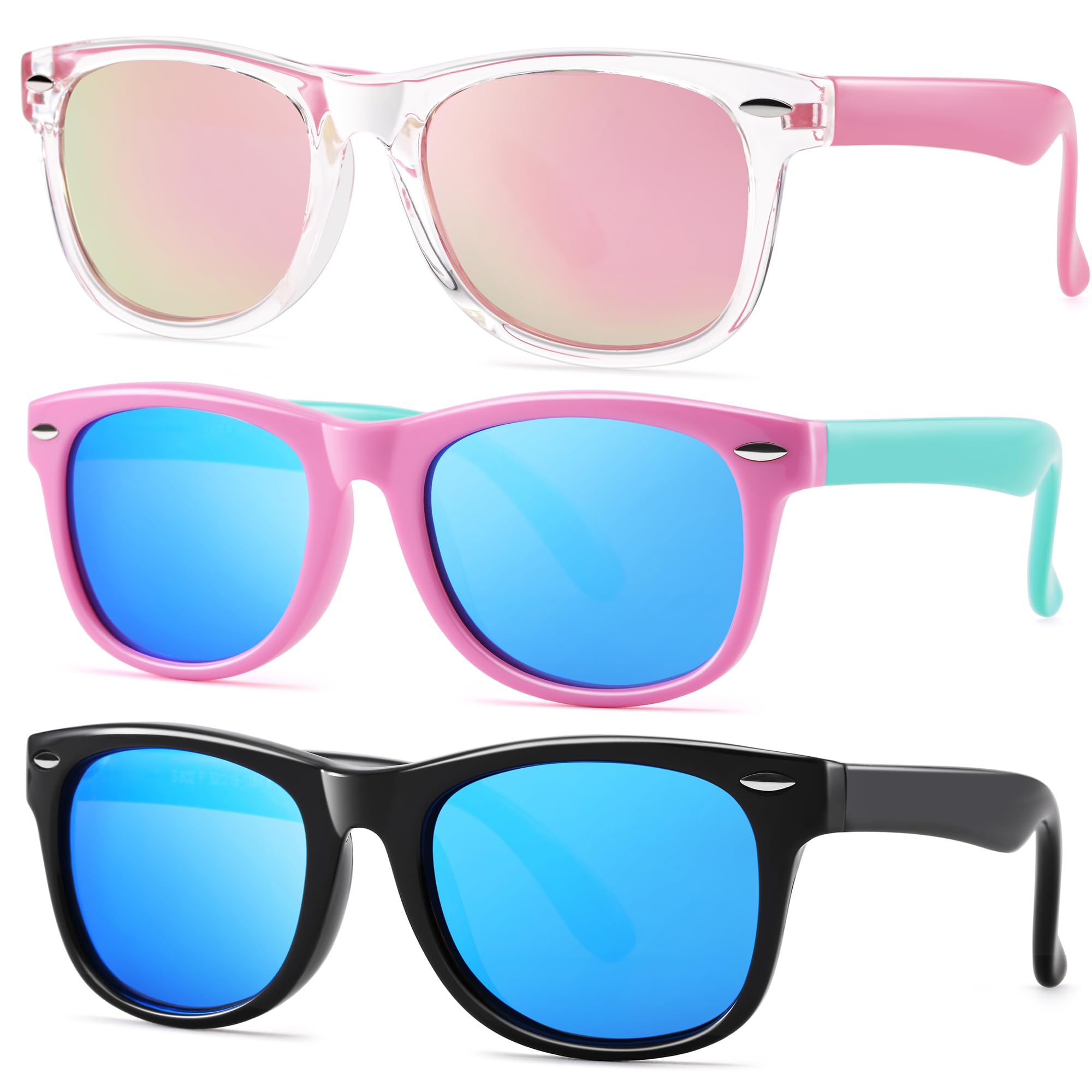


Best for Everyday All-Rounder
COASION Kids Polarized Sunglasses
Key Features
- Lens: Polarized, UV protection
- Frame: Flexible
- In the box: Cloth case, cleaning cloth, mini screwdriver
- Stated age range: 3 to 9 years
- Price: Midrange
The box tells you what kind of pair this is before anyone puts them on: a soft cloth case, a cleaning cloth and a tiny screwdriver for tightening the arms all come with them. That isn’t luxury packaging. It’s the kit that keeps a kids’ pair in circulation — somewhere to live, something to wipe the lens with, and a way to snug a loose hinge instead of retiring the glasses.
The frame bends well past the point where a hard plastic one gives up and snaps. They sit close to the face without pinching at the temples, and they stay there through a scooter ride without a strap pulling them back. The lens is polarized as well as UV-protective, which is the combination that actually cuts glare off water, snow and the back window of the car.
Colors run brighter than the aviators or the plain black frames here, and the finish has a little more shine than the price band suggests. The screwdriver earns its place, too: hinge screws on kids’ glasses work loose, and being able to tighten one is the difference between a pair that lasts a school year and a pair that gets binned in June.
If you want to buy one pair and stop thinking about it, this is the one. It isn’t the cheapest here and it isn’t the coolest, but it covers daycare, errands and a beach week without asking anything of you, and that’s what we want from a kids’ pair.
Pros
- Polarized lens with a case and cloth included
- Flexible arms that bend without snapping
- Stays on without a strap
- Mini screwdriver for loose hinges
Cons
- Runs small for kids past about seven
We point most families here first: a polarized lens, a frame that bends instead of snapping, and a case in the box cover everyday wear better than anything else in this group.
Best for Budget Strap Pair
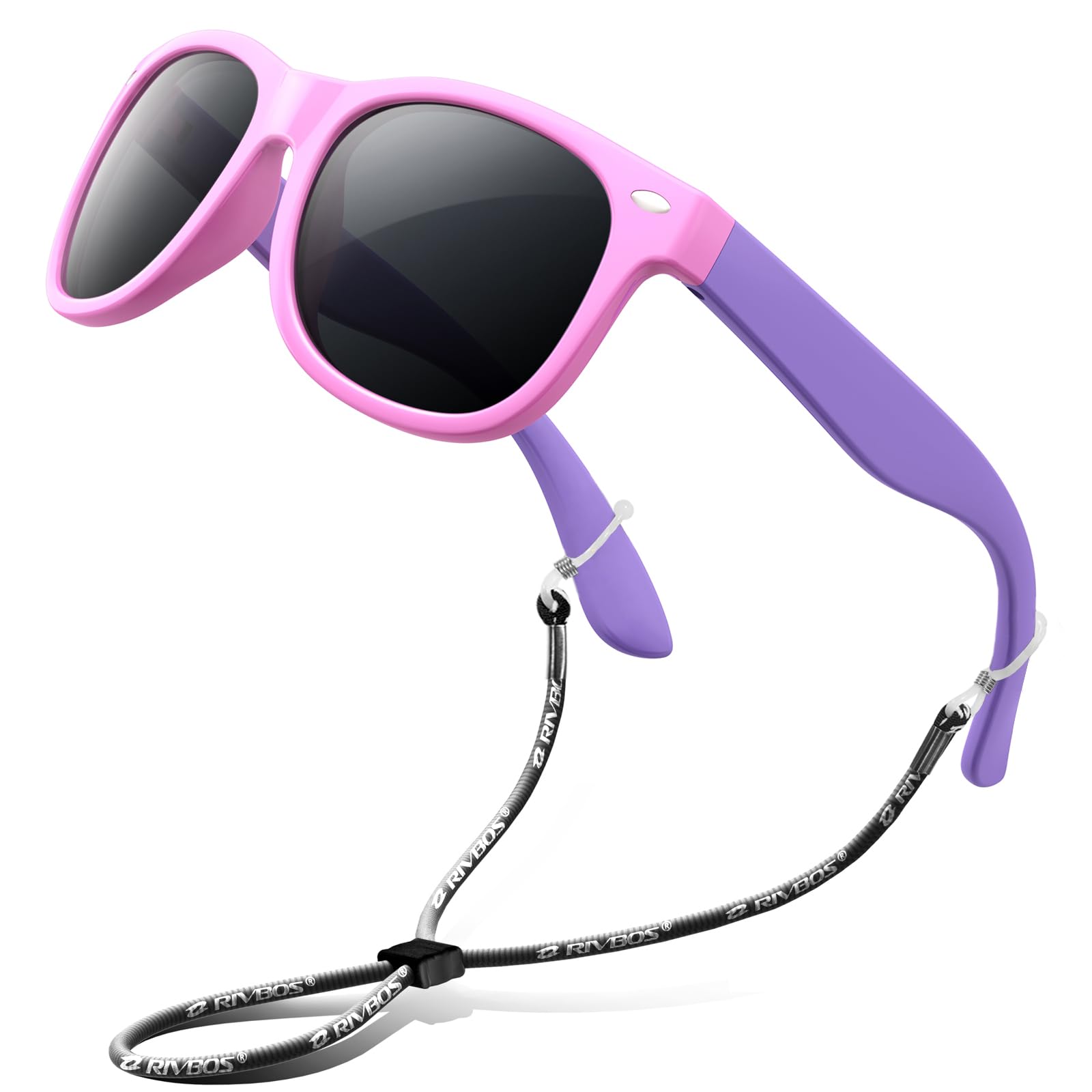
RIVBOS Kids Polarized with Strap
Key Features
- Lens: Polarized UV400
- Frame: Flexible TPE
- Retention: Attached strap
- Price: Budget
The strap is attached to the frame, so it can’t be lost and doesn’t need threading every time you put the glasses on. On a two- or three-year-old that’s the whole game: they stay on through a stroller walk, a nap in the car seat and the part of the afternoon where a small child hangs upside down off the couch.
A strap, a flexible TPE frame and a polarized UV400 lens are the whole offer, and that combination is why these stay on our list. Budget sunglasses usually give up the strap or the flexibility; this pair has both, and for a child who is still learning to keep glasses on their face, that’s the useful half of the job done.
The strap has one annoyance: with it attached, getting the arms over the ears takes two hands and a bit of patience, and a two-year-old supplies neither. That’s a fair trade for not chasing sunglasses across a parking lot, and it’s why we hand these to families with a runner rather than a sitter.
Pros
- Attached strap that can’t get lost
- Flexible TPE frame that bends
- Budget price with a polarized UV400 lens
Cons
- Fit varies: loose at the temples or short in the arm
- Soft ear pieces can warp out of shape
Our budget pick when you want a strap: it keeps a toddler’s glasses on without spending much, and the flexible frame takes the yanking.
Best for Toddlers
HXS 2-Pack Toddler Sunglasses
Key Features
- Lens: Polarized UV400
- Pack size: 2 pairs
- Retention: Removable strap
- Stated fit: Toddlers
- Price: Midrange
Short arms, a soft frame and a removable band: this pair is built for the stage when a child’s head is still mostly cheek and the glasses have to be held on rather than balanced at the temples. For that stage it works, and that’s why they earn a spot here — most of the frames in this group start at three and swim on a toddler.
The band is the part doing the work. It comes off when you want a photo without it and goes back on for the stroller, and because it holds the frame against the head instead of pinching at the temples, the glasses don’t migrate down the nose when a toddler looks at their shoes. The frame itself is soft enough to be yanked off one-handed without cracking.
Two pairs is the other half of the appeal: one in the diaper bag, one in the car, and a lost pair doesn’t end the week. Both are polarized and UV400, which matters more than the color once the sun is properly in their eyes.
Pros
- Two pairs in a single pack
- Removable strap for strollers and car seats
- Polarized UV400 lenses
- Soft frame that bends easily
Cons
- Runs small; best for 1- and 2-year-olds
For the toddler stage, this is the pair we keep on hand: short arms, a soft frame and a removable band that holds glasses on a head that’s still mostly cheek.
Best for Rough Play
Pro Acme Flexible TPEE Kids
Key Features
- Lens: Polarized
- Frame: Flexible TPEE
- Stated fit: Toddlers and young kids
- Price: Midrange
TPEE is the rubbery plastic that makes a frame feel more like a dog toy than eyewear, and it’s why this pair keeps coming back into shape. Bend an arm flat, let go, and it returns. Of everything here, this is the frame most likely to come out of a laundry load still wearable.
This is the pair for the kid who has already broken two this year. Flexible frames are common in this group; what separates this one is how much of it is soft — there’s nothing poky or sharp to catch on a car seat strap, and the arms give before the hinge does. The finish also looks better than the price band, which matters to a five-year-old with opinions.
Flexible isn’t indestructible, and we don’t want to oversell it: lenses still scratch, and a pair that lives loose in a backpack will look tired by August. The difference is that the frame is the part that usually ends a kids’ pair’s life, and here it’s the part that keeps going.
Pros
- TPEE frame bends and springs back
- No sharp or poky parts
- Finish looks more expensive than it is
Cons
- Runs large on smaller preschoolers
The pair for the kid who has already broken two this year — the TPEE frame takes bending, dropping and one accidental trip through the wash.
Best for Ball Sports
SEKKAF Youth Baseball Sunglasses
Key Features
- Lens: UV protection
- Stated fit: Youth
- Stated use: Baseball and softball
- Price: Budget
T-ball, soccer, softball: the sunglasses that work on a field are the ones a kid forgets about between plays. This pair sits close to the face with a bit of wrap at the corners, and the shape sits low enough that they stop needing to be pushed back up mid-play.
They’re light on the face, which matters more than any spec on a hot afternoon, and the frame curves in behind the ear so they stay put through a sprint without a strap. The color range is the part kids care about: bright frames, dark lenses, and enough choice that picking one out is half the fun of owning them.
For a season of games, this is the pair we reach for. It’s the least expensive way here to get a low-profile, UV-protective frame that stays on during play, and the colors mean a kid will actually choose it over whatever is already in the drawer.
Pros
- Stays in place during play
- Low-profile shape with side coverage
- Light on the face
Cons
- Wears faster than the rubber-frame picks here
A field-ready pair for t-ball and soccer: low-profile, light on the face, and stable enough that a five-year-old stops pushing them back up.
Best for Tweens and Teens
Pro Acme Kids Aviator
Key Features
- Lens: Polarized
- Style: Aviator
- In the box: Hard case, soft case, cleaning cloth
- Stated age range: 3 to 18 years
- Price: Midrange
A hard case comes with these, and it’s the right signal: this is the pair for a kid old enough to put something back where it belongs. The aviator shape, the thin frame and the mirrored lens are styled like grown-up sunglasses rather than kids’ ones, which is exactly the point for a nine- or ten-year-old.
Stated sizing runs from 3 to 18 years, but the useful part of that range is the top. On a ten- or twelve-year-old they fit like a normal pair of sunglasses — arms the right length, lens covering the eye, no strap needed. They also suit a narrow adult face, which is rare for a kids’ frame.
Once a child has outgrown the bendy frames, this is where we point. They look right, they come with somewhere to keep them, and they cost about the same as the flexible pairs here, which makes stepping up to a grown-up shape an easy call.
Pros
- Hard case and soft case included
- Suits older kids and narrow adult faces
- Styling that reads as grown-up
Cons
- Mirrored lenses show scratches early
What we suggest once a kid outgrows toddler frames: proper aviator styling, a hard case, and a size that suits a nine- or ten-year-old.
Best for Plain Classic Look
JUSLINK Flexible Polarized Kids

Key Features
- Lens: Polarized
- Frame: Flexible
- Stated age range: 3 to 9 years
- Price: Budget
Not every kid wants dinosaurs or glitter, and this is the pair for the one who wants to look like everyone else. The shapes are classic, the black option is properly black, and the lens is dark enough to matter. That plainness is why we keep coming back to them for school-age kids.
Sizing is stated at 3 to 9 years, and the frame suits the middle of that range: fine on a four- or five-year-old, generous on a three-year-old. It’s flexible without being floppy, and it sits at the bottom of this group on price, which makes it the pair you buy in twos.
The other thing in their favor is that kids wear them. The pink and aqua options are bright without being babyish, the polarized lens cuts glare off water and car windows the way the pricier pairs here do, and for a child with opinions about looking like a little kid, that settles most of the argument.
Pros
- Plain, classic shape that reads grown-up
- Polarized lens at the bottom of the price range
- Flexible frame
Cons
- Wide bridge sits loose on narrow faces
- Arms can lose their spring after hard bending
The plain-classic option — polarized, inexpensive and shaped like grown-up glasses, which is exactly what some kids will actually wear.
Best for Multi-Kid Households
DYLB 3-Pack Flexible Kids

Key Features
- Lens: Polarized
- Frame: Flexible TPEE rubber
- Pack size: 3 pairs
- Stated age range: 3 to 8 years
- Price: Budget
Three pairs, one purchase: that’s the pitch, and for a household with more than one small kid it’s a good one. Three children get a pair each, or one child gets a pair for the backpack, a pair for grandma’s house and a spare for the car.
The frame is TPEE, the rubbery plastic that bends and comes back, and the ear pieces curve in behind the head instead of sitting straight back. On a three- or four-year-old that curve is what stops them sliding forward every time they look down at their shoes.
The lenses are polarized, and the colors are distinct enough that each kid can claim one, which sounds trivial until you’ve refereed an argument about whose sunglasses are whose. The set also means a lost pair isn’t a crisis; there are two more in the drawer.
We recommend this pack for families with two or three young kids who go through sunglasses like socks. It’s the household supply rather than the one nice pair, and buying it that way takes the sting out of the third pair going missing before July.
Pros
- Three polarized pairs in one pack
- TPEE frame bends without snapping
- Distinct colors keep pairs straight
- Ear pieces curve in to stay on
Cons
- Runs small past about age five
Three flexible, polarized pairs in one go, which is the practical answer for a household with more than one small kid.
How We Tested 16 Pairs of Kids Sunglasses
We started with a long list of kids sunglasses from brands we already knew, plus a few smaller labels that kept surfacing in parent reviews. We filtered that list by whether the lenses stated 100 percent UVA/UVB protection, whether the frame came in more than one size range, and whether the price felt reasonable for something a child might lose by Tuesday. That left us with 16 pairs to test for six months.
Four families with kids ages 2 to 9 wore the pairs through preschool drop-off, playground afternoons, beach weekends, backyard sprinkler sessions, soccer practice, and car rides. We watched whether the frames slid down during monkey bars, whether the arms pinched behind small ears, and whether kids asked for a pair again or quietly left it in the car. We also bent the temples backward, twisted the front frame, and opened and closed the hinges repeatedly—then checked for cracks, loose screws, and lenses that scratched after a week in a backpack.
For UV protection, we read the lens labeling and packaging rather than relying on marketing copy; any pair that made a vague claim never made the cut. We judged appearance by letting each child pick from the group without prompting, because a pair they refuse to wear offers zero protection. To assess value, we tracked how often each pair got worn, how well it cleaned up, and whether it survived the full six months without a replacement—then compared that against what it cost.
How to Choose Kids Sunglasses
Fit decides more than any feature on the box: a pair that stays on your child’s face gets worn every sunny day, and one that slides ends up in the glove box.
Start with the face, not the age on the label
Age ranges are a rough guide at best, and they’re where most of the disappointment in this category comes from. Frames sold as fitting three- to nine-year-olds run small often enough that a tall seven-year-old ends up with arms that stop short of the ear, and a narrow-faced child swims in a pair that’s technically the right age.
Before you buy, take a pair your child already wears and look at where the arm ends. If it finishes about a finger’s width past the ear, a new pair of the same stated size will fit. If your child is at the top of a stated range, look at the aviator style instead — it’s cut for older, wider faces.
What the lens label needs to say
UV400 or 100% UV protection is the line to look for. Without it, a dark lens is worse than no sunglasses at all, because the pupil opens behind the tint and takes in more of the UV you were trying to block, so don’t judge protection by how dark the lens looks.
Polarization is a separate question. It doesn’t add UV protection, but it kills glare off water, snow and car glass, which is what makes a pair genuinely useful on a boat or a ballfield. For everyday wear either is fine; for a light-sensitive kid or a summer of outdoor sports, pay for the polarized lens.
Flexible frames: what they survive, and where they still fail
Rubberized TPEE and TPE frames bend flat and spring back, and for a child under five that’s the most useful thing a pair can do. What flexibility doesn’t fix is the rest of the construction: hinges still work loose, lenses still scratch, and a frame left loose in a bag will look tired by August.
A mini screwdriver in the box lasts longer than the pair without one, not because the tool is clever but because a loose hinge is what usually ends a kids’ pair’s life. Buy flexible for toddlers. For older kids who’ll tolerate a case, a sturdier frame and somewhere to store it matters more than bendiness.
Straps, cases and multipacks: the boring stuff that decides lifespan
A strap is the biggest retention upgrade you can buy for a toddler, and it’s worth choosing a pair for that reason alone. Above about five, a strap becomes something kids refuse to wear, and a case takes over as the thing that keeps a pair alive.
Multipacks make sense in two situations: more than one child, or one child who needs a pair in the car, the backpack and grandma’s house. If you’re buying a single pair for a school-age kid, put the money into the case and the lens rather than the frame.
Frequently Asked Questions
At what age can a child start wearing sunglasses?
There’s no minimum age — what decides it is whether your child will leave them on. A baby who pulls them straight off is better served by a hat brim and a stroller shade. Once they’ll tolerate a pair, start with a strap style and keep the first outings short so the glasses become routine rather than a wrestling match.
Are kids sunglasses safe for a toddler who chews on them?
Check the small parts first. Metal aviators with nose pads and tiny screws are the wrong shape for a child who mouths everything; a one-piece rubber frame has nothing to work loose. Run a finger over the hinge screws every few weeks and tighten any that have backed out — our top pick even ships with a screwdriver for exactly that job.
How do I clean kids sunglasses without scratching the lenses?
Rinse the lenses under the faucet before you wipe them, because grit and sand do the scratching, not the cloth. Then dry with the microfiber cloth that came in the box rather than a shirttail or a paper towel, both of which leave fine marks over time. Wash the cloth now and then; a gritty cloth is worse than none.
Final Verdict
The pair we recommend without a caveat is the COASION: polarized, flexible, sold with a case, and sized for the three-to-nine range where most families are shopping. Buy the HXS two-pack instead if your child is still a toddler — at that age the strap and the smaller frame matter more than anything else on this page.
And if you’re shopping for a nine- or ten-year-old who has outgrown every bendy frame here, the Pro Acme aviators are the ones that fit properly and come with somewhere to keep them.
