This post contains affiliate links. We may earn a small commission when you buy through our links — at no extra cost to you.
Every kid who has ever walked the length of a couch cushion with arms out and tongue between their teeth is already doing balance beam work — the beam just gives them somewhere safer to do it. The trouble is that the category splits in two: folding beams that slide under a bed but can shift underfoot mid-walk, and solid wooden ones that feel like a real gym but weigh as much as one. What a good beam actually fixes is both at once — a surface your child can trust and a parent can put away before dinner.
Over the past six months, my team and I have watched 12 of these get walked on, jumped on, folded, dragged outside, and stashed in closets, and the differences rarely show up in a product photo. One thing I’d tell a first-time buyer: a wider top is friendlier for a toddler, but a 4-inch surface is what they’ll need as their skills grow, so height and width both matter. The picks below cover that whole range.


Best for Home Gymnastics Practice
Zelus 8′ Folding Beam
Key Features
- Length: 8 ft
- Material: Suede, wood, EVA
- Top width: 4 in
- Max weight: 330 lb
- Price: Midrange
An 8-foot beam with a wood core is the shape most home gymnasts actually need, and the Zelus gets the proportions right: 4 inches across the top, a 2-inch profile, and a base that sits low enough to feel like a floor beam rather than a balance challenge of its own. The suede cover is the part you notice underfoot: it has grip without feeling sticky, and the wood-EVA core gives the beam a firmer landing than the all-foam picks here.
That firmness is why it’s our top pick. A child can walk, hop, and link a short routine on the 8-foot run without the beam compressing under every step, and the 330-pound rating means a parent can step on to demonstrate a skill. It folds in half and has a carry handle, but the 11-pound weight makes it a two-hand carry for most kids.
On a hard floor, the textured anti-slip base is reassuring; on a thick rug, give the folded seam a press before a fast routine and expect a little more give. The 4-inch top is the same width a competition beam uses, which is useful for a child learning to place a foot precisely, though it’s less forgiving for a toddler who is still finding balance.
The extra mass is the price of that stability. If the beam needs to travel to a class or a grandparent’s house every week, a lighter foam beam is easier to live with. If it’s staying in one room and getting daily use, the Zelus is the one we choose first.
Pros
- 8-foot wood-core deck stays firm
- 330-pound rating covers adult demos
- Folds in half with carry handle
- Textured anti-slip base
Cons
- Heavy for a child to carry
We recommend the Zelus for school-age beginners who want one stable home beam; its 8-foot wood-core deck is worth the extra carry weight.
Best for Young Beginners
Marfula 6 FT Folding Beam
Key Features
- Length: 6 ft
- Weight: 3.75 lb
- Top width: 4 in
- Base width: 6 in
- Price: Budget
At 1.7 kg, this is the beam a small child can drag out without asking for help. The 6-foot length is short enough to fit across a playroom, the 4-inch top matches a competition beam, and the 6-inch base gives it a wider footprint than the narrow foam strips that tip when a foot lands off-center. That combination makes it our favorite light beam for younger beginners.
The EVA foam is extra firm for a floor beam, so a first cartwheel gets cushioning without the whole foot sinking in. The hook-and-loop seam at the middle is the practical detail that makes it work as a living-room object: the halves line up when open and lock together when folded. The carry bag is basic, but it keeps dust off between uses, and the anti-slip bottom needs a clear, flat patch of floor rather than a thick rug.
Six feet is the limitation. It’s plenty for walks, jumps, and basic routines, but older gymnasts working on longer tumbling passes will want the 8-foot Zelus or the longer We Sell Mats beam. For a first beam that gets put away every night, the short length is a feature: it fits where a full-size beam won’t.
Pros
- Light enough for kids to move
- 6-inch base adds stability
- Firm EVA foam with suede cover
- Folds and stores in carry bag
Cons
- Short for older gymnasts’ routines
Our pick for a first beam is this light Marfula: a small child can move it, and the 6-foot length suits short practice spaces.
Best for Long Beginner Beam
We Sell Mats 9 ft Beam
Key Features
- Length: 9 ft
- Thickness: 2.5 in
- Base width: 6 in
- Max weight: 82 lb
- Price: Budget
A 9-foot foam beam buys room for long routines, but firmness is the trade-off. The We Sell Mats beam is the longest pick here, with a 6-inch base and a 2.5-inch foam profile that sits low to the floor. For a young beginner who is still building confidence, that length is a luxury: there’s more beam to walk, hop, and practice on without stepping off the end.
The vinyl cover is the practical side of the design. It wipes clean, doesn’t hold chalk the way suede can, and stands up to a beam that doubles as an indoor obstacle course. The medium-density foam is forgiving underfoot, which is exactly what you want when a child is learning to trust the beam.
We reach for this one when the goal is a long, gentle runway for a preschooler or early beginner. The softness that makes it friendly is also the limit: older or heavier gymnasts will feel the beam compress, and the 82-pound weight limit rules out most adult demonstrations. The 9-foot length also folds in half rather than shrinking small, so it needs a corner or closet with real height.
If your child is doing handstands and leaps with power, the Zelus’s wood core is the better match. If the beam is mainly for balance walks, hops, and building confidence, this is the longest, most forgiving option here.
Pros
- 9-foot length for long routines
- Wide 6-inch base
- Wipe-clean vinyl cover
- Folds in half for storage
Cons
- Too soft for advanced tumbling
- 82-pound weight limit excludes adults
We reach for the We Sell Mats beam when a young beginner needs a long, forgiving runway more than a firm competition feel.
Best for Growing Gymnasts
Marfula Adjustable 8 ft Beam
Key Features
- Length: 8 ft
- Top width: 4 in
- Max weight: 330 lb
- Height range: 9 to 17 in
- Price: Premium
The step up from a floor beam is exactly what this Marfula model sells: the same 8-foot, 4-inch-wide practice surface, but with legs that lift it from a 9-inch floor beam to a 13- to 17-inch raised beam. That makes it the pick for a child who is ready to practice mounts, leaps, and skills that need a little air underneath.
The triangular supports and rubber-wrapped leg bars are the right idea for a raised beam. They spread the load and give the base more contact than a single central post, and the 330-pound rating means an adult can at least test the frame. Assembly is more involved than unfolding a foam beam, and the 15 kg package is a two-person setup for most families.
The build is the part to inspect. Check that the screws and knobs align before the first session, and keep the packaging until you’ve assembled it once; the hardware is where a raised beam has the least room for slop. The height change also turns a floor-level toy into a piece of gym equipment, so it needs a clear, padded landing zone and an adult nearby.
We think the height range is worth the money for a child already taking classes and ready to bridge home and gym. For a toddler, a floor beam is simpler and safer. The Marfula earns its place by growing with a gymnast, not by being the easiest beam to live with.
Pros
- Height adjusts from 9 to 17 inches
- 330-pound weight rating
- 8-foot competition-width top
- Triangular supports and wrapped legs
Cons
- Heavier and more involved to assemble
- Screw alignment can need a check
The Marfula adjustable earns its higher price when a child is ready to practice on a raised beam, not just the floor.
Best for Toddler Sensory Play
B. toys Balance & Build
Key Features
- Use: Indoor
- Pieces: 13
- Material: Plastic
- Age range: 3 to 9 years
- Price: Budget
If your child is three or four and not yet in a gymnastics class, a single long beam can be the wrong shape of toy. The B. toys Balance & Build set turns the idea into a path: eight beam sections and five sensory stones click together into a wavy course, a bridge, or whatever layout your child invents. That makes it a balance beam in the loosest sense, but a very good one for balance play.
We like it for the years before a child is ready to walk a 4-inch competition-width beam. The pieces are chunky, the textures give bare feet something to notice, and the whole thing stacks into a small footprint when play is over. The 3-to-9 age range is broad, and the set is sturdy enough for siblings to take turns. We also appreciated that the beams connect in several directions, so the course changes without adult help.
The trade-off is precision. A modular plastic course won’t teach a child to stay on a narrow beam the way a foam or wood beam does, and the clicking together is part of the play. For toddler sensory work and living-room obstacle courses, that’s the point; for a child training for gymnastics, choose a traditional beam.
Pros
- Modular paths keep balance play varied
- Textured sensory stones
- Stacks for small-space storage
Cons
- Not a narrow training beam
We recommend the B. toys set for toddler balance play and obstacle courses, not for serious beam training.
Best for Wood-Core Practice
FC Funcheer 8 ft Wood-Core Beam
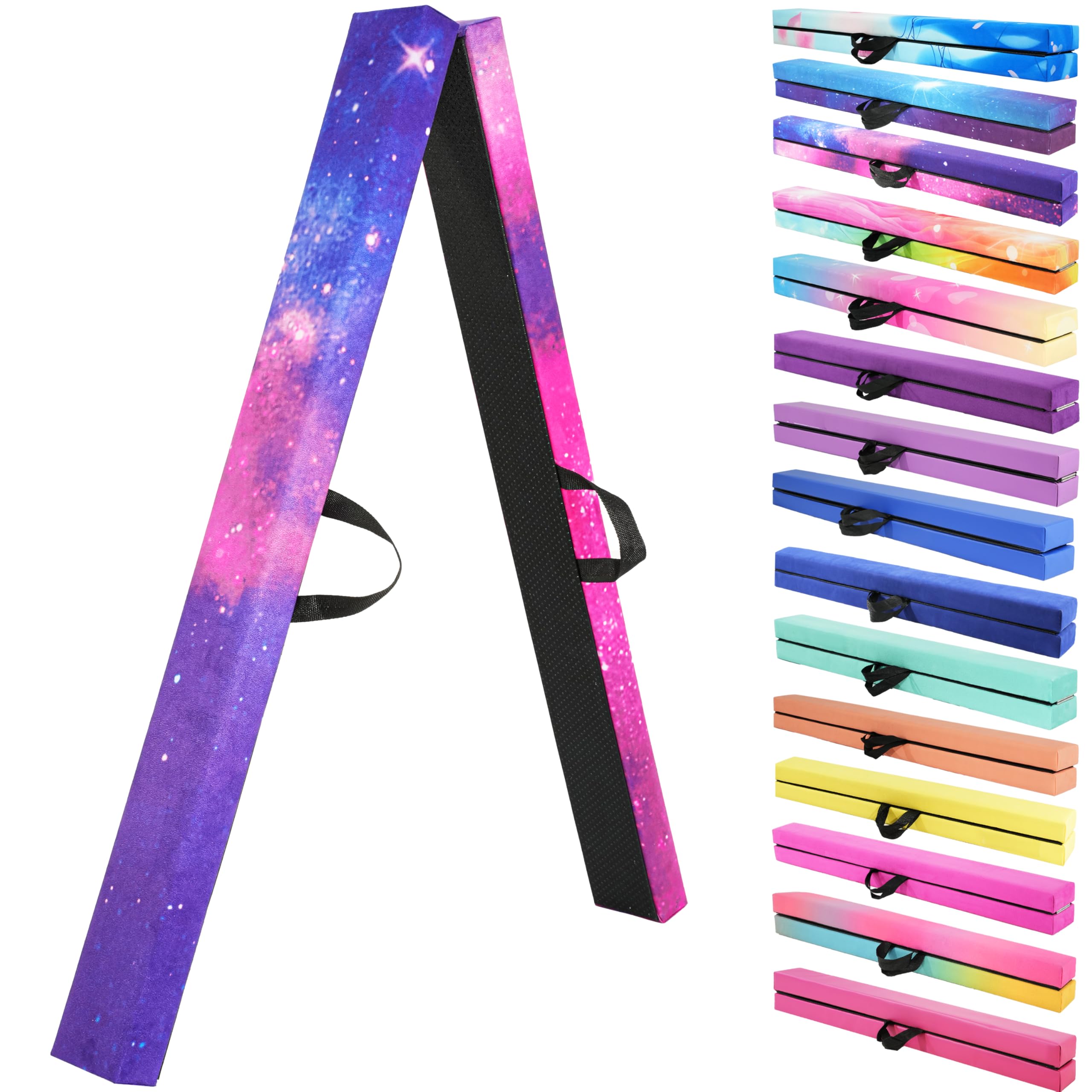
Key Features
- Length: 8 ft
- Material: Wood core, EVA foam
- Thickness: 2.5 in
- Top width: 4 in
- Price: Budget
The wood core is the first thing to notice about this 8-foot FC Funcheer beam. A 50/50 mix of wood and high-density EVA gives it a firmer feel than the all-foam beams here, while the suede cover and full anti-slip bottom are aimed at the same home-gym job as the Zelus. On paper, it looks like a direct challenger.
We put it in the same category as the Zelus, but the experience is less settled. The beam is long enough for real routines and the 4-inch top is the right width, yet stability is the weak point: it can feel wobbly on carpet, and the hardware is the part to watch. That doesn’t make it a bad beam, but it does make it a pick for a family who wants a wood-core feel at a lower price and is willing to check the base and screws.
For a hard floor and a child who mainly walks and practices basic skills, it’s a sensible alternative. For a beam that will be dragged onto carpet or used for handsprings, the Zelus is the safer default, with a 330-pound rating and more consistent stability.
Pros
- Wood-core feel at a lower price
- 8-foot length with 4-inch top
- Full anti-slip bottom
Cons
- Can feel wobbly on carpet
- Hardware needs checking
We see the FC Funcheer as a wood-core alternative for hard floors and basic skills, provided you check the base and hardware.
Best for Small Spaces
TINY TUMBLERS 7 ft Beam

Key Features
- Length: 7 ft / 210 cm
- Weight: 3.75 lb
- Material: EVA foam
- Top width: 3.94 in
- Price: Budget
The flash cards are a nice extra, but the 7-foot beam is the reason to look. TINY TUMBLERS uses a high-density EVA foam core with a faux-suede cover, and the whole thing weighs 1.7 kg, so it’s one of the easiest beams here for a child to move from the living room to the garden.
The shorter length is the practical part. A 7-foot beam still gives a young child room for walks, hops, and simple routines, and the 3.94-inch top is close enough to a competition beam to feel familiar. The included carry bag and straps make storage less of an afterthought, and the flash cards give a child something to do beyond walking back and forth.
We like the TINY TUMBLERS for small rooms and younger children who need a beam they can move themselves. It’s softer and shorter than the Zelus, so it’s not the pick for an older gymnast working on tumbling, but it is easier to live with in an apartment or a shared playroom. The low weight is the point: if the beam is easy to put away, it gets used more.
The cover brushes clean, and the foam has enough firmness for balance walks without feeling like a mattress. Check the length against the room before you commit: 7 feet is compact for a beam, but it still needs a clear runway at both ends.
Pros
- Very light for its length
- 7-foot size fits small rooms
- Flash cards and carry bag included
Cons
- Softer and shorter than an 8-foot beam
We like the TINY TUMBLERS for small rooms and young children who need a beam they can move themselves.
Best for Light Travel Beam
FBSPORT 8 ft Folding Beam
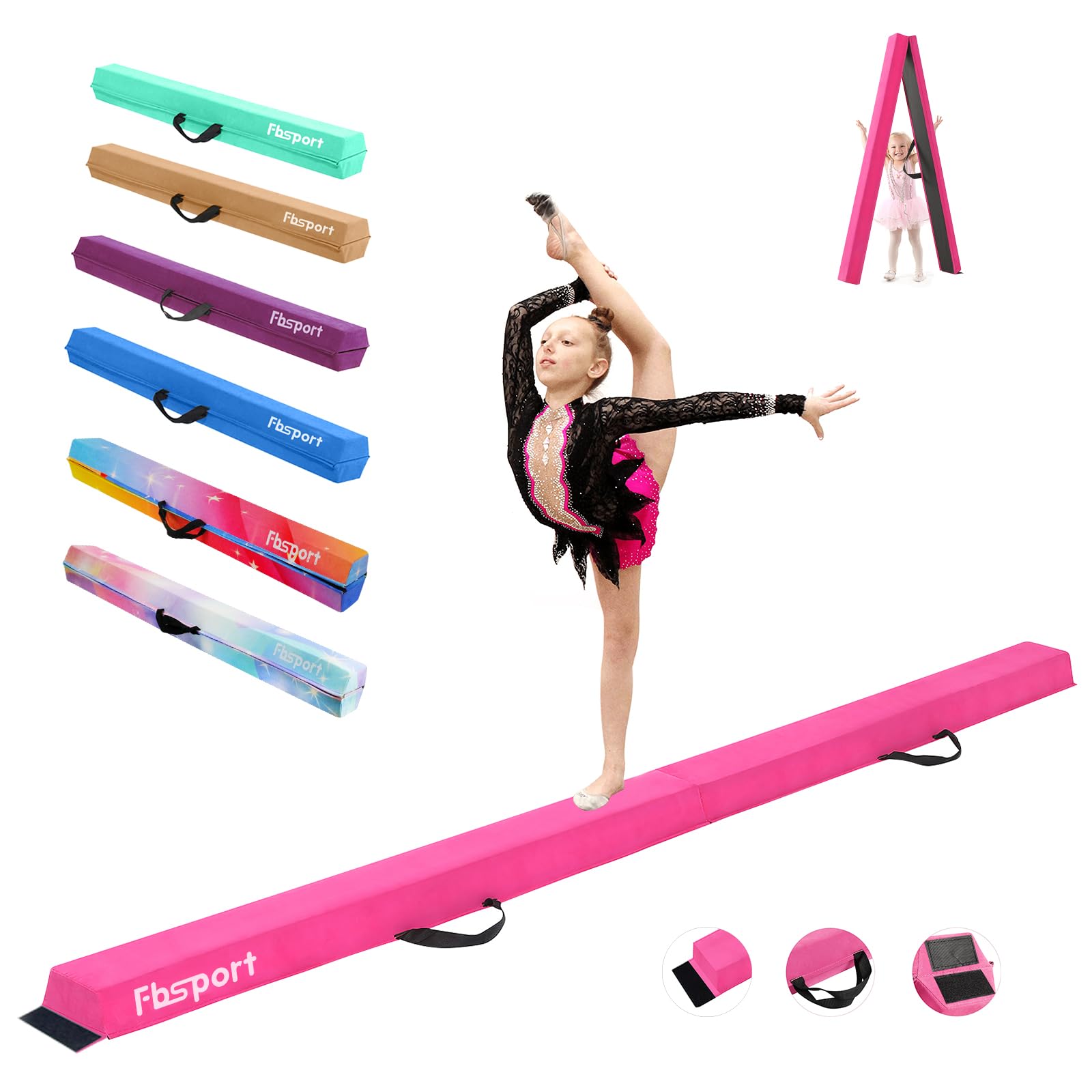
Key Features
- Length: 8 ft
- Weight: 5 lb
- Top width: 4 in
- Base width: 6 in
- Price: Budget
If the 8-foot Zelus sounds right but the 11-pound carry gives you pause, this is the lighter route. The FBSPORT beam is an 8-foot folding foam beam that weighs about 5 pounds, with a 4-inch top, a 6-inch base, and a suede-like cover over high-density EVA foam.
The lighter weight makes it easier to move between rooms, and the folding hinge and carry bag make it a reasonable choice for a beam that lives in a closet. The 6-inch base is the detail that matters for stability; it gives the beam a wider footprint than a narrow foam strip. The trade-off is firmness. This is a soft beam, and older gymnasts will want more support for handsprings and hard landings.
On a hard floor, the anti-slip bottom does its job; on thick carpet, the base can shift, so test the spot before a fast routine. The carry bag is simple but useful, and the 8-foot length gives a beginner more room than the 6-foot Marfula without adding much weight.
The FBSPORT is our lighter 8-foot option for beginners who want a long beam without a heavy carry. It won’t replace a wood-core beam for advanced skills, but for balance walks, basic tumbling, and a beam that comes out and goes away, it’s a strong value.
Pros
- About 5 pounds, easy to carry
- 8-foot length with 6-inch base
- Folds in half with carry bag
Cons
- Soft for advanced tumbling
The FBSPORT is our lighter 8-foot option for beginners who want a long beam without a heavy carry.
How We Tested (and Kept Testing) These Beams
We started with a long list of kids’ balance beams that published a weight limit, an adjustable height, and a top somewhere between 3 and 6 inches wide, then filtered down to 12 covering everything from folding floor beams to low wooden practice beams. Anything without a stated weight limit was cut, and so were models whose reviews kept mentioning feet that slid.
Those 12 beams lived in real homes for six months — on a living room rug, on bare hardwood, on a basement mat, and out on the backyard lawn. Kids from 2 to 10 used them after school, on weekend mornings, and in the middle of sibling arguments, in bare feet and sneakers alike, and a few adults stepped on to confirm nothing tipped.
Stability came first: mid-walk we’d nudge the beam sideways with a foot to see whether the base held or skated across hardwood, and we noted which ones needed a rug to stay put. We pressed a heel into the top to feel how much it gave under a 50-pound kid, folded and unfolded each folding model twice a day to check whether the hinge locked flat and stayed locked, and timed how long setup took with one adult working alone. Every month we went back over seams, stitching, pilling covers, wooden joints, and splinters, since a beam that looks fine at unboxing can fray or wobble by month three. Value came last: what the price bought in sturdiness and years of use, not add-ons.
How to Choose a Kids Balance Beam
Start with the job the beam has to do: a first balance path for a toddler is a different purchase from an 8-foot training beam for a child taking classes.
Match the length to the practice, not the age
A 6-foot beam is enough for a young child to walk, hop, and practice a short routine, and it fits across many playrooms. Once a child starts linking skills or working on tumbling passes, the extra runway of an 8- or 9-foot beam matters more than the extra storage space. We treat length as the first decision because it’s the hardest thing to change later. Measure the clear floor you can give the beam, then pick the longest beam that fits with a safe landing zone at both ends.
Firmness is the real dividing line
A soft foam beam is welcoming for a preschooler: it cushions a stumble and makes the beam less intimidating. But softness has a ceiling. Once a child is doing handstands, leaps, or anything with speed, a beam that compresses underfoot gives back less control. A wood core or extra-firm EVA holds its shape better. We think most families are better served by the firmest beam their child will actually use; if the beam is only for balance walks, a softer foam pick like the We Sell Mats is the kinder choice.
Check stability on the floor you’ll use
A 6-inch base and an anti-slip bottom help, but the floor decides how much grip you get. A folding beam that feels planted on hardwood can shift on thick carpet, and a modular set with small feet can skate on smooth tile. Before you buy, test the intended spot with the beam empty, then with your child walking slowly. Keep the landing zone clear of furniture and toys. If the beam will move between rooms, choose one that’s light enough to reposition without dragging the base.
Adjustable and modular beams solve different problems
An adjustable beam is for a child who already has some gym experience and needs to practice at a raised height; it adds setup, weight, and a fall zone that a floor beam doesn’t have. A modular beam-and-stepping-stone set is for a younger child who needs a changeable path, sensory input, and short bursts of play. Neither is a substitute for the other. We steer toddlers toward modular sets, school-age beginners toward floor beams, and kids who are already training toward an adjustable beam with adult supervision.
Frequently Asked Questions
Can adults use a kids balance beam?
Some can, but only within the stated limit. The Zelus and Marfula adjustable are rated to 330 pounds, while the We Sell Mats beam tops out at 82 pounds. Check the maximum weight before you step on, and treat a child’s foam beam as a child’s beam unless the listing clearly says otherwise.
How do I clean a foam or suede balance beam?
Wipe the cover with a damp cloth and mild soap, then dry it right away. Don’t soak EVA foam or put a suede-covered beam in the washing machine; trapped water can soften the core and weaken the hinge. For dust or chalk, a soft brush or a vacuum with an upholstery nozzle is enough.
Can I use a balance beam outside?
A flat patio or driveway can work for a foam floor beam, but bring it inside after use. Suede and EVA don’t like rain, dew, or long sun exposure, and a slick surface changes the grip. A modular plastic set is the better choice for indoor-outdoor play; check that the surface is clear and flat before your child starts.
Final Verdict
Choose the Zelus 8′ if you want one beam for school-age beginners who will use it at home several times a week. Its 8-foot wood-core deck gives a child room to link skills, and the 330-pound rating means an adult can demonstrate without worrying.
If the beam has to be carried or stored by a small child, the 6-foot Marfula is the easier daily companion; if your child is ready for a raised beam, the Marfula adjustable is the step up.
