This post contains affiliate links. We may earn a small commission when you buy through our links — at no extra cost to you.
A baby humidifier has one job: add moisture to the nursery without waking the baby, soaking the dresser, or turning into a mold farm by week two. Dry air shows up fast in a small room—crusty noses, a cough that hangs on, static on the sleep sack—and the fix should be boringly reliable. The right one keeps the air comfortable through cold season and nap time, holds enough water to make it to morning, and comes apart for a real scrub. The wrong one gurgles, leaks, or leaves the crib sheet damp.
I learned the hard way that tank shape matters more than a mist dial: if the opening is too narrow for a bottle brush, you’ll dread cleaning it. My team and I have run 12 humidifiers through six months of overnight and nap-time duty, on dressers, nightstands, and changing tables. We refilled tanks in the dark, listened for gurgles at the crib rail, carried full units across the room, and watched for cracking plastic and replacement-filter costs. The picks below earned their spot.


Best for Most Nurseries
Levoit NeoClassic 450
Key Features
- Runtime: 42 hours
- Capacity: 4.2 liters
- Room coverage: 432 square feet
- Sleep-mode noise: 21 dB
- Price: Midrange
Twenty-one decibels is the number that earned this one the top spot. That’s the sleep-mode rating, and it’s the lowest of the three humidifiers we’re recommending here — the Classic 160 sits at 25 and the DREO at 28. The rest of the machine behaves the same way after dark: sleep mode takes the display down, so nothing glows on the dresser at 3 a.m. while you’re trying not to wake a baby.
The 4.2-liter tank carries the same argument. Levoit rates it at 42 hours in sleep mode, which turns a nightly refill into one every few days. Filling happens from the top, so the tank stays where it is, and the tray underneath detaches and goes on the top rack of a dishwasher — that’s the detail we appreciated most, because it keeps the cleaning away from the electrics. Mist is rated to rise 46.8 inches, high enough that it spreads through the room rather than landing on whatever is nearest.
What you give up is dresser space and money. At 8.1 inches square and nearly 13 inches tall it wants a proper patch of furniture, and at 3.9 pounds it isn’t the one you shift one-handed while holding a baby. It’s also the most expensive of our three. None of that changes the recommendation for a nursery that has the room: quiet, capacity, and a cleaning design that survives a whole winter are exactly where the money goes here.
Pros
- Quietest sleep mode here at 21 dB
- 42 hours on a fill in sleep mode
- Detachable tray is dishwasher-safe
- Blue-light-free night light with two levels
Cons
- Wide 8.1-inch footprint for a dresser
- Highest price of our three picks
Our default pick for a nursery: the quietest sleep mode here, a tank that lasts several nights, and a tray that goes in the dishwasher.
Best for Small Nursery
Levoit Classic 160
Key Features
- Runtime: 25 hours
- Capacity: 2.5 liters
- Noise level: 25 dB
- Room coverage: 219 square feet
- Price: Budget
Start with the footprint, not the tank. This one is 7.12 inches wide and 6.38 deep — narrow enough for a nightstand that also has to hold a monitor, a lamp and a stack of board books — and at 2.2 pounds you can pick it up with one hand. Levoit rates it for 219 square feet, which is the honest reading of a 2.5-liter tank: it’s a bedroom unit, and it’s happiest in a small one.
The interface is a single knob, and we count that as a feature rather than a shortcut. In a dark room you find it by feel and turn the mist down without waking anyone or lighting up a screen. It’s rated at 25 dB, a step up from our top pick, but it’s still a fan you stop hearing. All the lights go off, which for a nursery is most of the battle.
Cleaning is a hand job, and the design makes it a short one: the tank fills from the top without being flipped, the opening is wide enough for a hand and the included brush, and the base is built without the deep corners where film collects. For a nursery, a unit you set once at bedtime and then ignore is the right shape of machine, and this is the cheapest way to get there.
Pros
- 7.1 inches wide, light enough for one hand
- All lights off, 25 dB
- Top-fill with a wide cleaning opening
Cons
- No humidity sensor to hold a set level
- 2.5 liters is a short run at high output
The small-room pick: it fits where bigger units won’t and still runs quiet all night, with the simplest controls of the three.
Best for Tight Budgets
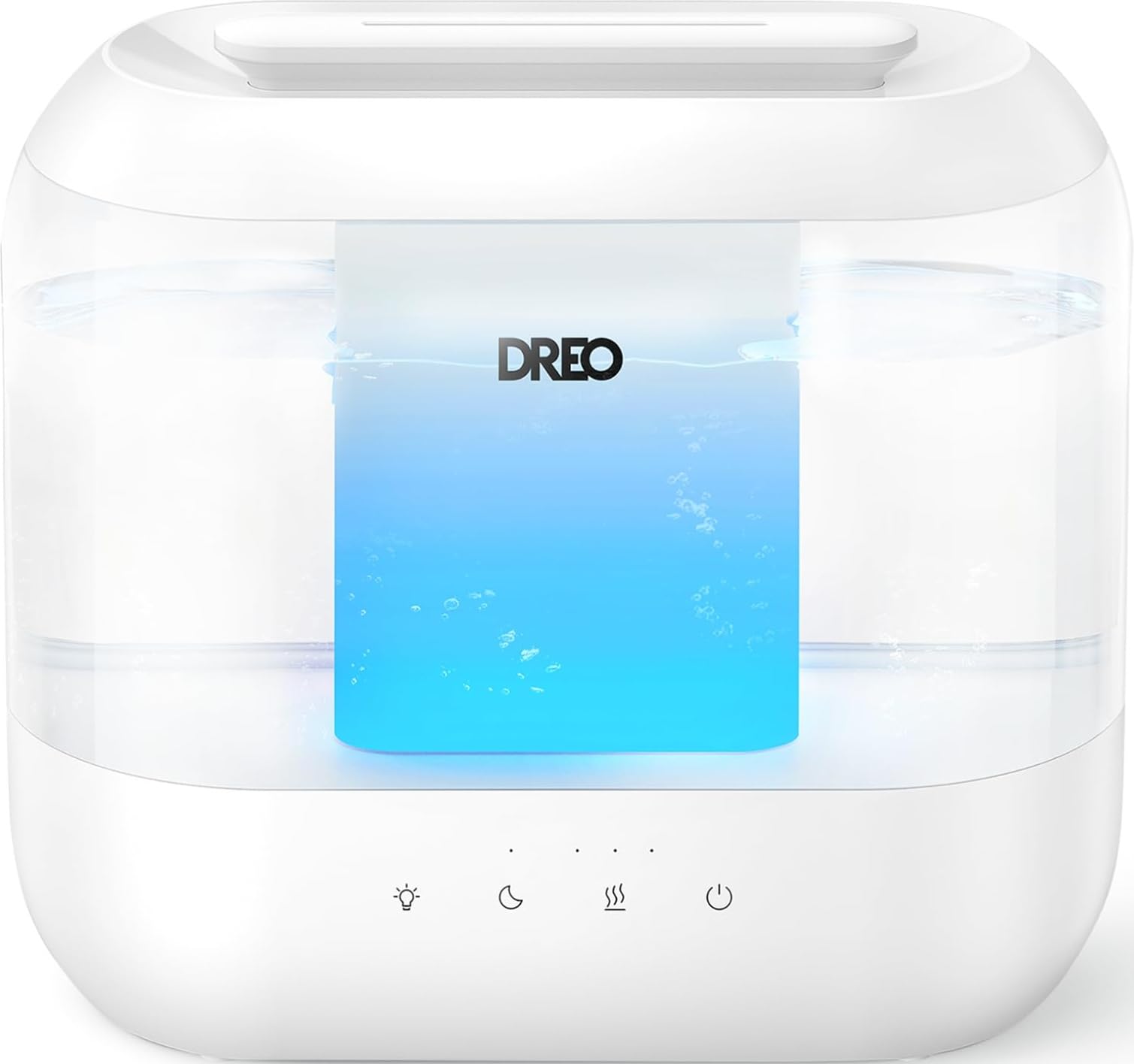
DREO HM311
Key Features
- Runtime: 36 hours
- Capacity: 4 liters
- Noise level: 28 dB
- Room coverage: 300 square feet
- Price: Budget
Four liters for less than our top pick costs is the pitch, and it mostly holds up. The DREO is rated for 36 hours on a fill and 300 square feet, which puts it between the Classic 160 and the NeoClassic 450 on capacity — and between them on price too. You give up some refinement for that, but not as much as the gap in price suggests.
Its shape does something the two Levoits don’t. The body is 11 inches wide but only 5.5 inches deep, so it sits along the back edge of a dresser or flat against a wall instead of bulging into the room. The 4-inch outlet throws a genuinely fine mist, and the blue night light is soft enough to leave on — a glow rather than a lamp.
The tank is the catch. It has to seat squarely: set it down a degree off and water finds its way out from under the base, which is the last thing you want on a wood dresser. Give it a waterproof tray, press the tank down until it settles, and check the seam before you walk away. Do that and it stays dry. Skip the aroma pad in a baby’s room.
At 28 dB it’s the loudest of the three, though 28 dB is still a soft fan rather than something you hear from a crib. That’s the trade for the capacity and the price, and in a room that already runs a sound machine it barely counts as a trade at all.
Pros
- Four-liter tank, 36 hours between fills
- Cheaper than our top pick
- Shallow 5.5-inch body sits back against a wall
Cons
- Loudest of the three at 28 dB
Worth a look when the dresser is shallow and the budget is tight: lots of tank for the money, as long as the tank goes on square.
How We Tested Baby Humidifiers
We started with roughly 30 models and narrowed the field by tank capacity, footprint, price, and whether the tank opening could fit a bottle brush. Anything with a filter that needed replacing every few weeks, a footprint wider than a standard nightstand, or a fill port you couldn’t reach without a funnel came off the list.
Over six months, the 12 finalists ran in real nurseries through overnight stretches and nap time. We filled each tank before bed, set the unit on a dresser or nightstand, and checked a small humidity gauge at crib height in the morning; we also felt the crib sheet and windows for dampness. We measured sound from the crib rail, but the more telling test was whether we heard gurgling or fan whine through the monitor during a 2 a.m. feed. Every unit got carried full from the bathroom to the nursery, and we checked seams, towels, and carpet afterward for leaks.
Once a week, we took each humidifier apart, scrubbed the tank and base with a bottle brush, and looked for pink film or mineral crust in the corners. We kept notes on how many pieces had to be dried and whether the opening let us reach the bottom without scraping a knuckle. Over the six months, we watched for hairline cracks, fading mist output, and parts that loosened with daily use, and we tallied replacement filters and accessories against the original cost. Footprint got checked against a narrow dresser and a crowded changing table, because a humidifier that doesn’t fit the room won’t get used.
How to Choose a Humidifier for a Baby’s Room
The features that matter in a nursery are the unglamorous ones: a low setting you stop hearing, a tank that doesn’t need filling at 3 a.m., and an opening you can actually get a brush into.
Read the noise figure at its lowest setting
Every humidifier quotes its quietest number, and the quietest setting is the one a nursery runs on, so that’s the figure that counts. Our three sit at 21, 25 and 28 dB. All of them are a fan you stop noticing rather than a hum that keeps anyone awake, which is why we put light ahead of decibels as the tiebreaker.
A display that stays lit in a dark room undoes a lot of careful engineering, and it is the thing a listing is least clear about. Look for a sleep mode that dims or kills the panel. The other sound is water: a tank that gurgles as it drains is more noticeable in a quiet room than the fan is, so keep the box until you’ve slept a night with whichever one you buy.
Match the tank to the night, not to the room
Capacity on its own tells you very little. Capacity against runtime tells you how often you’ll be carrying water to the bathroom: 2.5 liters rated at 25 hours covers a night with margin, 4.2 liters at 42 hours covers several. Both figures are quoted on the low setting, which is where a nursery runs, so they’re the honest ones to compare.
Bigger isn’t automatically better. A full tank is heavier to lift and takes more dresser top, and the refill you’re avoiding happens in a room you walk past anyway. Pick the smallest tank that gets you through a night plus a buffer, and spend the difference on quiet and easy cleaning.
Cleaning is the cost you actually pay
Mineral film, and the pink film that follows it, is why most humidifiers get retired early. What makes cleaning easy is geometry: a wide tank opening, a base without deep corners, and parts that lift out so you aren’t wiping around a cord or a heating plate. Our top pick’s tray detaches and goes on the top rack of a dishwasher, which is the single most useful upgrade in this group.
Read that claim carefully, though. Dishwasher-safe usually covers one removable part and not the tank itself, so check which pieces a listing actually names before you count on it.
Cool mist, auto shut-off, and where it stands
For a nursery, cool mist is the sensible default: there’s no heating element inside the unit and nothing warm coming out of the nozzle. Warm-mist models do the same job with a heater added, which is worth thinking about when the machine sits within reach of a crib.
Two things to confirm before you order: that the listing states auto shut-off for a dry tank, and that the cord reaches your chosen spot without an extension lead trailing across the floor. Then site it on a stable surface out of reach, nozzle pointed into the room rather than at the crib or a wall, so the mist disperses instead of dampening one patch of paint.
Frequently Asked Questions
Can I add essential oils to a baby’s humidifier?
Most of the models here have an aroma pad, and in a nursery we leave it empty. You’re buying the machine for moisture, and a small closed room concentrates scent far more than the open living space these features are designed around.
If you want the fragrance for yourself, use it in another room and keep the nursery’s unit filled with water only.
Does a humidifier actually help a congested baby?
It puts moisture back into air that central heating has dried out, which is the comfort most parents are chasing at 2 a.m. It isn’t a treatment and it won’t clear a cold on its own.
Run it through heating season and stop when the room starts to feel damp. If your baby is congested and struggling to feed or sleep, that’s a call for your pediatrician rather than a shopping decision.
Why is there white dust on the nursery furniture?
That’s the minerals in tap water, thrown into the air with the mist and settling as a fine powder on the dresser, the crib rail and everything else nearby.
Distilled water in the tank stops most of it, and a wipe-down of nearby surfaces every few days handles the rest. If your tap is hard, switching water is the single change that makes the biggest difference.
Can I leave water in the tank between nights?
Empty it. Standing water is what grows the film you end up scrubbing, and topping up a half-full tank for a week is the fastest route to a humidifier that smells.
Tip the remainder out in the morning, leave the tank open to dry, and fill it fresh at bedtime. It takes less time than the cleaning it saves you.
Final Verdict
The Levoit NeoClassic 450 is the humidifier we recommend for most nurseries: 21 dB in sleep mode, 42 hours on a fill, and a tray that goes in the dishwasher. Where the room is small and the furniture is narrow, the Classic 160 does the same job in a 7-inch footprint.
The DREO earns its place on tank size for the money, provided you seat the tank squarely every single time.
