This post contains affiliate links. We may earn a small commission when you buy through our links — at no extra cost to you.
A baby will tolerate sunglasses for about as long as it takes to buckle a stroller—unless the fit is right. The wrong pair slides down the nose, presses on little temples, or becomes a chew toy before you reach the end of the driveway. What you want is a pair that keeps glare out of their eyes on stroller walks and car rides and stays put when they turn to watch a dog go by. We put 14 pairs through five months of stroller walks, carrier trips, and diaper-bag life, and the differences came down to strap adjustability, lens clarity, and whether the frames survived a baby’s grip.
I check the strap first, not the color. A baby can’t tell you a lens is distorted or a hinge is pinching, so watch for squinting, rubbing, and the telltale head-shake. Cute frames are a bonus, but appearance shouldn’t outrank UV protection markings, a size range that suits a baby’s face, and construction that survives a diaper bag. The picks below stayed on longest and felt worth the money.


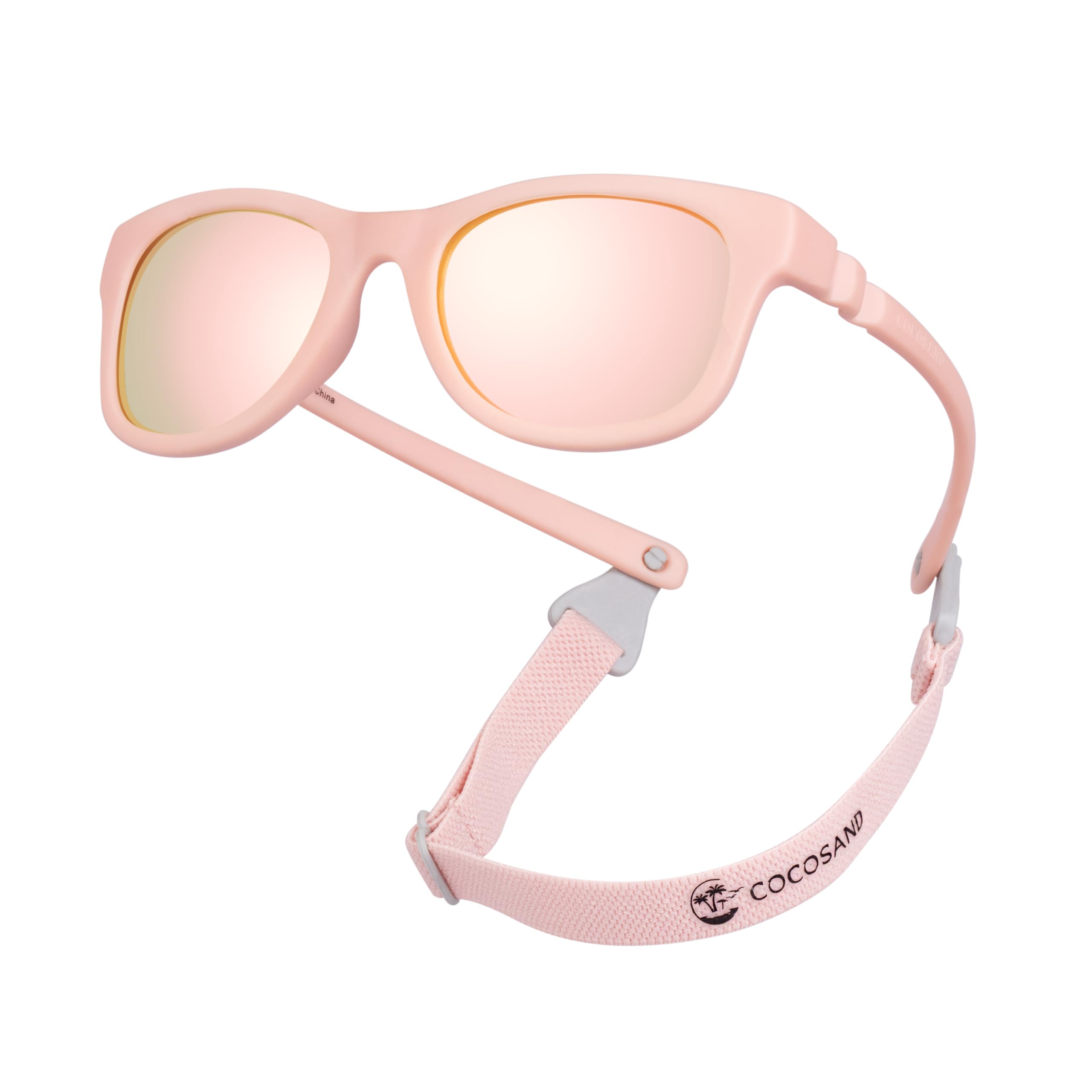
Best for Most Babies
COCOSAND Flexible Polarized Baby Sunglasses
Key Features
- Lens: Polarized
- Frame: Flexible
- Strap: Included
- Price: Midrange
The strap is what puts this pair ahead of every other one here. It is elastic, it adjusts through a wide range, and it lifts off entirely once your baby stops needing it, which is the detail that turns a newborn pair into one still in use at eighteen months. We minded how many of the others only work with the strap attached.
The frame is the other half of the argument. It bends flat enough to disappear into a diaper bag and springs back without a crease, and the polarized lenses cut glare instead of simply making the world darker. Between the bendy frame and the adjustable band, the fit grows with the head rather than needing a second purchase at the six-month mark.
Comfort holds up over a long morning out. The frame is light, the arms leave only a faint line behind the ears, and a baby who has decided sunglasses are a toy tends to forget about them once they are seated properly.
The exception is the first few weeks. The built-in nose pads hold the frame a little high on a brand-new face, and a wriggly newborn needs two or three goes before the lenses sit where they should. Snug the strap first, then adjust from the bridge rather than the arms. Past about three months, we have not found a reason to look elsewhere.
Pros
- Adjustable strap that removes completely
- Bendy frame survives grabs and bag life
- Polarized lenses cut glare
- Fit stretches from newborn into toddler months
Cons
- Lenses scratch with rough handling
- Strap can break with repeated stretching
The pair we point most parents to: polarized lenses, a bendable frame, and a strap that tightens for a newborn and comes off once it is outgrown.
Best for Budget Second Pair
COASION Bendable Polarized Baby Sunglasses
Key Features
- Lens: Polarized
- Frame: Bendable
- Age range: 0-24 months
- In the box: Case included
- Price: Budget
There is a version of this decision that costs a fraction of what our top pick does and covers the same ground: a bendable polarized frame, an elastic strap, and a small case in the box. That is the COASION, and it is the pair we suggest buying two of, one for the diaper bag and one to leave at Grandma’s.
What we found is that the softness matters more than the finish. The frame twists and folds without creasing, the strap loops over the arms instead of clipping on, and the lenses are genuinely polarized rather than just dark. For a baby who grabs at everything within reach, that combination is worth more than a nicer hinge.
The one weak point is how the lenses are seated. A hard, determined tug can work one loose, and pressing it back in takes patience and a firm thumb from the edge rather than the middle. Treat this as the second pair you do not have to be precious about, and it is the best value on this list.
Pros
- Bendable polarized frame
- Case included at a budget price
- Costs far less than the top pick
Cons
- Lens can work loose with a hard tug
Our value pick: the same bendable, polarized formula as the top pick for a fraction of the money, with a case in the box.
Best for Hard-To-Fit Heads
Mausito Baby Sunglasses 0-24 Months
Key Features
- Frame: Flexible
- Age range: 0-24 months
- In the box: Fabric case
- UV protection: UV400
- Price: Premium
Velcro at both temples, rather than a single elastic loop around the back, is the design decision that sets the Mausito apart. It lets each side be brought in or let out on its own, which is the difference between a pair that fits and a pair that fits properly, and on a wide head or a very narrow one that is the whole game. We were surprised by how much difference such a small mechanical change made.
The rest is premium in the way the price suggests: UV400 lenses with a genuinely dark tint, a flexible frame, a fabric case, and a close wrap that keeps wind and dust out as well as glare. On a bright morning at the beach, that coverage is the thing we noticed most.
Two things to know before you spend the money. The tint is dark enough that this is not the pair for a shaded stroller or a dim car, and the fit is adjustable rather than grippy, so a determined toddler can still pull them off the front. If you have already tried three pairs that slid down your baby’s nose, this is the one worth the premium.
Pros
- Velcro adjustment at both temples
- UV400 lenses with a dark tint
- Close wrap against wind and dust
- Fabric case included
Cons
- Highest price of these picks
The most adjustable pair here, with velcro at both temples that dials in a fit on heads the elastic-band designs slide off.
Best for Newborn Babies
COCOSAND Square Frame Baby Sunglasses
Key Features
- Frame: Flexible square frame
- Strap: Included
- Age range: 0-12 months
- Price: Midrange
The 0 to 12 month label on this frame is not marketing. It is cut narrower than the 0 to 24 month pairs here, with a squarer profile that sits closer to the eyes on a small face, which is exactly what a newborn needs and exactly why it stops working later.
The frame is soft and springy, the strap is there for the months when nothing stays on, and on a three-month-old it sits snug without a mid-walk adjustment. It also arrives in a box that makes it presentable as a baby-shower gift, which is how a lot of pairs this small get bought.
What we noticed is how quickly that snugness turns. The same close fit that keeps it on a tiny head presses against the sides of the face and leaves a line behind the ears once your baby fills out, and by the time they are sitting up you are shopping again. As a first pair for the newborn months it is the best of these; as a two-year purchase it is not.
Pros
- Narrow cut made for newborn faces
- Soft flexible frame with a strap
- Presentable box for gifting
Cons
- Outgrown within the first year
- Snug arms leave lines behind the ears
The newborn specialist: a narrow, soft frame that sits properly on a tiny face and should be replaced once your baby outgrows the first year.
Best for Diaper Bag Kit
NACUWA Baby Sunglasses with Case

Key Features
- Age range: 0-2 years
- In the box: Case and pouch
- UV protection: 100% UV proof
- Price: Budget
A hard case, a soft pouch and a cleaning cloth come in the box, three things most pairs here make you supply yourself. For sunglasses that live in a diaper bag, the hard case is the part that matters: it is the difference between clear lenses and lenses ground against a set of keys.
The lenses are stated as 100 percent UV proof, the frame flexes, and the strap adjusts at the back. The shape is rounder and a little more old-fashioned than the rest of this set, which we liked on a small face.
For the money, what we appreciated most is the lack of fuss: nothing to buy separately, nothing extra to remember, and a frame that folds into its own case in a couple of seconds. It is the pair to hand to someone who wants one set and no project.
Pros
- Hard case, pouch and cloth included
- Stated 100% UV proof lenses
- Strap adjusts at the back
Cons
- Strap runs long on small heads
- Frame runs tight on round faces
The one that comes with everything: hard case, pouch, cloth and a flexible UV-proof frame that lives in the diaper bag.
Best for Tiny Newborns
Baby Sunnies Polarized Infant Sunglasses

Key Features
- Lens: Polarized
- Frame: Flexible
- Age range: 0-24 months
- In the box: Case included
- Price: Midrange
Small is the headline here, and it cuts both ways. On a newborn or a two-month-old this is the pair that actually sits against the face instead of floating in front of it, and on a nine-month-old with an average head it is snug at best.
We wish the strap shortened, because everything else about the design is right: a soft, bendy frame that is hard to break in the way babies test things, polarized lenses, and a rubber strap that loops around the ends of the arms so there is no clip to dig into a cheek. But there is no adjustment in that strap, so the fit you get is the fit you get.
That makes it a newborn buy rather than a first-year buy. If you are shopping for a baby under about six months and want something that stays on a tiny head with no fiddling, this is excellent; if you are buying once and hoping to still be using it at a year, the top pick or the Mausito will serve you better.
Pros
- Cut small for newborn heads
- Bendy frame that resists breaking
- Soft rubber strap with no clip
- Polarized lenses
Cons
- Strap has no length adjustment
A tiny-head specialist: soft, bendy and secure on a newborn, though the strap has no adjustment and the fit runs out fast.
Best for Style and Photos
NULOOQ Heart Polarized Baby Sunglasses

Key Features
- Lens: Polarized
- Frame: Flexible
- Design: Heart
- Age range: 0-24 months
- Price: Midrange
The heart-shaped frame is the reason to look at this pair, and it is a better reason than it sounds: babies look like babies in it, and it arrives with a pouch and a cleaning cloth included.
Underneath the shape it is a proper pair of sunglasses. The frame is flexible, the lenses are polarized, the strap adjusts at the back, and once the frame is seated it stays where it is put instead of sliding down the nose.
The catch is the nose bridge. On a very small, flat newborn nose this frame sits high and lets light in along the bottom edge; on a slightly older face, from around four or five months, it seats well and stays. Try it on a face before you commit to it as the only pair.
We kept coming back to it as the pair for a photo, a party, or a baby who has already refused three plainer frames, because the shape does a lot of the work of getting them worn. It is not the one to buy blind. It is the one people ask about.
Pros
- Flexible polarized frame
- Adjustable strap at the back
- Pouch and cloth included
- Distinctive heart shape
Cons
- Lenses scratch with rough storage
A heart frame that behaves like a real pair of sunglasses, best once your baby has a nose bridge to sit it on.
How We Chose and Tested the Best Baby Sunglasses
We started by sorting through dozens of pairs sold for babies, filtering out frames with no stated UV protection, straps that couldn’t adjust small enough, and sizes clearly meant for toddlers. That left 14 pairs, which we tested over five months with babies from about 6 months to 2 years. We put them on before morning stroller walks, carrier trips to the grocery store, car-seat rides, and afternoons on a blanket in the park, then watched how long they stayed on and what happened when a baby reached up to pull them off.
Fit got checked in motion, not in a mirror. We adjusted each strap to the smallest setting, then watched whether the frames slid down the nose during a 20-minute walk or pressed on the temples when a baby turned their head. We also noted whether the strap stayed where we set it after being clipped and unclipped several times, and whether the size range left room for a growing head without becoming loose enough to tug off. Comfort showed up as squinting, rubbing, or a sudden head-shake, so we logged those reactions rather than guessing from the frame shape.
We treated durability like normal diaper-bag life: dropped the glasses on pavement, stuffed them into a bag with keys and a water bottle, and wiped the lenses with a cloth and, separately, sunscreen-covered fingers. After each round we checked hinges for looseness, lenses for scratches and distortion, and any printed UV protection marking for fading. Appearance was judged in photos and in hand—whether the finish showed scuffs quickly—and value came down to whether the strap, lenses, and hinges felt proportionate to what the pair cost.
How to Choose Baby Sunglasses
Protection is the easy part to get right; the pair that actually works is the one that fits a face this small and stays on long enough to matter.
Know What UV400 Actually Promises
UV400 means the lens blocks wavelengths up to 400 nanometers, which covers the whole UV spectrum including UVA. Polarization is a separate filter that cuts glare bouncing off water, sand and car hoods. It is a real comfort upgrade on a bright day, but on its own it says nothing about UV. The pair worth buying carries UV400 or 100% UV protection on the label, with polarization as a bonus on top.
The trap is a dark lens with no rating behind it. A dark tint widens the pupil, so if the lens is not filtering UV, more of it reaches the back of the eye than with no sunglasses at all. If the packaging or product page cannot tell you what the lens blocks, keep walking.
Fit Is a Number, Not an Age Range
It is tempting to buy the pair labeled 0 to 24 months and assume it covers the whole span. Most of these frames are a single mold, and the complaints run in one direction: small. A newborn’s head measures roughly 13 to 14 inches around and closer to 18 inches by the first birthday, which is a lot of growth for one piece of molded plastic to absorb.
If you are buying for a baby under six months, start with a frame cut for newborns, like the COCOSAND square pair. If you want one purchase to stretch, choose a design whose fit adjusts at the strap and accept that you may hand it down rather than use it for two full years.
The Strap Decides Whether They Stay On
Three designs turn up here: a single elastic loop around the back, velcro tabs at the temples, and a short rubber strap with no adjustment at all. The first two adjust; the third either fits your baby or does not. Removability matters as much as adjustment, because the strap is what stops a six-month-old flinging the glasses onto the pavement, and it is also the first thing an older baby objects to.
Choose adjustable and removable. If the head is unusually wide or narrow, velcro at both temples, as on the Mausito, gives finer control than an elastic band ever will.
Frames, Lenses and What You Will Replace
Flexible frames are the norm in this category for good reason: a baby will bend, sit on and chew whatever is on their face, and a frame that springs back matters more than one that holds a prettier shape. The parts that actually fail are the lenses, which pick up scratches, and the joint where the strap meets the arm.
Think of a pair as a seasonal purchase rather than an heirloom. Check that the lenses sit firmly in the frame, keep the case if one comes with it, and do not pay extra for hardware a baby has no use for.
Frequently Asked Questions
How old does a baby need to be to wear sunglasses?
There is no minimum age, and a newborn can wear them for a stroller ride in the first weeks. What limits it is tolerance rather than age: start with short stretches, put them on once the sun is already in your baby’s eyes, and build up from there.
Shade and a hat still do most of the work for a young baby, so treat sunglasses as one layer of sun protection rather than the whole plan.
How do I get a baby to keep sunglasses on?
Put them on before you step outside, so the glasses are linked to the bright world rather than to being dressed, and let your baby handle the pair indoors first with the strap around the back of the head. A strap that sits snug against the back of the skull does most of the remaining work.
If the glasses still come off within a minute, the fit is the problem rather than the baby. A frame that presses at the temples or slides down the nose is worth replacing.
How should I clean baby sunglasses?
Rinse the lenses under a running tap and dry them with the cloth that came with the pair. Do not polish with a tissue, a paper towel or the hem of a shirt, because that is how the scratches happen.
Store them in the case rather than loose in a bag, and hold the lenses up to the light before a sunny day out so a scratch does not catch you by surprise.
Final Verdict
For most families the COCOSAND pair is the answer. Polarized lenses, a frame that bends instead of snapping, a strap that tightens down for a newborn and lifts off when it is outgrown: it is the one purchase here that plausibly covers the whole first two years.
If you want two pairs so one can live in the car, the COASION does the same job for far less. If you have already failed with three pairs that slid down your baby’s nose, spend the extra on the Mausito and its velcro temples. And if you are buying for a baby still in the first three months, the narrow COCOSAND square frame will sit better than any of them.
